> ## Documentation Index
> Fetch the complete documentation index at: https://chatbotx.io/docs/llms.txt
> Use this file to discover all available pages before exploring further.
# Create Google App
> Learn how to create a custom Google App to enable Google Login, Google Sheets, and Google Calendar integrations under your own brand.
Creating a custom Google App allows you to customize the Google OAuth consent screen to display your own brand name and logo when clients connect their accounts or use data synchronization features.
Your custom Google App configuration applies to three core features on your portal:
* Login with Google (Google Login).
* Spreadsheet synchronization (Google Sheets).
* Calendar event synchronization and management (Google Calendar).
## Configuration Steps on Google Cloud Console
Perform the application registration following the latest Google Cloud Console workflow:
* Log in to the [Google Cloud Console](https://console.cloud.google.com).
* Click the project dropdown in the top-left corner and select **New Project**.
* Enter a project name corresponding to your portal brand and click **Create** to initialize.
Navigate to the **APIs & Services > Library** section using the search bar or side menu, search for and enable the following two API libraries:
* **Google Sheets API**: Used to read and write data to client spreadsheets.
* **Google Calendar API**: Used to schedule and synchronize events.
Navigate to the **APIs & Services > OAuth consent screen** section:
* Select the user type as **External** and click **Create**.
* Fill in the basic app details: App name, User support email, App logo, and Developer contact information.
* In the **App domain** section, enter the links to your portal homepage, Privacy Policy page, and Terms of Service page using your custom portal domain.
* In the **Authorized domains** section, add your main portal domain (e.g., `bananaagency.site`).
* Save settings and proceed to Scopes configuration.
Click **Add or remove scopes** to specify the access permissions your application will request from clients:
* Add basic scopes for login information: `.../auth/userinfo.email` and `.../auth/userinfo.profile`.
* Add the scope for Google Sheets: `.../auth/spreadsheets`.
* Add the scope for Google Calendar: `.../auth/calendar.events`.
* Click **Save and Continue** to proceed.
On the OAuth consent screen summary page, scroll to the bottom and click **Publish App** to transition the application status from Testing to Production.
To allow Google Calendar to deliver event notifications (webhooks) to your portal domain, Google requires you to verify your custom domain ownership:
* Go to **APIs & Services > Domain Verification** in the left menu.
* Click **Add domain**.
* Enter your portal domain (e.g., `botx.bananaagency.site`).
* If the domain has not been verified, you will be prompted to verify ownership in **Google Search Console** (by adding a DNS TXT record or uploading an HTML verification file).
* Once verified in Google Search Console, return to the Google Cloud Console and click **Add domain** again to complete the link.
Navigate to the **APIs & Services > Credentials** section:
* Click **+ Create Credentials** at the top of the page and select **OAuth client ID**.
* Select **Web application** as the Application type.
* Enter a descriptive name for your credentials.
* In the **Authorized JavaScript origins** section, enter your portal domain URL (e.g., `https://botx.bananaagency.site`).
* In the **Authorized redirect URIs** section, paste the Redirect URI provided in your Portal admin dashboard.
* Click **Create**. The system will display a modal containing your **Client ID** and **Client Secret** for you to copy.
## Configure Webhook Verify Token and Synchronize to Portal
To complete the Google App connection to your admin portal, prepare your webhook verification details:
### What is the Webhook Verify Token?
The **Webhook Verify Token** is a custom security token that you define (choose a random alphanumeric string with a length between 16 and 32 characters).
This token is used as a shared secret to verify incoming webhook notifications sent from the Google Calendar API (Google Calendar Push Notifications). When a calendar event is modified, Google sends a notification request containing this token in the HTTP header (`X-Goog-Channel-Token`). This allows your portal to verify that the request originates from Google and not from a malicious third party.
### Enter Credentials in the Admin Portal
Log in to your admin portal, navigate to **SaaS > Platform Credentials**, find Google, and click **Edit**.
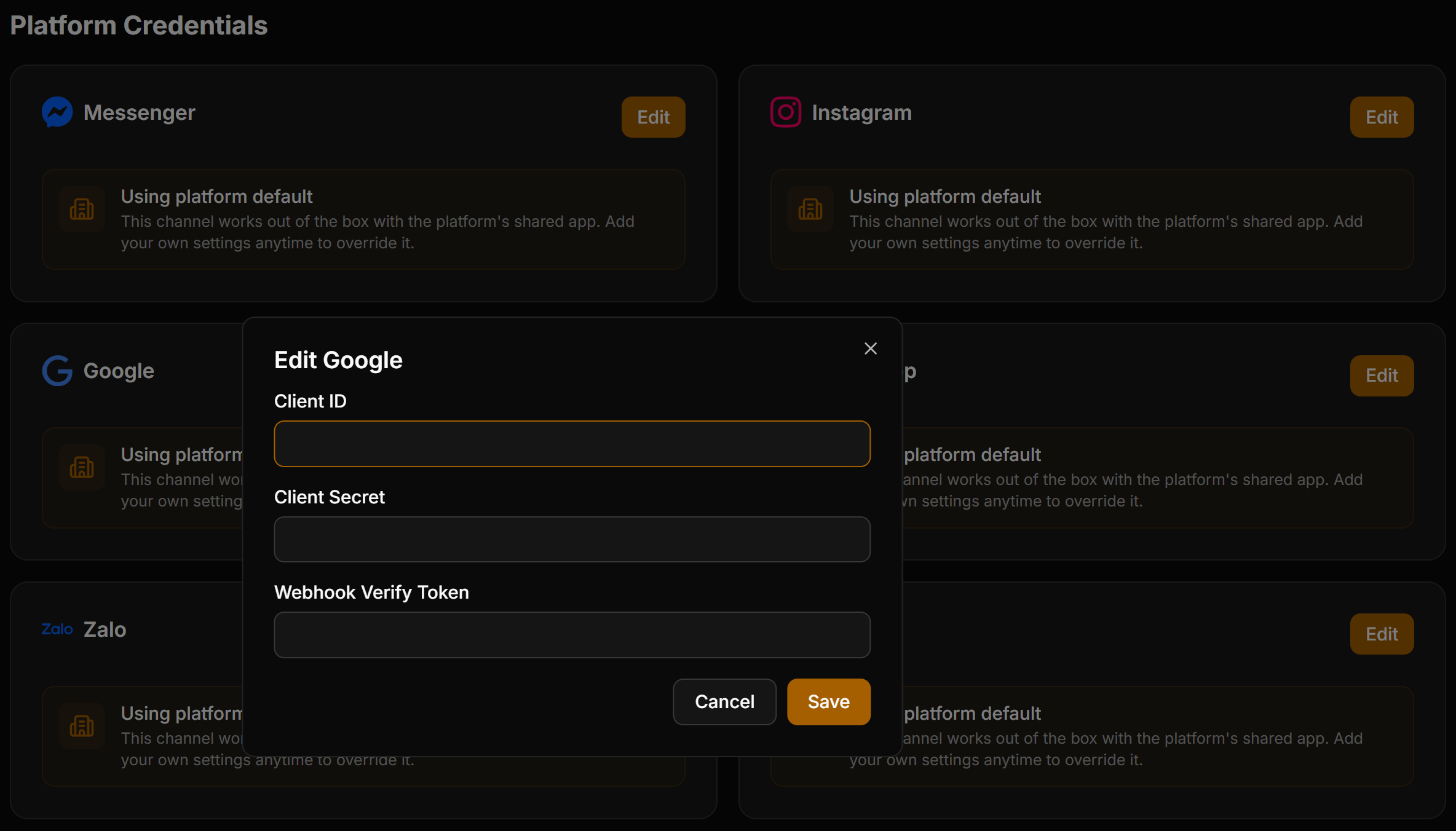 Enter the three parameters you prepared:
* **Client ID**: Paste the Client ID obtained from Google Cloud Console.
* **Client Secret**: Paste the Client Secret obtained from Google Cloud Console.
* **Webhook Verify Token**: Enter the custom security string you generated.
Click **Save** to apply the configuration and enable the custom Google App for all users across your portal.
Once configured, create a test client account on your portal to test logging in with Google and connecting Google Sheets and Google Calendar to verify that credentials and webhooks propagate correctly.
Enter the three parameters you prepared:
* **Client ID**: Paste the Client ID obtained from Google Cloud Console.
* **Client Secret**: Paste the Client Secret obtained from Google Cloud Console.
* **Webhook Verify Token**: Enter the custom security string you generated.
Click **Save** to apply the configuration and enable the custom Google App for all users across your portal.
Once configured, create a test client account on your portal to test logging in with Google and connecting Google Sheets and Google Calendar to verify that credentials and webhooks propagate correctly.