
WhatsApp has surpassed 2 billion monthly active users, and businesses across Southeast Asia, Europe, and Latin America are rapidly turning it into a genuine revenue channel – not just an expected support service. But scaling WhatsApp beyond a handful of daily conversations requires one critical decision: choosing the right WhatsApp Business Solution Provider (BSP) – the foundation of your entire messaging infrastructure.
Make the wrong choice and you face account suspension risks, hidden costs, and automation that never delivers a return. Make the right choice and you unlock a direct communication channel with customers that outperforms email and SMS on almost every engagement metric – WhatsApp messages achieve open rates of up to 98%, compared to 20–25% for email.
This guide covers everything you need to make a confident, informed decision:
- What a WhatsApp BSP is and how it differs from the free Business app
- An 8-criteria evaluation framework for assessing any BSP
- A detailed feature-by-feature comparison of ChatbotX, Sleekflow, Wati, and imBee
- Use case recommendations matched to your business model
- A practical 60-day implementation roadmap with KPI benchmarks
- A transparent breakdown of total cost of ownership (TCO)
What Is a WhatsApp Business Solution Provider (BSP)?
A WhatsApp Business Solution Provider (BSP) is a Meta-authorized third party that provides businesses with access to the WhatsApp Business Platform – the enterprise-grade infrastructure that supports high-volume messaging, chatbot automation, and CRM integration. BSPs handle the technical complexity of API provisioning, compliance management, and ongoing infrastructure maintenance so your team can focus on building conversations that drive conversions.
Key distinction: The term “WhatsApp Business API” is the legacy name. Meta now officially calls it the WhatsApp Business Platform. Both terms refer to the same enterprise-level capabilities.
WhatsApp Business App vs. WhatsApp Business Platform: What’s the Difference?
Many businesses start with the free WhatsApp Business app and quickly hit its ceiling. Here is a direct comparison:
| Capability | WhatsApp Business App | WhatsApp Business Platform (via BSP) |
|---|---|---|
| Team size | 1–5 users | Unlimited agents |
| Bulk messaging | Heavily restricted | Tiered broadcasting, fully scalable |
| Chatbot & automation | Not supported | Full API-based automation and flow sequences |
| CRM / e-commerce integration | Not supported | Salesforce, HubSpot, Shopify, and more |
| Shared team inbox | Single device only | Multi-agent with role-based access |
| Message templates | Manual submission | Dashboard-managed with status tracking |
| Analytics & reporting | Basic read receipts | Revenue attribution, campaign analytics |
| Compliance support | Self-managed | BSP-guided policy compliance |
When your business needs to send hundreds or thousands of messages per day, manage conversations across a team, or connect WhatsApp to your CRM – you need the platform, not just the app.
Why You Should Only Work With an Official Meta BSP
Not all WhatsApp API providers are equal. Only BSPs listed in the Meta Partner Directory hold official API access rights. Working with unauthorized resellers or grey-market API solutions exposes you to risks that can cause lasting damage to your business:
- Permanent account suspension for violating Meta’s Terms of Service
- Loss of your business phone number and the trust built around it
- No escalation path when your account is flagged or restricted
- No access to new features such as WhatsApp Flows, in-conversation payments, and product catalogs
An official BSP is not just a technical gateway. It is your compliance partner – accountable for keeping your account in good standing with Meta.
How to Choose the Right WhatsApp BSP: An 8-Criteria Evaluation Framework
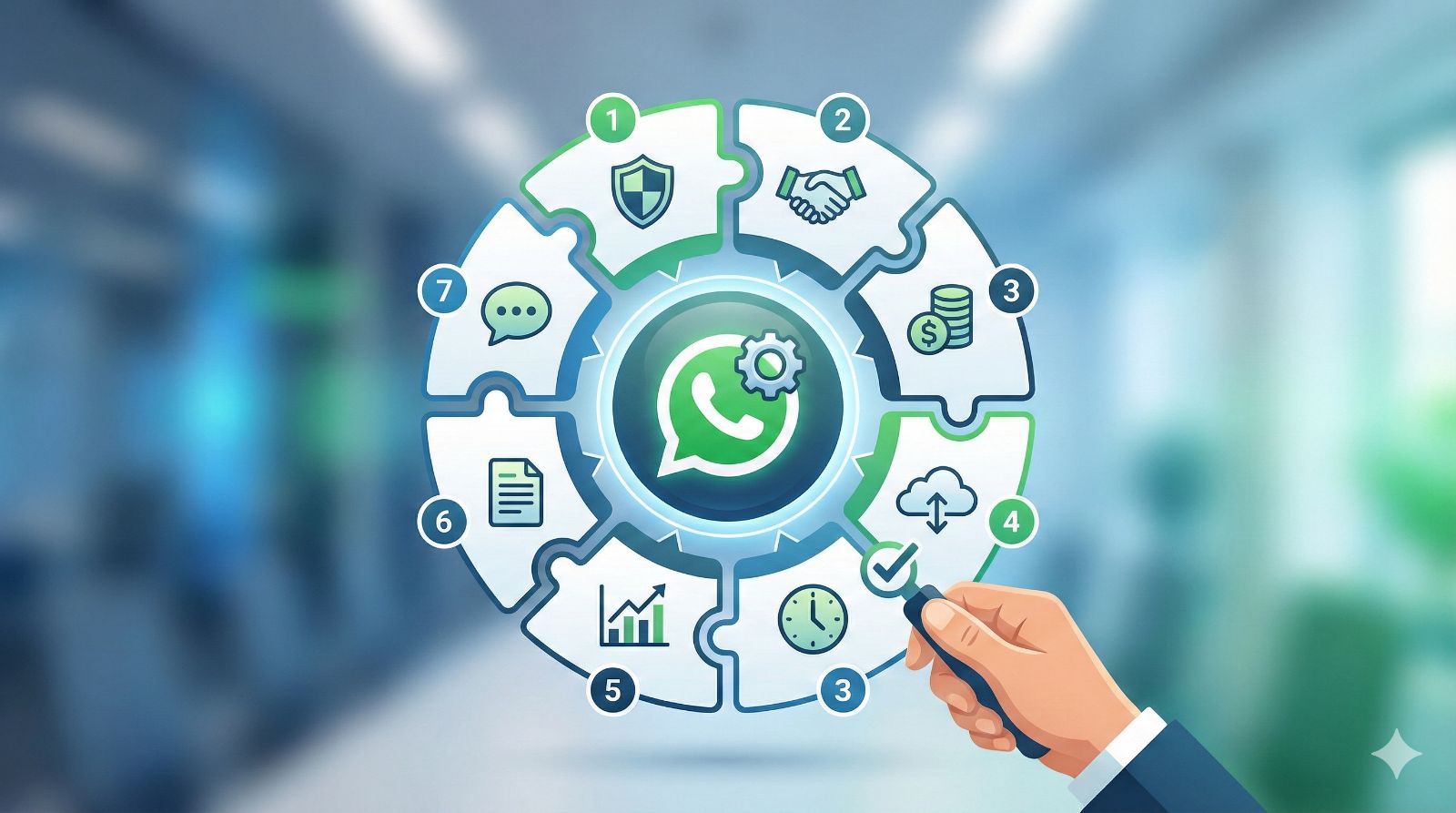
Price alone is rarely the best primary filter when selecting a BSP. The right provider is the one that fits your operational requirements, technology stack, and growth trajectory. Use the eight criteria below to score every provider you evaluate.
Criterion 1: Official BSP Status and Compliance Track Record
Start by confirming their listing in the Meta Partner Directory – then dig deeper:
- How many years has this BSP held official Meta partner status?
- What is their average message template approval rate?
- Do they provide proactive account monitoring and dedicated issue resolution?
- Do they support accounts through Meta policy changes or platform updates?
A BSP with a long compliance track record is far less likely to put your account at risk during Meta’s periodic policy reviews.
Criterion 2: Pricing Model and Total Cost of Ownership (TCO)
WhatsApp pricing is based on a per-conversation model, divided into four categories with different costs per conversation depending on the country. You can find the full rate table in Meta’s official pricing documentation:
| Category | Initiated By | Typical Use Case |
|---|---|---|
| Marketing | Business | Promotions, campaigns, re-engagement |
| Utility | Business | Order confirmations, delivery updates |
| Authentication | Business | OTP codes, identity verification |
| Service | User | Customer support replies within 24 hours |
On top of Meta’s base charges, BSPs add their own fees:
- Monthly platform subscription
- Per-agent seat fees
- One-time integration or analytics fees
- Per-message markup (some BSPs, not all)
Practical tip: Never evaluate a BSP’s price based on their published rate card alone. Always request a cost simulation based on your actual expected message volumes and conversation mix. The gap between the listed price and real operational cost is often 20–40%.
Criterion 3: Automation Depth and AI Capabilities
Automation is what makes or breaks the ROI of a WhatsApp investment. Evaluate each platform on:
- No-code flow builder: Can non-technical team members build and edit conversation flows without developer support?
- AI-powered intent detection: Can the platform understand free-text responses and route conversations accordingly?
- Conditional branching: Can you build multi-step sequences based on user responses?
- Intelligent handoff: When does the system transfer to a human agent, and how smooth is that transition?
The difference between a BSP with basic automation and one with strong AI capabilities can translate to a 3–5x difference in cost per resolved interaction. According to Gartner’s research on AI automation ROI, organizations deploying AI-powered chat automation reduce support costs by up to 30%.
Criterion 4: Integration Ecosystem
A BSP operating in isolation from your existing technology stack delivers only a fraction of its potential value. Prioritize platforms that offer deep native integrations with:
- CRM platforms: Salesforce, HubSpot, Zoho CRM, Microsoft Dynamics
- E-commerce platforms: Shopify, WooCommerce, Magento, BigCommerce
- Customer Data Platforms (CDP): Segment, mParticle, Bloomreach
- Analytics tools: Google Analytics 4, Mixpanel, Amplitude
- Payment gateways: Stripe, PayPal, Razorpay, regional payment gateways
The deeper the integration, the more personalized and timely your messages become – which directly impacts conversion rates.
Criterion 5: Broadcast and Campaign Management
There is a meaningful gap between BSPs that support basic broadcasting and those that enable full campaign management. Before committing, verify support for:
- Dynamic audience segmentation based on behavioral, transactional, and demographic attributes
- A/B testing for message templates, send timing, and calls to action
- Scheduled sending for time-zone-aware campaigns
- Automated opt-in and opt-out management compliant with GDPR, PDPA, and similar regulations
Criterion 6: Infrastructure Reliability and SLA
For businesses sending millions of messages per month, infrastructure is not a secondary concern. Ask each provider directly:
- What is your uptime SLA? (99.9% should be your minimum acceptable threshold – see Meta’s platform status page for historical uptime data)
- What are your support response times during and outside business hours?
- How does your platform respond when Meta’s infrastructure experiences an outage?
- Do you have fallback mechanisms to maintain message throughput during API disruptions?
Criterion 7: Multi-Market Scalability
If international expansion is in your roadmap, your BSP must scale with you:
- Does the platform support multilingual chatbots without requiring separate builds per language?
- Are there regional data residency options for markets with strict data localization laws (EU, India, etc.)?
- Is phone number portability between markets and between BSPs clearly documented and supported?
Criterion 8: Analytics and Revenue Attribution
Vanity metrics – read rates, response rates – are table stakes. Enterprise-grade BSPs deliver:
- Campaign-level revenue attribution: How much GMV did this broadcast generate?
- Conversation-to-purchase conversion tracking: Which automation sequences drive the highest conversion rates?
- Cross-channel performance comparison: How does WhatsApp ROI compare to email, SMS, and paid notifications?
- Raw data export for teams running their own BI systems
Top WhatsApp BSP Comparison: ChatbotX, Sleekflow, Wati, and imBee (2026)
The table below reflects an objective assessment of four BSPs commonly used across Southeast Asia and the broader Asia-Pacific market. This is a structured reference, not a sponsored ranking.
Core Feature Comparison
| Feature | ChatbotX | Sleekflow | Wati | imBee |
|---|---|---|---|---|
| Official Meta BSP | ✅ | ✅ | ✅ | ✅ |
| Omnichannel inbox | ✅ WhatsApp, LINE, FB, IG, WeChat, Web | ✅ WhatsApp, Facebook, Instagram, Live Chat | ✅ WhatsApp-focused | ✅ WhatsApp + selected channels |
| No-code chatbot builder | ✅ Advanced | ✅ Intermediate | ✅ Basic | ✅ Basic |
| Unlimited broadcasting | ✅ | ⚠️ Tier-limited | ✅ Tiered | ✅ Tiered |
| Native cart recovery automation | ✅ Built-in | ❌ | ❌ | ⚠️ Limited |
| Advanced audience segmentation | ✅ | ⚠️ Partial | ⚠️ Basic | ⚠️ Basic |
| Social CDP / unified data layer | ✅ | ❌ | ❌ | ❌ |
| Campaign revenue attribution | ✅ | ⚠️ Limited | ❌ | ❌ |
| E-commerce integration | ✅ Shopify, Magento, WooCommerce | ✅ Partial | ⚠️ Basic | ⚠️ Basic |
| Multilingual support | ✅ | ✅ | ⚠️ | ✅ |
| AI-powered intent detection | ✅ | ⚠️ | ❌ | ❌ |
Disclaimer: Features, pricing, and regional availability change frequently. Always validate capabilities through a live demo before making a vendor decision.
ChatbotX – Best for Omnichannel Automation and Data Orchestration
ChatbotX is built around a single philosophy: connecting every step of the customer journey – from the first touchpoint to post-purchase – within one unified data platform. It is the only BSP in this comparison that includes a native Social CDP, enabling businesses to build consistent customer profiles across every messaging channel they use.
What sets ChatbotX apart:
See it in action: ReThink HK achieved an 86% message read rate and 52% click-through rate – while eliminating all manual confirmation calls – using ChatbotX’s broadcast and automation tools. Read the full case study →
- Widest channel coverage in this comparison group – WhatsApp, LINE, Facebook Messenger, Instagram, WeChat, and website live chat managed in a single shared inbox
- Native e-commerce automation module including abandoned cart recovery, product carousels, discount code delivery, and post-purchase follow-up sequences – no third-party connectors required
- Social CDP that aggregates behavioral, transactional, and demographic data across channels to power true 1:1 personalization at scale
- Revenue attribution reporting at the campaign and channel level, giving marketing and leadership teams clear visibility into WhatsApp’s contribution to GMV
Limitations to consider:
- The full feature set requires a steeper learning curve compared to simpler solutions; smaller teams may take longer to fully activate the platform
- To maximize the CDP, upfront data architecture work is required to connect existing data sources
Best for: D2C brands, omnichannel retailers, e-commerce businesses, and any organization that needs direct revenue attribution from messaging activity.
Sleekflow – Best for Customer Service Teams Prioritizing Agent Productivity
Sleekflow takes an inbox-first approach that prioritizes agent productivity before automation depth. It is the strongest choice for service-heavy organizations where efficient conversation management is the primary success metric.
Strengths:
- Clean, intuitive inbox interface that significantly reduces onboarding time for new agents
- Conversation routing based on agent workload, skills, team assignment, or current queue depth
- Strong support for internal approval workflows and private agent notes within conversations
- Solid native integrations with HubSpot and Salesforce CRM
Limitations:
- Broadcast volumes are capped at lower pricing tiers
- No native e-commerce automation module – cart recovery and upsell sequences require third-party integrations
- Revenue attribution reporting is not available out of the box
Best for: B2B companies, financial services providers, education providers, and organizations where team inbox management is prioritized over marketing automation.
Wati – Best for SMBs Getting Started With WhatsApp
Wati is purpose-built as a WhatsApp-first platform optimized for simplicity and fast time-to-value. It covers essential functionality without enterprise-level complexity.
Strengths:
- Fastest onboarding time in this group – most businesses can go live within 1–2 weeks
- Competitive pricing well-suited to SMB budgets
- Strong core features: chatbot builder, broadcasting, shared inbox, and template management
- Comprehensive documentation and active user community
Limitations:
- No true omnichannel capability – LINE, WeChat, and other Asian messaging apps are not supported
- Analytics stops at read and reply rates; no campaign-level revenue tracking
- Scalability limits become apparent as message volumes and team size grow
Best for: Startups and SMBs getting on the WhatsApp Business Platform for the first time, with primary use cases of customer support and straightforward broadcast campaigns.
imBee – Best for Omnichannel Operations in Hong Kong and the Region
imBee delivers multichannel coverage with a user-friendly interface, making it a practical choice for markets where multiple messaging apps coexist – particularly Hong Kong.
Strengths:
- Good support for messaging channel combinations common in Hong Kong and parts of Southeast Asia
- Simple, easy-to-navigate interface
- Suitable for businesses needing multi-channel management without the cost of a complex enterprise platform
Limitations:
- Advanced automation capabilities are more limited compared to ChatbotX
- No native CDP module or e-commerce automation
- Performance reporting lacks the depth needed for campaign-level optimization
Best for: Mid-sized businesses in Hong Kong or Southeast Asia that need a straightforward multichannel inbox without enterprise-level automation requirements.
Which BSP Fits Your Business Model?
D2C and E-Commerce
Primary goals: Recover abandoned carts, drive repeat purchases, deliver personalized promotions, provide proactive order status updates.
Essential capabilities:
- Abandoned cart recovery sequences (triggered at 1 hour, 24 hours, 72 hours)
- Real-time order confirmation and shipping updates
- Post-purchase upsell and cross-sell automation
- Campaign-level revenue attribution tied to WhatsApp activity
Recommended platform: ChatbotX – native e-commerce modules and the Social CDP eliminate the need for multiple third-party integrations and deliver the revenue reporting D2C brands need to justify channel investment. See a real-world deployment example →
Omnichannel Retail (O2O – Online to Offline)
Primary goals: Bridge digital and physical touchpoints, increase in-store visit frequency, build engagement within loyalty programs.
Essential capabilities:
- Unified customer profiles combining online behavior with point-of-sale transaction history
- Location-based segmentation for proximity-triggered campaigns
- Loyalty reward notifications and tier update sequences
- POS system and CRM integration
Recommended platform: ChatbotX – its Social CDP architecture is specifically designed to unify this type of cross-channel data.
High-Volume Customer Support Operations
Primary goals: Reduce average handle time, increase first-contact resolution rates, maintain SLA compliance at scale.
Essential capabilities:
- Shared inbox for multiple agents with skill- and workload-based routing
- Chatbot capable of automatically resolving 40–60% of support volume
- Real-time SLA monitoring dashboard
- Full conversation history visible to every agent to avoid repeated questioning
Recommended platform: Sleekflow for teams focused on inbox management; ChatbotX if you need to run support operations and marketing automation on the same platform.
B2B Lead Generation and Sales Teams
Primary goals: Automate lead qualification, route to the right sales representative, and track follow-up without manual effort.
Essential capabilities:
- Qualification chatbot with multi-step branching based on prospect responses
- Direct CRM integration for lead data sync and automatic pipeline stage triggers
- Automated follow-up sequences triggered by prospect action or inaction
Recommended platform: Any BSP with strong CRM integration depth; both ChatbotX and Sleekflow perform well for B2B sales workflows.
Financial Services and Regulated Industries
Primary goals: Ensure full auditability, protect customer data, enable secure user authentication, record every interaction.
Essential capabilities:
- Regional data residency options for markets with local data sovereignty requirements
- Full audit logs for every conversation and agent action
- Pre-approved Meta authentication templates for OTP workflows
- Granular access controls by role with activity monitoring
Recommended platform: Prioritize BSPs with ISO 27001 certification that can provide written evidence of compliant deployments within your industry vertical.
60-Day BSP Implementation Roadmap: From Contract to Positive ROI

Phase 1 (Weeks 1–2): Foundation Setup
- Complete WhatsApp Business Manager verification under your legal business name
- Verify your business phone number through the BSP
- Submit a minimum core set of message templates for Meta approval (welcome, cart recovery, order confirmation, shipping update, re-engagement)
- Connect your CRM and e-commerce platform via native connectors or API
Important note: New accounts start at Tier 1, limited to 1,000 unique conversations per day. Do not push high message volumes in the first 30 days. Maintaining high quality scores during this period is the prerequisite for automatic tier upgrades.
Phase 2 (Weeks 3–4): Build Core Automation Flows
Focus on three flows that deliver measurable results fastest:
- Welcome and opt-in confirmation sequence – Greet new subscribers, set expectations, deliver a first-time offer within minutes of sign-up
- Abandoned cart recovery sequence – A three-message series triggered at 1 hour, 24 hours, and 72 hours after cart abandonment; include a time-limited incentive at the third message
- Order confirmation and fulfillment status updates – Proactive status messages that eliminate “Where is my order?” support requests entirely
Build these three before anything else. They typically account for 60–70% of the WhatsApp revenue achievable within the first 90 days.
Phase 3 (Weeks 5–6): Launch and Measure Your First Campaign
- Run your first broadcast to a small, high-quality segment (500–1,000 contacts)
- Track read rate, response rate, click-through rate, and conversion rate for each send
- Compare cost per conversion against your email and SMS benchmarks
- Adjust send timing, template language, and CTA button placement based on real data before scaling
Phase 4 (Months 2–3): Optimize and Scale
- A/B test message templates systematically – change headlines, media, and CTAs in separate tests, not simultaneously
- Expand audience segmentation using behavioral and purchase data collected from your CRM and CDP integrations
- Build second-tier automations: post-purchase upsell sequences, loyalty program notifications, NPS survey flows
- Begin language localization if operating across multiple markets
WhatsApp BSP Pricing: Understanding Your Total Cost of Ownership
Cost Component Breakdown
| Cost Component | Description | Typical Range |
|---|---|---|
| Meta conversation fees | Charged per conversation, by category and country | Market-dependent; marketing conversations typically cost 3–5x utility rates |
| BSP platform subscription | Fixed monthly or annual fee | \$200–\$800/month |
| Agent seats | Per active agent per month | \$30–\$80/agent/month |
| Integration fees | CRM and e-commerce connector setup | One-time or monthly |
| Onboarding | Initial setup, training, and technical configuration | Free–\$2,000 depending on complexity |
Monthly Cost Estimates by Business Scale
| Business Profile | Volume | Estimated Monthly Cost |
|---|---|---|
| SMB – Getting started | 2,000 conversations, 3 agents | \$400–\$700 |
| Mid-market | 10,000 conversations, 10 agents | \$1,200–\$2,500 |
| Enterprise | 50,000+ conversations, 30+ agents | \$5,000–\$15,000+ |
These are directional estimates only. Your actual cost depends heavily on your conversation category mix, target countries, and BSP tier. Always request a scenario-based cost model from shortlisted vendors before signing a contract.
KPI Benchmarks for WhatsApp Business Platform Performance
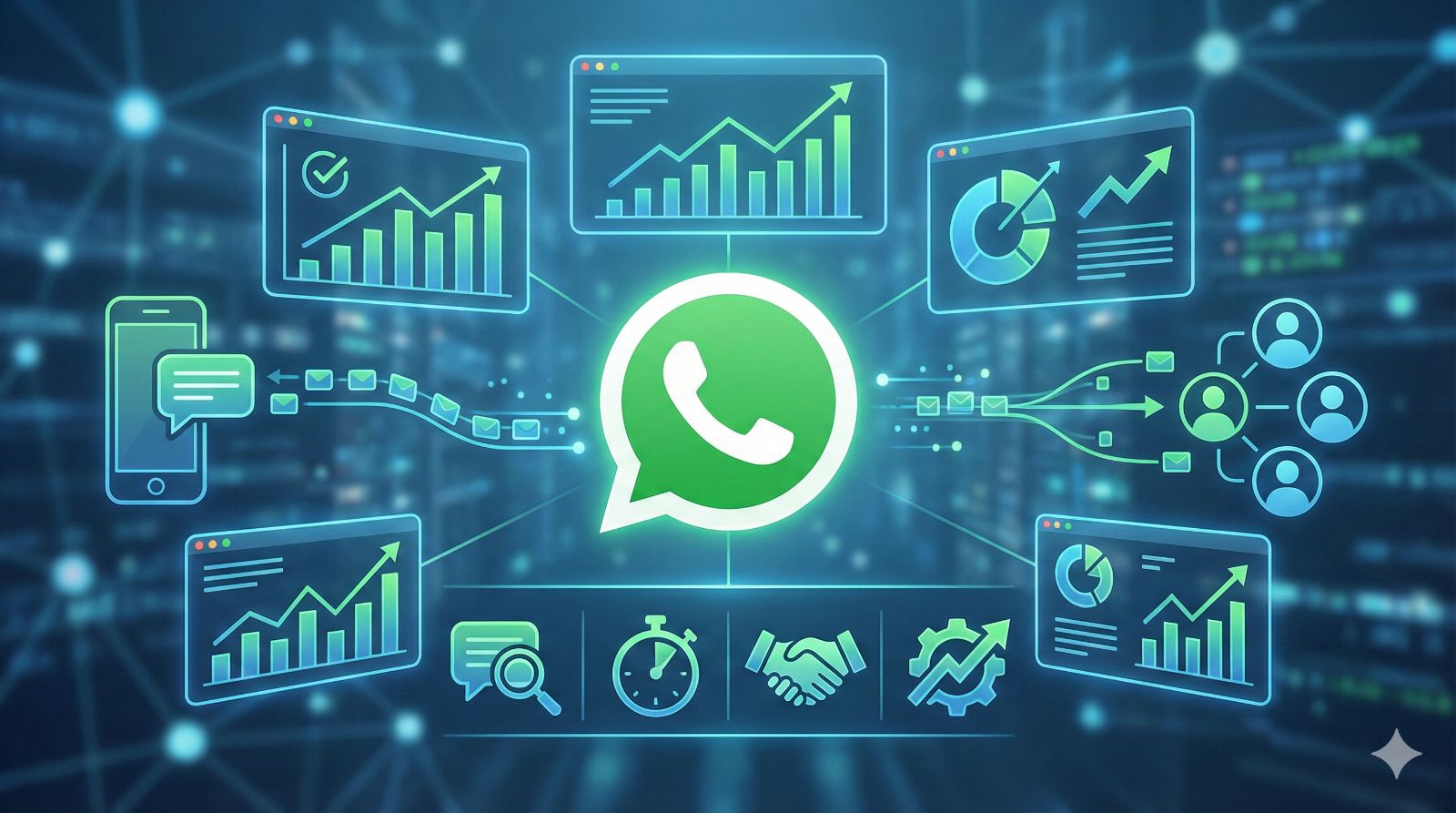
Use these benchmarks to set realistic targets and identify performance issues early:
| KPI | Strong Performance | Key Variables |
|---|---|---|
| Read rate | 70–90% | Send timing, sender quality, message relevance |
| Response rate | 15–35% | Clear CTA, personalization, conversational context |
| Conversion rate | 3–10% | Offer strength, follow-up sequence, segment quality |
| Cost per conversion | 30–50% lower than equivalent email | Audience segmentation precision, template optimization |
| Revenue per conversation | Industry-dependent | Continuous A/B testing, post-purchase automation |
| Opt-out rate | Below 2% | Message frequency management, value-led content |
BSP Selection Decision Matrix
Score each BSP you are evaluating from 1 to 5 for each criterion. Multiply by the weighting to calculate a weighted score. The BSP with the highest total score is the best fit for your requirements.
| Evaluation Criterion | Weight | ChatbotX | Sleekflow | Wati | imBee |
|---|---|---|---|---|---|
| Official Meta BSP status | 15% | /5 | /5 | /5 | /5 |
| Pricing transparency | 15% | /5 | /5 | /5 | /5 |
| Automation and AI depth | 20% | /5 | /5 | /5 | /5 |
| Integration ecosystem | 15% | /5 | /5 | /5 | /5 |
| Analytics and revenue attribution | 15% | /5 | /5 | /5 | /5 |
| Support and onboarding quality | 10% | /5 | /5 | /5 | /5 |
| Scalability and regional availability | 10% | /5 | /5 | /5 | /5 |
| Weighted Total | 100% |
Quick Decision Guide
- Need omnichannel sales automation + advanced AI + revenue attribution? → Evaluate ChatbotX first
- Customer care team focused on CRM integration and inbox management? → Evaluate Sleekflow
- SMB looking for a fast, straightforward WhatsApp deployment? → Wati is a solid starting point
- Multichannel inbox for Hong Kong or Asia-Pacific operations? → imBee is worth evaluating
Frequently Asked Questions
What is the difference between a WhatsApp BSP and the WhatsApp Business app?
The WhatsApp Business app is a free mobile application designed for small teams managing conversations manually on a single device. A WhatsApp Business Solution Provider gives you access to the WhatsApp Business Platform – the enterprise API layer that enables automation, shared multi-agent inboxes, CRM integration, bulk messaging, and advanced analytics. If you need to scale beyond a handful of conversations per day, a BSP is the only viable option.
How long does it take to go live with a WhatsApp BSP?
Most businesses complete onboarding and send their first messages within 2–4 weeks. The main factors affecting timeline are: speed of business verification through Meta Business Manager, complexity of CRM or e-commerce integration, and approval time for initial message templates. Having your business documentation ready and drafting five to ten core message templates in advance significantly shortens this window.
Can I switch WhatsApp BSPs later without losing my phone number?
Yes. Meta supports phone number portability between BSPs. The migration process typically takes 3–7 business days and may involve a brief messaging disruption window. You will not lose your phone number, opted-in contact list, or WhatsApp Business verification status. Always review a BSP’s documented migration process before signing a long-term contract.
Is message template approval guaranteed?
No – Meta reviews every template against its messaging policies before approval. Common rejection reasons include overly promotional language, missing opt-in references, undefined variable placeholders, and conflicts with Meta’s commerce or business policies. An experienced BSP will review your templates before submission and advise on any likely rejection points, significantly improving your first-submission approval rate.
How do I measure ROI for WhatsApp marketing activity?
Track these metrics as your primary reported ROI indicators: read rate (are messages being opened?), response rate (is it generating engagement?), conversion rate (is it driving a target action?), revenue per conversation (what average value is associated with a WhatsApp interaction?), and cost per conversion (how does this compare to email and paid channels?). BSPs with revenue attribution capabilities, like ChatbotX, surface these figures automatically in the platform dashboard. To see what strong benchmark performance looks like in a real campaign, read the ReThink HK case study →
What happens if my WhatsApp account quality drops?
Quality degradation – caused by high opt-out rates, spam reports, or messaging non-subscribers – triggers messaging limits and can ultimately result in account restriction mode. Your BSP should proactively alert you when quality score changes are detected and guide you through remediation steps, which typically include pausing outgoing campaigns, reviewing your opt-in collection process, and submitting an account review request to Meta.
Is the WhatsApp Business Platform available in all countries?
The WhatsApp Business Platform is available in most markets where WhatsApp has a significant user base. However, available features, regional pricing, and compliance requirements vary meaningfully by country. Confirm regional availability and per-conversation pricing for each market you intend to message before committing to a BSP.
Conclusion: Choosing the Right BSP Is a Strategic Infrastructure Decision

Choosing a WhatsApp Business Solution Provider is not a procurement task you can complete with a feature checklist alone. It directly determines how effectively you can attract, convert, and retain customers through the world’s most widely used messaging platform.
The right BSP will help you:
- Reduce support costs by automating repetitive queries that currently consume agent time
- Recover lost revenue through abandoned cart sequences and timely personalized re-engagement
- Build a unified customer data foundation that improves the relevance and timing of every message you send
- Prove channel ROI to leadership with campaign-level revenue data, not just engagement counts
The wrong BSP will cost you more than it saves – through integration failures, account health issues, and the opportunity cost of automation that never gets built.
Recommended next step: Shortlist two or three BSPs that meet your specific criteria. Request live demos using your actual use cases – not scripted walkthroughs. Run a small pilot before signing an annual contract.
Ready to See How ChatbotX Fits Your WhatsApp Strategy?
ChatbotX is a Meta-certified WhatsApp Business Solution Provider built for businesses that need more than a basic messaging platform. With native support for WhatsApp, LINE, Facebook Messenger, Instagram, and WeChat in a single unified inbox – combined with a Social CDP, built-in e-commerce automation, and campaign-level revenue attribution – ChatbotX is designed to make every customer conversation measurably contribute to revenue.
Whether you are migrating from another BSP, deploying WhatsApp for the first time, or scaling existing operations into new markets, our team can assess your requirements and design a deployment plan built around your goals.
Book a free ChatbotX consultation →
📩 Email: [email protected]
🌐 Website: ChatbotX.io