Meta Description: Discover 10 proven social media strategy frameworks used by top brands in 2026. Boost engagement, drive ROI, and scale visibility with data-backed tactics.
As we move into 2026, social media has evolved from a branding tool into a full-scale AI-powered sales engine. However, technology is only the vehicle—your social media strategy is the driver. Explore these 10 proven frameworks tailored to help your brand lead the next wave of social commerce and maximize your ROI in the digital-first economy.
Launch agentic chat marketing in minutes with ChatbotX












What Are Social Media Strategy Frameworks?
Social media strategy frameworks are structured systems that help brands plan, execute, and optimize content across platforms to achieve measurable business goals. In 2026, the most effective social media strategy frameworks focus on algorithm-driven distribution, audience behavior signals (watch time, saves, shares), and conversion-focused content that reduces customer acquisition cost (CAC) while increasing ROI.
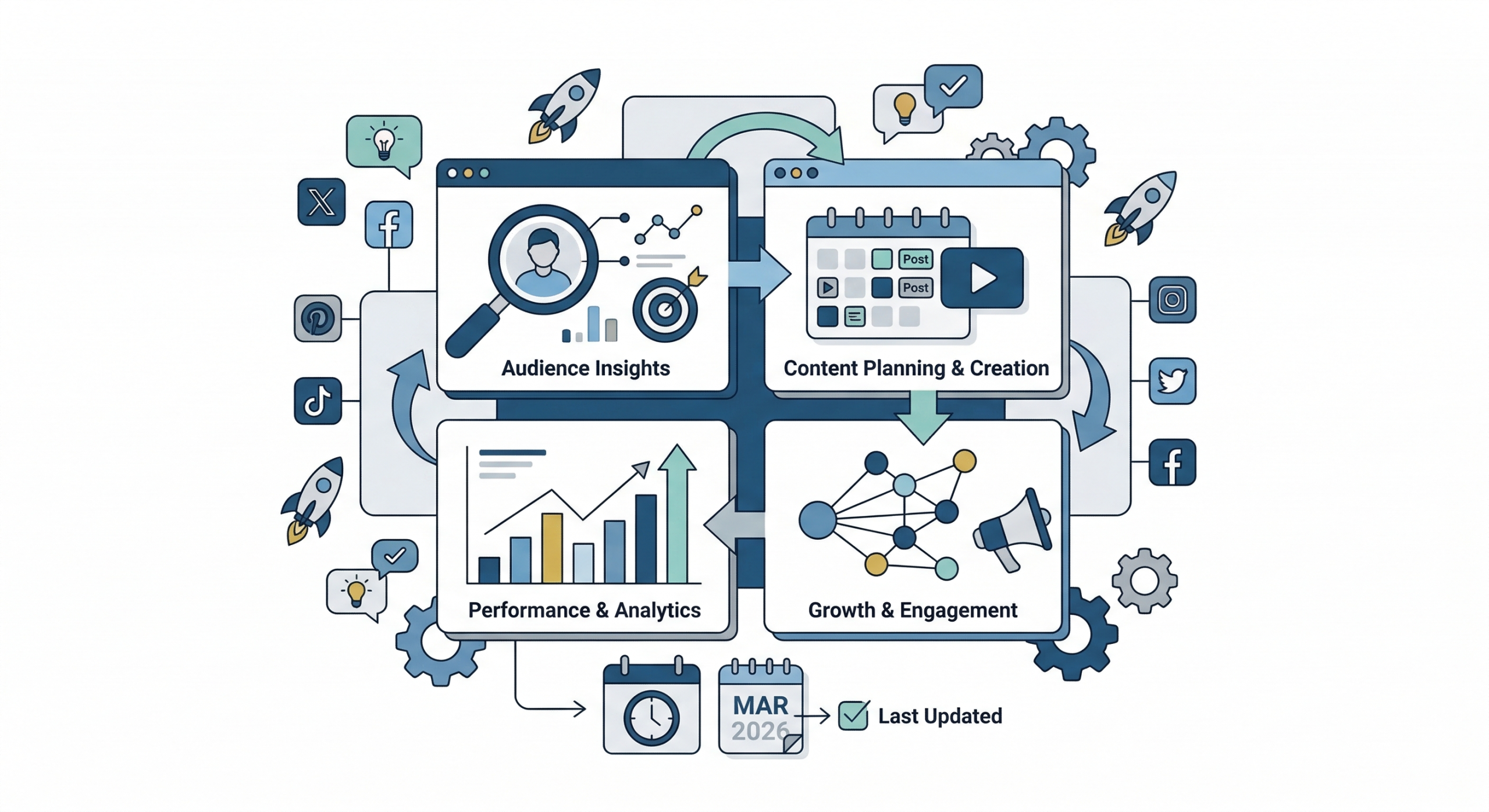
In 2026, winning on social media requires more than consistent posting. It demands a structured, data-driven social media strategy. The brands generating measurable revenue are those deploying proven social media strategy frameworks: systematic methodologies that convert scattered activity into predictable growth.
According to DataReportal’s 2026 Global Social Media Report, there are now over 5.66 billion active social media users worldwide, yet average organic reach continues to decline across every major platform. The gap between brands with a clear social media strategy framework and those posting without a plan has never been wider.
This guide breaks down 10 battle-tested social media strategy frameworks used by leading brands and digital marketers. Each section covers the target audience, content pillars, key performance indicators (KPIs), and actionable implementation steps, whether you are scaling a B2B company’s thought leadership or driving direct e-commerce revenue.
What is a Social Media Strategy Framework? A social media strategy framework is a structured, systematic approach that helps brands define business objectives, select the right platforms, and build data-driven content processes. In 2026, these social media strategy frameworks focus on optimizing algorithm-driven content distribution by generating behavioral signals like watch time, saves, and shares that AI algorithms prioritize, in order to convert organic engagement into sustainable revenue and reduce Customer Acquisition Cost (CAC).
Why You Need a Proven Social Media Strategy Framework
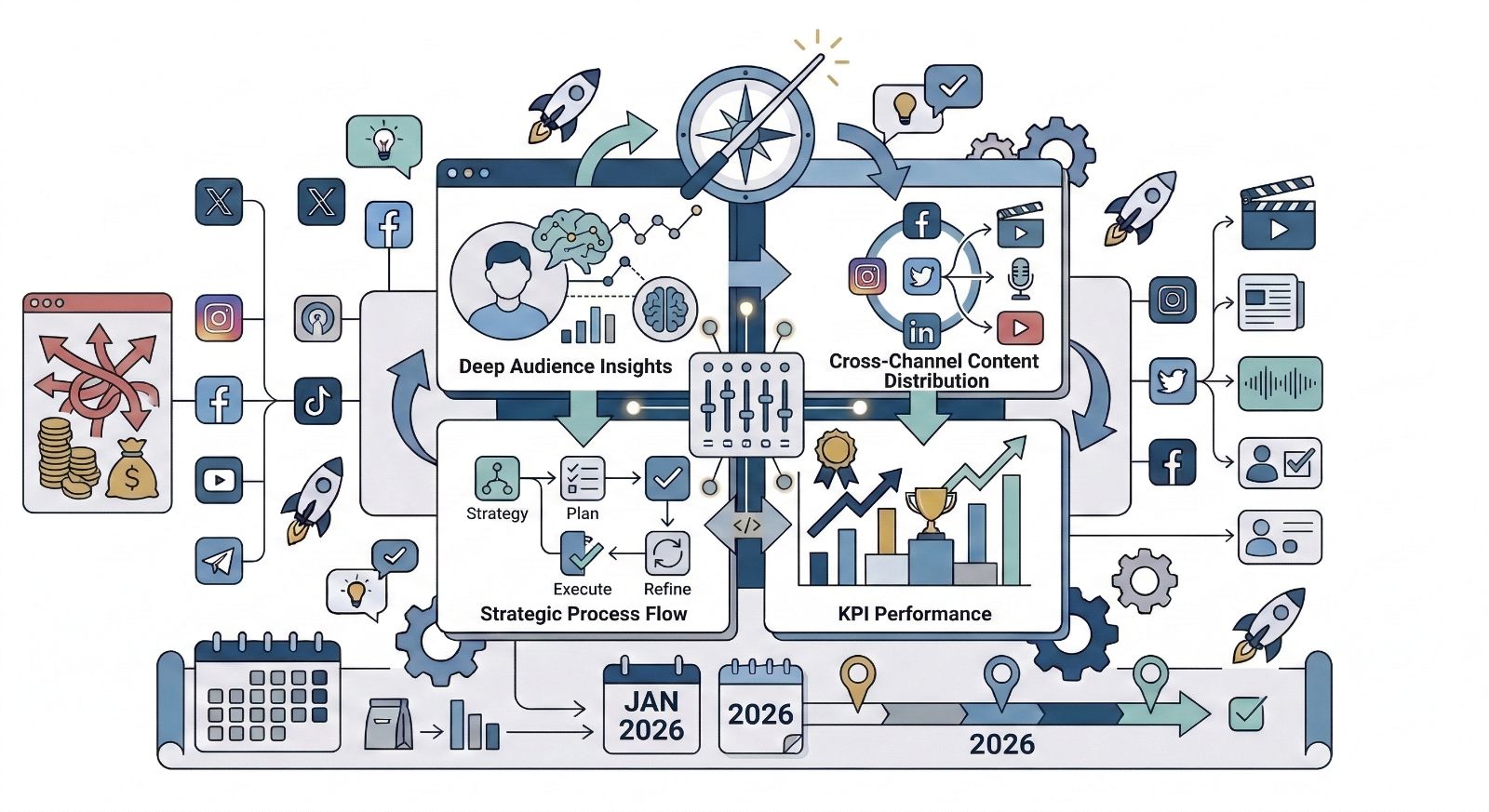
Running campaigns without a structured social media strategy framework in 2026 is a costly mistake. Algorithm updates across Instagram, LinkedIn, and TikTok actively suppress generic content, prioritizing behavioral signals like watch time, saves, and community depth. A proven social media strategy framework shifts your team from reactive posting to a proactive, revenue-generating operation.
How Social Media Algorithms Changed the Rules
Modern platform algorithms no longer reward posting frequency. They reward demonstrated relevance. Content is evaluated by behavioral signals including completion rates, reshares, and the depth of replies it generates. Without a social media strategy framework that consistently triggers these signals, organic reach will decline regardless of how often you post.
The shift is structural: platforms now have a commercial incentive to reduce unpaid reach in order to monetize attention through advertising. Your content must earn visibility by genuinely matching user intent and triggering engagement, or you pay for it.
Core Benefits of a Structured Social Media Strategy Framework
A defined social media strategy framework eliminates guesswork, aligns social efforts with broader business objectives, and enables accurate performance measurement.
Key advantages include:
- Predictable ROI: Historical performance data enables reliable forecasting and budget planning.
- Resource Efficiency: Budget and creative energy are directed toward high-converting formats rather than scattered experimentation.
- Brand Consistency: A unified voice is maintained across every digital touchpoint, from TikTok to LinkedIn.
- Algorithm Alignment: Structured content strategies generate the behavioral signals platforms reward with organic distribution.
| Approach | Content Focus | Primary Goal | Key Metric |
|---|---|---|---|
| Unstructured Posting | Trending topics | Hope for virality | Likes (vanity) |
| Social Media Strategy Framework | Audience pain points | Predictable revenue | Conversions and CAC |
1. The Cross-Channel Orchestration Framework
The most effective brands in 2026 do not treat platforms in isolation. They orchestrate long-form videos, short-form reels, live streams, and paid retargeting into one unified customer journey, with each touchpoint designed to serve a specific role in the funnel. This social media strategy framework is ideal for brands managing presence across three or more platforms simultaneously.
Mapping the Customer Journey Across Platforms
Each platform serves a distinct function within a cross-channel social media strategy framework. A user may discover your brand through a YouTube Short or TikTok clip (discovery), deepen engagement during a LinkedIn newsletter or Instagram Live (consideration), and convert through a retargeted ad or email sequence (conversion). Republishing identical content everywhere collapses this progression entirely.
Real-world example: Duolingo’s cross-channel strategy is one of the most studied cases in modern social media marketing. The language-learning app built distinct content personalities per platform: absurdist TikTok humor for awareness, detailed feature explainers on YouTube, and community engagement on Reddit, while keeping brand voice consistent throughout. This approach helped them surpass 133 million monthly active users, with 52.7 million daily active users as of Q4 2025 (Duolingo Annual Report, 2025), without relying on a massive paid media budget.
How to Implement the Cross-Channel Framework
Start with a platform audit: identify which channels currently drive discovery, which nurture consideration, and which convert. Then build a centralized content calendar that keeps the core message consistent while adapting the format to each platform’s native environment. A social media content planning template can dramatically speed up this process for teams managing multiple channels.
Pro Tip: Assign explicit funnel stages to each platform before scheduling content. Discovery platforms (TikTok, YouTube Shorts, Instagram Reels) require hook-first, entertainment-led creative. Conversion platforms (email, retargeting ads, landing pages) require proof-led, offer-specific messaging. Conflating the two on either platform reduces performance on both. A tool like ChatbotX’s omnichannel inbox centralizes every conversation from every channel into one dashboard, so no customer touchpoint gets missed as complexity scales.
2. The Influencer Partnership and Brand Advocacy Framework
This social media strategy framework replaces direct brand messaging with credible creator voices to reach niche audiences authentically. It is particularly effective for entering new market segments where trust has not yet been established organically. Brands applying this social media strategy framework benefit from pre-built audience trust that takes years to develop through owned channels alone.
Why Micro-Influencers Deliver Higher ROI in 2026
Micro-influencers, creators with 10,000 to 100,000 followers, consistently outperform celebrity endorsements in both engagement rate and conversion efficiency. Their communities are niche-specific and highly interactive, making their product recommendations feel like peer advice rather than paid promotion. Long-term partnerships further amplify this effect by building genuine familiarity over time.
According to Influencer Marketing Hub’s 2025 Benchmark Report, businesses earn an average of \$5.78 in earned media value for every \$1 spent on influencer marketing, with micro-influencers generating the highest efficiency ratios in the study.
Real-world example: Daniel Wellington built a watch brand worth over \$200 million almost entirely through a micro-influencer gifting strategy on Instagram. Rather than paying celebrities, the brand sent watches to thousands of smaller creators and tracked performance via custom promo codes, a model that is now standard practice across direct-to-consumer brands applying this social media strategy framework.
Pros and Cons of Influencer Marketing
Pros:
- Direct access to pre-qualified, niche-engaged audiences.
- Generates authentic creative assets that consistently outperform polished brand ad creative.
- Builds durable social proof and brand credibility.
Cons:
- Vetting and ongoing relationship management require significant time investment.
- Brand safety risk if a creator’s public behavior conflicts with brand values.
- Attribution can be complex without proper UTM tracking and dedicated promo codes.
3. The User-Generated Content (UGC) Amplification Framework
The UGC social media strategy framework turns existing customers into brand storytellers, generating authentic peer-to-peer social proof at scale. Customer photos, unboxing videos, and real reviews consistently outperform polished brand content in both trust metrics and purchase influence. This is one of the most cost-efficient social media strategy frameworks available to brands of any size.
Building a Self-Sustaining UGC Content Engine
An effective UGC strategy publicly rewards participation and always credits the original creator, two practices that reinforce a voluntary contribution cycle. This approach reduces internal content production costs significantly while building a growing library of diverse, conversion-tested creative assets.
Real-world example: GoPro’s UGC strategy is widely cited as one of the most scalable examples in the industry. The brand built its entire content ecosystem around customer-submitted footage, creating a self-replenishing library of authentic extreme sports content. Their YouTube channel, built primarily on UGC, has surpassed 10 million subscribers, with user-generated content dramatically reducing production costs while maintaining high authenticity signals.
UGC Performance Metrics to Track
Monitor hashtag usage volume, total content submissions per campaign, and website traffic from community galleries. Track the conversion rate of product pages that include UGC reviews versus those without. The delta is typically where the strongest case for UGC investment is made. Once you identify your best-performing UGC, use targeted broadcast campaigns to push that content directly to segmented audiences at scale.
Important: Always obtain explicit written permission before reposting customer content. Failure to do so creates copyright liability and can quickly damage the community trust you have built.
4. The Community-Led and Engagement-First Framework
This social media strategy framework shifts the focus from broadcasting to building a loyal, self-sustaining community around shared interests. It prioritizes deep two-way conversations over promotional content. Brands that execute this social media strategy framework effectively create a defensible competitive moat that is extremely difficult to replicate.
Building Defensible Brand Moats Through Community
Communities generate a sense of belonging that ties customers to a brand beyond product utility. Platforms such as Discord, Slack, Reddit, and Circle are well-suited for hosting these hubs. Regular formats including weekly AMAs, user showcases, and member spotlights create reliable participation rhythms that compound over time.
Real-world example: LEGO Ideas is one of the most successful brand community frameworks in consumer goods. Members submit product ideas, vote on each other’s designs, and approved concepts become real commercial products with the original creator receiving royalties. As of 2025, LEGO Ideas has received over 35,000 project submissions and produced more than 50 commercial products from community concepts.
Integrating AI Tools for 24/7 Community Response
One practical challenge in community management is response latency. Most teams cannot monitor community channels around the clock, yet response speed is directly correlated with member satisfaction. An AI Agent is increasingly filling this gap by handling recurring product questions, routing support requests, and qualifying warm leads from community conversations, all without requiring a human to be online at every hour.
The key is configuration: automated keyword-triggered responses should feel helpful and personalized, not robotic. Well-built chatbot workflows use member context (account history, past purchases, forum activity) to tailor responses.
Best Practices for Sustainable Community Management
Define clear community guidelines at launch and assign dedicated moderators from day one. Build an ambassador program that rewards highly active members with exclusive access, including beta features, private Q&A sessions, early product reveals, and co-creation opportunities. If you are still building your overall audience base, pair this social media strategy framework with a documented social media growth strategy to feed your community funnel consistently.
Warning: Never treat your community hub as a dumping ground for promotional links. Members who feel constantly sold to disengage quickly and permanently.
5. The Educational Content and B2B Thought Leadership Framework
This social media strategy framework positions brands as trusted industry authorities by solving real audience problems before asking for anything in return. It is especially powerful in B2B markets where purchase cycles are long, decision-makers are skeptical of overt sales messaging, and trust is the primary currency. Brands that consistently apply this social media strategy framework over 12 to 18 months often see a measurable reduction in customer acquisition cost.
The Reciprocity Principle: Educate First, Sell Second
When a brand consistently solves problems at no cost, it activates the psychological principle of reciprocity. Audiences begin to associate expertise with the brand and naturally consider paid solutions when they are ready to invest. As documented in Harvard Business Review’s research on B2B buyer behavior and thought leadership, thought leadership content shortens sales cycles and increases close rates when it genuinely addresses decision-maker pain points.
Real-world example: HubSpot built the dominant inbound marketing software brand largely through educational content. Their blog, free certifications, and YouTube tutorials consistently address marketer problems without requiring any product commitment. HubSpot’s blog attracted approximately 6 to 7 million monthly visitors as of 2025 (SimilarWeb), still generating substantial inbound leads with a significant share converting to paid subscribers.
How to Structure Educational Content Pillars
Break complex topics into accessible, actionable formats. A strong educational content architecture within this social media strategy framework includes three core content types:
- Step-by-Step Tutorials: Walk audiences through achieving a specific, measurable outcome using clear sequential steps.
- Industry Trend Analysis: Interpret what new platform changes, algorithm updates, or market shifts mean in practical terms for your audience.
- Client Case Studies with Real Metrics: Detail how a real customer overcame a specific challenge and include quantified outcomes such as percentage improvements, time saved, and revenue generated.
6. The Trend-Jacking and Real-Time Marketing Framework
Trend-jacking, capitalizing on timely cultural moments, allows brands to generate significant organic reach without paid budget. When executed with precision, a single well-timed post can deliver the visibility of a mid-sized campaign. This social media strategy framework requires speed, brand clarity, and a pre-approved decision process to execute consistently.
How to Capitalize on Cultural Moments Effectively
Speed is critical in real-time marketing. Most viral trends have a relevance window under 48 hours. Brands requiring multi-layer approvals before posting consistently miss these windows. The content must also be genuinely relevant. Forced trend participation reads as inauthentic and frequently triggers audience backlash.
Real-world example: Wendy’s remains the benchmark for brand trend-jacking on social media. Their strategy of engaging with pop culture moments, roasting competitors, and responding to trending conversations has generated consistent earned media coverage. Sprout Social cites it as one of the strongest examples of brand personality driving follower growth within a real-time social media strategy framework.
Brand Safety Protocols for Trend-Jacking
Speed must be balanced with judgment. Create a documented Go or No-Go decision framework defining off-limits categories: tragedies, political events, health crises, and any trend where brand participation could read as exploitative.
Pro Tip: Pre-approve a whitelist of evergreen trend categories your team can engage with immediately, including sports moments, entertainment releases, and seasonal events, reserving leadership review only for ambiguous situations where brand risk is unclear. Setting up pre-built conversation flows in advance means your brand can activate coordinated responses the moment a trend hits, across all channels simultaneously, without scrambling your team. Pair this with a solid social media automation strategy to keep response time near zero.
7. The Video-First and Short-Form Content Dominance Framework
Video is the dominant content format across every major platform in 2026. Short-form clips between 15 and 90 seconds generate the highest organic reach of any format. Brands without a video-first social media strategy framework are actively ceding market share to those that have built systematic video production workflows.
This video highlights a critical principle in modern video marketing: clarity beats complexity. Instead of cramming multiple ideas into one piece of content, high-performing videos focus on a single objective, whether it is to teach, inspire, or inform. This is exactly what social media algorithms reward: content that retains attention, communicates quickly, and drives a clear action.
How to Hook Viewers in the First Two Seconds
Effective short-form video must capture attention before the viewer can scroll. The first frame requires either a strong visual disruption, a compelling text overlay stating the immediate value, or an opening statement that creates curiosity. Generic intros such as brand logos, slow product pans, and “Hey everyone” greetings perform poorly regardless of production quality.
Real-world example: Spotify’s Wrapped campaign is the gold standard for a video-first social media strategy framework at scale. In 2025, Wrapped attracted over 200 million engaged users within the first 24 hours of launch, 19% more than the prior year, and generated more than 500 million shares across social media in the same period (Spotify, December 2025). The lesson: video-first content designed specifically for sharing generates earned reach that paid media cannot replicate at the same efficiency.
Repurposing Long-Form Content into a Short-Form Library
Sustainable video production is built on repurposing, not constant original creation. Record high-quality long-form content including webinars, podcast episodes, executive interviews, and product demos, then extract 15 to 20 optimized short-form clips per session. This approach maximizes content ROI while maintaining consistent output volume.
Pros and Cons of a Video-First Social Media Strategy Framework:
| Details | |
|---|---|
| Pros | Highest organic reach ceiling across all major platforms. Highly repurposable across TikTok, YouTube Shorts, Instagram Reels, and LinkedIn Video. Builds stronger audience connection than static content. |
| Cons | Requires video editing skills and production infrastructure. Time-intensive without a streamlined batch-production workflow. Algorithm preferences evolve quarterly, so regular format testing is required. |
8. The Paid Social and Retargeting Funnel Framework
Organic reach builds brand equity; paid social delivers predictable, scalable revenue. This social media strategy framework uses sequential messaging to guide users from initial awareness through to final conversion, relying on pixel tracking, behavioral data, and audience segmentation. It is the most measurable of all social media strategy frameworks in terms of direct revenue attribution.
Sequential Messaging Strategy for Higher Conversions
Never ask for the sale on the first interaction. Build a multi-stage funnel that progressively warms cold audiences.
| Funnel Stage | Ad Format | Campaign Objective | Primary KPI |
|---|---|---|---|
| Top: Awareness | Broad video ads | Brand introduction | Cost Per View (CPV) |
| Middle: Consideration | Carousel and Story ads | Benefit communication | Click-Through Rate (CTR) |
| Bottom: Conversion | Direct offer and Retargeting | Drive purchase | Return on Ad Spend (ROAS) |
Real-world example: Dollar Shave Club’s paid social funnel is a frequently referenced case in digital marketing courses. Their top-of-funnel video content built massive brand awareness organically, which was then systematically retargeted through Facebook and Instagram ads to drive subscriptions, eventually leading to a $1 billion acquisition by Unilever.
Optimizing Return on Ad Spend (ROAS)
ROAS improvement is driven by disciplined creative testing across tightly defined audience segments. Establish automated A/B testing cycles early, testing headlines, opening frames, offer structures, and CTAs independently rather than in combination. Scale winning combinations immediately and eliminate losing variants before they drain budget. For a deeper breakdown of how to measure and improve your social media ROI across every channel, see our guide to social media ROI strategies in 2026.
9. The Data-Driven Content Optimization Framework
Posting content without a systematic review cycle is the single most common reason social media programs plateau after an initial growth period. This social media strategy framework treats every piece of content as a data point in a continuous improvement experiment, not a one-off creative deliverable. Teams applying this social media strategy framework consistently outperform peers on engagement rates within two to three content cycles.
Building a 90-Day Content Performance Review Cycle
The framework operates on a 90-day sprint model:
- Days 1 to 30: Publish content across your established pillars and collect baseline performance data.
- Days 31 to 60: Identify the top 20% of posts by the metric that matters most for your objective, such as saves, link clicks, DMs, and story replies rather than likes.
- Days 61 to 90: Double down on the formats, topics, and hooks from your top performers. Eliminate or reformat the bottom 20%.
To make this data actionable at scale, consider connecting your analytics to your CRM. Our guide on CRM social media integration covers exactly how to set this up in 2026.
Real-world example: The social media team at Morning Brew built their newsletter to over 4 million subscribers in part by applying rigorous A/B testing to subject lines, content formats, and CTA placements. As documented in a case study by Mailchimp’s research team, brands that implement systematic content testing report 20 to 30% higher engagement rates over 12 months compared to teams operating on intuition alone.
Key Metrics by Business Objective
| Business Objective | Primary Metric | Secondary Metric | Red Flag Metric |
|---|---|---|---|
| Brand Awareness | Reach and Impressions | Share rate | CPM rising without reach gain |
| Lead Generation | Link Clicks and DMs | CPC | High CTR, low lead quality |
| Community Growth | Follower growth rate | Comment depth | High follows, low engagement |
| Revenue | ROAS and Conversion rate | CAC | High conversion cost |
10. The Social Commerce and Shoppable Content Framework
Social commerce, the ability to discover, evaluate, and purchase products without leaving a social media platform, has emerged as one of the fastest-growing revenue channels in digital retail. According to eMarketer’s 2025 Social Commerce Forecast, US social commerce sales are projected to reach $100.99 billion in 2026, an 18% increase year-over-year, driven primarily by TikTok Shop, Instagram Shopping, and Pinterest’s native checkout features. This social media strategy framework is essential for any brand selling directly to consumers online.
Building a Shoppable Content Architecture
The social commerce framework requires three interconnected components working in parallel:
1. Product Discovery Content: Short-form videos and carousel posts that introduce products in high-context, lifestyle-oriented scenarios. The goal is not to sell directly but to trigger intent. The TikTok channel algorithm is particularly effective at surfacing product discovery content to users who have demonstrated purchase intent through prior behavior.
2. Social Proof Layer: User-generated reviews, unboxing videos, and creator endorsements linked directly to product pages. Studies by Nielsen’s Global Trust in Advertising Report consistently show peer recommendations outperform brand-created content in purchase influence by a significant margin.
3. Native Checkout Integration: Enabling TikTok Shop, Instagram Shopping, and Pinterest Checkout reduces the friction between intent and purchase to near zero. Every additional step between wanting a product and buying it introduces abandonment risk. Native checkout removes those steps entirely.
Real-world example: Rare Beauty, Selena Gomez’s cosmetics brand, built one of the most effective social commerce operations in the beauty category. By combining authentic founder-led content, micro-influencer seeding, and seamless Instagram Shopping integration, Rare Beauty generated over \$70 million in revenue in its first year (Glossy.co, 2021), with social media as the primary acquisition channel.
Social Commerce Implementation Steps
- Enable native shopping features on all platforms where your audience is active (TikTok Shop, Instagram Shopping, Pinterest Catalogs).
- Tag products directly in every relevant piece of organic content including reels, stories, carousels, and static posts.
- Build a creator seeding program specifically for shoppable content, providing creators with unique product links and commission structures that incentivize purchase-oriented posts.
- Measure social commerce attribution separately from standard e-commerce by tracking platform-native checkout completions, link-in-bio click-to-purchase rates, and UGC conversion rates as distinct channels.
Pro Tip: Social commerce content performs best when the purchase feels natural, not transactional. The best-converting TikTok Shop content looks like organic product reviews, not advertisements. Invest in creator briefings that prioritize authenticity over brand message control.
Frequently Asked Questions
What are the most effective social media strategy frameworks for small businesses?
Small businesses with limited budgets should prioritize the UGC social media strategy framework and the Video-First social media strategy framework as their starting points. Both require creative investment rather than large media spend. Short-form video on TikTok and Instagram Reels can reach new audiences organically without paid budget, while UGC from existing customers builds immediate credibility at near-zero cost. Once organic traction is established, the Paid Social Retargeting framework can amplify what is already working.
How often should I review and update my social media strategy?
Conduct a structured performance review every 90 days. Platform algorithms and consumer behavior shift fast enough that annual strategy reviews are functionally obsolete before the year ends. Analyze your KPIs quarterly: double down on overperforming content pillars, reallocate budget away from declining formats, and test one new social media strategy framework element per cycle.
Can B2B companies use a video-first social media strategy?
Yes, and many of the highest-performing B2B brands in 2026 have adopted a video-first social media strategy framework. Short-form video on LinkedIn that explains complex industry problems in accessible terms, demonstrates product use cases, or features executive thought leadership consistently outperforms text posts by a wide margin. Video humanizes corporate brands and builds decision-maker familiarity significantly faster than written content alone.
What social media metrics actually matter for measuring ROI?
The metrics that matter depend entirely on your business objective. For brand awareness, track reach and share rate. For lead generation, measure cost per click and lead quality score. For revenue, focus on ROAS, customer acquisition cost (CAC), and lifetime value (LTV) of social-acquired customers. The most common measurement mistake is optimizing for engagement (likes, comments) when the actual objective of the social media strategy framework is revenue.
How do I choose which social media platforms to focus on?
Start with your audience’s platform behavior, not platform popularity. B2B decision-makers are primarily active on LinkedIn and YouTube. Gen Z consumers are reachable on TikTok and Instagram. Older demographics index heavily on Facebook Messenger. Two platforms executed well within a focused social media strategy framework consistently outperform five executed poorly.
How long does it take to see results from a social media strategy framework?
Organic social media strategy frameworks typically show meaningful traction at 60 to 90 days when executed consistently. Paid social funnels can show results within two to three weeks with sufficient test budget. Community-led and educational content frameworks have longer compounding timelines of six to twelve months, but produce higher-quality leads and lower customer acquisition costs at maturity.
What is social commerce and why does it matter in 2026?
Social commerce is the ability to complete a product purchase without leaving a social media platform. TikTok Shop, Instagram Shopping, and Pinterest Checkout have enabled seamless in-app transactions, removing the friction of redirecting users to external websites. With US social commerce projected to reach $100.99 billion in 2026 (eMarketer), brands without a shoppable content social media strategy framework are increasingly absent from a major and rapidly growing purchase channel.
Key Takeaways
The 10 social media strategy frameworks covered in this guide represent the approaches generating measurable results for leading brands in 2026. No single social media strategy framework works in isolation. The most effective social media programs combine elements of multiple frameworks into a cohesive system tailored to the brand’s specific audience, objectives, and resources.
The most important action you can take today:
- Audit your current social media activity against the 10 social media strategy frameworks above.
- Identify the one area with the highest gap between current practice and best practice.
- Commit to closing that gap over the next 90 days.
Systematic, incremental improvement, not wholesale reinvention, is the path to sustainable social media growth in 2026.
One Tool Worth Adding to Your Stack
As you scale these social media strategy frameworks, one challenge will surface consistently across nearly all of them: keeping up with audience interactions without burning out your team. Community questions pile up, DMs go unanswered for hours, and valuable content insights get buried in inboxes.
This is where a tool like ChatbotX fits naturally into the workflow. ChatbotX is an AI-powered chatbot platform designed for brand engagement, helping teams automate first-response community management, handle repetitive DMs, route support requests to the right people, and surface recurring audience questions that can directly feed your content calendar.
It works quietly in the background, so your team stays focused on the high-value, relationship-building work that no automation should replace. If managing audience engagement at scale is a priority for your social media strategy framework in 2026, it is worth a look.