
This comparison is for teams deciding whether to stay with Wati or move toward a more flexible open-source stack. The core question is not only which tool is easier to start with, but which platform keeps working once messaging, AI, and integrations become part of real operations.
Quick Overview + Key Features
Wati has a clear center of gravity, and that focus is often why teams choose it first. ChatbotX is the better fit when the roadmap grows beyond a single product opinion and starts demanding open infrastructure, extensibility, and deeper AI execution.

Focused WhatsApp Operations
Wati is built for teams that want official WhatsApp Business workflows, team inbox collaboration, and no-code chatbots without moving into a broader developer platform. It is strong for sales and support teams that stay concentrated on WhatsApp-led operations.
- Team Inbox: supports assignments, teams, contact tags, and reporting aids.
- No-Code Chatbots: includes up to 200 steps per bot.
- AI Support: adds AI Support Agent and translation features inside the inbox.
- Commercial Plans: combine message charges with plan-gated automation limits.

Agent-First Architecture
ChatbotX Omnichannel keeps Messenger, WhatsApp, Instagram, Zalo, and Webchat inside one shared chatbot account, so teams can reuse the same logic, customer context, and workflows across channels. Open architecture, agentic execution, MCP, and CLI workflows make that layer easier to own and extend.
- 100% Open Source: full customization, stronger privacy, and data ownership.
- Agentic Workflow: AI-driven task execution that replaces rigid manual flows.
- MCP Protocol: faster data access for Claude and modern LLM workflows.
- CLI-Powered: lightweight, headless, and deeply integrated with OpenClaw-style operations.
- Unified Omnichannel Account: run Messenger, WhatsApp, Instagram, Zalo, and Webchat from one shared chatbot account.
Feature-by-feature comparison
Before going deeper, the table below gives a fast scan of the tradeoffs. It is especially useful if your shortlist is already down to one commercial platform versus ChatbotX.
| Category | Wati | ChatbotX |
|---|---|---|
| Best fit | Businesses centered on official WhatsApp team workflows and campaigns. |
Teams that need WhatsApp plus one shared chatbot account across a broader open-source omnichannel system. |
| Core strength | Team inbox operations, contact handling, and structured WhatsApp automations. |
Open-source AI orchestration that lets one chatbot account support multiple channels and use cases. |
| Workflow depth | Clear no-code chatbot builder with plan-aware automation ceilings. |
Better for workflows that need more than one channel or one vendor frame. |
| AI posture | AI Support Agent and translations are valuable but product-bounded. |
Agentic workflows and developer-facing control are more central. |
| Team inbox | A major strength with assignments, roles, and contact management. |
More compelling if the inbox must connect deeply with open workflows and AI execution. |
| Channels | Primarily WhatsApp-led, even where adjacent channels exist. |
Run WhatsApp, Messenger, Instagram, Zalo, and Webchat from one shared chatbot account with less channel lock-in. |
| Pricing model | Plan tiers plus message charges, credits, and add-on style limits. |
Open-source deployment paths soften long-term dependence on packaged SaaS limits. |
| Developer fit | Documented APIs exist, but the product stays product-led. |
A better fit for engineering teams that want open extensibility. |
Interface and builder experience
Wati is clear, practical, and operationally focused from the beginning. The product is built around the needs of teams that live inside official WhatsApp workflows, so the interface emphasizes inbox actions, contact handling, broadcasts, and no-code automation rather than broad system design. That makes adoption easier for sales and support teams that need to move quickly without involving a platform team. The tradeoff is that the product experience reflects a WhatsApp-first worldview, so it feels less adaptable once the business wants messaging to serve a wider role.
ChatbotX is more flexible and more technical, which means it usually asks more from the team upfront. In return, it gives the business a stronger foundation for one shared chatbot account that can serve multiple channels instead of forcing the roadmap to live inside one WhatsApp-shaped product model. Teams with product, engineering, or operations involvement often value that openness because the platform can keep stretching as requirements change. Wati is easier to adopt for WhatsApp execution; ChatbotX is stronger when messaging has to become part of a wider system.
Automation logic and workflow power
Wati's no-code chatbot builder is practical and official, which matters for teams that want clear guardrails around WhatsApp automation.
The promoted 200-step framing is enough for many businesses, especially when the goal is structured routing, FAQs, support flows, or straightforward selling journeys inside one channel.
- Strong for bounded WhatsApp process design with clear no-code limits.
- Useful when the automation goal is structured support or selling inside one channel.
- Less flexible once workflow ambition expands beyond a WhatsApp-defined bot model.
ChatbotX is a better fit when automation has to cross those boundaries.
It is more comfortable supporting flows that retrieve context, coordinate multiple systems, and behave differently across use cases rather than staying inside one channel-defined bot model.
- Better for cross-channel orchestration and richer operational logic.
- Stronger when workflows need to coordinate AI, systems, and teams together.
- More durable if the business expects automation to outgrow a single-channel builder.
Contacts, segmentation, and CRM context
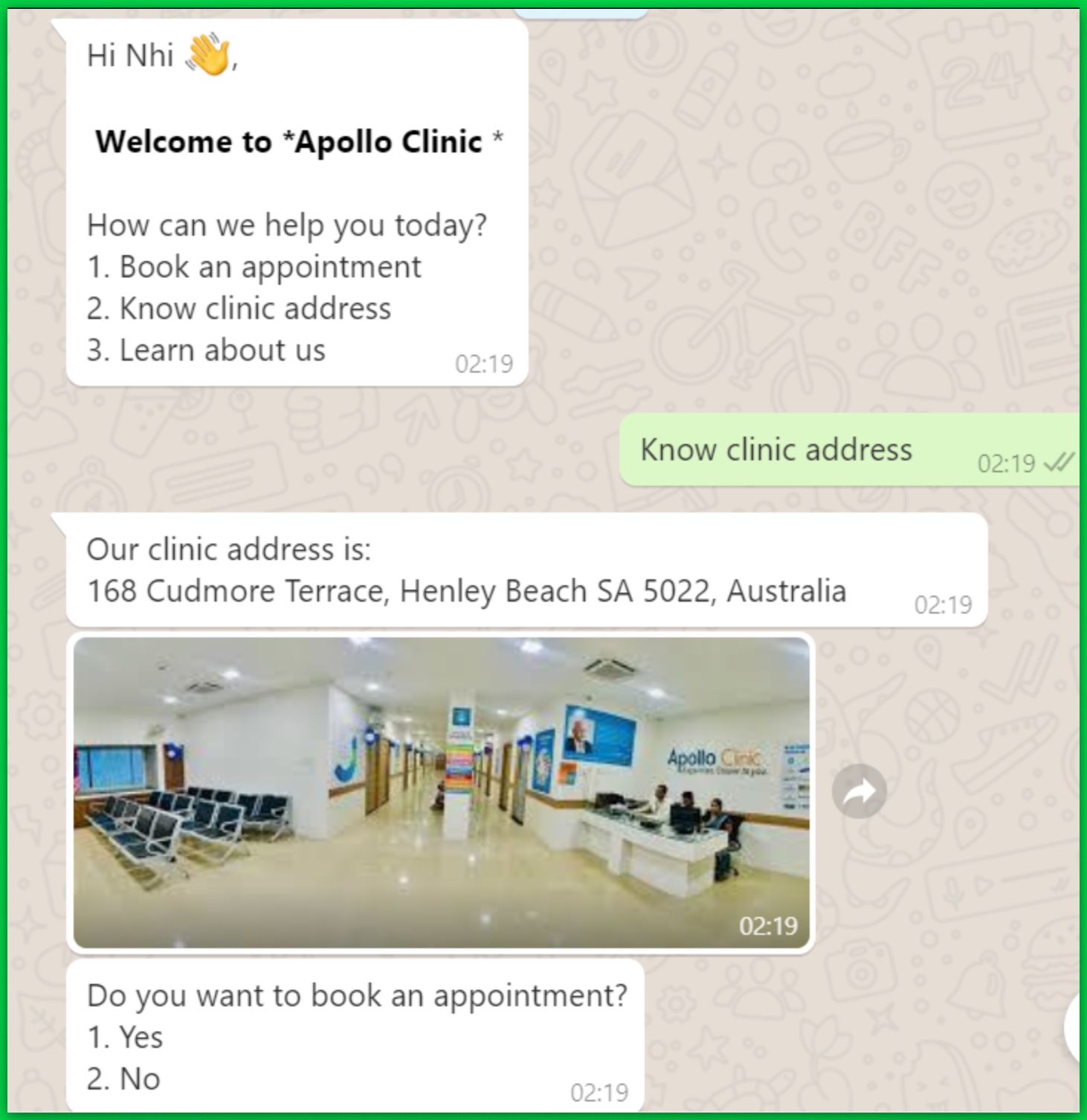
Wati has strong practical contact operations. Lists, tags, imports, exports, and inbox-centric visibility help teams manage WhatsApp relationships at scale without needing a larger architecture discussion.
That is useful when the contact model mainly exists to support team execution, outbound messaging, and basic operational visibility.
- Useful for contact handling that stays close to daily inbox work.
- Good for list management, tagging, and operational visibility inside WhatsApp.
- Less compelling when contact data needs to drive broader workflow or AI behavior.
ChatbotX is more compelling when contact data needs to feed automation, AI behavior, routing logic, and external systems together.
Instead of treating contacts as mainly a WhatsApp operating layer, it can treat them as reusable context across a broader messaging platform.
- Better when conversation data must influence more than outbound lists and inbox actions.
- Stronger if contact context needs to travel across systems, channels, and automations.
- More useful when messaging data is expected to become shared infrastructure.
AI features, memory, and extensibility
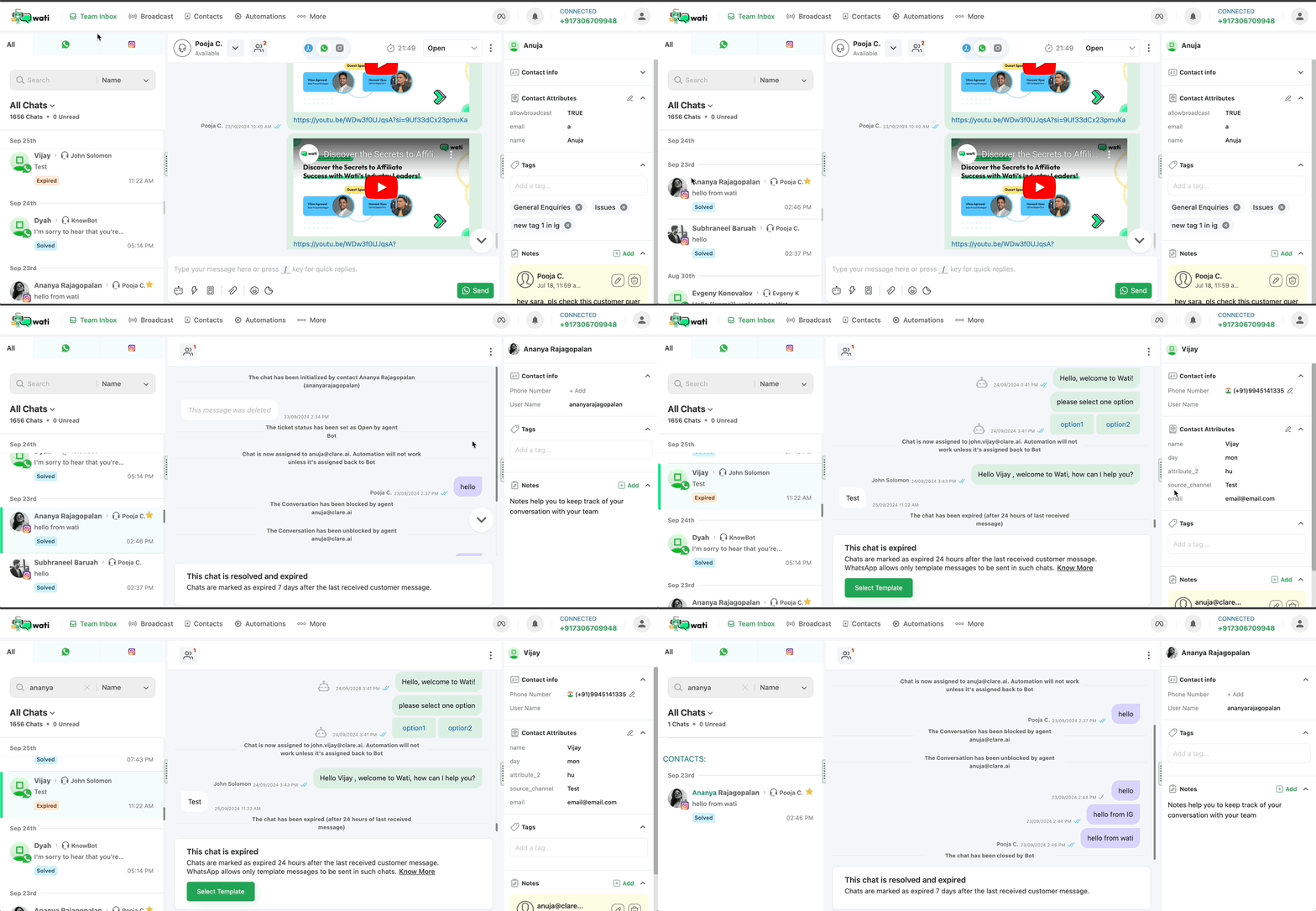
Wati now offers AI Support Agent capabilities and OpenAI-backed features that are genuinely useful for inbox productivity and support acceleration. For many teams, that is enough because AI only needs to summarize, draft, translate, or help with routine interactions inside WhatsApp operations. The issue is not that AI is absent, but that it remains product-bounded and shaped by a managed WhatsApp-centric environment. That works when AI is mainly a service layer for operators.
ChatbotX goes further on the architecture side. Its open-source posture, autonomous workflow capabilities, and Agent-First approach make AI easier to treat as part of platform logic rather than only as an inbox helper. This is more relevant when businesses want AI to participate in routing, orchestration, retrieval, or system actions across channels and teams. If AI is mainly for WhatsApp support acceleration, Wati is viable; if AI becomes part of the platform logic, ChatbotX is the stronger long-term option.
Live chat, team inbox, and routing
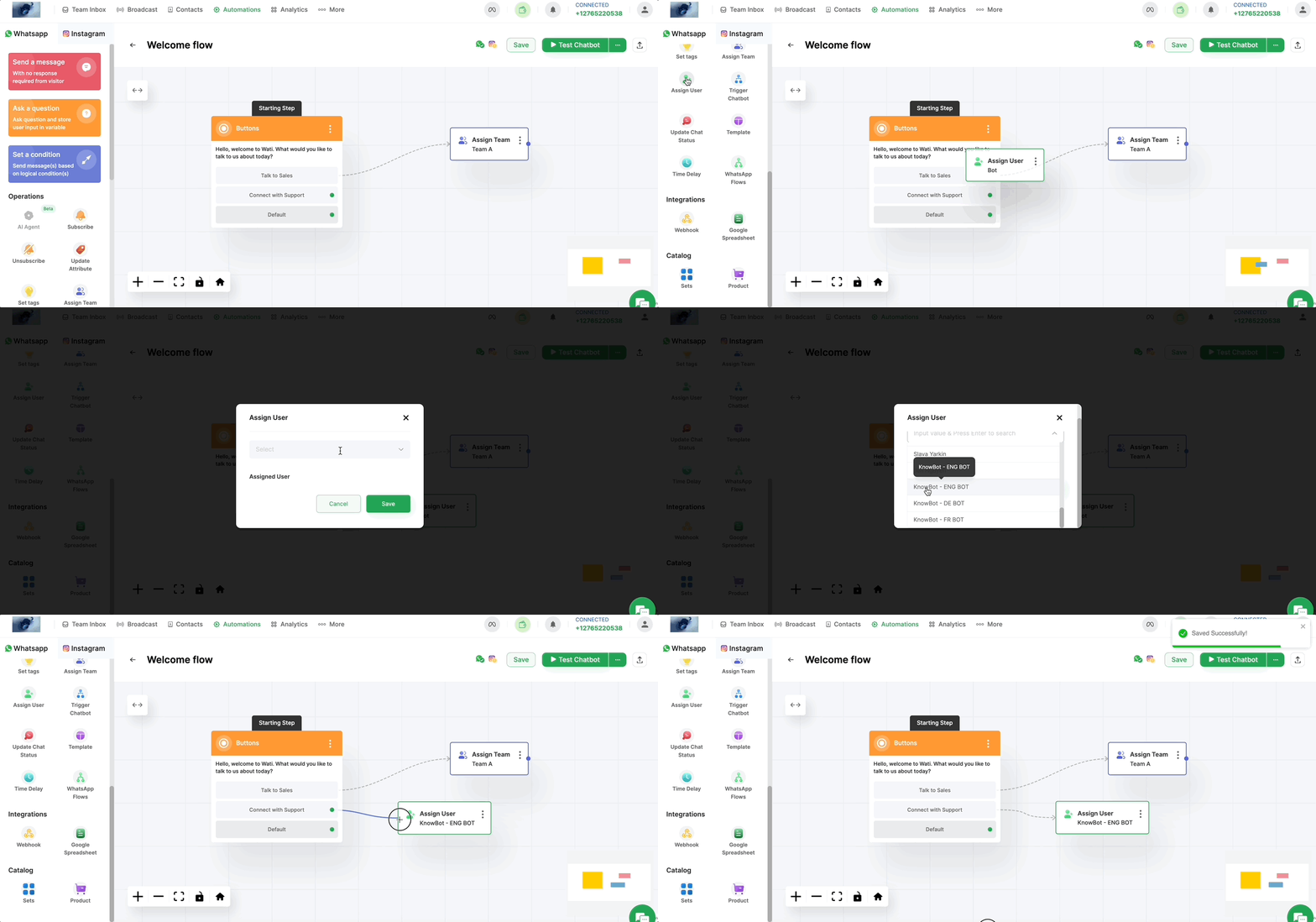
This is where Wati is strongest. Team assignments, routing, visibility, contact handling, and shared execution are all central to the product, and that clarity is exactly why many businesses adopt it.
For companies whose operation lives on WhatsApp, Wati can feel purpose-built in a very practical way.
- Excellent for WhatsApp-first team execution.
- Strong around visibility, assignments, and inbox coordination.
- Best when WhatsApp is the true operating center of the business.
ChatbotX becomes stronger when inbox operations are only one layer of a broader messaging system.
It can connect inbox work to open-source flows, AI agents, and external systems more naturally, which matters when the business wants ownership and extensibility beyond a managed WhatsApp environment.
- Better when inbox work must connect to a larger stack.
- More adaptable for teams building beyond one channel.
- Stronger when ownership and extensibility matter as much as operator efficiency.
Channels and growth tools
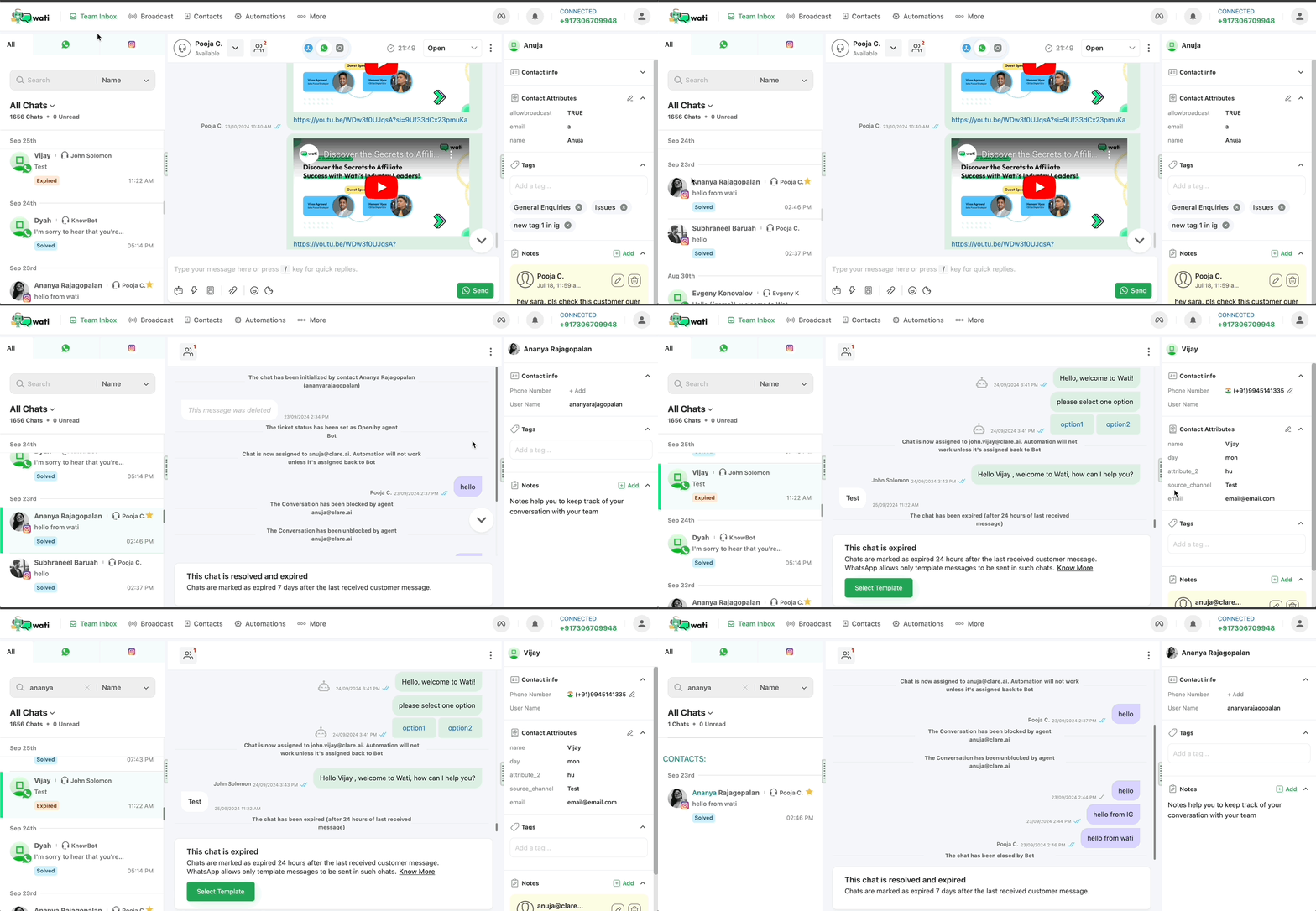
Wati is clearly WhatsApp-led, and that focus is precisely what many businesses want. If support, sales, and outbound engagement all happen primarily on official WhatsApp, a narrower product can actually be an advantage.
The limitation is strategic: the more the roadmap expands beyond WhatsApp, the more that focus starts to feel restrictive.
- Ideal when the business truly wants a WhatsApp center of gravity.
- Helpful when adjacent channels are not a major priority yet.
- Less attractive once omnichannel operations become core to the roadmap.
ChatbotX gives you WhatsApp without forcing the rest of the messaging strategy to orbit one channel.
One shared chatbot account can keep WhatsApp, Messenger, Instagram, Zalo, and Webchat inside the same logic layer, which matters when the business wants one operating model instead of separate channel-led setups.
- Better when one chatbot account needs to support multiple channels together.
- More adaptable once channel strategy broadens.
- Stronger when the business wants one operating layer across messaging touchpoints.
Integrations, API, and developer flexibility
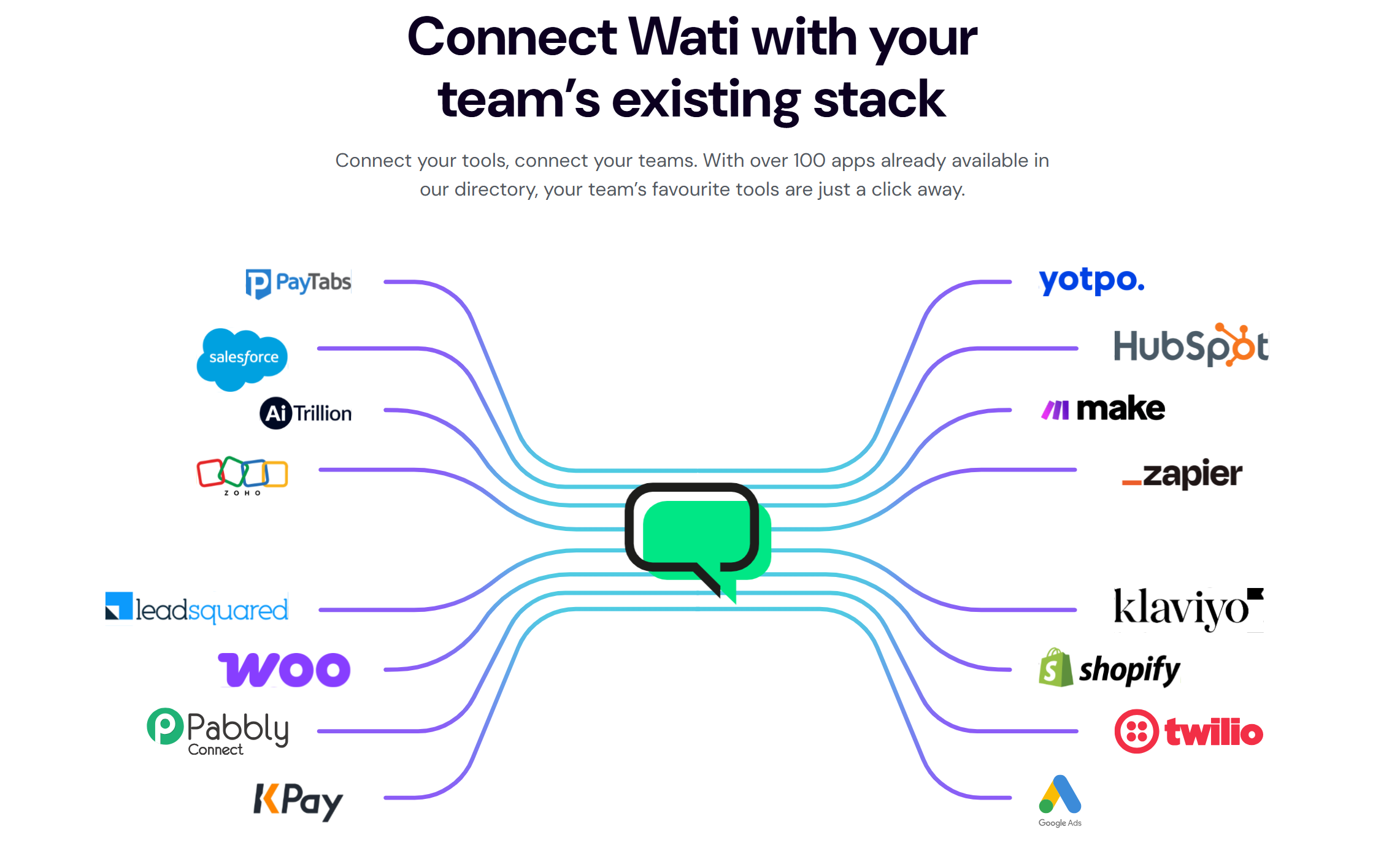
Wati offers APIs and integrations, but the depth and freedom of those connections still depend heavily on plan structure and the product's WhatsApp-first logic.
For some teams, that is enough because the goal is simply to connect a CRM or trigger practical workflow actions without redesigning the platform.
- Capable for practical WhatsApp-centric integrations.
- Good when the team mainly needs CRM sync and straightforward automation triggers.
- More constrained for developer-heavy organizations that want deeper leverage over system behavior.
ChatbotX is more naturally aligned with teams that want to extend behavior deeply through APIs, CLI workflows, and broader integration architecture.
That makes it easier to treat messaging as part of a controllable system instead of a vendor-defined operating space.
- Better fit for engineering teams that want more than packaged integration hooks.
- Stronger when APIs are expected to unlock deeper workflow and deployment control.
- More attractive for technical organizations optimizing for leverage rather than convenience.
Pricing, analytics, templates, and support
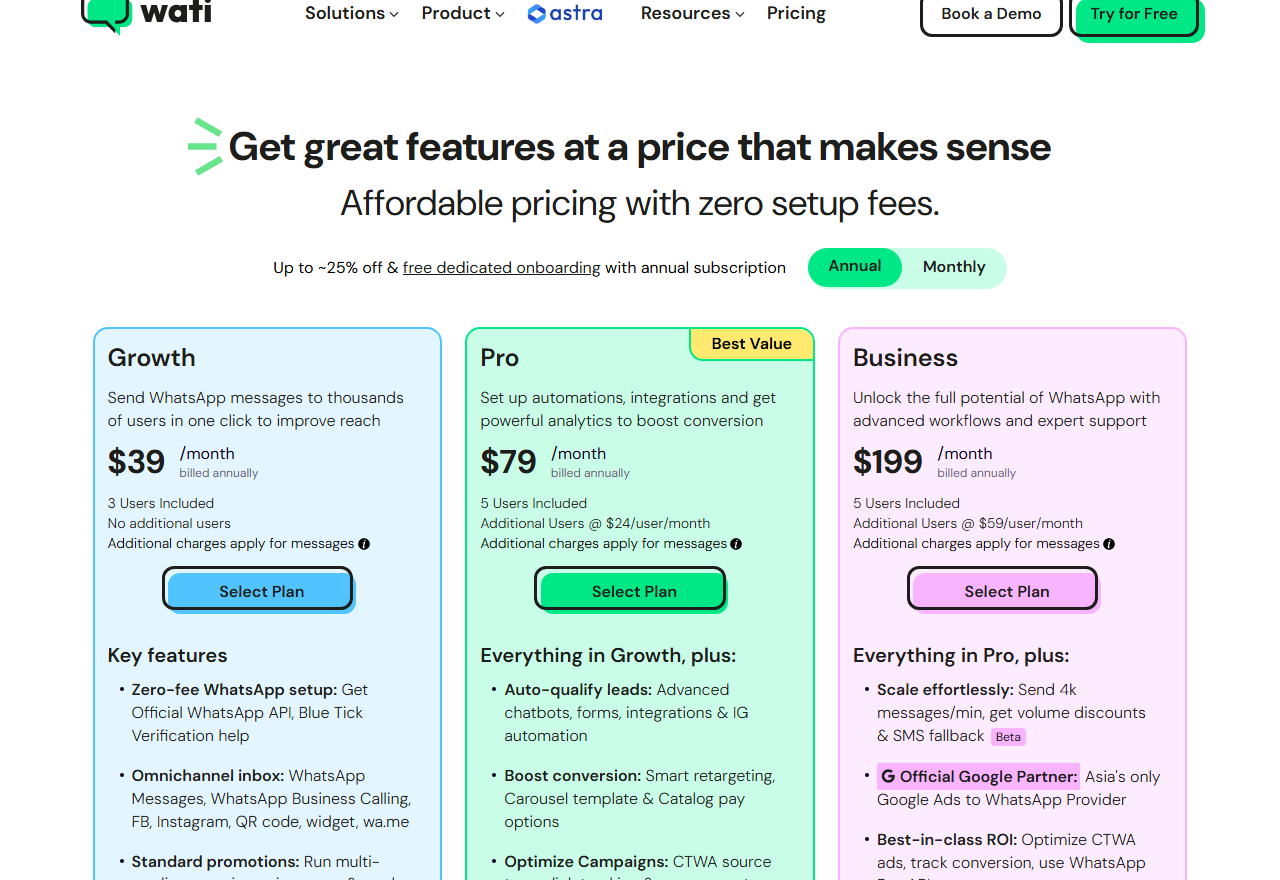
Wati offers a commercially clear SaaS path, which is one reason it is easy to shortlist. Teams can understand the offer quickly, but they also have to think about message charges, credits, plan-gated triggers, and other boundaries that become more meaningful as volume grows.
That means the pricing conversation often becomes more strategic over time than it appears at the start.
- Easy to shortlist because the product promise is clear.
- Costs and plan boundaries matter more as usage scales.
- Strong commercial option, but still a vendor-shaped WhatsApp SaaS.
ChatbotX is the better strategic choice for teams that want to reduce long-term vendor dependence while keeping AI and automation central.
The value proposition is not mainly in packaged simplicity, but in open-source ownership, broader extensibility, and a system that can evolve without resting entirely on SaaS plan boundaries.
- More relevant for teams optimizing for long-term control.
- Better when platform flexibility matters more than SaaS convenience.
- Stronger if the business wants messaging architecture that can keep evolving.
Bottom line
Choose Wati if your priority is official WhatsApp operations with a strong shared inbox, contact handling, and no-code automation inside one managed product.
Choose ChatbotX if you want WhatsApp inside one shared omnichannel chatbot account, plus open-source control, agentic AI, and room to grow beyond a WhatsApp-only center of gravity.
FAQ
Is Wati better if everything happens on WhatsApp?
For many teams, yes. Wati is optimized for exactly that operating model, which is why it feels practical for businesses running support, sales, and outbound flows primarily inside official WhatsApp.
ChatbotX becomes more attractive when WhatsApp is only one part of the roadmap or when open-source ownership matters strategically.
What is Wati strongest at compared with broader platforms?
Wati is strongest when a business wants one focused product for official WhatsApp inbox operations, team assignments, contact handling, and straightforward no-code automation.
That narrower product shape is often a benefit for teams that do not want to pay for or learn a broader omnichannel platform before they actually need one.
Does Wati support voice or video calls?
According to Wati Help Center documentation available in March 2026, Wati does not support voice or video calls yet.
That matters less for purely text-based WhatsApp operations, but it does matter for teams evaluating a broader communications stack instead of a WhatsApp operations workspace.
Where can a team outgrow Wati?
Teams usually start to outgrow Wati when WhatsApp is no longer the only channel that matters and when workflow logic has to span more systems, more data sources, and more product-specific behavior.
The more messaging becomes a platform decision instead of a channel decision, the more a WhatsApp-first SaaS can start to feel constraining.
When is ChatbotX the better Wati alternative?
ChatbotX is the stronger alternative when the team wants one shared chatbot account to support WhatsApp, Messenger, Instagram, Zalo, and Webchat without splitting the architecture by channel.
It is especially relevant when WhatsApp is important but should not become the permanent center of gravity for the entire messaging strategy.
Related comparisons
Compare ManyChat vs ChatbotX for creator-first growth automation, newer 2026 pricing, and platform ownership.
Read comparisonCompare Chatfuel vs ChatbotX for SMB sales automation, built-in CRM, and extensibility.
Read comparisonCompare Respond.io vs ChatbotX for omnichannel inbox maturity, AI workflows, and developer control.
Read comparison