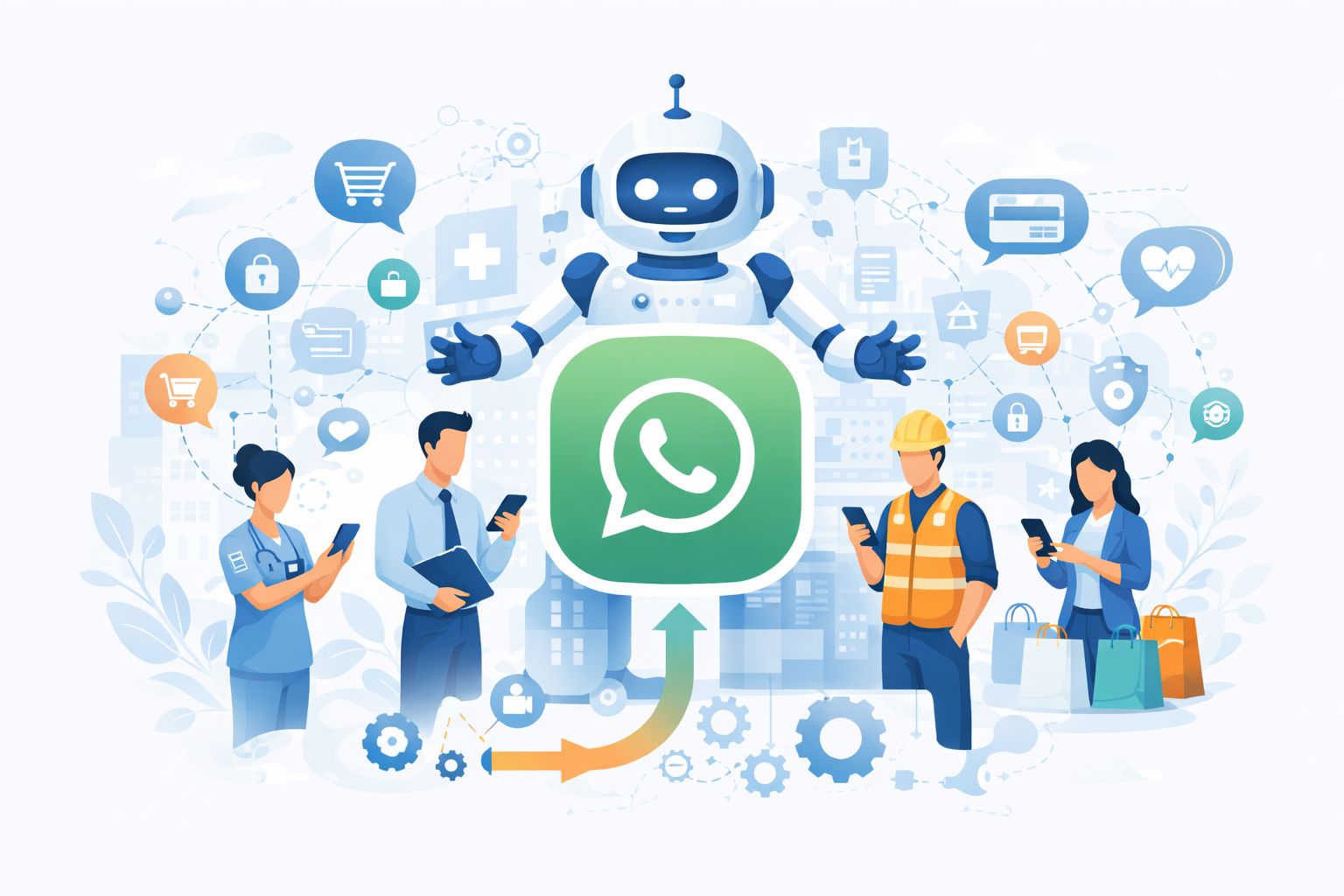
AI-powered WhatsApp automation is no longer a competitive edge reserved for the largest enterprises. In 2026, it has become the channel infrastructure that brands across retail, financial services, healthcare, and e-commerce rely on to turn conversational moments into measurable revenue – at scale, in real time, without proportional headcount growth.
This guide goes beyond surface-level tips. You will get a practitioner-grade breakdown of how to architect an automation stack, which KPIs actually matter, how to govern deployments responsibly, and where AI automation delivers the fastest return across the customer lifecycle. Every section is structured so you can apply it directly to your next discovery call, pilot brief, or board presentation.
Launch agentic chat marketing in minutes with ChatbotX












The 12 Reasons at a Glance
- Unmatched reach across 2.7 billion users, completely outside algorithmic control.
- Opt-in rates that consistently double those of traditional email campaigns.
- 24/7 availability that meets asynchronous support expectations without increasing headcount.
- First-response times under 60 seconds – versus 12-hour averages for email-based competitors.
- A single encrypted thread that collapses the distance between discovery and purchase.
- Rich media commerce – carousels, shoppable catalogs, and short videos – that replicates in-store discovery.
- AI-powered tier-one support that resolves high-volume, repetitive inquiries instantly and consistently.
- Trigger-based drip sequences that scale loyalty and retention without proportional marketing effort.
- VIP community building through moderated group chats and live shopping events.
- Real-time CRM and CDP integration that feeds personalization at the individual level.
- A four-metric KPI framework that ties every workflow to lagging business outcomes.
- Governance built in from day one – not retrofitted after launch – so compliance never blocks growth.
Why WhatsApp Automation Belongs at the Center of Your 2026 Growth Strategy
Reason 1: Unmatched Reach Outside Algorithmic Control
WhatsApp now counts over 2.7 billion monthly active users according to Statista – making it the world’s largest messaging platform and one of the few owned channels that operates completely outside algorithm-controlled reach. Brands that establish an active presence here are not competing for feed placement. They are showing up in the most personal, most-checked application on their customers’ phones.
Unlike social media feeds where reach depends on algorithmic favor, WhatsApp delivers messages directly into the hands of opted-in subscribers. For growth teams, this means predictable distribution at scale – a foundational advantage that no other channel currently matches.
Reason 2: Opt-In Rates That Double Email
The behavioral data reinforces the opportunity. Opt-in rates for WhatsApp messaging regularly double those of traditional email campaigns. Asynchronous support preferences – messaging-based, non-real-time help – have accelerated post-pandemic, with customers expecting responses during evenings and weekends rather than within business hours.
Voice note adoption is also expanding the format palette available to brands, enabling richer, more human service exchanges without requiring video infrastructure. For teams evaluating which platform to anchor their messaging strategy around, Best WhatsApp Business Solution Providers (BSP) in 2026 provides a comprehensive vendor landscape review that maps BSP options to specific business requirements and scale thresholds.
Reason 3: 24/7 Availability That Meets Modern Buyer Expectations
According to research cited by the World Economic Forum, 75 percent of consumers now expect AI to handle routine requests while humans focus on complex or emotionally sensitive interactions. That expectation extends directly into messaging channels – buyers want immediate intent capture and instant response, with human escalation available but not mandatory for every exchange.
AI automation enables brands to deliver consistent, round-the-clock service without scaling headcount proportionally. Predictive alerts that surface high-propensity buyers before the conversation even begins give human agents a meaningful head start when they do step in.
Note: Benchmark reviews should be refreshed at minimum quarterly to capture WhatsApp platform policy changes, new opt-in rules, and throughput updates that affect automation performance.
Reason 4: First-Response Times Under 60 Seconds
Executives who benchmark service response levels consistently find that messaging-first brands answer within 10 seconds while email-based competitors average 12 hours. In competitive verticals – retail, insurance, telecoms, financial services – that time delta directly influences win rates and first-purchase conversion.
AI automation amplifies the speed advantage by launching template responses, product catalogs, and knowledge articles automatically the moment matching keywords appear in a conversation. The result is a response experience that feels immediate and human, even when it is fully automated.
Reason 5: A Single Encrypted Thread That Collapses the Path to Purchase
AI-powered WhatsApp automation satisfies modern buyer expectations by maintaining full conversation context, surfacing shoppable catalogs at the moment of curiosity, and delivering cart links, payment reminders, and delivery confirmations inside a single encrypted thread. The distance between discovery and purchase collapses when the entire journey lives in one conversation.
Practical signals worth building workflows around include:
- One-question polls embedded in chats for voice-of-customer data.
- Limited-time offers triggered the second inventory peaks or expires.
- CRM-qualified lead routing while purchase intent is still hot.
Reason 6: Rich Media Commerce That Replicates In-Store Discovery
Rich media carousels, shoppable catalogs, and embedded short videos replicate in-store discovery experiences in under 30 seconds. When a customer scans an offline QR code or clicks a social ad, an automated greeting can collect preferences, check live inventory, and surface a payment link – all within the same thread, without human intervention.
🎥 Video Guide: Curious about customer experience? Click here to see how a typical WhatsApp conversation led to a completed order in just 3 contacts.
Virtual concierges – styled as product advisors, stylists, or financial consultants depending on the vertical – operate within the security of an encrypted WhatsApp thread and handle consultations that previously required a call center agent. High-performing commerce automation sequences include:
- Drop alerts with live countdown timers and waitlist options.
- Appointment scheduling for high-ticket consultations directly inside chat.
- Instant financing calculators that return eligible plans without requiring customers to leave the conversation.
Pro Tip: Pair catalog push campaigns with first-party browsing data to cap message frequency per contact. Protecting deliverability scores is more valuable long-term than maximizing short-term send volume.
For a real-world example of how WhatsApp campaigns drive measurable engagement outcomes, WhatsApp Business API Event Marketing: How ReThink HK Hit a 52% CTR documents a campaign that achieved results well above industry benchmarks.
Reason 7: AI-Powered Tier-One Support That Resolves Issues Instantly
Tier-one support automation is the most commonly deployed WhatsApp use case – and for good reason. Shipping status, warranty claims, booking policies, and account inquiries follow predictable patterns that AI can handle accurately and instantly, freeing human agents for the conversations that genuinely require judgment.
The business case is strong across the board: lower average handle time, consistent answers sourced from approved knowledge bases, and structured data capture for downstream product analytics – all without additional headcount.
Pros and cons of automated WhatsApp tier-one support:
| Details | |
|---|---|
| ✅Pros | Consistent resolution of high-volume, repetitive inquiries; structured conversation data for analytics; 24/7 availability without staffing costs. |
| ⚠️Cons | Requires ongoing intent model training to maintain accuracy above SLA thresholds; may frustrate VIP customers if human escalation triggers are poorly calibrated; needs multilingual validation before rolling out across markets. |
When disputes arise, automation can attach receipts, policy excerpts, or courier tracking visuals directly in the thread – reducing escalation rates by addressing emotional friction with evidence rather than waiting for a human agent.
Reason 8: Trigger-Based Drip Sequences That Scale Loyalty and Retention
Subscription and loyalty programs generate enormous repeat-engagement potential that most brands underutilize on WhatsApp. When automation is connected to loyalty data, the system knows exactly when a customer hits a new tier, when a replenishment window opens, or when an anniversary milestone approaches – and can act on that context instantly with a personalized message.
ChatbotX‘s Drip Campaign flows are built for this retention layer. Teams configure trigger-based sequences – “Viewed Product → Wait 1 hour → Send reminder → Wait 24 hours → Send discount” – that run automatically based on customer behavior, without requiring manual campaign management for each contact. The result is a retention engine that scales with the contact list rather than with the marketing team’s bandwidth.
Reason 9: VIP Community Building Through Group Chats and Live Events
Beyond individual retention, WhatsApp automation can moderate micro-community group chats by inviting VIP customers into exclusive spaces for sneak previews, early access waitlists, and live shopping events. This transforms a messaging channel into a loyalty ecosystem where high-value customers feel seen and rewarded.
Post-event surveys sent through the same channel close the feedback loop and feed directly into net promoter scoring without requiring a separate survey platform. The combination of exclusivity, immediacy, and automation creates a community experience that competitors cannot easily replicate through traditional channels.
Architecting an AI-Powered WhatsApp Automation Stack
The Four Core Platform Components
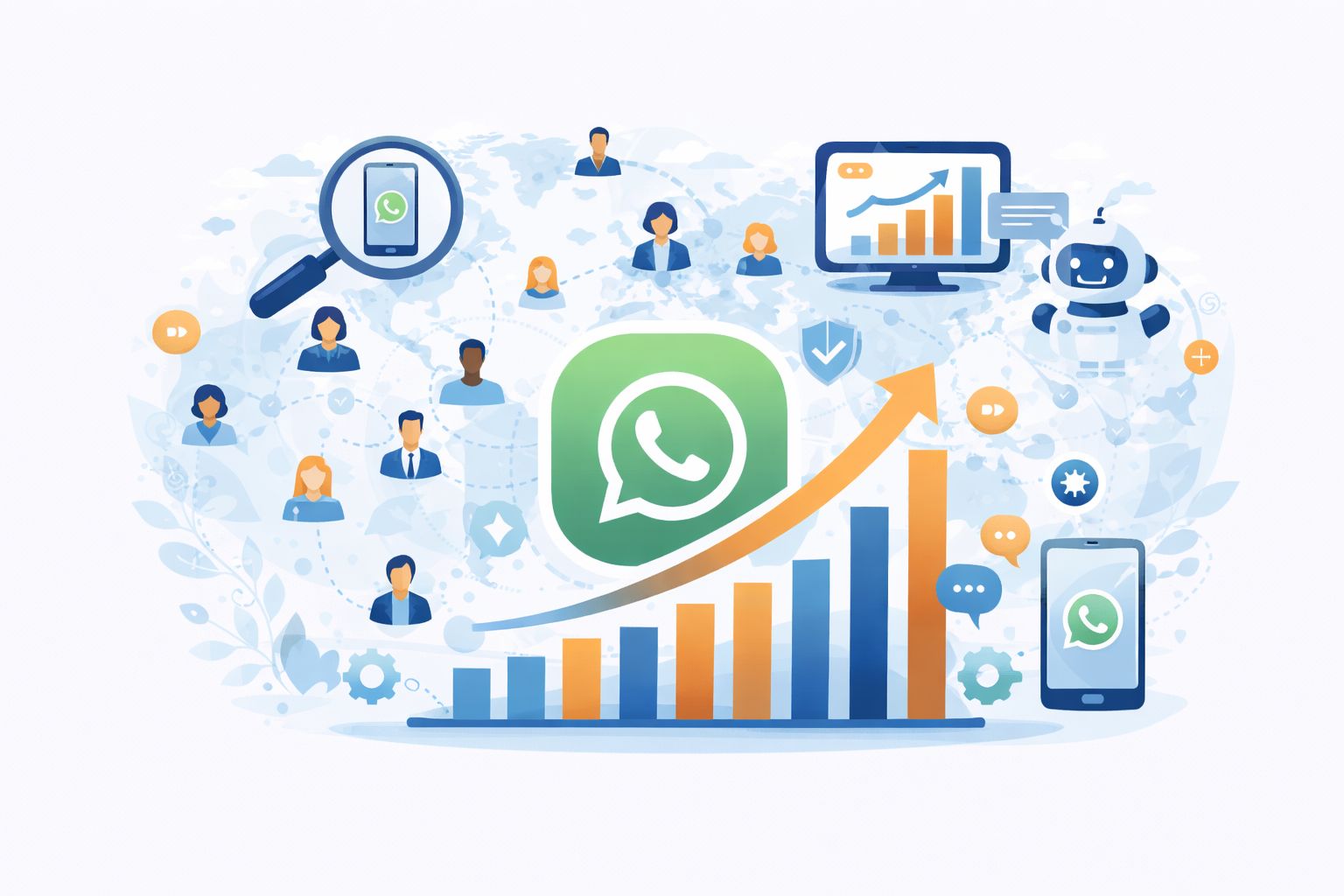
A production-grade WhatsApp automation stack requires a conversation orchestration layer connected to the official WhatsApp Business Platform, underlying AI engines, and the business systems that hold customer and product data. Each component must integrate into a unified interface – because stack fragmentation creates template duplication, compliance gaps, and agent experience degradation.
| Component | Role in the Stack | Key KPIs |
|---|---|---|
| Official API access | Maintains throughput compliance; unlocks rich media templates and verified sender status. | Template approval speed, quality score. |
| Conversation intelligence | Detects intent, sentiment, and urgency to trigger precise automation flows. | Intent accuracy rate, escalation rate. |
| Agent workspace | Gives human agents full conversation history, macros, and collaborative notes in one view. | Handle time, first contact resolution. |
| Automation designer | Visual flow builder for broadcasts, drip sequences, and decision trees. | Flow completion rate, testing velocity. |
When evaluating platforms, prioritize those that offer native connections across all four layers rather than requiring custom middleware for each integration. For a structured framework on choosing and comparing cross-channel platforms, 2026 Omnichannel Chatbot Strategy: A 7-Step Optimization Guide covers how leading teams architect multi-platform deployments without creating data silos.
Reason 10: Real-Time CRM and CDP Integration for Personalization at Scale
WhatsApp automation reaches its full potential only when conversation logic is fed by unified customer data. That means pulling from CRM, CDP, ERP, and e-commerce layers – not just internal contact lists.
Set up nightly sync processes for slow-changing attributes such as customer tier, location, and product history, and streaming API connections for real-time intent signals like browse abandonment and cart activity. Every data attribute connected to automation flows should be mapped to a specific business purpose so privacy teams can review and approve use cases without creating a compliance bottleneck.
The three data categories that deliver the highest automation ROI are:
- Customer 360 identifiers that align messaging profiles with loyalty, billing, and offline purchase history.
- Product metadata that powers dynamic recommendations with live availability and compliance flags.
- Event streams that capture on-site behavior, ad clicks, and support tickets for next-best-action triggers.
For teams building the CRM layer beneath their automation stack, CRM Social Media Integration: The Complete 2026 Strategy Guide outlines how to connect social engagement data with CRM records in a way that keeps both systems accurate and useful.
Security, Privacy, and Compliance Requirements
Conversation data in WhatsApp threads can include order history, financial details, health information, and personal identifiers – all of which require enterprise-grade protection. Security teams must enforce:
- Certificate Pinning – locks the app to a specific server certificate, blocking man-in-the-middle attacks.
- Token Rotation – periodic refresh of API authentication credentials.
- Role-based access controls – baseline requirements, not optional hardening.
Consent management is equally non-negotiable. Auditable logs that trace opt-ins and opt-outs at the individual and market level are required for GDPR, PDPA, and most regional privacy frameworks. Data masking in QA and testing environments prevents personally identifiable information from leaking into non-production systems during iteration cycles.
Reason 11: Measuring What Actually Matters — The 2026 KPI Framework
Four Metrics That Drive Accountability
Vanity metrics like message volume and open rate are easy to report but hard to act on. Leaders who build sustainable WhatsApp automation programs tie every workflow to lagging business outcomes – incremental revenue, churn reduction, or cost per contact – and use the following leading indicators to track progress.
| Metric | Formula | Healthy Benchmark |
|---|---|---|
| First Response Time | Time from customer message to first automated or human reply. | Under 60 seconds. |
| Automation Containment Rate | Automated resolutions ÷ total conversations. | 45%–70% depending on workflow complexity. |
| Conversation Conversion Rate | Orders or qualified leads ÷ total proactive journeys. | 8%–20%. |
| Customer Satisfaction Score (CSAT) | Positive survey responses ÷ total survey responses. | 85%+. |
For SaaS and B2B organizations where revenue attribution requires longer measurement windows, WhatsApp Business KPIs for SaaS and B2B: The 2026 Revenue Guide provides a purpose-built framework that connects WhatsApp engagement metrics to pipeline velocity and expansion revenue.
Running Experiments That Compound Over Time
Treat WhatsApp automation like a product: run weekly experiments on greeting scripts, CTA placements, offer structure, and message timing. Adopt A/B testing (champion-challenger testing) at the flow level as well as for the language model prompts that control agent tone and vocabulary.
Automate dataset labeling so your optimization backlog consistently prioritizes the intents with the largest revenue impact – not just the ones that are easiest to fix.
Executive Reporting That Secures Continued Investment
Executive dashboards should place WhatsApp automation KPIs directly alongside e-commerce, retail, and call center performance data so leadership can see total experience ROI in a single view. Drill-down access to conversation transcripts gives executives qualitative evidence that makes investment justification compelling rather than purely numeric.
Automate weekly digests – Slack or email – summarizing opt-in and opt-out trends, agent productivity, and compliance flags. For a broader automation strategy, Social Media Automation: The Complete Strategy for Sustainable Growth in 2026 provides the channel-agnostic framework that enterprise teams use to coordinate across platforms.
Reason 12: Deployment Roadmap and Governance Built In From Day One
The Four-Phase Delivery Model
Organizations that achieve enterprise-grade WhatsApp automation consistently follow a phased approach that builds governance into each stage rather than retrofitting it after launch.
Phase 1 – Discovery and Alignment
Audit existing customer journeys, map KPI baselines, secure API approvals, and document compliance requirements before a single flow is built.
Phase 2 – Pilot Build
Configure approved templates, integrate catalog and CRM data, craft AI prompts, and deploy one low-risk journey with human-in-the-loop safeguards throughout.
Phase 3 – Scale Up
Add languages, payment integrations, workforce routing rules, and market-specific compliance overlays to the validated foundation.
Phase 4 – Optimize
Automate governance processes, expand AI guardrails, and build continuous feedback loops that surface new automation candidates from conversation data.
Most brands complete a minimum viable journey in six to eight weeks when API access, template approvals, and consent flows are prioritized from day one. Scaling to multiple markets typically requires another quarter for localization, workforce training, and analytics automation.
Talent and Change Management
WhatsApp automation performs best when cross-functional squads pair conversational designers with data scientists, marketing strategists, sales coaches, and service leads. Each role contributes a distinct perspective that prevents the most common failure modes – flows that are technically accurate but commercially ineffective, or automation that performs well in testing but creates customer friction at scale.
Micro-learning modules embedded directly in the agent desktop let new team members reference policy snippets and escalation procedures mid-conversation without leaving their workspace.
Ethical Guardrails and Risk Mitigation
WhatsApp automation touches personal identifiers, purchase history, and in many verticals, health or financial data – all of which attract regulatory scrutiny. Every AI use case deployed in production should be documented with a purpose statement, a data flow diagram, and a defined fallback plan before it goes live.
Warning: Never allow unsupervised generative responses in markets where customer disclosures could be interpreted as financial or medical advice. Automated legal review gates and human override controls that allow supervisors to freeze risky flows instantly are not optional – they are the difference between responsible deployment and regulatory exposure.
Frequently Asked Questions About AI-Powered WhatsApp Automation

What distinguishes AI-powered WhatsApp automation from a basic chatbot?
A basic chatbot follows a fixed script and can only respond to anticipated inputs. AI-powered WhatsApp automation connects directly to enterprise systems, uses natural language understanding to interpret open-ended requests, and triggers personalized multi-step workflows based on conversation context, customer history, and real-time behavioral signals. It also respects WhatsApp template policies while detecting the moments where human escalation will deliver a better outcome than continued automation.
How long does an enterprise WhatsApp automation deployment typically take?
Most organizations stand up a minimum viable journey in six to eight weeks when API access, templates, and consent flows are approved early in the process. Scaling to multiple markets typically requires an additional quarter for localization, agent training, and analytics automation. Teams that skip the discovery phase tend to lose that time later when compliance or procurement surfaces unresolved issues.
Which industries see the fastest ROI from WhatsApp automation?
Retail, travel, telecoms, and financial services see the fastest payback periods because WhatsApp automation directly replaces high-cost inbound call center volume while simultaneously enabling proactive selling. Healthcare and education follow closely once compliance guardrails are properly codified and tested.
How do brands maintain compliance with privacy regulations on WhatsApp?
Legal, security, and marketing teams should co-own consent management, retention scheduling, and AI transparency documentation. Encrypting data at rest, rotating authentication tokens regularly, and maintaining auditable template usage logs keep the full stack inspection-ready for GDPR, PDPA, and regional equivalents.
What WhatsApp automation capabilities should teams prepare for in the next 12 months?
Expect in-chat subscription management that allows customers to upgrade, downgrade, or modify plans without leaving the conversation; interoperable loyalty wallets that work across messaging channels; and real-time translation that preserves tone and cultural nuance at enterprise scale. Building flexible data models now ensures these capabilities can be adopted without architectural rework when they reach production maturity.
Build the WhatsApp Automation Engine Your Growth Deserves
AI-powered WhatsApp automation in 2026 is not a feature to add to your marketing stack – it is the engagement layer that determines whether your brand captures micro-moments of intent or loses them to a competitor who responds faster, more personally, and at lower cost.
The brands compounding the most value from this channel right now share a common architecture: a platform that unifies AI automation and human escalation in one workspace, CRM data feeding real-time personalization, and governance built in from day one rather than patched in after launch.
ChatbotX was designed for exactly this stack. As an open-source omnichannel AI platform, it deploys AI Agents across WhatsApp, Messenger, Zalo, and WebChat from a single interface – with Smart Broadcasts for campaign distribution, Drip Campaigns for automated retention sequences, and a unified inbox so your team manages every conversation without switching tools. Because the platform is open-source, your security and compliance teams can audit data handling behavior directly rather than relying solely on vendor assurances.
Plans start at $29 per month with a 7-day free trial – no credit card required.