
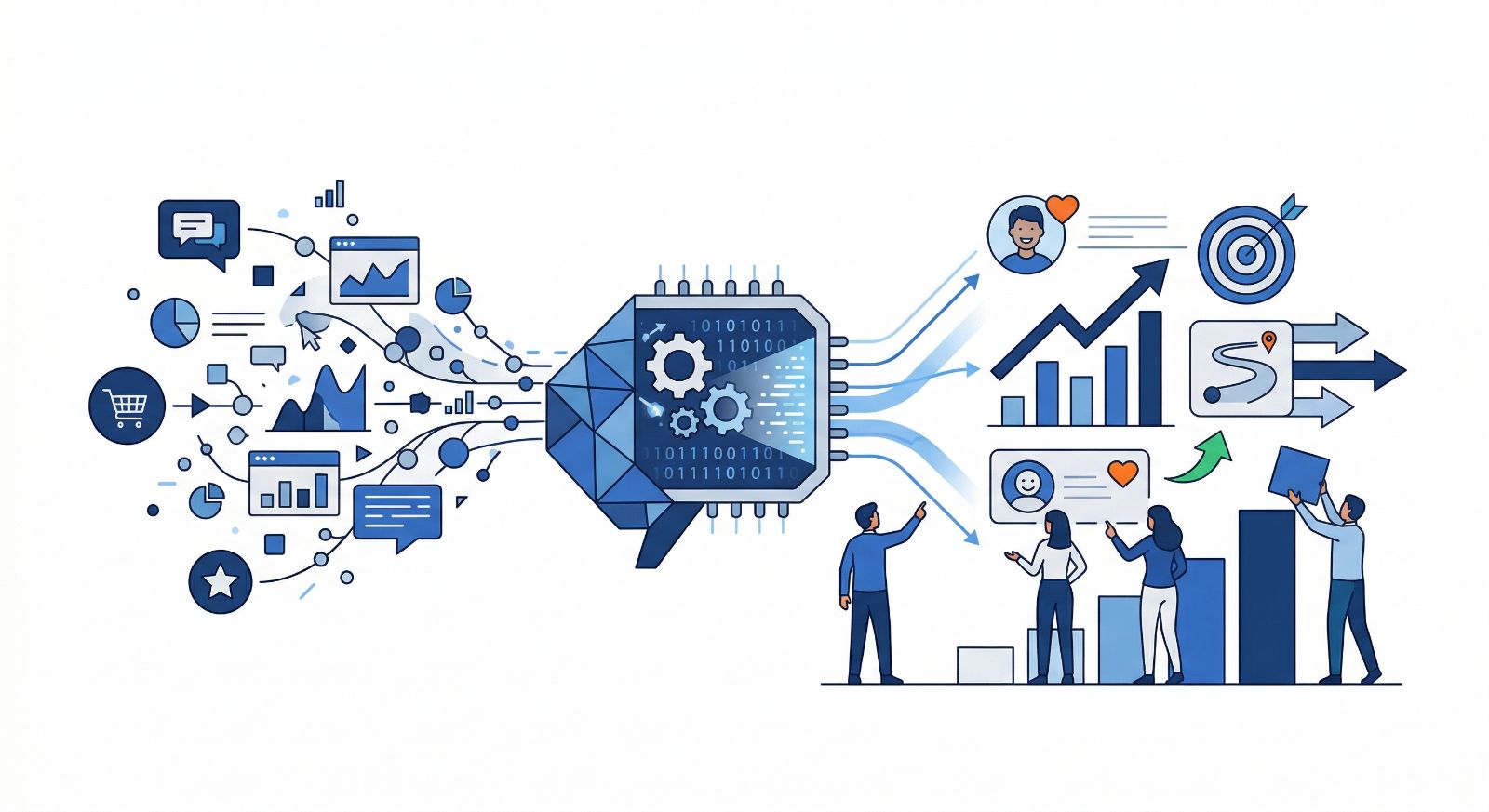
Every growth team has more customer data than they know what to do with. The brands that pull ahead are not the ones with the most data – they are the ones that convert it into action faster than their competitors. In 2026, that conversion happens through AI.
This guide is a practitioner-level playbook for operationalizing AI-powered customer intelligence. You will get concrete frameworks for data infrastructure, predictive modeling, sentiment analysis, personalization, and conversational automation – all mapped to the KPIs that executive teams actually care about. Skip the sections you have already solved and go deep on the ones that are slowing your growth down.
Launch agentic chat marketing in minutes with ChatbotX














Building the Strategic Foundation Before You Touch the Tech
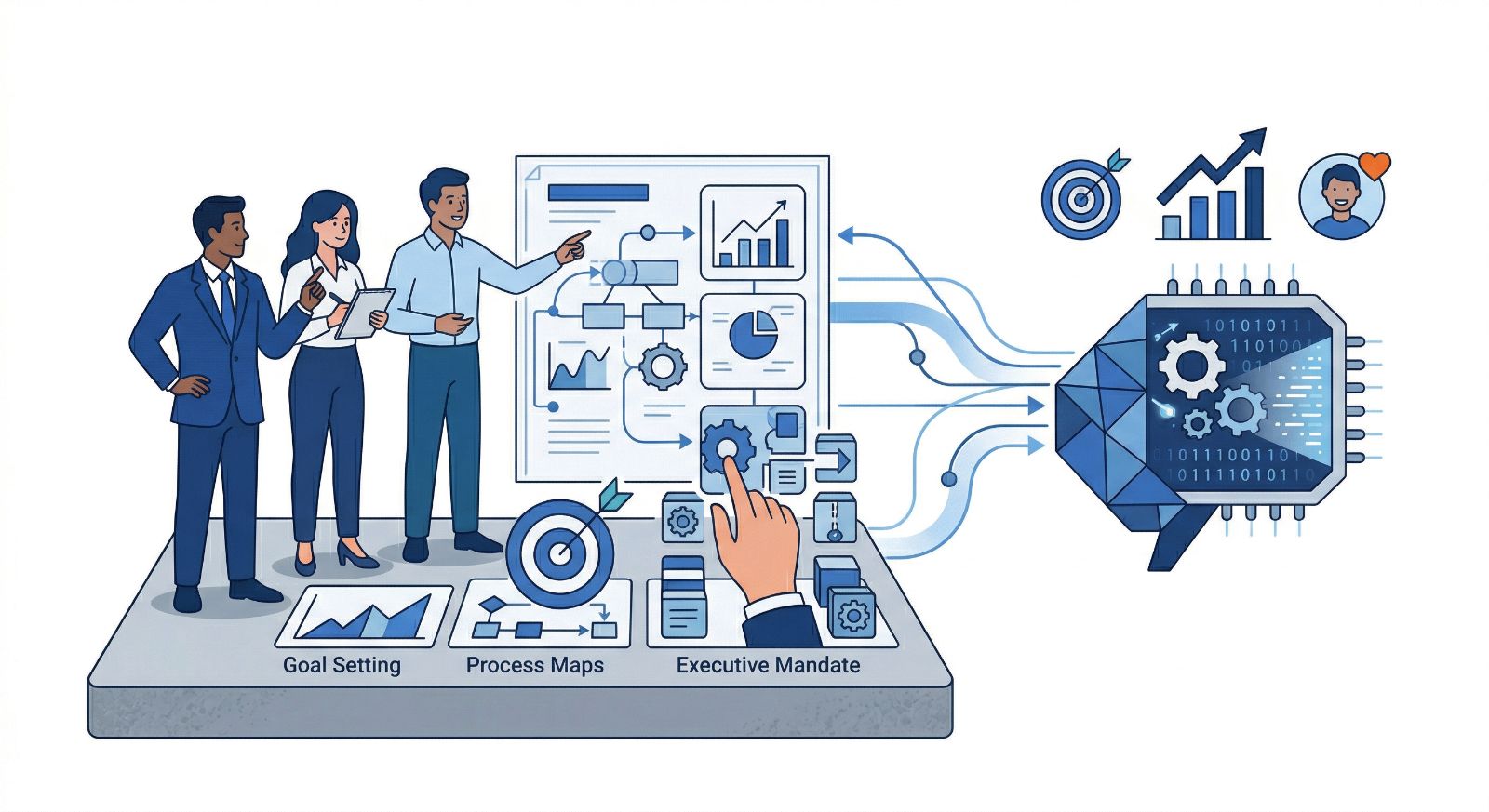
Establishing the Executive Mandate
No AI insight initiative survives without a clear business case that predates the technology decision. Before selecting a platform or hiring a data scientist, leadership must articulate exactly why this investment matters – tied to a specific revenue target, churn reduction goal, or cost-to-serve metric that every sprint can ladder back to.
Translate that mandate into a north-star KPI tree. The most commonly used anchors are average order value uplift, net revenue retention, customer lifetime value, and service cost per contact. When each initiative connects visibly to one of those metrics, funding conversations become straightforward and cross-functional alignment follows naturally.
Assessing Your Current Analytics Maturity
A candid self-assessment prevents the most expensive mistake in AI programs – investing in sophisticated modeling before the foundational data infrastructure is ready to support it. Compare your current analytics coverage, modeling sophistication, and automation depth against industry benchmarks from sources like Gartner’s Customer Data Platform research.
Use a three-tier scoring model – emerging, scaling, optimized – to prioritize the gaps that block the fastest wins first. Document dependencies clearly so teams understand whether the primary constraint is talent, process, or tooling. That clarity prevents the common failure of solving a technology problem that is actually a process problem in disguise.
Assembling the Right Cross-Functional Team
AI customer intelligence programs fail most often not because of bad models but because of organizational silos. Assemble a cross-functional tiger team with marketing, product, data science, CX, and compliance stakeholders who jointly own outcomes – with shared OKRs, not separate departmental goals.
Pro Tip: Rotate a frontline representative into sprint demos. Real feedback from sales or support surfaces context that dashboards rarely capture and often changes the priority order of what gets built next.
Structuring the Roadmap and Funding Model
Split the roadmap into 30-60-90 day releases with explicit gating metrics. If a pilot churn model reduces early attrition by five percent, that result unlocks the phase-two budget for personalization infrastructure. This staged approach keeps momentum high and proves ROI iteratively rather than requiring a large upfront commitment that depends on a single big bet succeeding.
A hybrid funding model – where cost savings from automation directly bankroll the next AI experiment – creates a self-sustaining investment cycle that is far easier to defend in budget reviews than a fixed annual allocation.
Data Infrastructure: The Foundation That Makes Everything Else Work

Designing a Unified Data Layer
The goal of a unified data layer is to create a single, coherent view of each customer across all touchpoints – what they purchased, where they browsed, when they contacted support, and how they responded to every communication. Without that foundation, AI models learn from incomplete pictures and produce predictions that are accurate in testing but unreliable in production.
| Data Source | Customer Signal | AI Technique | KPI Influence |
|---|---|---|---|
| Web behavior logs | Funnel drop-offs, micro-conversions | Sequence modeling | Conversion rate |
| POS and ERP feeds | Purchase cadence, basket composition | Time series forecasting | Inventory turns |
| CRM interactions | Lifecycle stage, deal velocity | Classification | Win rate |
| Support transcripts | Issue taxonomy, sentiment patterns | NLP topic modeling | First contact resolution |
Identity resolution – the process of connecting the same customer’s data across devices, channels, and sessions – is the highest-leverage infrastructure investment most organizations can make. Prioritize schema governance and access controls before layering models on top. A model built on unified, governed data will outperform a more sophisticated model built on fragmented inputs every time.
Real-Time Acquisition and Processing
Static overnight data pulls create a mismatch between when a customer acts and when your systems respond. Streaming pipelines – Apache Kafka, AWS Kinesis, or equivalent – feed online learning models with real-time behavioral signals that keep personalization and automation contextually relevant at the moment of interaction, not hours later.
Latency targets under two seconds are the threshold for cart-level personalization to feel immediate rather than delayed. Above that threshold, the experience degrades toward the generic, and the conversion lift from personalization largely disappears.
Data Quality, Governance, and Privacy
Automated validation on data arrival – flagging schema drift, missing identifiers, and statistical outliers before they reach model training pipelines – prevents the “garbage in, garbage out” failure mode that erodes trust in AI programs over time.
A governance board that approves new data sources and documents lineage does two things simultaneously: it protects privacy commitments and it creates an audit trail that satisfies GDPR, CCPA, and sector-specific regulations without requiring reactive remediation later. For teams connecting social engagement data into their customer data infrastructure, CRM Social Media Integration: The Complete 2026 Strategy Guide provides a practical framework for keeping both systems accurate, compliant, and mutually reinforcing.
Choosing an Interoperable Tech Stack
Select components that integrate cleanly: a customer data platform, a feature store, a model registry, and an orchestration layer. Favor open APIs and modular architecture so individual components can be upgraded or replaced without rewriting the entire pipeline.
Observability tooling that traces AI jobs end-to-end is not optional infrastructure – it is what allows engineers to diagnose and fix model failures before they affect customer outcomes at scale.
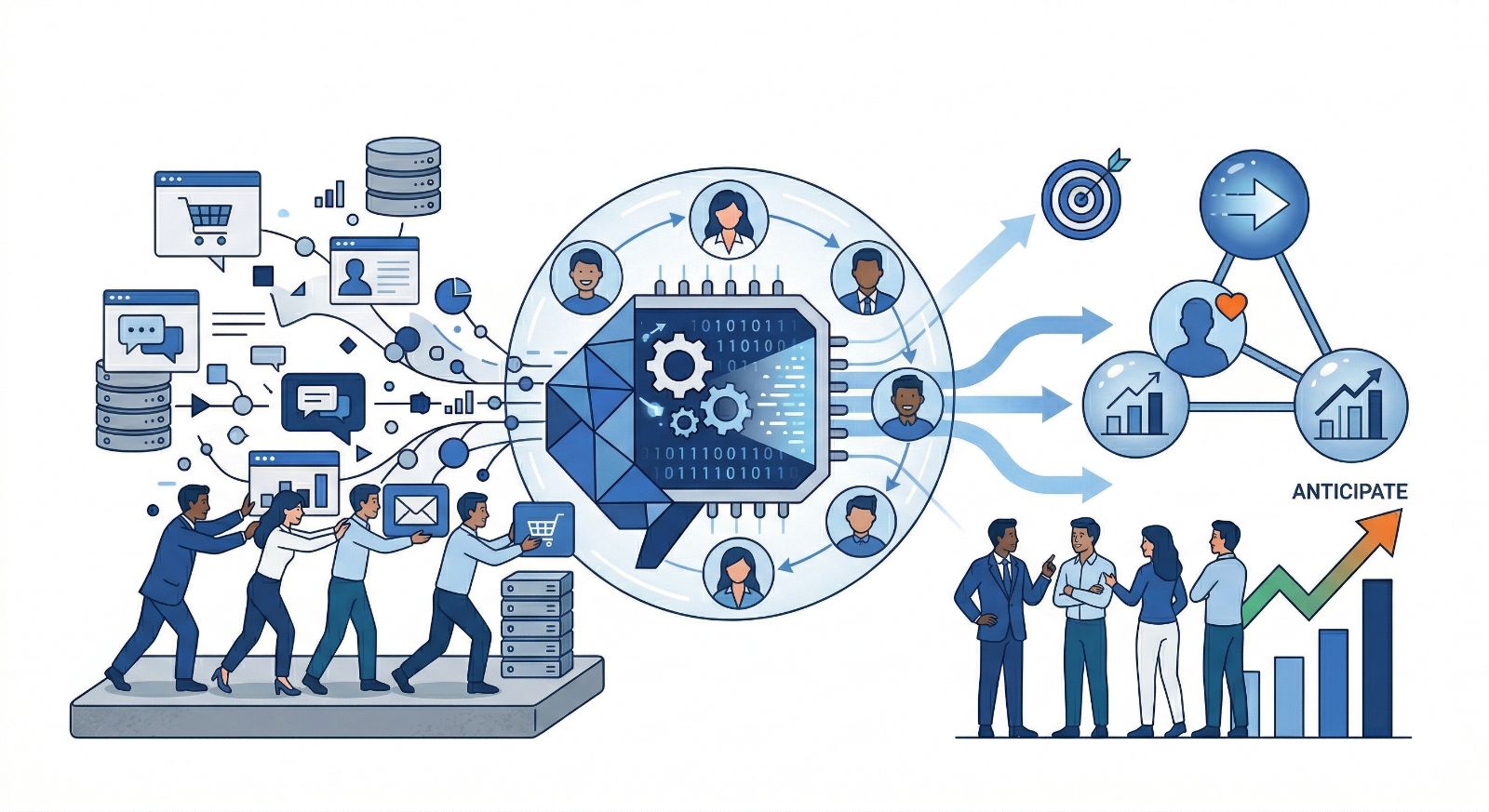
Predictive Intelligence: From Reactive to Anticipatory
Model Selection and Feature Engineering
Match each customer outcome to the appropriate mathematical technique. Propensity scoring suits churn prediction and upsell identification. Survival analysis forecasts subscription renewal timing. Collaborative filtering powers product recommendation. Using the wrong model architecture for a given prediction task is one of the most common sources of underperformance in otherwise well-funded AI programs.
Feature engineering remains the decisive variable. Blending transactional signals with behavioral streaks, recency patterns, and engagement velocity consistently outperforms models that rely on demographic or purchase-history data alone – because those signals capture momentum, not just state.
Operationalizing Predictive Workflows in Four Steps
- Define the business trigger – for example, churn probability crossing 0.6 for a customer in their first 90 days
- Score the relevant customer segment daily and store results in the feature store where downstream systems can access them
- Push prioritized audiences into activation channels automatically – email, SMS, in-app, or messaging – without manual export steps
- Measure lift via holdout control groups and recalibrate thresholds monthly based on observed outcomes, not assumptions
Use Cases With Proven ROI
The highest-return predictive applications in 2026 share a common characteristic: they intervene at the moment of maximum leverage, before a decision is made rather than after.
Inventory optimization models that feed replenishment planners with weekly demand forecasts reduce stock-outs without inflating safety stock. Dynamic incentive engines that issue variable discounts only to customers predicted to respond profitably protect margin while improving conversion. Proactive service programs that flag customers likely to experience issues – before they contact support – generate measurable NPS gains and inbound ticket reductions simultaneously.
According to McKinsey, organizations that embed predictive analytics into marketing and sales can outperform peers by up to 85 percent in sales growth. That figure reflects the compounding effect of acting on intelligence rather than reacting to events.
Warning: Never deploy models trained on biased historical data without rebalancing. Biased training sets replicate and amplify unfair outcomes at scale – and they generate exactly the kind of regulatory and reputational exposure that is hardest to recover from.
Sentiment Intelligence and Voice of Customer Analysis
Designing the NLP Pipeline
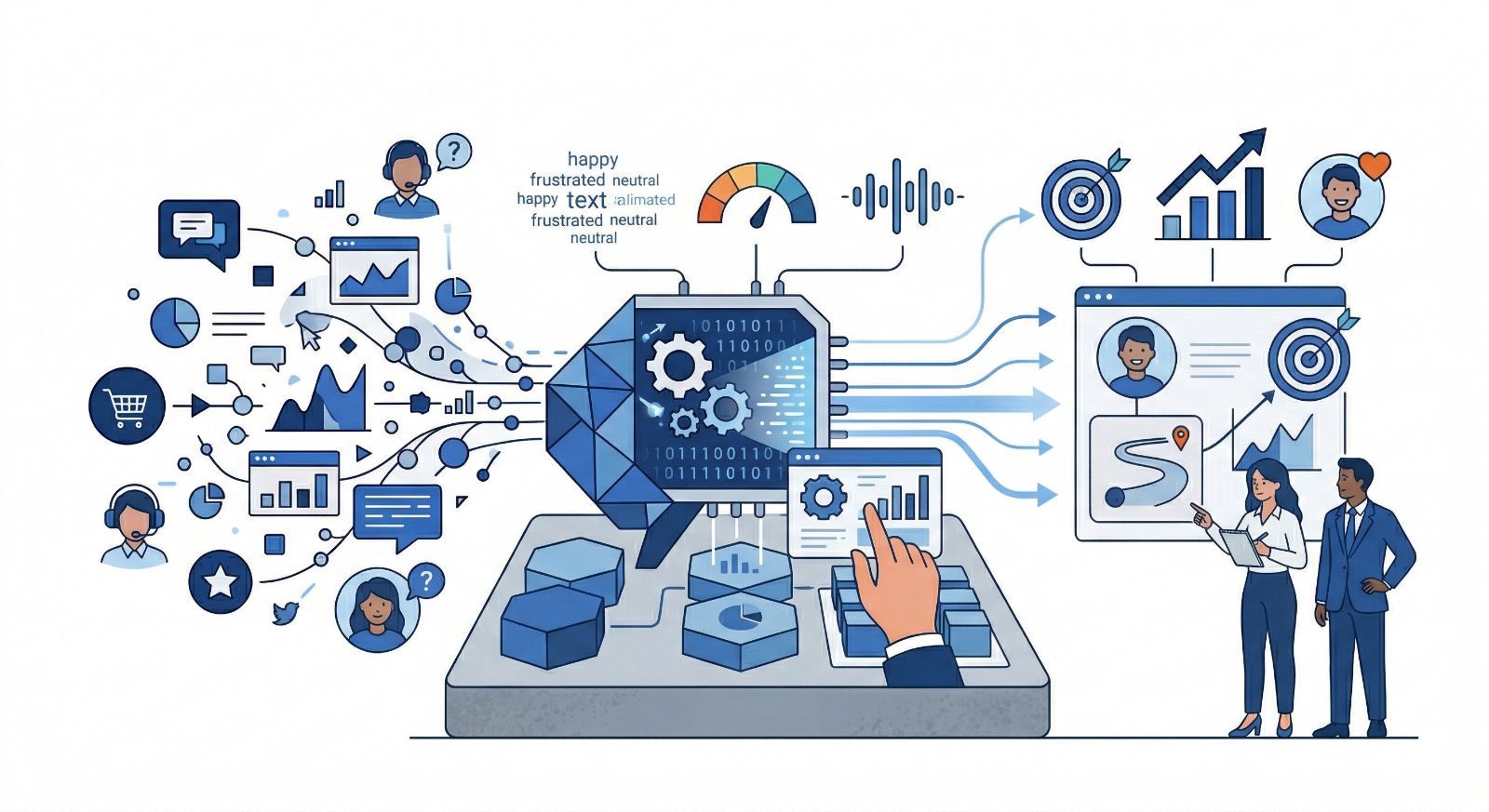
Sentiment intelligence starts with broad data capture across reviews, support chats, social feeds, forums, and call transcripts. Transformer models fine-tuned on domain-specific language – including industry terminology, product names, and regional slang – outperform general-purpose sentiment classifiers significantly in most vertical applications.
Chain models that first identify topic, then sentiment polarity, then emotional intensity. This layered architecture keeps analysis grounded in the specific context of each interaction rather than producing a single aggregated score that loses the nuance needed for action.
Translating Sentiment Signals Into Business Actions
Route severe negative sentiment to a response team within minutes, not hours. Configure alerts that populate ticketing systems automatically with recommended next steps and full customer conversation history – so the human who responds has context before typing a single word.
Aggregate weekly voice-of-customer dashboards by journey stage so product managers can identify exactly where friction originates. When a new product feature generates consistent negative sentiment in week two post-launch, that signal is far more valuable than the monthly NPS summary that would have captured the same information six weeks later.
Pros and cons of dedicated sentiment platforms:
- Pros: Captures emotional signal at scale beyond what NPS surveys can deliver; near real-time monitoring enables intervention before issues escalate; supports multilingual analysis for global brands
- Cons: Model tuning for industry-specific slang takes time and requires labeled training data; automated sentiment can misclassify sarcasm without human validation loops; storing conversation verbatims requires strict privacy architecture
Competitive Intelligence Through Sentiment Comparison
Overlaying your sentiment curve against industry-wide social conversation reveals whitespace that competitors have created through their own service failures. When a rival faces sustained negative sentiment around a specific product attribute – shipping reliability, onboarding complexity, pricing transparency – targeted messaging that highlights your strength in that area captures switching intent at exactly the right moment.
Pro Tip: Combine sentiment scores with conversion data to quantify the revenue impact of emotional experience swings. That calculation turns sentiment analysis from a “nice to know” metric into a board-level business case.
Hyper-Personalization: Delivering the Right Experience at the Right Moment
Building the Experience Orchestration Layer
Hyper-personalization requires decision engines that evaluate context at every touchpoint – intent signals, inventory status, eligibility rules, channel preference, and recency of last interaction – and select offers that are simultaneously relevant to the customer and profitable for the business.
The most common failure mode is personalizing the content without personalizing the timing or channel. A perfectly relevant offer delivered 48 hours after the purchase decision was made is not personalization – it is noise.
The Personalization Matrix by Channel
| Channel | Personalization Lever | AI Input | Success Metric |
|---|---|---|---|
| Dynamic product blocks | Browsing clusters, price sensitivity | Click-to-open rate | |
| Mobile app | Contextual in-app messages | Geolocation, session depth | Session revenue |
| Website | Real-time hero content swaps | Traffic source, behavioral signals | Bounce rate |
| Retail store | Associate prompts and recommendations | Loyalty tier, wishlist activity | Attachment rate |
| Paid media | Creative variation and audience targeting | Lookalike propensity scores | ROAS |
AI Techniques That Power Real Personalization
Reinforcement learning optimizes sequences where customer behavior evolves rapidly – onboarding flows, subscription upgrade paths, and re-engagement campaigns all benefit from models that learn continuously from each interaction rather than from a static training dataset.
Graph neural networks excel at uncovering micro-communities with shared behavioral patterns, enabling bundled offers and curated experiences that feel individually tailored even when delivered at scale.
Run champion-challenger tests for every personalization hypothesis before scaling. Verifying that personalization logic outperforms the control experience is the discipline that separates compounding programs from ones that plateau quickly.
Note: Maintain a single personalization scorecard shared across marketing, product, and analytics. Siloed victory metrics – where marketing optimizes click rate while product optimizes session depth – create conflicting incentives that ultimately hurt the customer experience.
AI Chatbots and Intelligent Service Automation
What Next-Generation Chatbots Actually Do
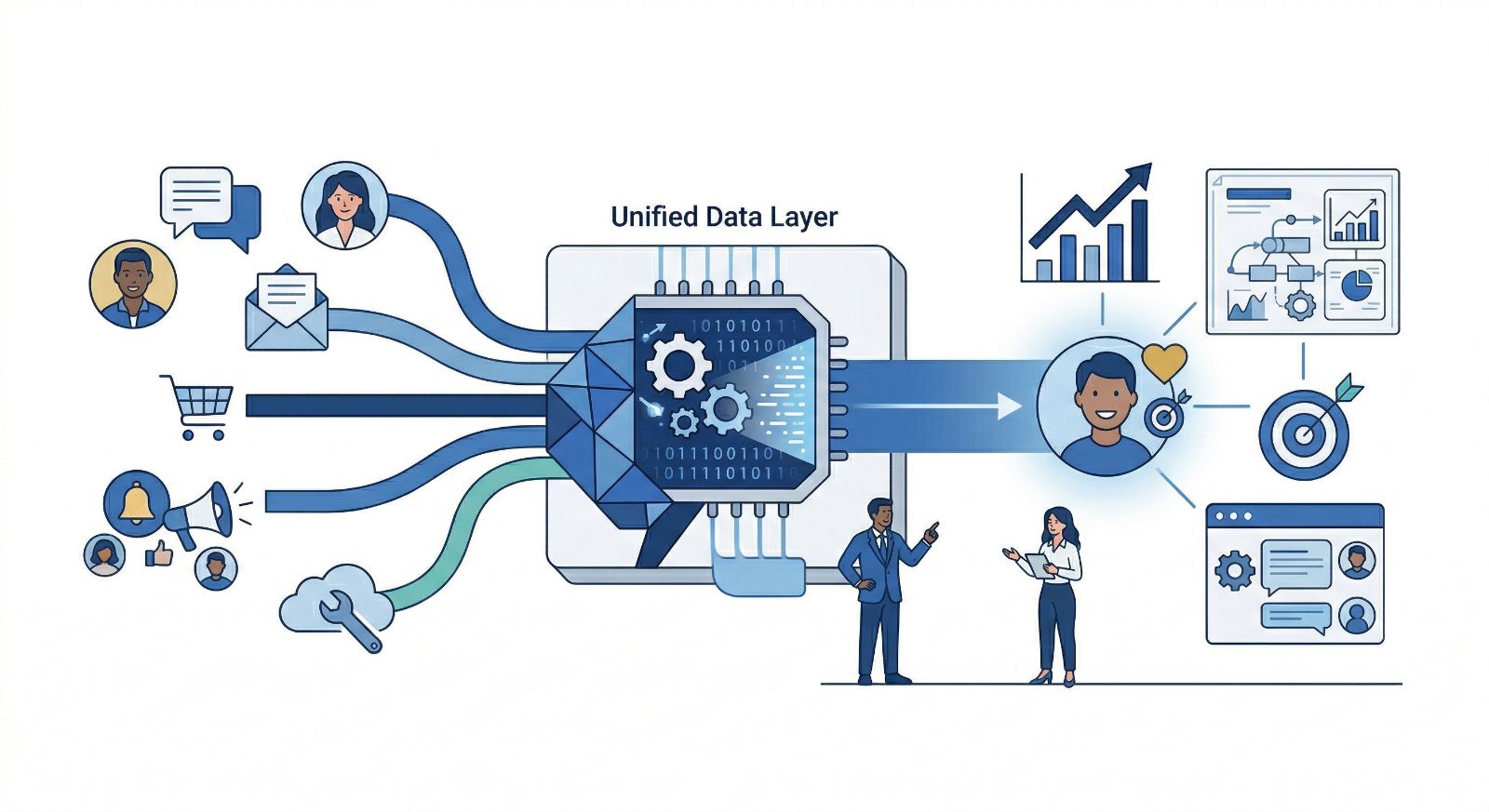
Modern AI chatbots go well beyond FAQ deflection. They use natural language understanding, entity extraction, and conversational memory to resolve the majority of inbound inquiries without human intervention – while generating structured intent data that feeds directly back into the customer insight programs described in every earlier section of this guide.
The integration layer is what separates high-performing chatbot deployments from disappointing ones. A bot connected to knowledge bases, order management systems, CRM records, and scheduling tools can complete transactions and resolve issues end-to-end. A bot that only retrieves static content creates a frustrating half-step that sends customers to the phone anyway.
For a comprehensive breakdown of how to approach chatbot deployment strategically – including the platform comparison and common mistakes that derail rollouts – AI Chatbot Strategy 2026: Trends, Platform Comparison and Mistakes to Avoid covers the full decision framework.
Industry Snapshots
Banking deployments use bots to authenticate users, surface balance information, and flag unusual transaction patterns without wait times – freeing relationship managers for conversations that require judgment and empathy. Travel and hospitality deployments handle rebooking automatically when disruptions strike, pushing proactive notifications before customers even realize there is a problem. Healthcare deployments capture symptom intake data and route patients to appropriate triage levels, compressing response times while maintaining HIPAA compliance throughout.
Chatbot automation – pros and cons in practice:
- Pros: Handles demand spikes without linear headcount increases; delivers consistent brand-voice responses at every volume level; generates structured intent data that enriches the full AI insight program
- Cons: Poorly designed escalation flows frustrate customers who need human empathy; dialogue maintenance requires ongoing investment as products and policies change; connecting legacy CRM or order systems adds integration complexity
Where ChatbotX Fits Into This Architecture
Chatbots are no longer just for answering FAQs; they are a powerful ‘weapon’ for customer retention. This video analyzes how deep AI integration with CRM creates hyper-personalized nurturing workflows explaining why ChatbotX prioritizes data connectivity to maximize your conversion rates.
ChatbotX is an open-source omnichannel AI platform that closes the gap between customer data intelligence and real-time conversation execution. Its built-in AI Agents detect user intent and respond contextually across WhatsApp, Messenger, Zalo, and WebChat – while every conversation generates structured engagement data that flows back into contact records and analytics pipelines.
The unified inbox centralizes conversations from all channels in a single workspace, so your team sees the full picture of each customer interaction without switching between platforms. Smart Broadcasts and Drip Campaign flows allow data-driven segmentation to trigger personalized messaging sequences automatically – turning the predictive models in your customer intelligence stack into operational programs that act on those predictions in real time.
For teams building the customer care layer of their AI insight architecture, Customer Care Chatbot Development: The Complete 2026 Guide for Businesses provides the end-to-end deployment framework that connects chatbot capabilities to measurable service and revenue outcomes.
Measuring Chatbot Performance Accurately
Track containment rate, CSAT scores specifically for bot-handled queries, and cost per automated resolution. Compare blended support costs before and after deployment to establish a clean payback timeline.
Pro Tip: Deploy silent monitoring for two weeks before going live. Let the model observe real conversations to learn actual intent distribution before it starts responding – this single practice dramatically reduces the cold-start accuracy problems that undermine early-stage user trust.
For organizations measuring the full downstream impact of AI-powered customer experience improvements, 13 Ways AI Improves Customer Experience in 2026 maps each AI capability to the specific experience and commercial outcomes it drives – a useful reference when building the business case for expanding chatbot scope.
Governance, Ethics, and the Measurement Framework That Sustains Investment
Privacy and Regulatory Compliance
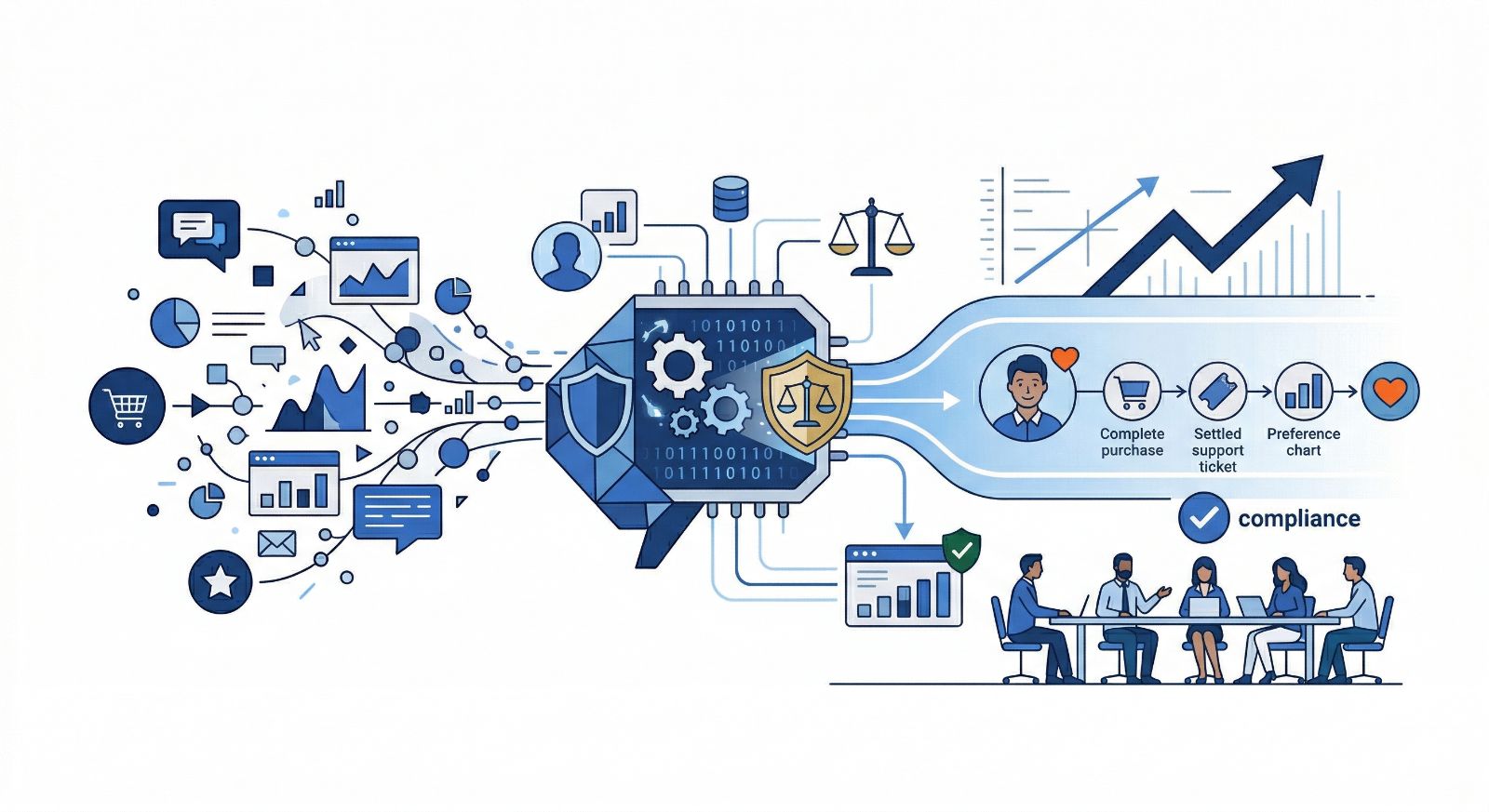
AI customer intelligence programs touch GDPR, CCPA, HIPAA, and a growing list of sector-specific regulations simultaneously. Consent logs must be maintained at the individual level, retention schedules must be configurable per data category, and every AI use case must have a documented purpose statement that justifies the data processing involved.
For sensitive data categories – health information, financial behavior, location history – adopt differential privacy or federated learning approaches that keep identifiable information on-device or within protected environments rather than centralizing it in ways that create disproportionate breach exposure.
Bias Detection and Model Governance
Audit training datasets for representation gaps across age, geography, income, and behavioral patterns before any model reaches production. Synthetic oversampling and reweighting techniques address historical imbalances that would otherwise reproduce unfair outcomes at algorithmic scale.
Document each model’s intended use, limitations, and retraining cadence in a model card that auditors, legal teams, and business owners can all read without a data science background. That documentation is increasingly required for regulatory compliance and is rapidly becoming a standard expectation in enterprise procurement processes.
The KPI Hierarchy That Connects Technology to Business Outcomes
Build a balanced scorecard that spans growth metrics, operational efficiency gains, and customer trust indicators – and report against it at a consistent cadence.
A practical three-tier hierarchy:
- Tier 1 (Board-level): Revenue lift, churn reduction, service cost savings
- Tier 2 (Leadership-level): Model accuracy, response latency, automation containment rate
- Tier 3 (Operational): Data freshness scores, annotation backlog size, experimentation velocity
For teams connecting AI customer intelligence to social and messaging channel ROI, Social Media ROI: 15 Proven Strategies to Drive Profitable Growth in 2026 provides attribution frameworks that work across the full channel mix – including the conversational channels where AI increasingly operates.
Building Continuous Improvement Into the Program Structure
Schedule quarterly retrospectives that review what hypotheses succeeded, which failed, and – critically – why. The “why” is where the most valuable learning lives. A model that underperformed because of a data quality issue teaches a different lesson than one that underperformed because the business objective was framed incorrectly.
Use post-implementation reviews to capture lessons in documentation accessible to new team members. Programs that institutionalize this learning compound faster than those where knowledge stays locked in individual contributors.
Frequently Asked Questions
How quickly can organizations start seeing results from AI customer intelligence?
Most organizations achieve their first measurable lift within 90 days if the foundational data infrastructure – identity resolution, CRM integration, basic consent management – is already in place. Quick wins typically come from predictive churn scoring or automated segmentation that plugs directly into existing campaign platforms without requiring new channel infrastructure.
What skills are essential for an AI customer intelligence team?
The highest-performing teams blend data scientists, machine learning engineers, marketing strategists, and privacy specialists. This combination ensures that models are technically accurate, that outputs translate into commercially relevant messaging, and that the program stays compliant across all markets from day one.
How can smaller organizations access AI customer intelligence capabilities affordably?
Cloud-based CDPs and low-code AI services with volume-based pricing make entry-level AI intelligence accessible to companies that cannot justify large infrastructure investments. Starting with a single high-value use case – email personalization or churn prediction for the top-revenue cohort – validates ROI before expanding scope. Platforms like ChatbotX offer contact-based pricing with a 7-day free trial, making the conversational AI layer of customer intelligence accessible from a $29/month starting point.
How should long-term success be measured?
Track a portfolio of KPIs that spans acquisition, retention, and efficiency: revenue per customer, churn rate trends, automation containment rates, and sentiment improvement trajectories. Combine quantitative dashboards with qualitative customer interviews conducted quarterly – the interviews consistently surface insight that metrics alone cannot capture.
What derails AI customer intelligence programs most often?
The three most common failure modes are poor data hygiene that corrupts model training, lack of sustained executive sponsorship that leaves cross-functional teams without authority to resolve competing priorities, and deploying models in production without human oversight that can catch and correct errors before they affect customer outcomes at scale. All three are governance failures, not technology failures – which means they are preventable with the right program structure from the beginning.
Turn Your Customer Data Into Your Sharpest Competitive Advantage
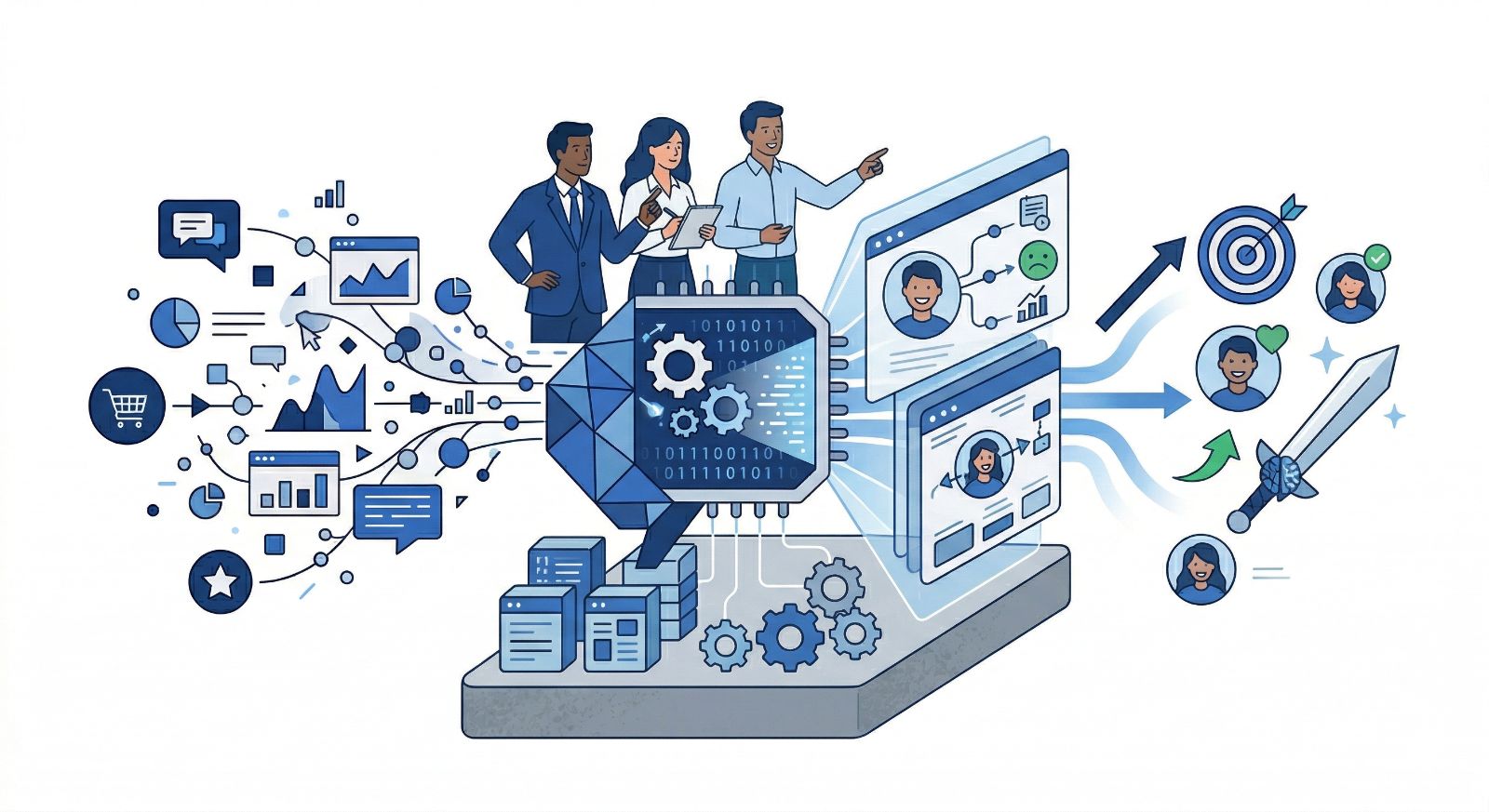
The gap between organizations that understand their customers and those that guess at them is widening in 2026 – because AI has made it possible to process the signals that were always present but never actionable at speed or scale.
The organizations compounding the fastest are not necessarily the ones with the most data or the most sophisticated models. They are the ones that connect intelligence to action the fastest – where a customer’s behavioral signal in the morning triggers a relevant, personalized interaction by afternoon, across whichever channel that customer is using at that moment.
That final connection – from insight to real-time conversation – is where ChatbotX fits. As an open-source omnichannel platform, it deploys AI Agents that act on the customer intelligence your data programs generate: detecting intent, personalizing responses, qualifying leads, and routing high-value conversations to human agents across WhatsApp, Messenger, Zalo, and WebChat from a single interface.
Plans start at $29 per month with a 7-day free trial – no credit card required.
Start turning your customer data into conversations that convert →