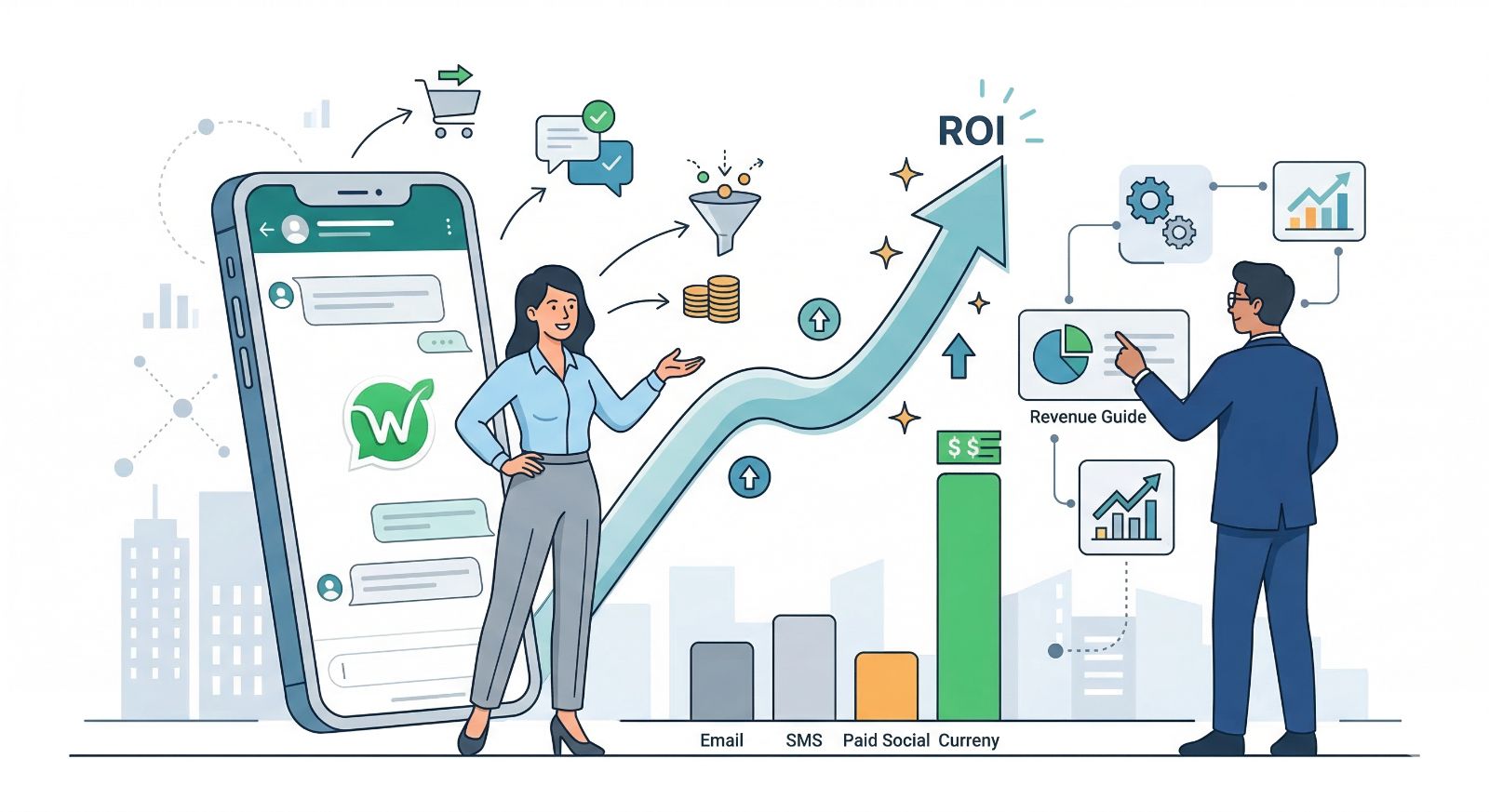
With over 3 billion monthly active users on WhatsApp, the platform has become one of the highest-ROI sales channels available – outperforming email, SMS and paid social on both engagement and conversion rates. For a detailed look at how to build the underlying channel infrastructure, see our WhatsApp chatbot guide.
The problem: most businesses cannot answer the one question that matters most – which conversations are actually generating revenue? This guide gives you the framework to answer it.
💡 Tracking KPIs manually across multiple campaigns is time-consuming. ChatbotX measures every metric in this guide automatically, at conversation level. See how it works →
Launch agentic chat marketing in minutes with ChatbotX














Why WhatsApp Business KPIs Matter in 2026
The Channel Has Outgrown Vanity Metrics
The first generation of WhatsApp Business measurement was straightforward: count opt-ins, count sends, count replies. In a high-growth SaaS environment where signal quality determines budget allocation, those metrics are no longer sufficient.
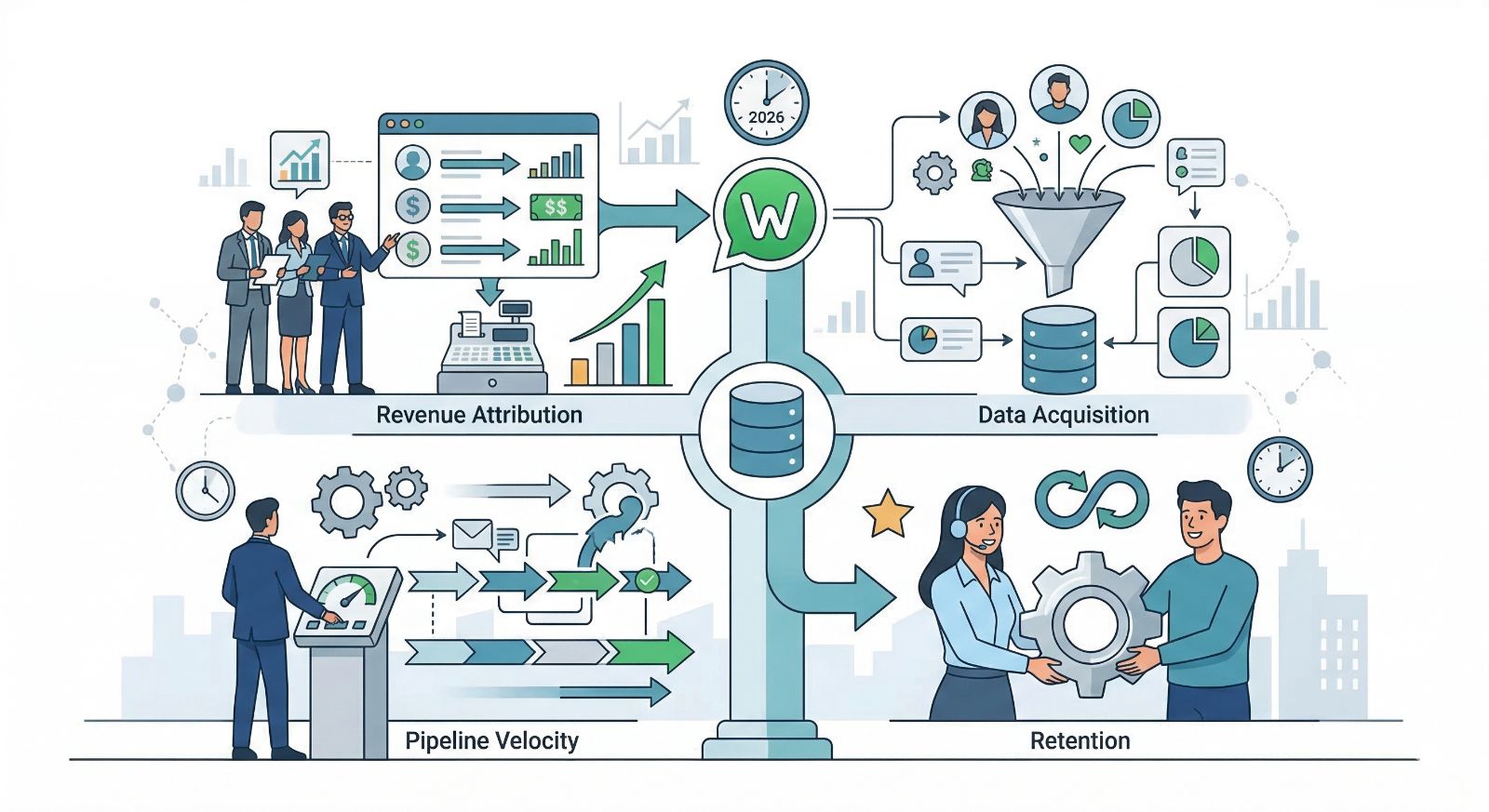
Sophisticated teams now track WhatsApp Business KPIs across four commercial dimensions:
- Revenue generation – Direct and assisted conversions attributable to WhatsApp conversations
- Data acquisition – Zero-party and first-party customer preference data captured at scale
- Pipeline velocity – Speed and conversion rate from first conversation to closed deal or activation
- Retention and expansion – WhatsApp-driven repeat purchase rates, upsell rates and CLV contribution
If your current WhatsApp Business KPI reporting stops at message volume or open rate, you are leaving significant budget optimisation and revenue attribution on the table.
Privacy Changes Make WhatsApp Business Data More Valuable
The deprecation of third-party cookies, Apple’s App Tracking Transparency (ATT) framework and Google’s Privacy Sandbox initiative have collectively degraded the quality and completeness of cross-site behavioural data. Customer acquisition costs (CAC) continue to rise while retargeting precision falls.
WhatsApp Business operates entirely outside this problem. Because customers initiate or explicitly consent to conversations, every data point collected is consent-based, first-party and brand-owned – independent of any ad platform. According to Salesforce’s State of the Connected Customer report, 88% of customers say the experience a company provides is as important as its products – and first-party conversation data is the foundation for delivering that experience at scale.
AI Agents Change the Attribution Challenge
WhatsApp Business AI agents now handle lead qualification, onboarding guidance, feature Q&A, renewal conversations and expansion upsells at scale. This creates a measurement challenge unique to technology companies: how much incremental ARR or revenue is generated by AI-driven WhatsApp conversations versus human CSMs, AEs or support agents?
Answering that question requires instrumenting every WhatsApp Business conversation with revenue attribution, and tracking Messaging ROAS per Chat (KPI 2) and Conversation-to-Conversion Rate (KPI 5) at the conversation level – not just at the campaign or channel level.
WhatsApp Business vs Email vs In-App Messaging: Performance Comparison
| Channel | Typical Open Rate | Typical CTR | Primary Commercial Strength |
|---|---|---|---|
| 15–25% | 1–3% | Nurture sequences, formal communications | |
| In-app messaging | 30–50% | 5–12% | Product adoption, in-context guidance |
| SMS | 90%+ | 2–5% | Time-sensitive alerts, OTPs |
| WhatsApp Business | 80–98% | 15–60% (incl. buttons/Flows) | High-intent sales conversations, rich interactions |
Benchmark ranges sourced from Mailchimp email benchmarks and Meta Business messaging performance data.
SaaS-specific insight: Use email for structured nurture and product updates. Use in-app messaging for adoption guidance. Use WhatsApp Business for high-intent sales conversations, renewal negotiations and complex support escalations – the moments where conversion and revenue are at stake.
Building Your WhatsApp Business Measurement Framework
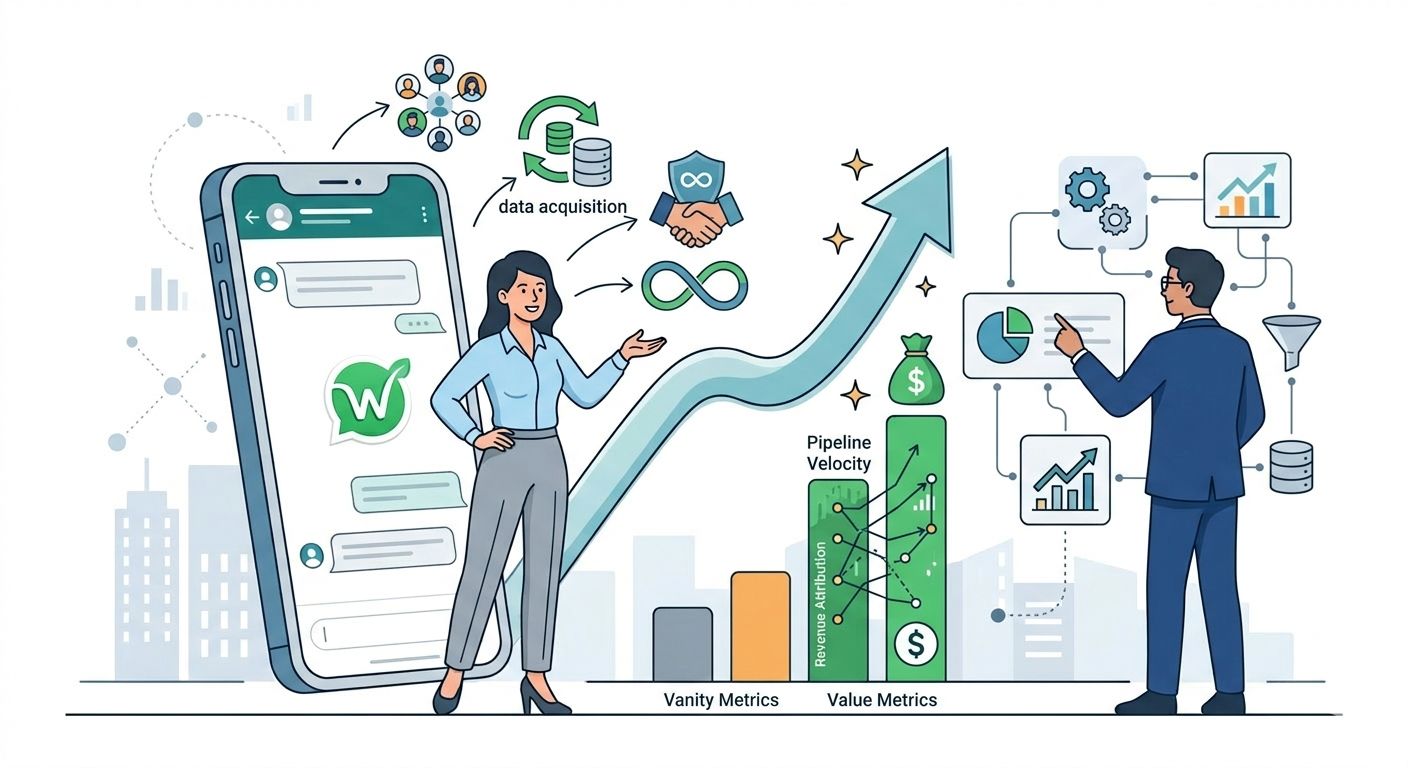
Tracking individual WhatsApp Business KPIs without an underlying measurement architecture produces isolated numbers that cannot drive allocation or optimisation decisions. Build the framework first.
Step 1: Map WhatsApp Business Objectives to Funnel Stage
Every WhatsApp Business initiative should map explicitly to a funnel-stage objective before any KPI is assigned:
- Acquisition and pipeline – Generate qualified conversations from Click-to-WhatsApp ads, outbound sequences or product-led growth (PLG) touchpoints. Key metrics: new conversation rate, lead qualification rate, MQL-to-SQL conversion from WhatsApp.
- Activation and conversion – Move prospects from intent to trial, demo booking or first purchase. Key metrics: conversation-to-conversion rate, revenue per conversation, payment link conversion rate.
- Retention and expansion – Drive renewals, upsells and cross-sells. Key metrics: WhatsApp-assisted renewal rate, NRR contribution from WhatsApp conversations, reactivation rate.
- Data and intelligence – Build enriched customer profiles to improve segmentation and personalisation across all channels. Key metrics: zero-party data acquisition rate, profile completeness score, tag coverage rate.
Step 2: Define Events and Data Sources
| Data Source | Key Events to Track |
|---|---|
| WhatsApp Business Platform / API | Session start/end, messages sent/received, button taps, Flow step completions, opt-ins/outs |
| CRM (Salesforce, HubSpot, etc.) | Lead stage changes, opportunity creation, deal closes, account attributes, lifecycle stage |
| Product / billing system | Trial starts, activations, subscriptions, renewals, upgrades, churns |
| CDP (Segment, mParticle, etc.) | Unified customer identity, zero-party attributes, cross-channel event stitching |
| BI / analytics layer | Revenue attribution, cohort performance, ROAS dashboards, A/B test results |
Map the complete journey: CTWA ad click → WhatsApp session → AI qualification → Demo booked → CRM opportunity created → Deal closed → CRM update + revenue attribution.
Step 3: Conversation-Level Tracking IDs
Every WhatsApp Business KPI depends on reliably tying revenue to conversations. Implement these four tracking elements before any campaign goes live:
- Conversation ID – Unique identifier for each WhatsApp session, passed alongside all downstream CRM events and order records.
- Customer / Account ID – Your CRM primary key, linked to the customer’s WhatsApp number, email address and product user ID.
- UTM parameters – Applied to all links shared via WhatsApp (demo booking pages, pricing pages, checkout flows) for web-side attribution.
- Source markers – Distinguish conversation origins: CTWA paid ad, QR code, product in-app prompt, outbound sequence, organic website widget.
Step 4: The WhatsApp Business Tech Stack for KPI Tracking
| Layer | Purpose | Example Tools |
|---|---|---|
| WhatsApp Business API | Message delivery, session management, event webhooks | Meta Cloud API, BSP provider |
| Conversation platform | AI agents, automation flows, human handoff, analytics | ChatbotX, Intercom, Respond.io |
| CRM | Lead and opportunity management, revenue attribution | Salesforce, HubSpot |
| CDP | Unified customer profiles, zero-party data storage, identity resolution | Segment, mParticle, Twilio Engage |
| BI / dashboarding | KPI dashboards, cohort analysis, ROAS reporting | Looker, Power BI, Tableau, Metabase |
| Experimentation | A/B testing for messages, flows and offers | LaunchDarkly, Optimizely, internal tooling |
For a broader look at how to select the right WhatsApp platform for your business, see our WhatsApp Business Solution Provider comparison guide.
Step 5: Align the 5 WhatsApp Business KPIs to Funnel Stages
| Funnel Stage | Primary WhatsApp Business KPI | Key Supporting Metrics |
|---|---|---|
| Data & Intelligence | KPI 1: Zero-Party Data Acquisition Rate | Tag coverage rate, profile completeness, opt-in rate |
| Acquisition & Ad Efficiency | KPI 2: Messaging ROAS per Chat | Cost per qualified conversation, revenue per chat |
| Field & Offline Revenue | KPI 3: OMO Revenue | Payment link conversion, field booking rate |
| Engagement & Content Fit | KPI 4: Interactive CTR | Flow completion rate, button tap depth per user |
| Revenue & Conversion | KPI 5: Conversation-to-Conversion Rate | Time-to-conversion, pipeline velocity, cart recovery % |
KPI 1 — Zero-Party Data Acquisition Rate
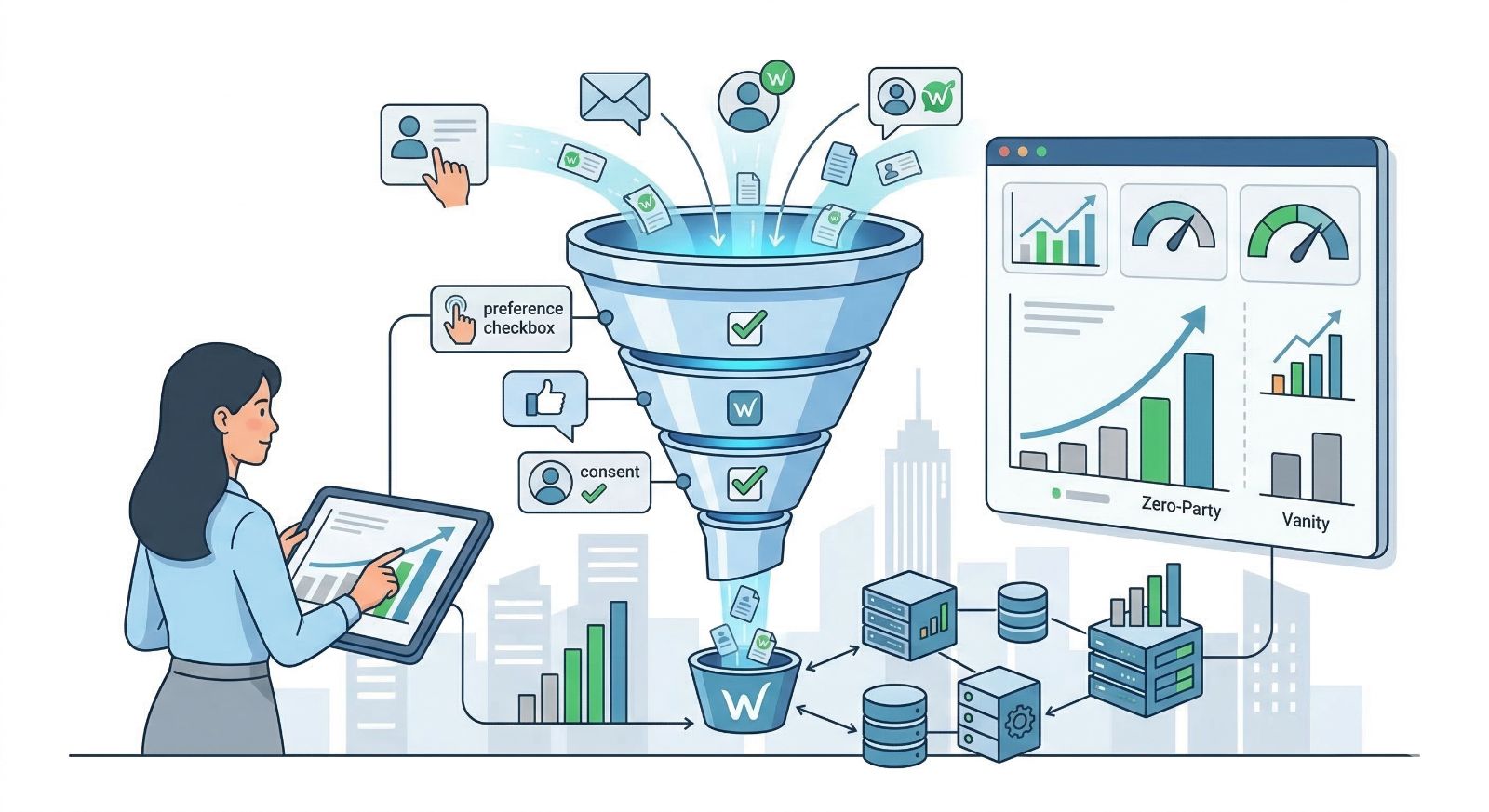
What Zero-Party Data Means for SaaS and Technology Teams
Zero-party data is information a customer deliberately and explicitly shares with your business – as distinct from behavioural data you observe passively on your own platforms (first-party) or purchase/infer from external sources (third-party).
In WhatsApp Business conversations, zero-party data includes:
- “We’re evaluating tools for a team of 200 across 3 countries.”
- “Our primary pain point is manual reporting – we spend 12 hours a week on it.”
- “We’re planning to decide by end of Q2.”
- Selecting “Enterprise > 500 seats” via a quick reply qualification step.
Understanding the data tier hierarchy helps frame why this is a critical WhatsApp Business KPI:
| Data Type | How Collected | SaaS Example | Accuracy |
|---|---|---|---|
| Zero-party | Explicitly shared by the customer | “We have a $50K annual software budget” | Very high |
| First-party | Observed on your own product or website | Pages visited, features used, trial actions | High |
| Third-party | Purchased or inferred from external sources | Firmographic estimates from data vendors | Medium to low |
SaaS competitive insight: Intent data from third-party providers (Bombora, G2, etc.) is valuable but shared across all your competitors. Zero-party data collected through WhatsApp Business conversations is owned exclusively by your brand. It is your unfair advantage in segmentation and personalisation.
Formula: Zero-Party Data Acquisition Rate
Zero-Party Data Acquisition Rate (%) =
(Contacts who provided ≥1 structured preference or intent attribute
÷ Total active WhatsApp Business contacts in the period) × 100
Worked example:
- 8,000 contacts had active WhatsApp Business conversations in Q1
- 3,200 answered at least one structured qualification or preference question
- Zero-Party Data Acquisition Rate = 40%
Track this WhatsApp Business KPI at three levels of granularity: by campaign type (structured quiz flow vs. open-ended broadcast), by entry point (CTWA ad vs. in-product QR vs. outbound sequence), and by AI flow versus human-led conversation.
Tactics to Increase Zero-Party Data Capture
Build qualification into the first interaction. Replace generic openers with a 2–3 step structured Flow: company size → primary use case → decision timeline. Each answer is stored as a CRM attribute (team_size=50-200, use_case=reporting, timeline=Q2), enriching the lead record before a human AE ever touches it.
Use value exchange to earn disclosure. B2B buyers share more when they receive something tangible: a personalised benchmark report, a tailored demo agenda pre-configured to their stated use case, or a shortlist of the three features most relevant to their expressed pain point. Lead with the value, then ask the question.
Apply progressive profiling across the lifecycle. Capture 1–2 high-signal attributes in early-funnel conversations (company size, primary pain point). Fill gaps in later-stage conversations (integration requirements, budget range, procurement process). Attempting to collect everything upfront causes drop-off.
Deploy AI to auto-tag intent from free-form messages. A well-configured AI agent detects intent signals without structured questions: “We’re currently using Salesforce but it’s too complex for our team” auto-tags current_tool=salesforce, pain=complexity, segment=smb. These signals enrich CRM records in real time, with no manual effort.
Benchmarks by Maturity Level
| Maturity Level | Zero-Party Data Acquisition Rate |
|---|---|
| Early stage (manual, ad-hoc flows) | 10–20% |
| Intermediate (structured flows, CRM sync) | 20–40% |
| Advanced (AI tagging, CDP integration) | 40–70%+ |
Diagnostic questions for SaaS teams: What percentage of your WhatsApp Business contacts have at least 3 meaningful CRM attributes from conversation data? Is that data actively used to personalise outbound sequences, demo experiences or renewal plays? How frequently does your RevOps or growth team review and evolve the zero-party data taxonomy?
KPI 2 — WhatsApp Business Messaging ROAS (Return on Ad Spend per Chat)
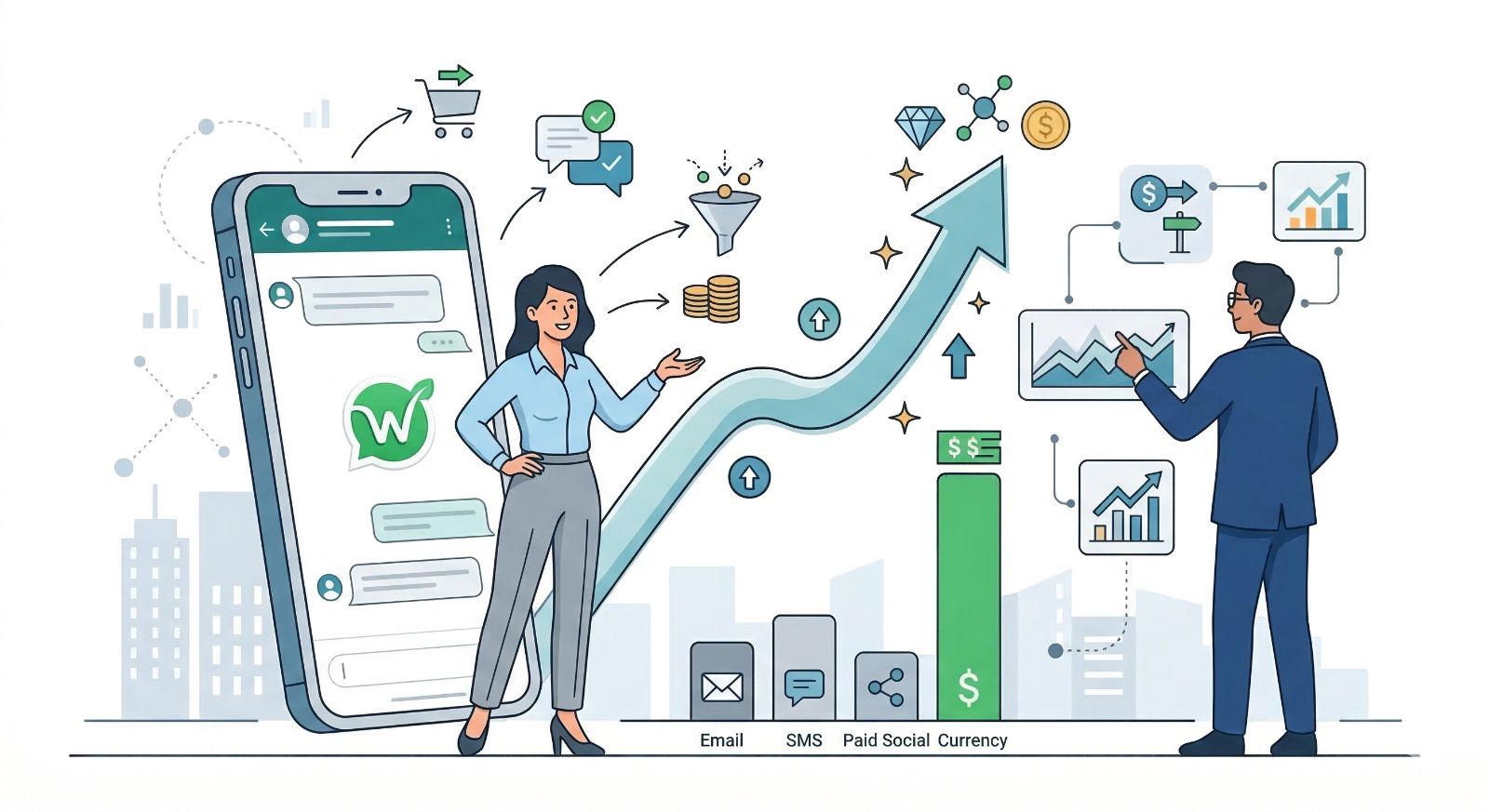
Why Blended ROAS Is Insufficient for WhatsApp Business
Channel-level or campaign-level ROAS blends together conversations with fundamentally different costs, intent signals and conversion behaviours. For WhatsApp Business KPI management in a SaaS context, you need ROAS at conversation level.
In 2026, your WhatsApp Business activity likely spans Click-to-WhatsApp (CTWA) acquisition campaigns from Meta, automated outbound sequences to trial users or churned accounts, and AI-powered inbound flows handling demo requests and renewal conversations. Each of these has a distinct cost structure and a distinct expected return. Blending them obscures where budget should grow and where it should be cut.
Formula: Messaging ROAS per Chat
Messaging ROAS per Chat =
Revenue attributed to WhatsApp Business conversations
÷ (CTWA ad spend + WhatsApp Business API / platform costs)
Supporting efficiency metrics:
- Cost per Qualified Conversation = (Ad Spend + Messaging Costs) ÷ Qualified conversations started
- Revenue per Conversation = WhatsApp-attributed revenue ÷ Total conversations started
- Pipeline per Conversation = WhatsApp-influenced pipeline ÷ Total conversations started (for longer B2B sales cycles)
SaaS note: For longer sales cycles, supplement revenue ROAS with a pipeline ROAS metric – WhatsApp-influenced pipeline value divided by total WhatsApp spend. This captures value before it closes, enabling faster optimisation decisions.
New Customer Acquisition vs Expansion: Why Segmentation Matters
| Segment | Description | Expected Return Profile |
|---|---|---|
| Net-new acquisition (CTWA) | First touch from paid WhatsApp ad campaign | Lower initial ROAS; builds ARR and CLV |
| Trial activation | Onboarding flows for recently signed-up users | Medium ROAS; drives time-to-value and retention |
| Renewal and expansion | WhatsApp-assisted renewal and upsell plays | High ROAS; fast payback with existing accounts |
| Win-back / reactivation | Churned or dormant account re-engagement | Variable; depends on churn reason and ICP fit |
Illustrative worked examples (USD):
- Scenario A – CTWA Acquisition Campaign: $8,000 ad spend + $800 messaging fees → 2,500 new conversations → 180 qualified leads → 22 new customers → $19,800 first-year ARR → ROAS ≈ 2.2× (lower now; compounds with CLV)
- Scenario B – Renewal & Expansion Sequence: $1,500 messaging fees only → 1,200 at-risk accounts → 310 renewals secured + 85 upsells → $64,500 retained/expanded ARR → ROAS = 43×
Never compare acquisition and retention ROAS directly. Evaluate each against its appropriate lifecycle benchmark.
Four Levers to Improve Messaging ROAS
1. Tighten CTWA audience quality. Build WhatsApp Business lookalike audiences from your highest-CLV or fastest time-to-value customer segments. Use zero-party firmographic data collected from prior conversations to create exclusion and inclusion lists that outperform generic interest targeting.
2. Qualify faster to reduce cost per qualified conversation. Integrate a 2-step AI qualification Flow at the top of every inbound conversation. Route clearly unqualified contacts to self-serve resources immediately. Reserve human SDR or CSM time for contacts that pass qualification criteria – reducing cost per qualified conversation without reducing pipeline volume.
3. Increase revenue per conversation with guided selling. Train AI agents to reference known CRM attributes when making recommendations. A contact tagged pain=manual_reporting should receive a feature demonstration tailored to reporting automation, not a generic product walkthrough. Contextual relevance consistently increases conversion rates and ACV.
4. Manage API and platform costs proactively. Group related outbound messages within a single 24-hour conversation window where Meta’s pricing model permits. See Meta’s WhatsApp Business pricing documentation for current per-conversation rates by market. For lower-intent informational requests (pricing page FAQ, integration lists), deflect to knowledge base links before opening a billable conversation session.
KPI 3 — WhatsApp Business OMO (Online-Merge-Offline) Revenue
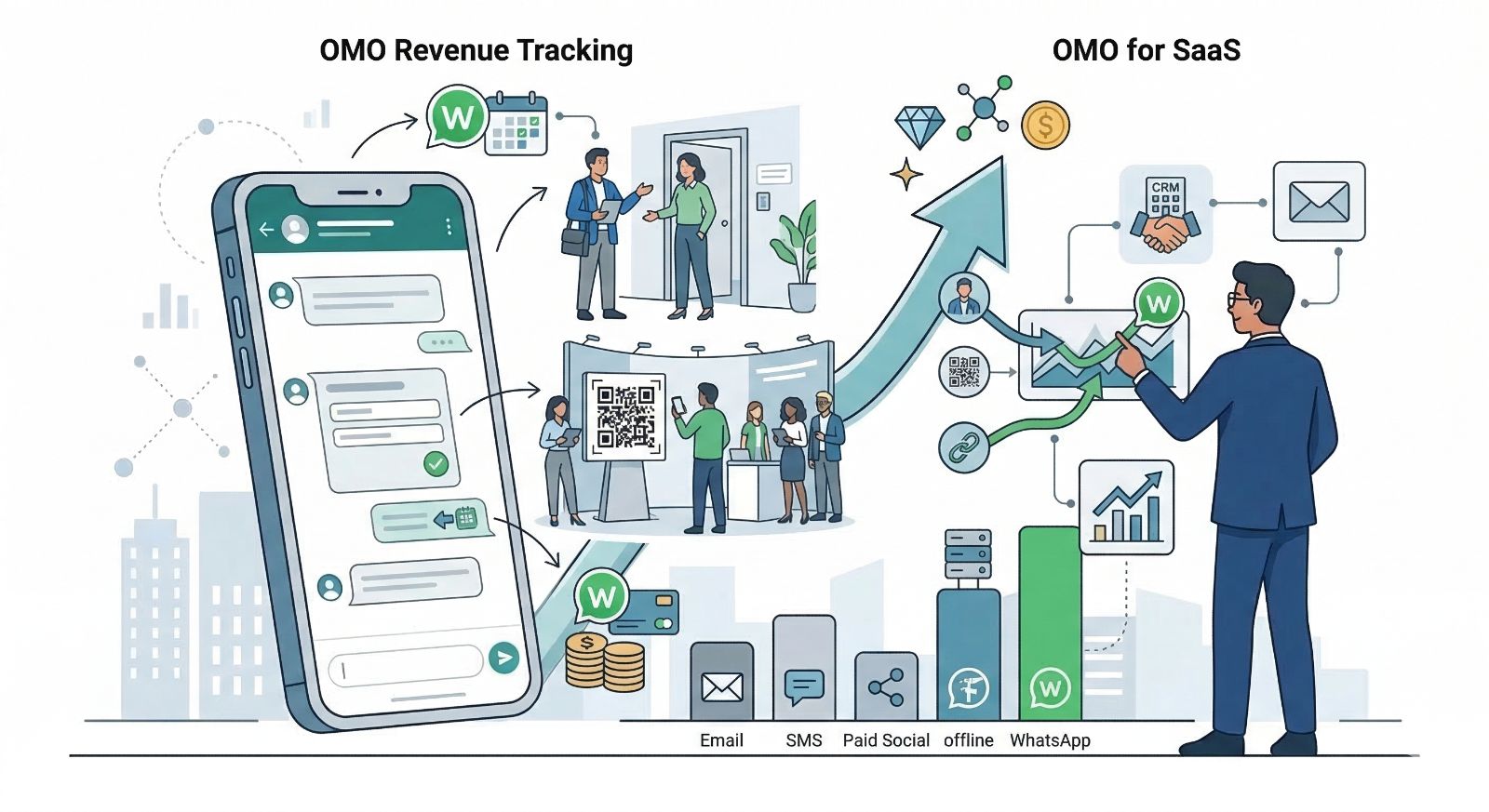
What OMO Means for SaaS and Technology Companies
OMO – Online-Merge-Offline – describes the integration of digital and physical customer touchpoints. For SaaS and technology companies, this WhatsApp Business KPI captures revenue that is influenced digitally via WhatsApp but closed or fulfilled through a human touchpoint: a field sales meeting, an in-person demo, an executive business review, or a conference booth conversation.
WhatsApp Business is uniquely effective as the bridge between digital intent and field-level closure:
- Field AEs and solutions engineers can conduct product conversations and share trackable demo links via WhatsApp
- Prospects receive personalised case study links or pricing summaries directly in the chat thread
- In-person events can drive WhatsApp opt-ins via QR code, converting booth conversations into attributable pipeline
OMO Key Metrics for Technology Teams
| Metric | Formula |
|---|---|
| Demo Booking Rate (WhatsApp) | Confirmed demos ÷ Relevant WhatsApp enquiries |
| Field Meeting Conversion Rate | Closed deals with WhatsApp touchpoint ÷ Field meetings held |
| Assisted Revenue per AE | Sum of closed revenue tagged to AE’s WhatsApp conversation ID |
| Event-to-Pipeline Rate | Pipeline created from QR opt-ins at events ÷ QR opt-ins captured |
Revenue Attribution Models for SaaS OMO
Conversation ID linking: Every WhatsApp Business conversation is assigned a unique ID. When an opportunity is created in Salesforce or HubSpot, the originating conversation ID is attached as a field. Revenue from that opportunity credits WhatsApp and the individual AE or CSM.
UTM-tagged asset links: All collateral shared via WhatsApp – case study PDFs, demo booking pages, pricing calculators – carries UTM parameters identifying the conversation source, campaign name and assigned team member.
Event QR attribution: Unique QR codes assigned to specific events, booth locations or individual team members allow post-event WhatsApp pipeline to be attributed at event, location and rep level.
Implementation tip for SaaS teams: Surface a personal WhatsApp conversion dashboard inside Salesforce or HubSpot for each AE and CSM. When field reps see a direct connection between WhatsApp activity and their quota attainment, adoption accelerates without requiring mandates.
Mini Case Study: Enterprise SaaS Field Sales – One Quarter {#case-study}
A mid-market SaaS company integrated WhatsApp Business into their field sales motion for one quarter, connecting inbound CTWA ads, event QR codes and a website widget into a unified conversation pipeline attributed at AE level.
Results:
- 1,800 inbound WhatsApp enquiries across all entry points
- 620 demo appointments booked via WhatsApp booking links → Demo Booking Rate: 34%
- 510 demos completed → Show-up Rate: 82%
- 94 deals closed, average ACV $12,400 → WhatsApp-influenced ARR: $1,165,600
- WhatsApp media and messaging costs for the quarter: $22,000 → OMO ROAS: 53×
Key lesson: The highest adoption barrier was not technical – it was convincing AEs to use WhatsApp as a primary prospecting channel. Once per-rep attribution dashboards went live in HubSpot, showing each AE’s closed ARR linked to WhatsApp activity, voluntary adoption reached 100% within three weeks.
Note: Figures represent results from a single deployment. Results vary by ICP, ACV and implementation quality.
OMO Use Cases Across SaaS Segments
PLG / Bottom-up SaaS: WhatsApp Business follows up with power users who have hit feature limits, sharing upgrade comparison flows and payment links. Expansion revenue is attributed to the WhatsApp conversation that triggered the upgrade decision.
Field sales / enterprise SaaS: AEs use WhatsApp Business to share exec-level briefing documents, coordinate multi-stakeholder evaluation timelines and confirm QBR agendas – with all activity tracked back to pipeline and closed ARR.
Partner and channel SaaS: Channel managers use WhatsApp Business to support partner reps in real time, sharing co-sell collateral, deal registration confirmations and SPIFFs via a trackable conversational thread.
KPI 4 — Interactive Click-Through Rate
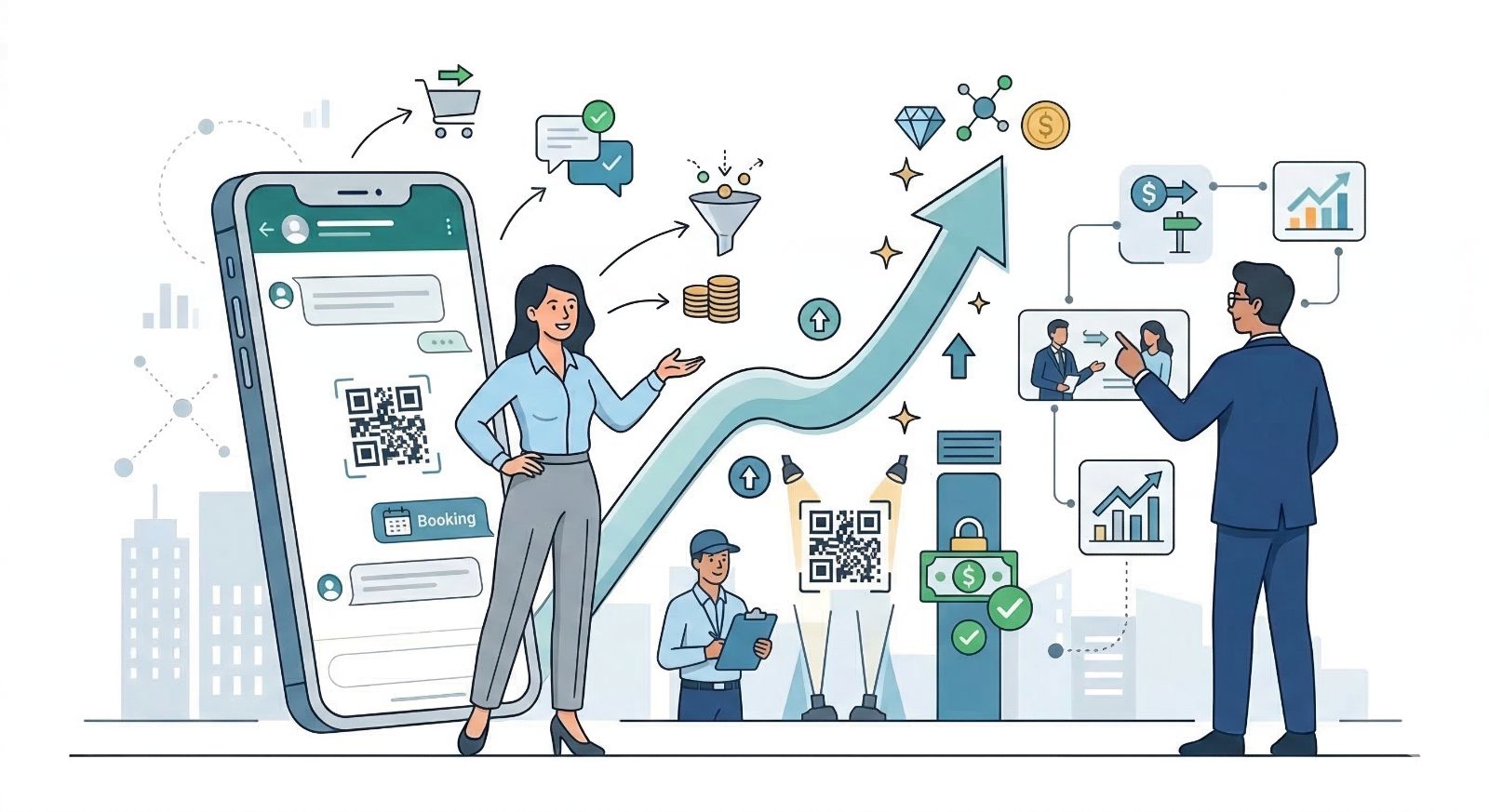
Why Standard CTR Understates WhatsApp Business Engagement
Traditional email or ad CTR measures link clicks. In WhatsApp Business, that definition misses the majority of meaningful engagement – and in a SaaS context, engagement quality is a direct proxy for pipeline quality.
Interactive CTR – the WhatsApp Business KPI that captures total meaningful interactions – encompasses taps on Quick Reply qualification buttons, clicks on Call-to-Action buttons (“Book Demo”, “Start Trial”, “See Pricing”), steps completed within WhatsApp Flows, and clicks on in-chat product cards or feature comparison carousels.
High Interactive CTR signals that your message content, segmentation and offer are aligned with customer intent. In a SaaS funnel, high Interactive CTR on a qualification Flow directly predicts MQL volume and pipeline creation rate. HubSpot’s research on messaging engagement confirms that personalised, trigger-based messaging outperforms broadcast campaigns by 2–4× on click-through and conversion metrics.
Formula: Interactive CTR
Depth metrics to track alongside Interactive CTR:
- Average interactions per engaged contact per session
- Flow completion rate (e.g. percentage completing all 4 steps of a qualification Flow)
- Drop-off rate at each specific Flow step (identify the friction point in your qualification or demo scheduling sequence)
Interactive CTR Benchmarks for SaaS Campaigns
| Campaign Type | Interactive CTR Range |
|---|---|
| Cold CTWA campaign to broad ICP audience | 10–25% |
| Segmented campaign using CRM or CDP attributes | 25–45% |
| Personalised Flow using zero-party intent data | 40–70%+ |
| Triggered behavioural message (trial expiry, etc.) | 50–80%+ |
If your WhatsApp Business Interactive CTR is comparable to your email newsletter click rate, you are significantly underutilising the channel’s interactivity and personalisation capabilities.
Five Tactics to Improve Interactive CTR for SaaS
1. Make CTAs specific to the customer’s stage and job-to-be-done. Avoid generic prompts like “Learn more.” Instead, write CTAs that reflect the exact outcome the contact achieves by tapping: “See how [Company] reduced reporting time by 70%”, “Check your trial usage and unlock advanced features”, “Book a 20-minute migration consultation.” Specificity reduces perceived friction and increases tap rate.
2. Use buttons to replace open-ended questions. A qualification question like “What’s your primary use case?” generates low response rates in free-text format. Converted to Quick Reply buttons – Reporting, Automation, Analytics, Integrations – it generates 3–5× more structured responses and a cleaner data pipeline into your CRM.
3. Personalise using CRM and CDP attributes. Reference known data in the message: “Hi [First Name] – based on your trial activity, you’ve been most active in the reporting module. Want to see what Pro plan unlocks for your team?” Messages that demonstrate contextual awareness consistently outperform generic broadcasts by 2–4× on Interactive CTR.
4. Time messages to behavioural triggers, not just calendar schedules. Triggered WhatsApp Business messages – trial day 7, feature limit reached, login inactivity after day 14, upcoming renewal – achieve materially higher Interactive CTR than scheduled broadcast campaigns because they arrive at a moment of genuine relevance.
5. Test message format before scaling spend. Before increasing CTWA budget, run a structured A/B test: copy variant (outcome-focused vs. product-feature-focused), CTA format (button vs. text link), and audience segment (broad ICP vs. intent-signal filtered). Measure Interactive CTR and downstream Flow completion rate. Scale only the winning variant.
A/B Testing Framework for Interactive CTR
| Test Type | Variant A | Variant B | Primary Metric |
|---|---|---|---|
| CTA copy | “See pricing plans” | “Find the right plan for a team of [size]” | Button tap rate |
| Message format | Text only with CTA link | Image + Quick Reply buttons + CTA | Interactive CTR |
| Personalisation | Generic ICP message | Message personalised with CRM attributes | Flow completion rate |
| Send trigger | Scheduled weekly broadcast | Triggered by in-product behavioural event | Interactive CTR + CVR |
KPI 5 — Conversation-to-Conversion Rate
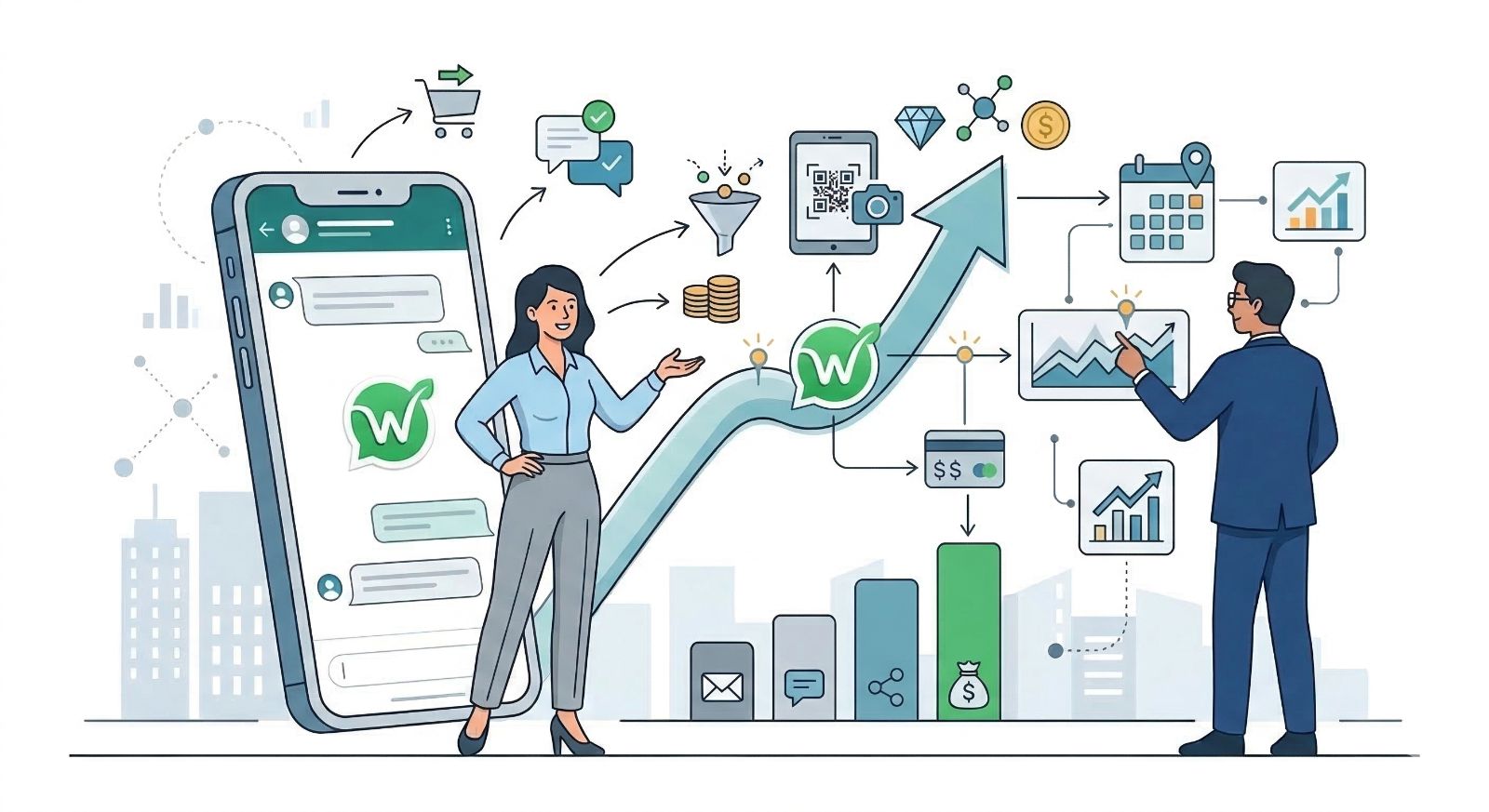
The Revenue-Closing WhatsApp Business KPI
When a prospect or customer enters a WhatsApp Business conversation, your team has earned a moment of focused attention. The defining question for this WhatsApp Business KPI is:
Of every 100 WhatsApp Business conversations, how many result in the commercial outcome you defined?
For SaaS and technology companies, “conversion” is more nuanced than a single transaction. Define it precisely for each conversation type before you track it.
Defining Conversion by SaaS Use Case
| Use Case | Conversion Definition |
|---|---|
| Trial acquisition | Free trial sign-up completed within the conversation window |
| Demo booking | Confirmed calendar booking with a qualified prospect |
| Trial-to-paid conversion | Subscription activated within 30 days of conversation |
| Renewal | Contract renewed before or at expiry date |
| Upsell / expansion | Higher-tier plan or additional seat purchase confirmed |
| Reactivation | Churned account reactivated within 90 days of re-engagement flow |
Formula: Conversation-to-Conversion Rate
Conversation-to-Conversion Rate (%) =
(Conversations that resulted in a defined conversion
÷ Total conversations in the period) × 100
Segment this WhatsApp Business KPI by entry point (CTWA ad, QR code, in-product prompt, outbound sequence), agent type (AI-only, human AE, AI+human hybrid), and conversion type (trial start, demo booked, renewal secured).
The WhatsApp Business Conversion Funnel
Every WhatsApp Business conversation follows a five-stage mini-funnel. Tracking drop-off at each stage is essential for improving this KPI:
- Conversation Started – Contact initiates chat or responds to an outbound message
- Engaged – Contact replies, taps a button or completes a Flow step
- Qualified Intent Confirmed – Contact passes qualification criteria or self-selects into a relevant Flow branch
- Conversion Action Taken – Contact completes trial sign-up, books demo, accepts renewal offer, confirms upgrade
- Post-Conversion Activated – Contact completes onboarding step, attends booked meeting, activates paid plan
Measure the drop-off percentage at each transition. The stage with the highest drop-off rate is where to invest optimisation effort first.
Common Drop-Off Points in SaaS WhatsApp Flows and How to Fix Them
Qualification friction at step 2–3. Symptom: contacts engage with the first message but abandon when qualification questions become specific (company size, budget, tech stack). Fix: reorder the qualification sequence to build trust first – lead with a high-value offer or piece of insight before asking qualifying questions.
Demo scheduling friction. Symptom: contacts express demo interest but abandon the scheduling step. Fix: embed a real-time calendar availability selector inside a WhatsApp Flow (no redirect to external booking page). Pre-fill name and email from the conversation context to reduce manual entry.
Price or plan complexity at conversion. Symptom: contacts reach the pricing conversation but go quiet. Fix: rather than presenting a full pricing page, use a guided WhatsApp Flow that asks 2 questions (team size + primary use case) and surfaces only the single most relevant plan tier.
AI handoff failures at complex objections. Symptom: AI handles top-of-funnel qualification well but conversion rate drops sharply when prospects raise security, compliance or integration objections. Fix: configure intent-based escalation triggers that detect these topic signals and route to a human solutions engineer or AE within 2 minutes, with full conversation context passed into the handoff. Gartner’s research on AI in customer service shows that hybrid AI+human models outperform fully automated flows on conversion rate for high-complexity, high-ACV deals.
Measurement best practice: Track Conversation-to-Conversion Rate separately for AI-only, human-only and AI+human hybrid interactions. For most SaaS teams, the highest-performing model is AI handling 70–85% of interactions – particularly qualification, scheduling and FAQ – with seamless human escalation reserved for commercial objection handling and enterprise deal-closing.
Automation Playbooks to Improve Conversion Rate
Trial activation sequence:
- Day 1 (T+2 hours post-signup): Welcome Flow with 3 personalised first-action recommendations based on stated use case
- Day 3: Check-in message with quick-reply “Are you getting value?” + offer to book a 15-minute guidance call
- Day 7: Feature-spotlight message tailored to stated pain point + one-tap upgrade CTA for contacts who have hit usage triggers
- Day 14 (trial expiry –3 days): Conversion offer with time-limited incentive for contacts who have not yet upgraded
Renewal at-risk intervention:
- 90 days pre-renewal: Health check message referencing usage metrics (“Your team has saved X hours this quarter”)
- 60 days pre-renewal: Check for expansion triggers – headcount growth, new use cases
- 30 days pre-renewal: Renewal confirmation Flow with one-tap acceptance for standard renewals
- 14 days pre-renewal: Escalation to human CSM for accounts flagged as at-risk
Post-demo follow-up:
- T+1 hour: Personalised WhatsApp summary referencing the specific use cases discussed in the demo
- T+48 hours: Social proof message with a customer story relevant to the prospect’s industry and use case
- T+5 days: Gentle next-step prompt with two options – “Ready to start a trial” / “Have more questions”
Conversation-to-Conversion Rate Benchmarks for SaaS
| Use Case | Conversation-to-Conversion Rate |
|---|---|
| Cold CTWA → trial sign-up | 3–10% |
| Warm inbound → demo booked | 15–35% |
| Trial-to-paid conversion (Day 14) | 10–25% |
| Renewal confirmation (low-risk account) | 50–80%+ |
| Reactivation of churned accounts | 8–18% |
Focus on improving each use case against its own baseline rather than cross-use-case comparisons. Prioritise use cases with the highest ACV and the highest volume first.
Troubleshooting Matrix
| Symptom | Most Likely Cause | Recommended Action |
|---|---|---|
| High Interactive CTR but low demo bookings | Scheduling friction or weak demo value proposition | Embed in-Flow calendar scheduling; rewrite demo CTA around outcomes |
| High demo booking rate but low trial conversion | Demo-to-trial handoff gap; no immediate next step | Trigger trial sign-up Flow within 1 hour of demo completion |
| Good conversion during business hours only | AI cannot handle evening enquiries; no async follow-up | Deploy AI agent with human callback scheduling for out-of-hours |
| Strong AI qualification but low close rate | AI unable to handle pricing/security/compliance objections | Improve escalation logic; reduce handoff delay below 2 minutes |
| High Flow completion but low final conversion | Offer or plan recommendation not matching stated need | Audit Flow branching logic; improve plan recommendation personalisation |
WhatsApp Business KPI Dashboard & Governance
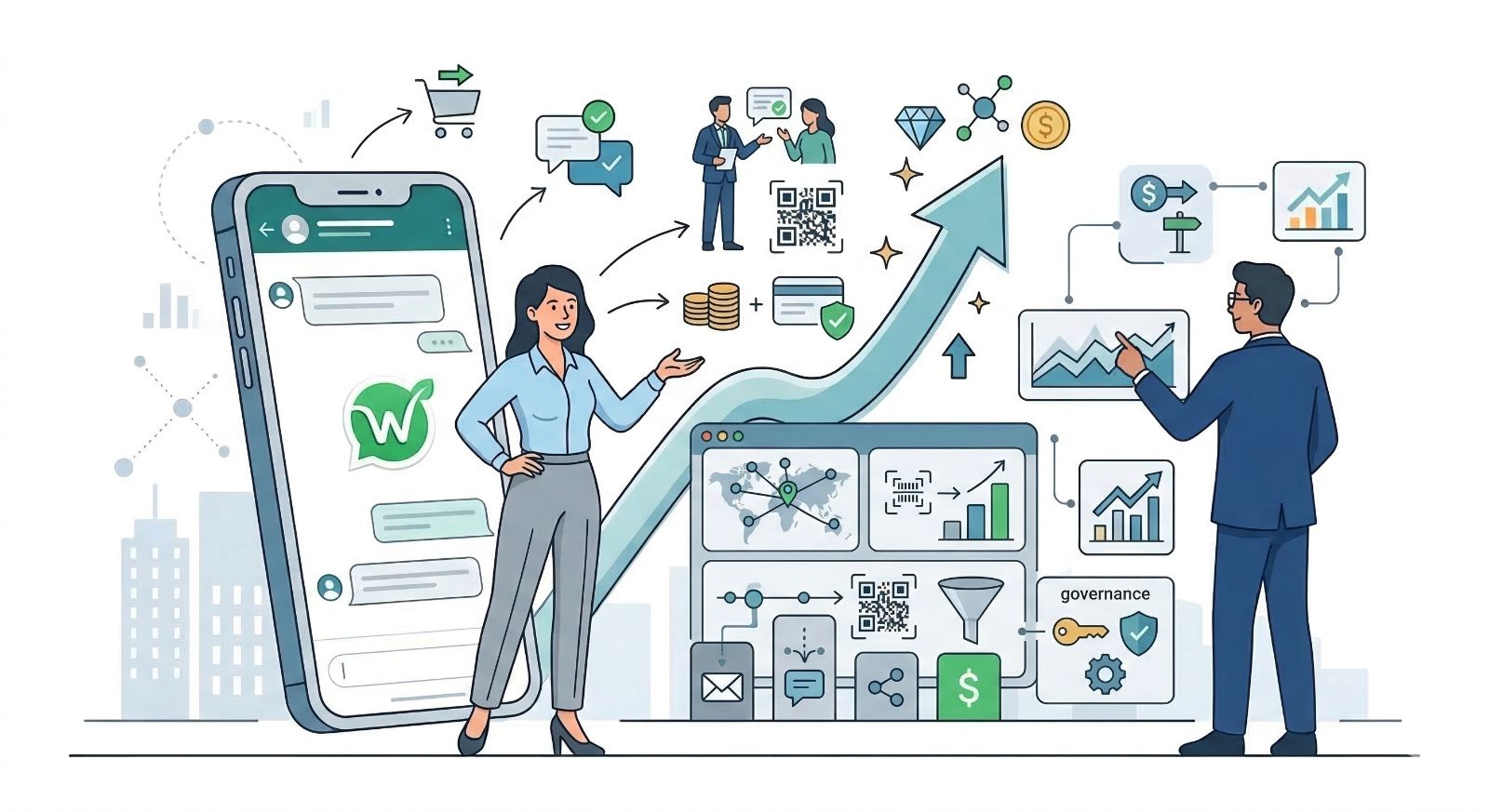
The Five-Section WhatsApp Business KPI Dashboard
Managing WhatsApp Business as a performance channel in a SaaS environment requires a single-view dashboard that connects messaging activity to pipeline, revenue and customer health data. Structure it across five sections:
Section 1 – Revenue and Pipeline (rolling 7 / 30 days): WhatsApp-attributed new ARR and expansion ARR, Messaging ROAS per Chat by campaign type, pipeline influenced by WhatsApp conversations (in-stage and closed-won).
Section 2 – Data and Segmentation Health: Zero-Party Data Acquisition Rate, average CRM attributes per active WhatsApp contact, month-over-month growth of opted-in WhatsApp subscriber base, percentage of contacts with ≥3 meaningful tags.
Section 3 – Engagement and Funnel: Interactive CTR by campaign and segment, Flow completion rate by step, drop-off heatmap across the 5-stage conversion funnel.
Section 4 – OMO and Field Revenue: Demo booking rate from WhatsApp, field meeting confirmation rate, WhatsApp-assisted closed ARR by AE and region, event QR pipeline attribution.
Section 5 – Platform and Operational Health: Average first response time (AI vs. human), AI-to-human escalation rate, opt-out rate trend (week-over-week), post-conversation CSAT where collected.
ChatbotX’s platform features include native dashboards for all five sections above, exportable to your BI stack via webhook or API integration.
KPI Ownership and Review Cadence
| WhatsApp Business KPI | Primary Owner | Review Cadence |
|---|---|---|
| Zero-Party Data Acquisition Rate | RevOps / Growth | Monthly |
| Messaging ROAS per Chat | Demand generation / Paid | Weekly |
| OMO Revenue (field-influenced) | Field Sales / Partnerships | Monthly |
| Interactive CTR | Growth / Lifecycle marketing | Weekly |
| Conversation-to-Conversion Rate | Sales / CS / Product-led | Weekly |
Include WhatsApp Business KPIs as a standing agenda item in weekly GTM syncs and monthly revenue reviews, evaluated alongside web, email, in-product and paid channel metrics.
Monthly Performance Review Agenda
- Revenue contribution – Total WhatsApp Business-attributed ARR, ROAS, percentage of total pipeline influenced by WhatsApp
- What improved – Campaigns or Flows that exceeded KPI targets; experiments with statistically significant positive results
- What underperformed – Flows with high drop-off; campaigns with ROAS below threshold; entry points generating unqualified conversations
- Root cause analysis – Segmentation quality, AI agent behaviour, offer or pricing presentation, handoff timing
- Prioritised action plan – 3–5 specific hypotheses with defined success criteria and owner for the next 30 days
Summary: The 5 WhatsApp Business KPIs at a Glance
| # | WhatsApp Business KPI | Core Business Question | Formula |
|---|---|---|---|
| 1 | Zero-Party Data Acquisition Rate | How effectively are conversations building our first-party customer data asset? | Contacts with new intent attributes ÷ Active contacts |
| 2 | Messaging ROAS per Chat | What revenue do we generate per dollar of WhatsApp media and platform spend? | WA-attributed revenue ÷ (Ad spend + Messaging costs) |
| 3 | OMO Revenue | How much field and offline revenue is WhatsApp Business directly influencing? | Revenue from WA-sourced links, bookings, event QR attribution |
| 4 | Interactive CTR | Are our messages and Flows aligned with what our ICP actually wants to do? | Interactive users ÷ Total message recipients |
| 5 | Conversation-to-Conversion Rate | How effectively are we converting WhatsApp attention into pipeline and revenue? | Conversions ÷ Total conversations in the period |
Conclusion: The WhatsApp Business KPIs That Will Define GTM Performance in 2026
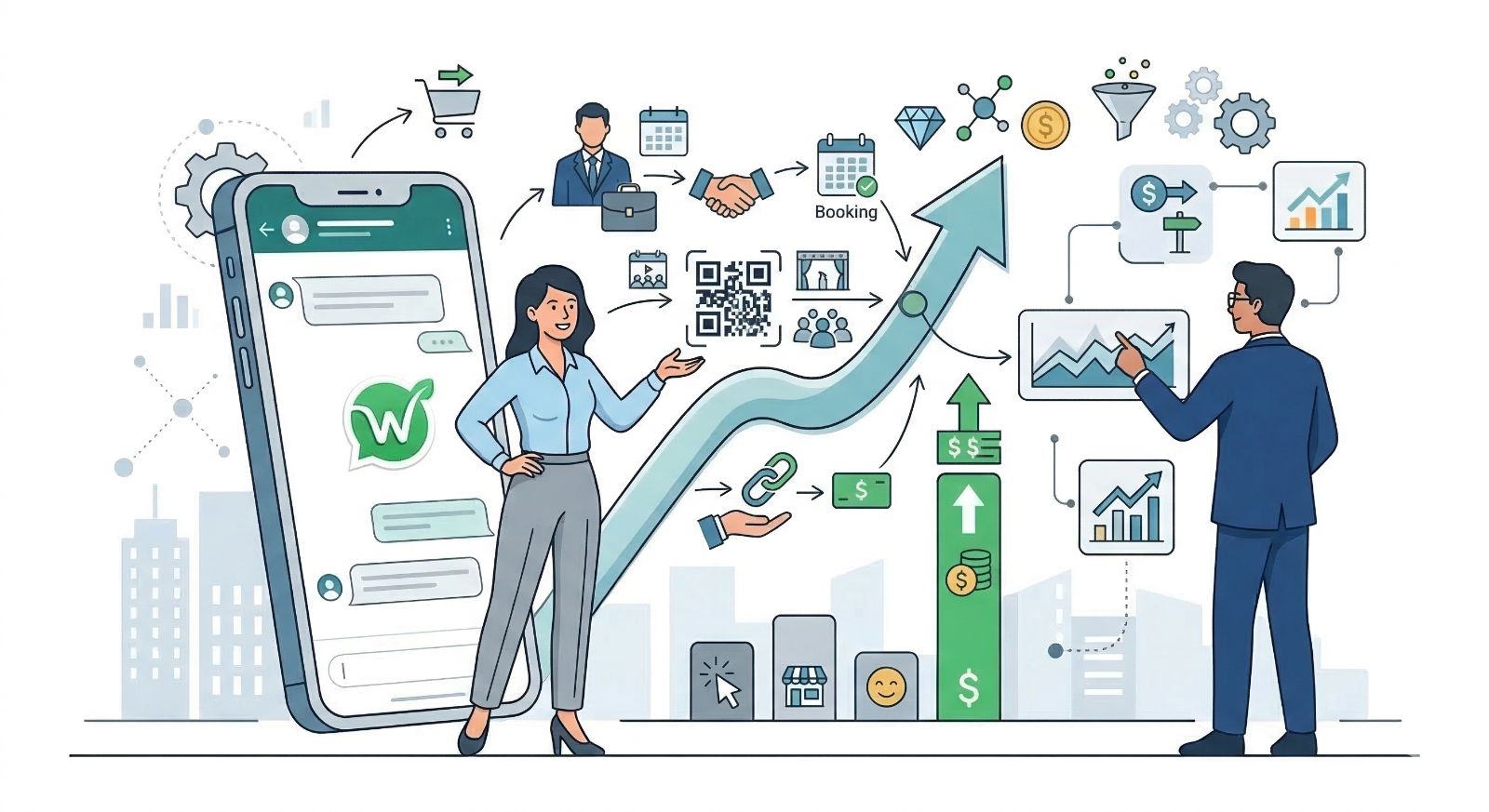
In 2026, WhatsApp Business performance for SaaS and technology companies is not determined by the volume of messages sent or the size of the opt-in list. It is determined by how intelligently each conversation is used to move the commercial needle.
The five WhatsApp Business KPIs in this guide operate as an interconnected system. Zero-Party Data Acquisition Rate ensures every interaction enriches your CRM with high-signal intent data that improves every downstream campaign. Messaging ROAS per Chat holds the channel accountable to the same financial standards as paid search and paid social. OMO Revenue quantifies WhatsApp’s contribution to field sales and physical business outcomes. Interactive CTR tells you whether your content and flows are genuinely aligned with ICP intent at each funnel stage. And Conversation-to-Conversion Rate is the bottom-line measure of whether your AI agents, human reps and automated sequences are actually closing business.
SaaS and technology companies that win the conversational commerce era will build WhatsApp Business into the core of their GTM infrastructure – with AI agents, structured data capture, conversation-level attribution and a governance model that continuously optimises these five KPIs.
If your WhatsApp Business reporting today consists of message delivery rates and subscriber counts, you are measuring outputs rather than outcomes – and missing the evidence needed to scale the channel confidently. The measurement foundation described in this guide is not complex to build, but it does require deliberate architecture decisions made before campaigns go live.
Start with KPI 5 (Conversation-to-Conversion Rate) to establish your baseline. Add KPI 2 (Messaging ROAS per Chat) to connect spend to revenue. Then build KPI 1 (Zero-Party Data Acquisition Rate) to ensure the data you need for sustained personalisation is accumulating with every conversation.
📖 Related guides: WhatsApp Chatbot features · Omnichannel Chatbot Strategy 2026 · CRM and Social Media Integration Guide
Frequently Asked Questions
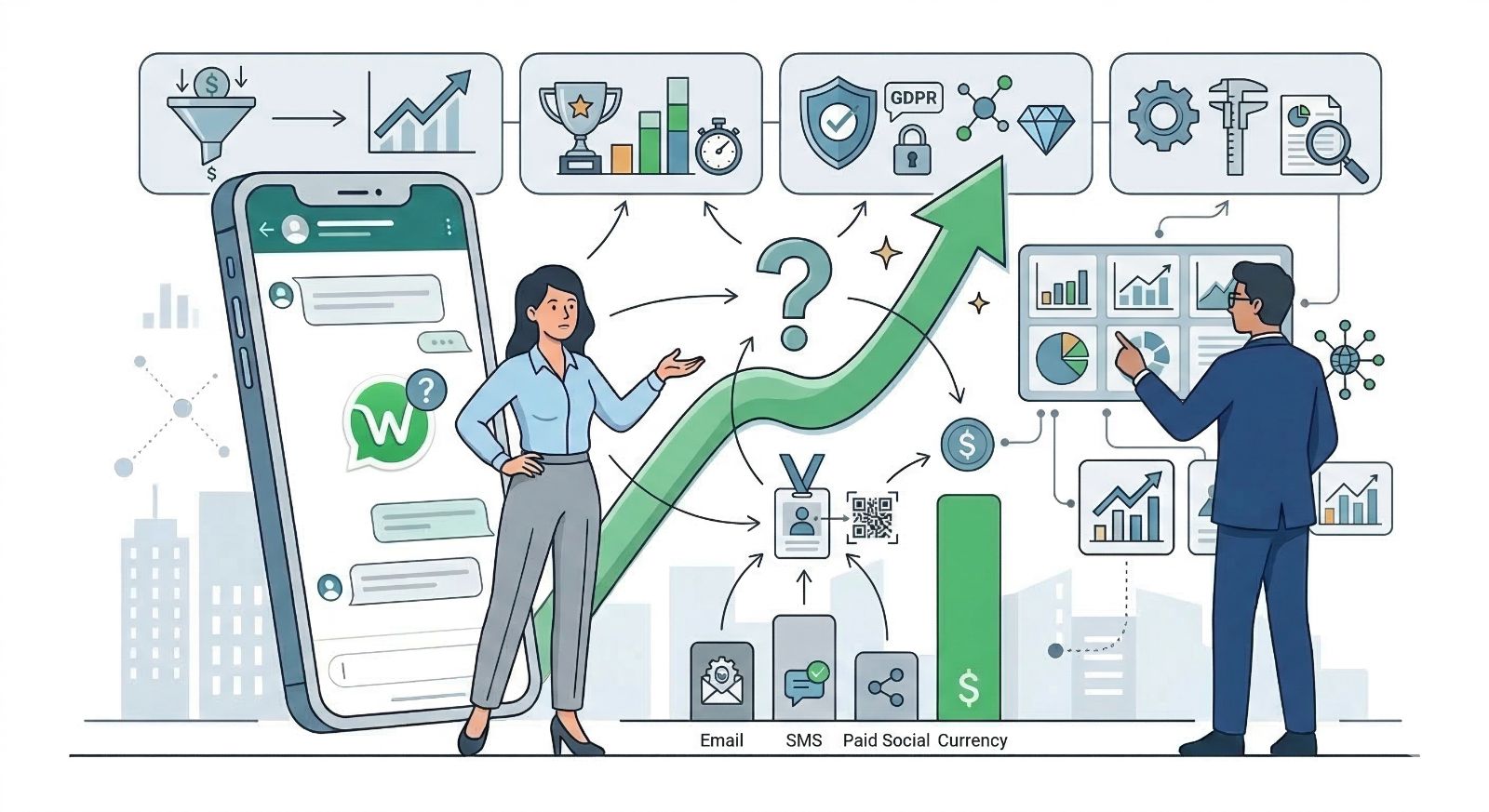
What are WhatsApp Business KPIs?
WhatsApp Business KPIs are the key performance indicators used to measure the commercial effectiveness of WhatsApp Business as a marketing, sales and customer success channel. Unlike vanity metrics such as message volume or subscriber count, meaningful WhatsApp Business KPIs tie conversation activity directly to revenue, pipeline, customer data quality and ROI. The five most important WhatsApp Business KPIs in 2026 are Zero-Party Data Acquisition Rate, Messaging ROAS per Chat, OMO Revenue, Interactive CTR and Conversation-to-Conversion Rate.
Which WhatsApp Business KPI should SaaS teams prioritise first?
For most SaaS teams starting their WhatsApp Business measurement journey, Conversation-to-Conversion Rate is the highest-priority KPI because it directly measures commercial output and is typically the fastest to improve with targeted flow optimisation. Once a baseline is established, add Messaging ROAS per Chat to connect WhatsApp spend to revenue attribution, then build toward Zero-Party Data Acquisition Rate to fuel long-term personalisation and segmentation improvements.
How do I attribute ARR or revenue to WhatsApp Business conversations?
Reliable WhatsApp Business revenue attribution requires four elements: a unique Conversation ID stored on every downstream CRM opportunity or order record; UTM-tagged links on all assets shared via WhatsApp for web-side attribution; unique voucher or booking codes for offline and field-sales attribution; and a defined attribution window (e.g. any opportunity created within 14 days of a WhatsApp Business conversation with a matching Conversation ID is attributed to the channel). For enterprise deals with longer sales cycles, supplement direct attribution with multi-touch models that share credit across WhatsApp, outbound email and field activities.
What is a good Conversation-to-Conversion Rate for WhatsApp Business?
Benchmarks vary significantly by use case. Cold CTWA campaigns to trial sign-up achieve 3–10%. Warm inbound enquiries to demo booked achieve 15–35%. Trial-to-paid conversion flows at day 14 achieve 10–25%. Renewal confirmation flows for low-churn-risk accounts achieve 50–80%+. Reactivation of churned accounts achieves 8–18%. The most actionable approach is to establish your own baseline per use case and set a 10–20% relative improvement target each quarter, rather than benchmarking against industry averages that may not reflect your ICP or ACV range.
How often should SaaS teams review WhatsApp Business KPIs?
Review Messaging ROAS per Chat, Interactive CTR and Conversation-to-Conversion Rate weekly – these are responsive to campaign and flow changes and can be actioned quickly. Review Zero-Party Data Acquisition Rate and OMO Revenue monthly – they move more slowly and require trend analysis to interpret correctly. Conduct a full strategic review of WhatsApp Business KPI performance quarterly, aligned with GTM planning cycles, to assess contribution to ARR, CLV and retention alongside other channels.
What WhatsApp Business platform and tools do I need to track these KPIs?
At minimum, tracking the five core WhatsApp Business KPIs in a SaaS context requires: a WhatsApp Business API provider (BSP or Meta Cloud API) with webhook-level event data; a CRM (Salesforce or HubSpot) that stores conversation IDs on lead and opportunity records; a CDP (Segment, mParticle or similar) for unified customer profiles and zero-party attribute storage; integration with your billing or subscription system for revenue attribution; and a BI tool (Looker, Power BI or Tableau) for dashboards. For a comparison of leading WhatsApp Business Solution Providers, see our BSP comparison guide.
How do I improve WhatsApp Business Interactive CTR without fatiguing my audience?
Strong WhatsApp Business Interactive CTR is driven by relevance, not frequency. The highest-impact changes are: shifting from scheduled broadcast campaigns to behavioural trigger-based messages (trial day events, feature usage milestones, renewal windows), which are inherently relevant; personalising message content using CRM and zero-party attributes so contacts see content specific to their use case and stage; and replacing open-ended questions with Quick Reply buttons to reduce response friction. Set per-contact frequency caps (typically 2–4 outbound messages per week), monitor opt-out rate weekly, and treat any week-over-week increase in opt-outs as an immediate signal to review segmentation quality and send cadence.
Is WhatsApp Business compliant with GDPR and data privacy regulations relevant to SaaS companies?
WhatsApp Business can be operated in full compliance with applicable data privacy regulations, but legal and technical responsibility rests entirely with the business. The core requirements across GDPR (EU/EEA), PDPA (Singapore, Thailand), Decree 13/2023/NĐ-CP (Vietnam) and similar frameworks are consistent: obtain explicit, documented consent before sending marketing messages; process only data necessary for the stated purpose; honour opt-out and data deletion requests promptly and completely; ensure sub-processors (including your BSP and CDP) are contractually bound under data processing agreements.
What is zero-party data and why does it matter for WhatsApp Business KPIs?
Zero-party data is information a contact explicitly and deliberately shares with your business – for example, “We have a team of 150 and our main pain is manual reporting.” It is distinct from first-party data (observed behaviour on your own platforms) and third-party data (purchased or inferred from external sources). In a WhatsApp Business context, zero-party data matters for two reasons. First, it is significantly more predictive of conversion and expansion behaviour than inferred intent signals, because it captures explicitly stated needs, timelines and constraints. Second, it is owned entirely by your brand and is completely independent of ad platform data quality – making it a durable competitive advantage as third-party data continues to degrade.
Ready to put this all into practice? With ChatbotX, you can track every WhatsApp Business KPI in this guide automatically – at conversation level, with native CRM integration and real-time dashboards. Try ChatbotX for free →