
This comparison is for teams deciding whether to stay with Chatfuel or move toward a more flexible open-source stack. The core question is not only which tool is easier to start with, but which platform keeps working once messaging, AI, and integrations become part of real operations.
Quick Overview + Key Features
Chatfuel has a clear center of gravity, and that focus is often why teams choose it first. ChatbotX is the better fit when the roadmap grows beyond a single product opinion and starts demanding open infrastructure, extensibility, and deeper AI execution.

Lightweight Sales Messaging
Chatfuel is built for businesses that want quick automation around WhatsApp, Instagram, Facebook, and ad-driven lead flows. The product leans into simplicity, shared inbox handling, and a built-in lightweight CRM rather than broad operational depth.
- No-Code Builder: supports lead capture, FAQs, and follow-up.
- Shared Inbox: includes live chat and a mobile inbox app for team messaging.
- Built-In CRM: lightweight leads pipeline and contact attributes for sales work.
- Integrations: includes Google Sheets, Zapier, Stripe, and JSON API.

Agent-First Architecture
ChatbotX Omnichannel keeps Messenger, WhatsApp, Instagram, Zalo, and Webchat inside one shared chatbot account, so teams can reuse the same logic, customer context, and workflows across channels. Open architecture, agentic execution, MCP, and CLI workflows make that layer easier to own and extend.
- 100% Open Source: full customization, stronger privacy, and data ownership.
- Agentic Workflow: AI-driven task execution that replaces rigid manual flows.
- MCP Protocol: faster data access for Claude and modern LLM workflows.
- CLI-Powered: lightweight, headless, and deeply integrated with OpenClaw-style operations.
- Unified Omnichannel Account: run Messenger, WhatsApp, Instagram, Zalo, and Webchat from one shared chatbot account.
Feature-by-feature comparison
Before going deeper, the table below gives a fast scan of the tradeoffs. It is especially useful if your shortlist is already down to one commercial platform versus ChatbotX.
| Category | Chatfuel | ChatbotX |
|---|---|---|
| Best fit | SMBs that want WhatsApp and Instagram selling without heavy setup. |
Teams that need one shared chatbot account across channels, open-source ownership, and broader orchestration. |
| Core strength | Simple lead capture, sales follow-up, and AI-assisted responses. |
Agentic workflows and an omnichannel account model that keeps multiple channels in one system. |
| Workflow depth | Clean and approachable, but built for straightforward business flows. |
Better for richer process logic and custom integration paths. |
| Inbox and CRM | Shared inbox plus a built-in leads board for lightweight pipeline work. |
Inbox and contacts connect more naturally to a broader operational stack. |
| AI posture | AI boosts common messaging tasks and qualification inside a managed product. |
AI is treated as infrastructure for agents, execution, and integration. |
| Channels | Strong around WhatsApp, Instagram, and Facebook-centered selling. |
Run Messenger, WhatsApp, Instagram, Zalo, and Webchat from one shared chatbot account instead of splitting the experience into channel-led setups. |
| Pricing model | Conversation-based business pricing with enterprise expansion when needed. |
Open-source plus cloud deployment paths reduce dependence on a single packaging model. |
| Developer fit | Useful APIs exist, but simplicity is the point. |
A better home for teams that want to extend behavior through code and workflows. |
Interface and builder experience
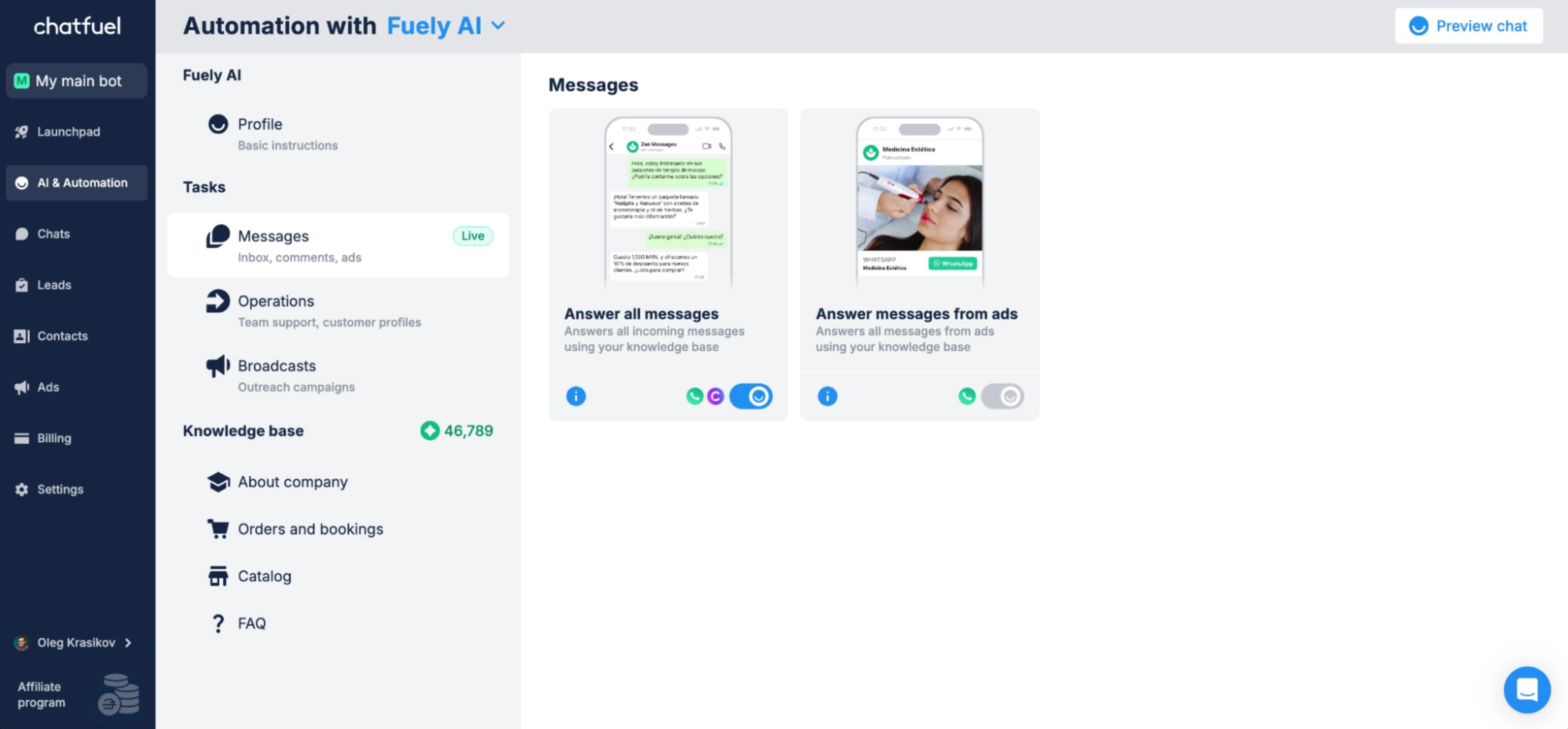
Chatfuel is intentionally lightweight in how it presents the product. The builder is made for teams that want a straightforward path to launch lead capture, FAQs, basic qualification, and follow-up messaging without spending weeks learning a larger platform. That simplicity is part of the appeal because smaller businesses often need something their sales or operations team can own directly. The downside is that the interface also reflects a smaller ambition: it is great for practical business messaging, but less suited to teams trying to design a wider conversation system.
ChatbotX asks for more intent from the team at the beginning. The payoff is that one shared chatbot account can coordinate multiple channels, richer integrations, and more technical orchestration over time instead of forcing the team to duplicate logic across separate channel-led setups. For teams that expect messaging to become an operational layer rather than a single-purpose tool, that tradeoff is often worth it.
Automation logic and workflow power
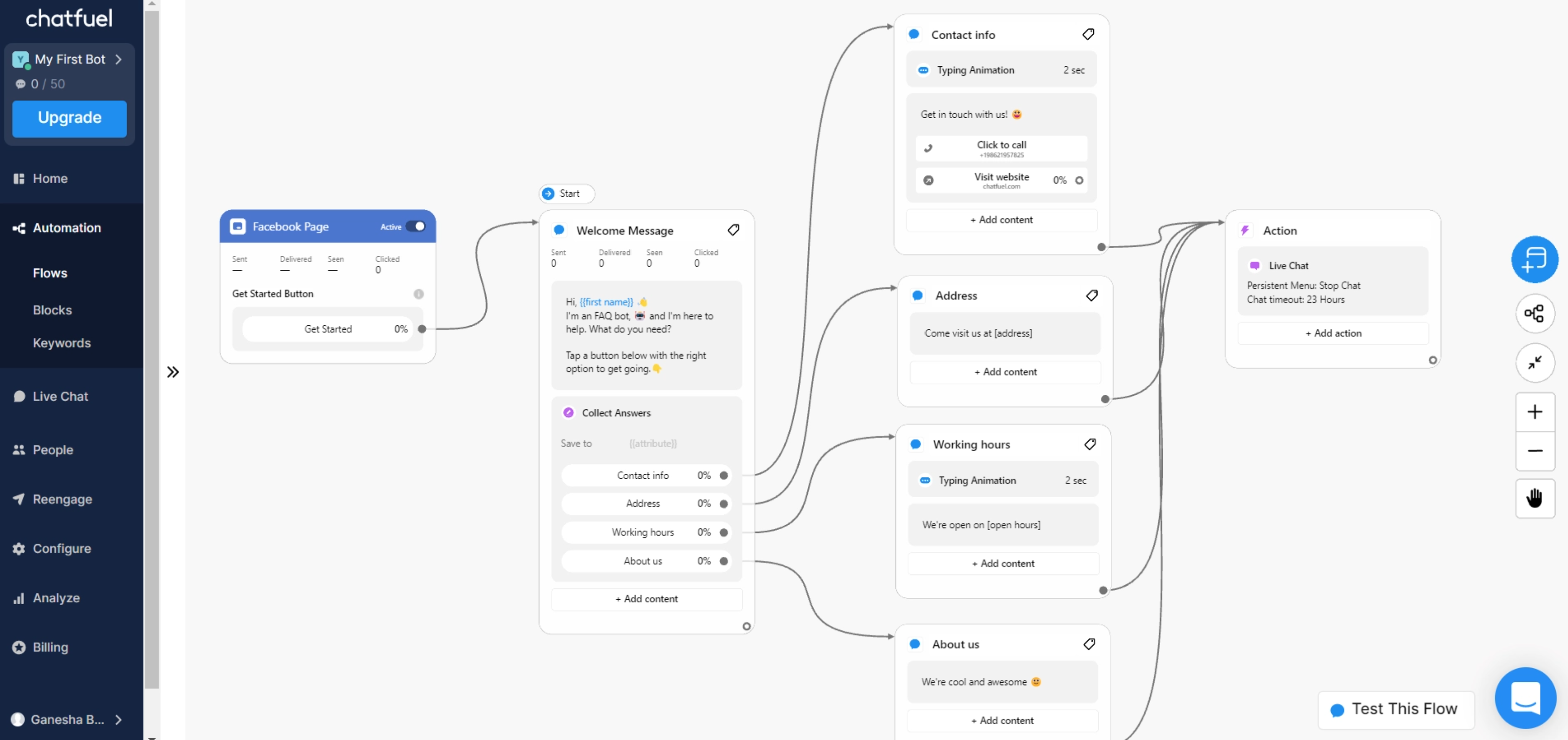
Chatfuel covers the common business motions well: keyword actions, lead capture, basic qualification, re-engagement, and flow triggers connected to live chat.
It is effective when the conversation path is mostly linear and the business wants a practical sales machine instead of a deeply customized workflow engine.
- Strong for straightforward sales and follow-up flows.
- Good when the team values clarity and speed more than orchestration depth.
- Less comfortable once workflows need to branch deeply across tools, teams, or operational states.
ChatbotX is stronger when the workflow has to become more intelligent and more connected.
It can support flows that retrieve context, route by priority or segment, and trigger downstream actions in a way that feels closer to process orchestration than lead follow-up.
- Better when one flow needs to coordinate sales, support, onboarding, or AI actions together.
- Stronger if routing and business logic depend on external context, not just form-style qualification.
- More suitable when automation must keep scaling after the first sales use case is live.
Contacts, segmentation, and CRM context
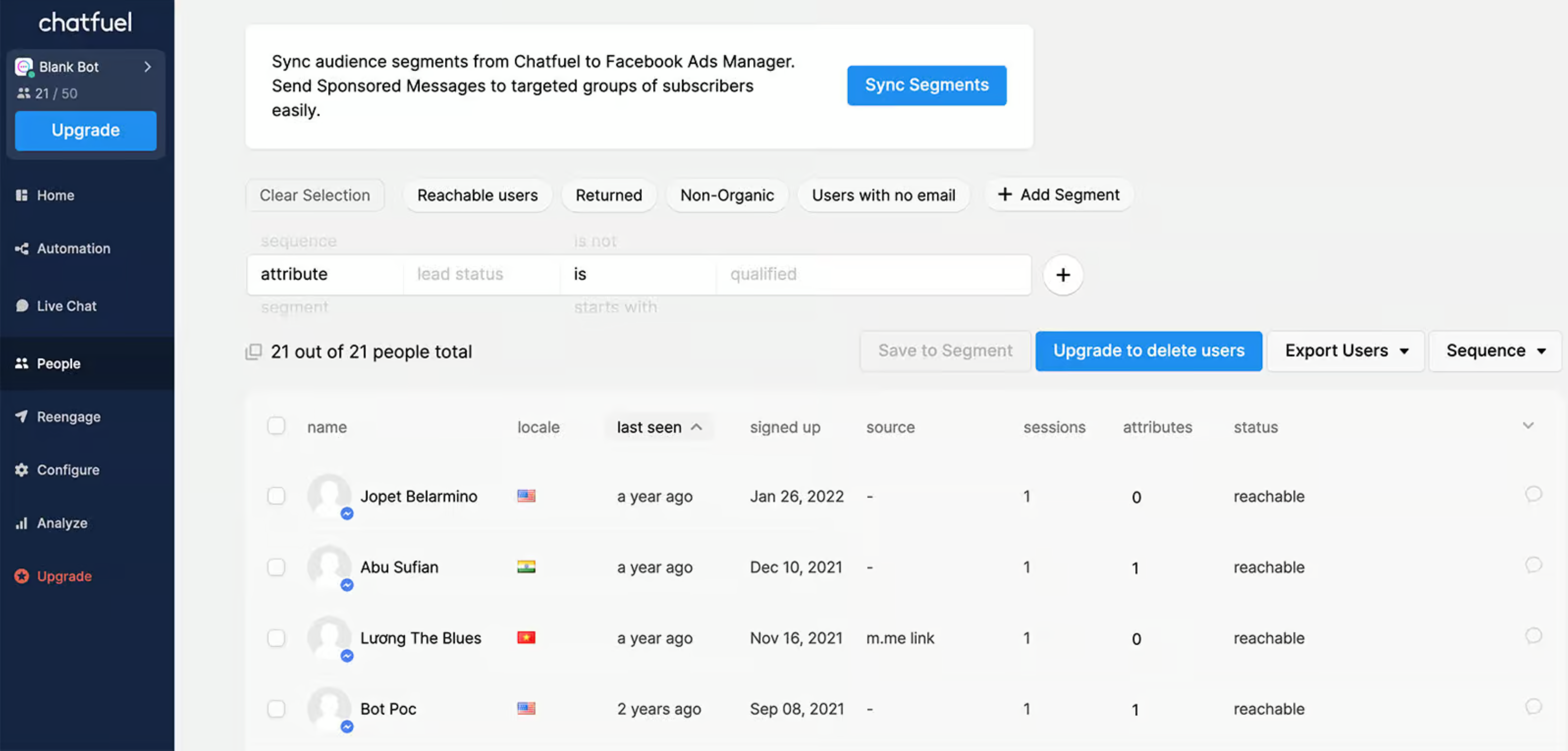
Chatfuel has a practical built-in CRM story, and that is one of its most useful differentiators for smaller teams.
The Leads board, contact attributes, and audience segmentation make it easier to track prospects, manage follow-up, and give sales users something familiar without introducing a full external system.
- Useful for lightweight pipeline visibility.
- Good when the team wants simple follow-up structure close to the inbox.
- Best when contact context mainly serves small-team sales execution.
ChatbotX is a better fit when contact context needs to travel further than a small built-in CRM can reasonably carry it.
Profile data can influence inbox workflows, automation branches, AI behavior, and external syncs in a way that supports a more connected platform model.
- Better when contacts must support AI, automation, and routing together.
- More useful for teams operating across departments and systems.
- Stronger when messaging data needs to become a reusable platform asset.
AI features, memory, and extensibility
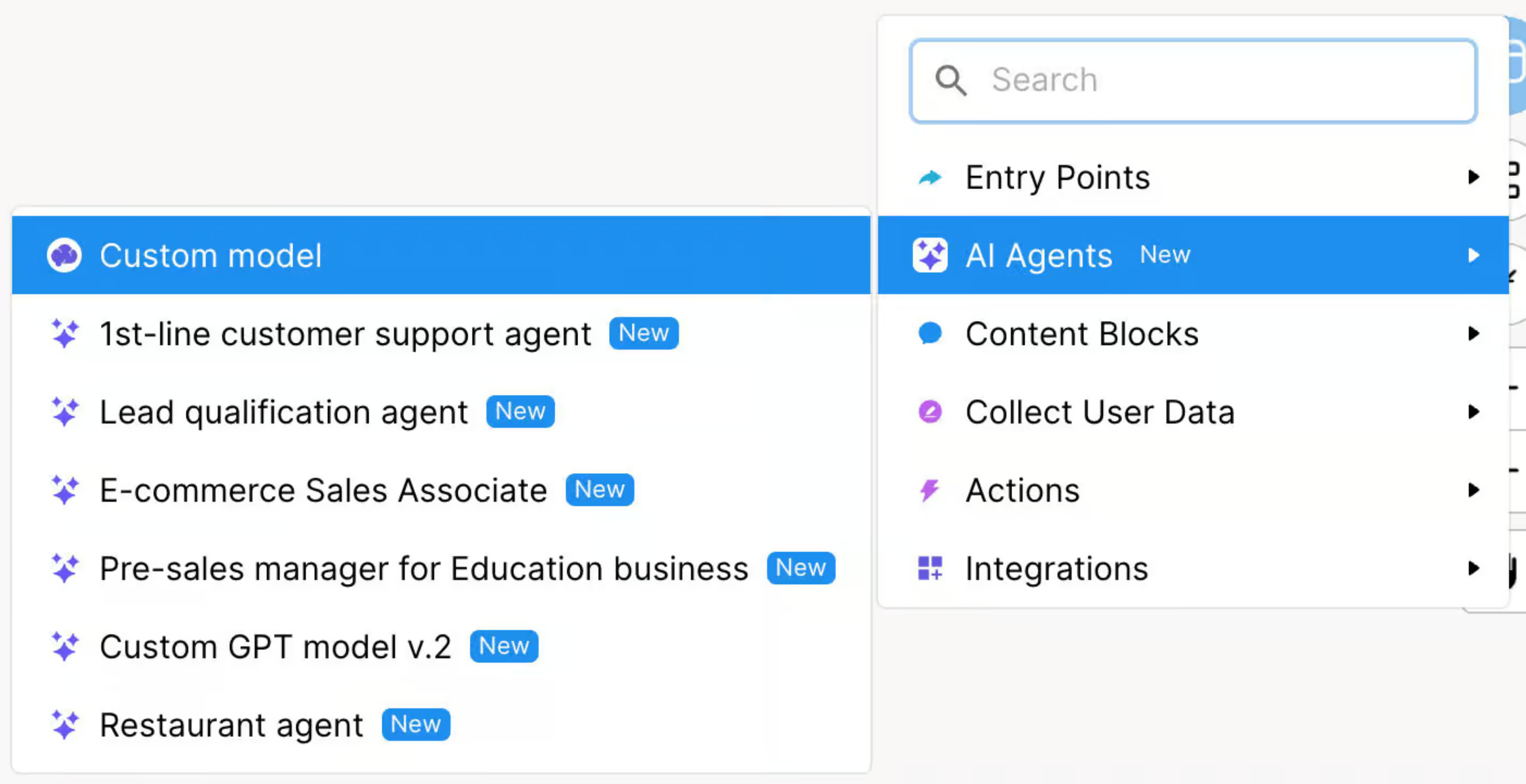
Chatfuel positions AI around practical sales acceleration: faster responses, lightweight qualification, and assistant-like support inside a managed product. That makes sense for the audience it serves because most teams are not trying to build custom agent architectures; they just want a useful AI layer inside a sales workflow. The tradeoff is that AI still lives inside the product's predefined boundaries, so flexibility is shaped by Chatfuel's packaging decisions. For many SMB use cases, that is acceptable, but it does limit long-term architectural freedom.
ChatbotX uses AI as part of a more open operating model. The emphasis on agentic workflow thinking, open architecture, and developer-facing extension points makes it easier to connect intelligence to real process logic instead of only generating replies inside a predefined experience. That matters for teams that want AI to drive routing, retrieval, orchestration, and system actions in a more deliberate way. If AI is becoming a core capability rather than a supporting feature, ChatbotX gives technical teams more ways to shape the outcome.
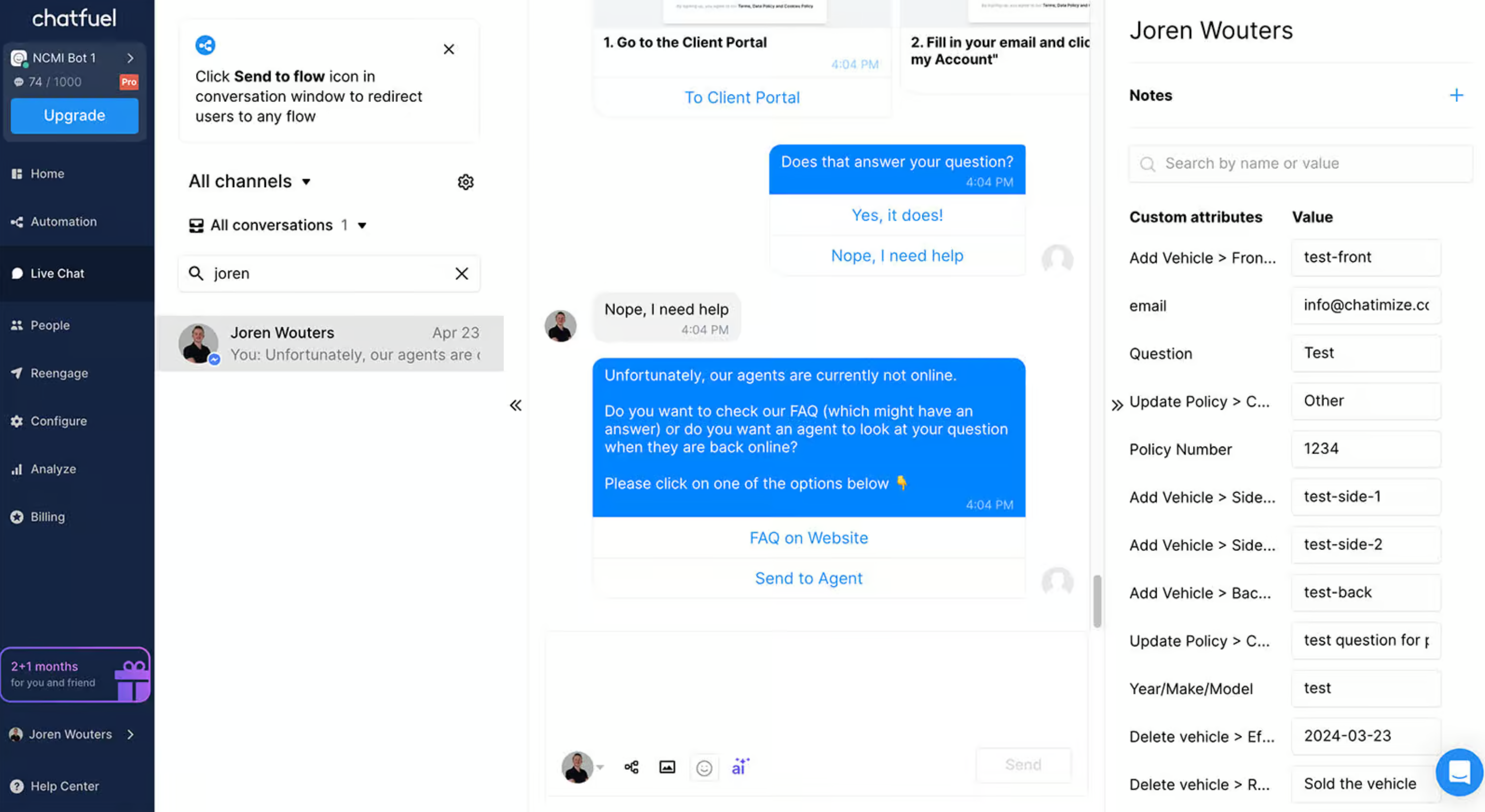
Live chat, team inbox, and routing
This is one of Chatfuel's strongest areas for its target market. Shared inbox, agent assignment, and mobile handling make it practical for smaller businesses that need humans and automation to work together without a complicated operations stack.
The experience is approachable, and that usually matters more than advanced configurability for teams focused on fast response and simple selling motions.
- Strong for lightweight shared inbox use cases.
- Agent assignment and mobile handling are practical advantages.
- Best when the inbox supports a straightforward sales workflow.
ChatbotX has more upside when inbox activity has to connect tightly with flows, AI behavior, and external business logic.
Instead of stopping at assignment and handoff, the system can support a broader relationship between conversation state, automation state, and the systems around them.
- Better for inbox-plus-orchestration use cases.
- Stronger when human handoff is only one layer of the operating model.
- More compelling when inbox behavior needs to stay deeply extensible.
Channels and growth tools
Chatfuel is messaging-first and strongest around WhatsApp and social DMs, especially when paired with click-to-message ads and selling flows.
It is a practical fit for businesses that want to capture intent, continue the conversation, and close or nurture leads in the same product.
- Good fit for sales-led messaging across WhatsApp, Instagram, and Facebook.
- Useful when the business mainly wants one product for ads, leads, and follow-up.
- Less attractive once the roadmap expands into broader lifecycle or omnichannel operations.
ChatbotX is built for teams that want one shared chatbot account to work across Messenger, WhatsApp, Instagram, Zalo, and Webchat.
That makes it easier to keep one logic layer, one customer context, and one operating model instead of splitting the experience by channel.
- Better when one chatbot account needs to support multiple channels together.
- Stronger when logic, routing, and customer context should be reused across channels.
- More durable once the roadmap expands beyond one sales-led motion.
Integrations, API, and developer flexibility
Chatfuel supports practical integrations and JSON API access, which is enough for many smaller businesses to connect forms, spreadsheets, simple CRM actions, and other lightweight workflows.
The product is built to hide complexity, and that is part of the value proposition.
- Good for practical extensions that keep the tool easy to operate.
- Useful when engineering only needs lightweight hooks into the workflow.
- Less suitable once the team wants to shape the product behavior itself.
ChatbotX is better for teams that explicitly want that deeper level of control.
APIs, CLI-friendly workflows, and open architecture thinking make it easier to treat messaging as a connected system instead of a packaged application with extension points.
- Better for engineering-led organizations.
- More natural when APIs and custom logic are strategic, not secondary.
- Stronger if the team wants deeper leverage over integrations, workflow behavior, and deployment.
Pricing, analytics, templates, and support
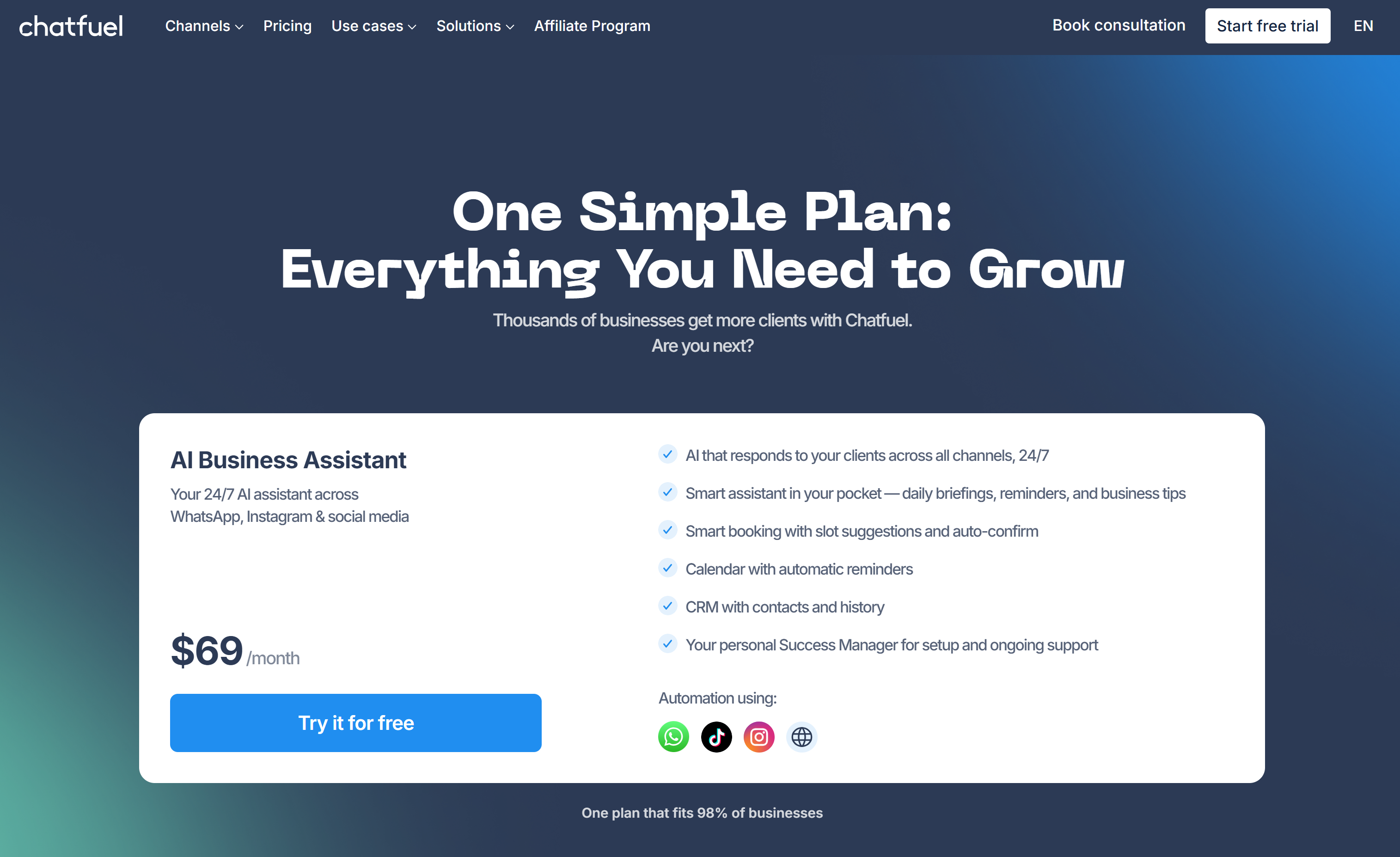
Chatfuel is commercially approachable. It has accessible entry points, practical templates, and support positioning that makes sense for smaller businesses looking for a quick path to value.
That usually makes the buying process easier because teams can understand what they are getting without first committing to a broader platform strategy.
- Easy to understand and easier to buy into quickly.
- Templates and packaged usefulness are part of the appeal.
- Best suited to teams prioritizing speed and simplicity over strategic extensibility.
ChatbotX is less about buying a simpler box and more about gaining a platform that can evolve with the business.
The value proposition is not mainly in ready-made templates or a polished commercial wrapper, but in the control to adapt the messaging layer as needs change.
- More relevant for teams thinking in platform terms.
- Heavier decision upfront, but stronger long-term flexibility.
- Easier to justify when the messaging stack is expected to compound over time.
Bottom line
Choose Chatfuel if your main goal is a straightforward WhatsApp and social selling machine with a friendly shared inbox and lightweight CRM.
Choose ChatbotX if you want one shared chatbot account across channels, open-source control, and a platform that can grow into agentic AI and custom integrations.
FAQ
Is Chatfuel better for small sales teams?
Often, yes. Chatfuel is intentionally simple, and commercial teams can get value from it quickly when the main goal is lead capture, follow-up, and lightweight shared inbox handling.
That makes it attractive for businesses that want a practical sales tool before they want a broader messaging platform.
Does Chatfuel have its own CRM-style layer?
Yes. Chatfuel positions Leads as a lightweight CRM built into the product, with stages, assignment, and audience attributes.
That is useful for small teams because it keeps qualification and follow-up close to the inbox, but it is not the same as owning a broader open-source messaging stack or deeper operational data layer.
What is Chatfuel strongest at today?
Chatfuel is strongest when a business wants one approachable tool for capturing leads, handling simple qualification, and managing day-to-day conversations across WhatsApp, Instagram, and Facebook.
Its value comes from keeping the experience lightweight and commercially practical rather than turning messaging into a heavier platform decision too early.
Where does Chatfuel start to feel too small?
The limits appear when workflows need to coordinate more systems, more channels, and more operational states than a lightweight sales automation product is designed to handle.
That usually becomes visible when engineering wants deeper control or when the team needs messaging to support broader processes than lead follow-up and inbox handoff.
When does ChatbotX beat Chatfuel clearly?
ChatbotX pulls ahead when one shared chatbot account needs to support more systems, more channels, and more AI-driven operational actions than a lightweight sales automation product is designed to handle.
It becomes the stronger option when messaging is part of platform architecture instead of only part of a selling workflow.
Related comparisons
Compare ManyChat vs ChatbotX for creator-first growth automation, social messaging depth, and open-source ownership.
Read comparisonCompare Wati vs ChatbotX for WhatsApp-first operations, inbox collaboration, and omnichannel expansion.
Read comparisonCompare Respond.io vs ChatbotX for inbox maturity, AI workflows, and platform control.
Read comparison