
This comparison is for teams deciding whether to stay with ManyChat or move toward a more flexible open-source stack. The core question is not only which tool is easier to start with, but which platform keeps working once messaging, AI, and integrations become part of real operations.
Quick Overview + Key Features
ManyChat has a clear center of gravity, and that focus is often why teams choose it first. ChatbotX is the better fit when the roadmap grows beyond a single product opinion and starts demanding open infrastructure, extensibility, and deeper AI execution.

Fast Audience Growth
ManyChat is designed to help marketers launch automations quickly across high-intent messaging channels. It is strongest for driving engagement, capturing leads from comments or DMs, and running campaign-driven messaging without much technical setup.
- Visual Flow Builder: aimed at fast campaign deployment.
- Growth Tools: strong for comments, story replies, and ad-driven entry points.
- Manychat Inbox: supports team seats, manual assignment, auto-assignment, and assignment rules.
- Campaign Reporting: suited to social and conversion-focused workflows.

Agent-First Architecture
ChatbotX Omnichannel keeps Messenger, WhatsApp, Instagram, Zalo, and Webchat inside one shared chatbot account, so teams can reuse the same logic, customer context, and workflows across channels. Open architecture, agentic execution, MCP, and CLI workflows make that layer easier to own and extend.
- 100% Open Source: full customization, stronger privacy, and data ownership.
- Agentic Workflow: AI-driven task execution that replaces rigid manual flows.
- MCP Protocol: faster data access for Claude and modern LLM workflows.
- CLI-Powered: lightweight, headless, and deeply integrated with OpenClaw-style operations.
- Unified Omnichannel Account: run Messenger, WhatsApp, Instagram, Zalo, and Webchat from one shared chatbot account.
Feature-by-feature comparison
Before going deeper, the table below gives a fast scan of the tradeoffs. It is especially useful if your shortlist is already down to one commercial platform versus ChatbotX.
| Category | ManyChat | ChatbotX |
|---|---|---|
| Best fit | Creators, ecommerce marketers, and teams running high-volume social campaigns. |
Teams that want one shared chatbot account across channels, deeper automation, and AI tied to real business systems. |
| Core motion | Launch social messaging automations fast with low setup overhead. |
Operate one shared omnichannel account with agents, workflows, and system integration behind it. |
| Workflow style | Easy visual flows with guardrails shaped around campaign use cases. |
Flows plus agentic execution for more technical, operational journeys. |
| Data ownership | SaaS-managed environment with platform-level constraints. |
Source-level ownership plus self-hosting paths for teams that need control. |
| AI approach | AI add-ons and in-product helpers layered onto a marketing automation product. |
AI agents and developer-friendly workflows are part of the product direction, not an extra layer. |
| Channels | Supports Messenger, Instagram, WhatsApp, Telegram, SMS, and Email, with the strongest fit still in social-first marketing workflows. |
Run Messenger, WhatsApp, Instagram, Zalo, and Webchat from one shared chatbot account instead of managing separate channel-led setups. |
| Pricing model | Pricing now depends on plan generation: accounts created on or after March 2, 2026 may be on the newer Essential/Pro/Business/Advanced model, while Manychat Inbox pricing remains separate. |
Open-source deployment plus cloud paths, with less strategic dependence on vendor-only packaging. |
| Developer leverage | Possible, but not the product center of gravity. |
A better fit for API, CLI, MCP, and custom-system thinking. |
Interface and builder experience
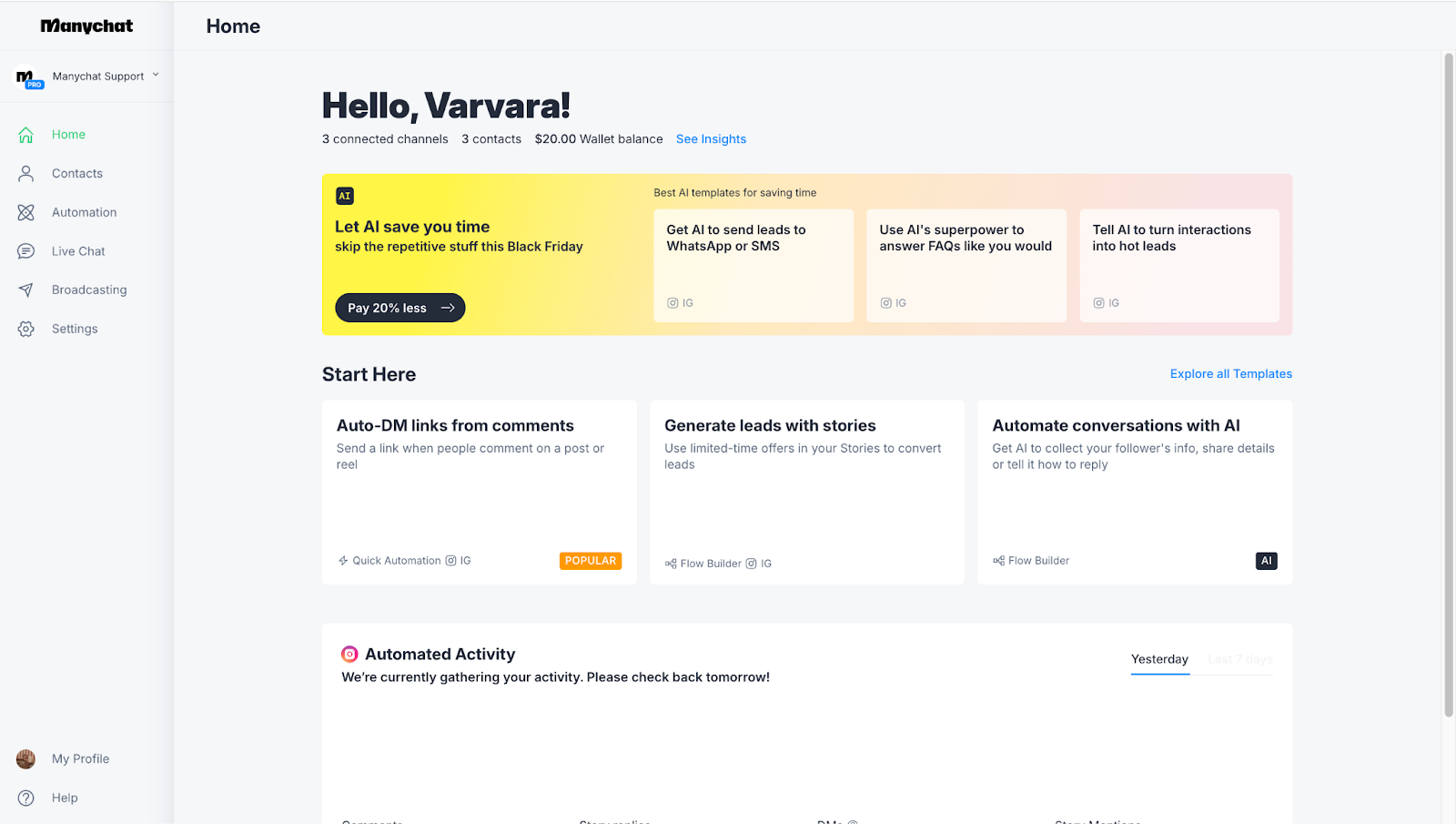
ManyChat keeps the learning curve intentionally light. The builder is optimized for marketers who want to launch comment triggers, DM flows, story interactions, and lead capture journeys without spending much time thinking about system design. That focus is a real strength because the product surfaces the things growth teams use most often, such as audience entry points, simple branching, and campaign-centric automations. The tradeoff is that the interface tends to guide users toward ManyChat-shaped patterns instead of encouraging broader process design.
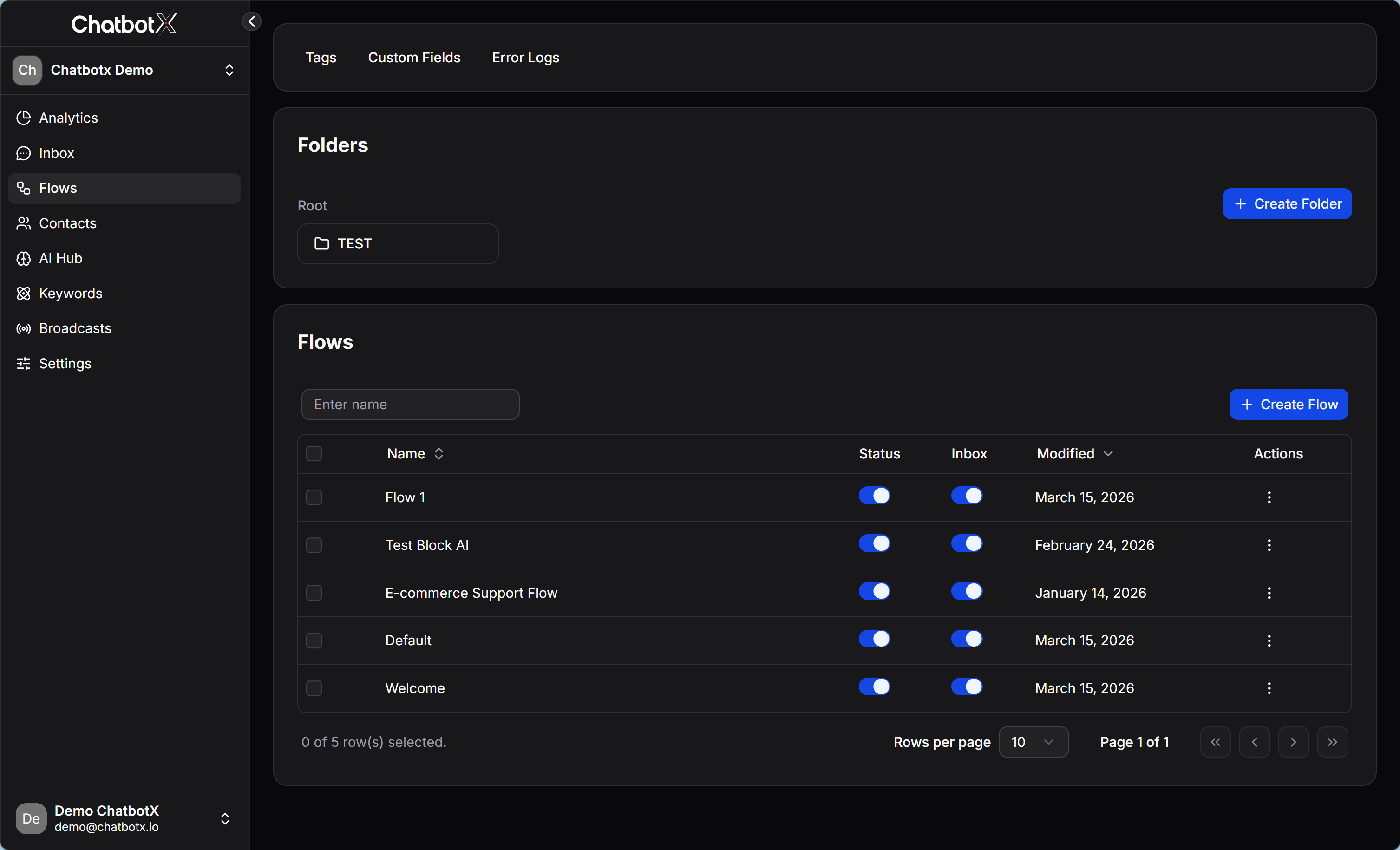
ChatbotX feels more like an omnichannel operating layer than a marketing app with chatbot features. Instead of duplicating flows for separate channel setups, teams can keep one shared chatbot account at the center and let Messenger, WhatsApp, Instagram, Zalo, and Webchat reuse the same routing, context, and business logic. That makes ChatbotX heavier at first, but much harder to outgrow once messaging becomes part of the operating model.
Automation logic and workflow power
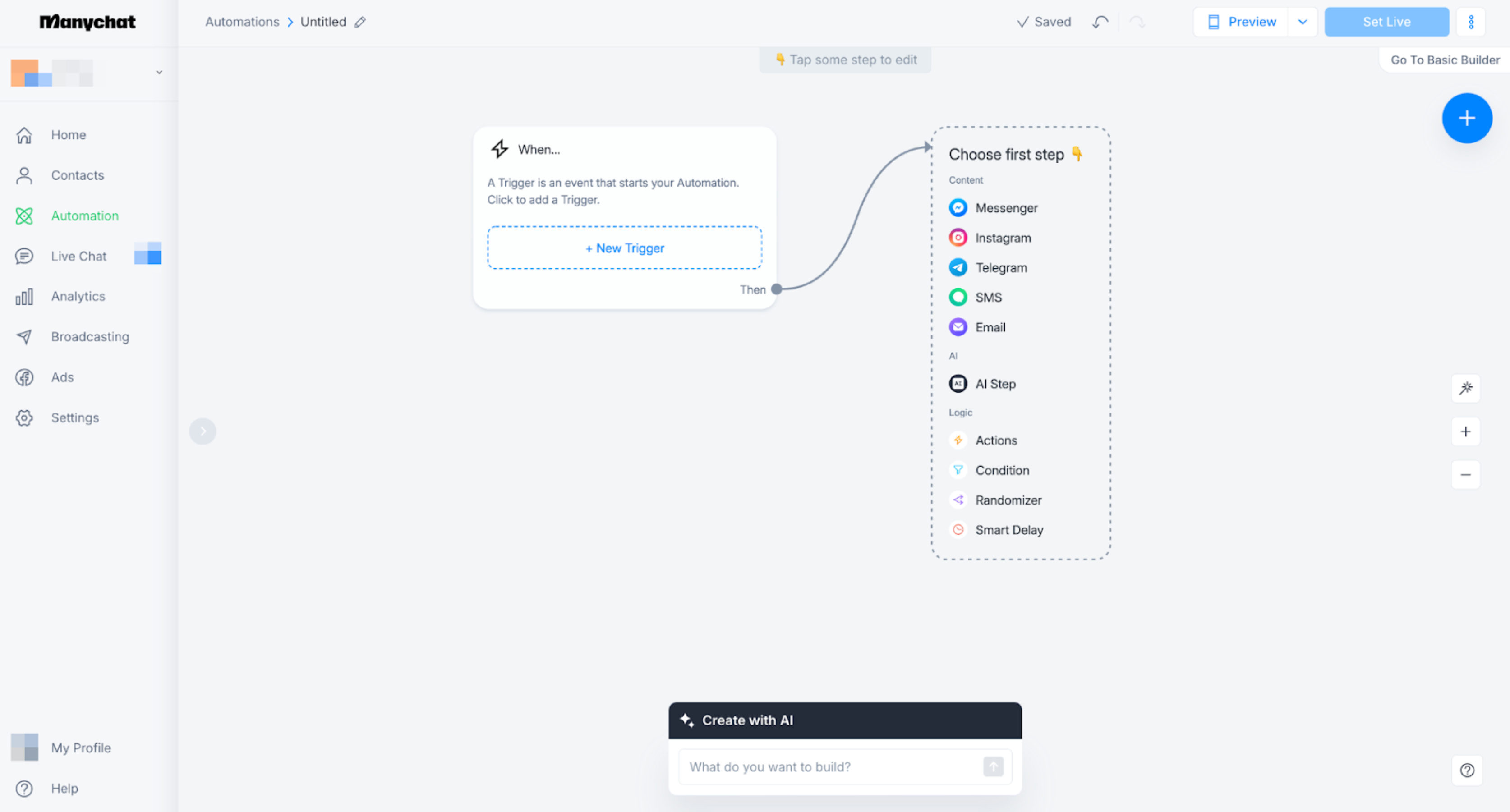
ManyChat is good at branching, triggers, and practical nurture logic, especially when the main objective is to move users from engagement to conversion.
It works well for lead magnets, comment-to-DM funnels, timed follow-ups, and campaign flows that do not require deep coordination with internal systems.
- Strong for campaign-driven automations that move quickly from engagement to conversion.
- Comfortable for comment triggers, DM follow-up, and nurture logic shaped around social growth.
- Less natural once workflows must act like shared business processes across teams or tools.
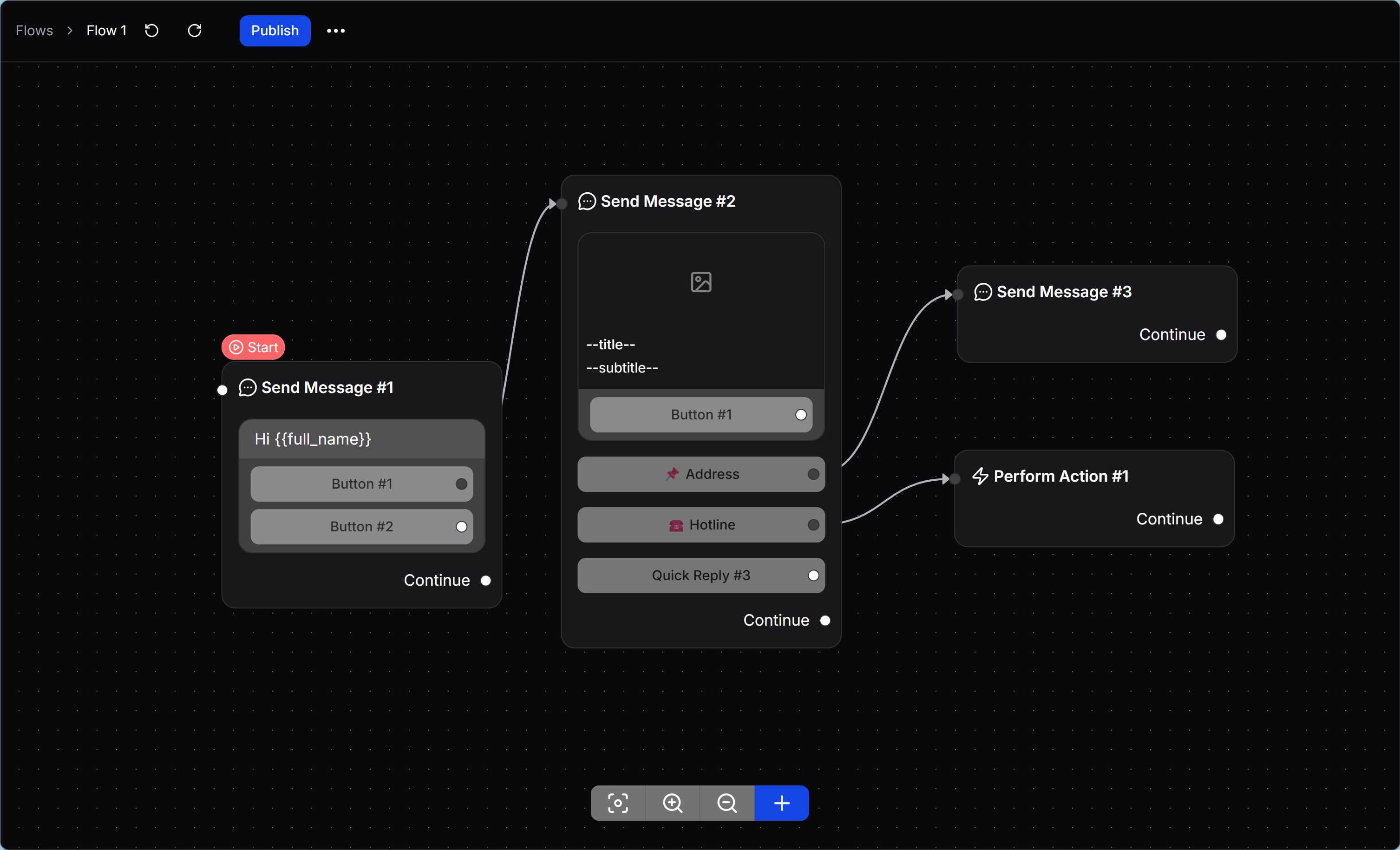
ChatbotX is more convincing when the workflow itself is the product decision.
It is built for flows that need to qualify intent, route users by priority, pull context from other tools, and trigger next actions without turning the whole setup into a maze of workarounds.
- Better when automation needs to behave like an operational workflow, not only a marketing funnel.
- Stronger for routing, qualification, and AI-assisted execution that depends on external context.
- A better long-term fit when multiple departments will rely on the same messaging logic.
Contacts, segmentation, and CRM context
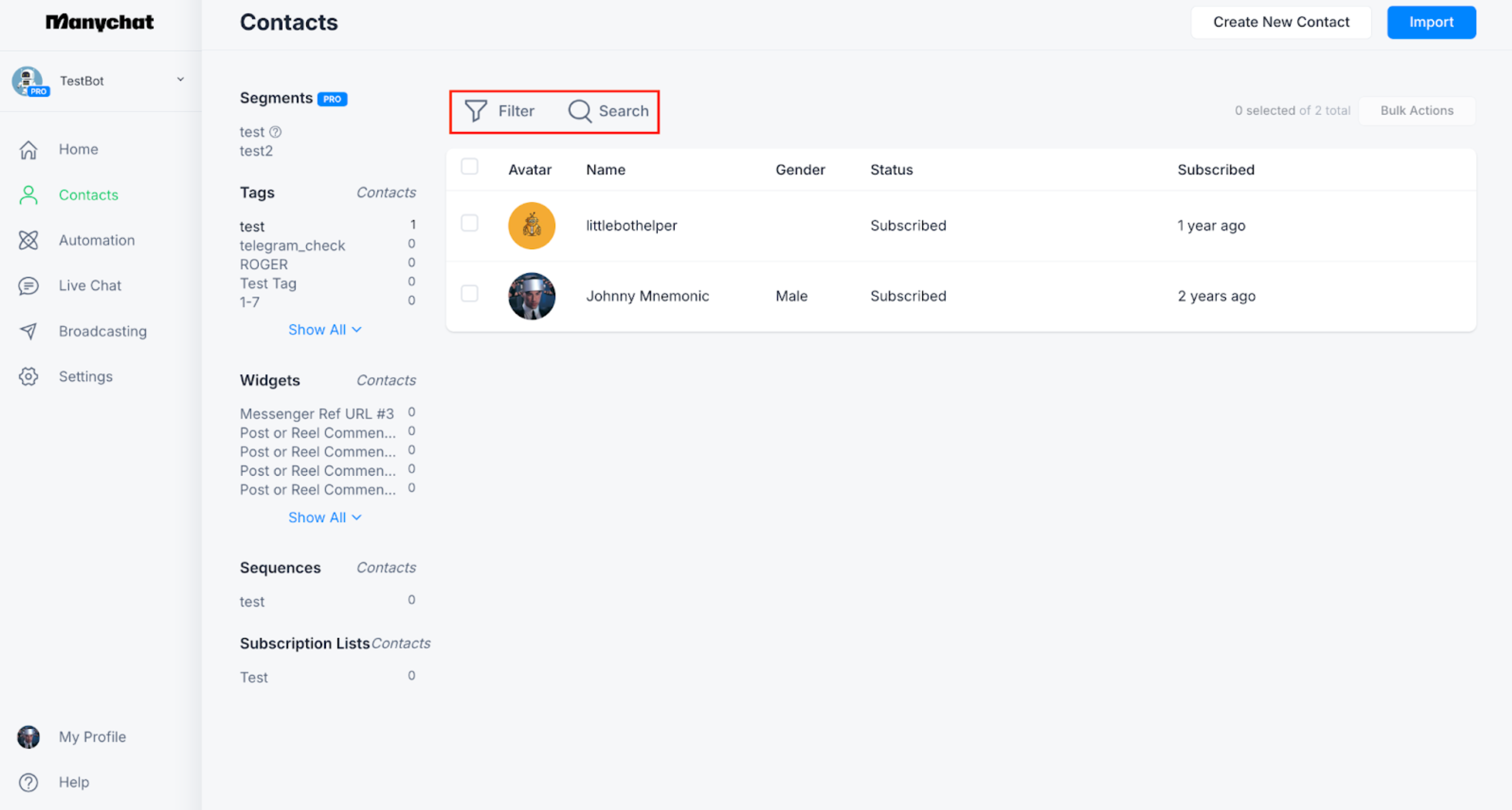
ManyChat handles tags, custom fields, and audience segmentation well for campaign management.
That means marketers can personalize broadcasts, target specific groups, and build follow-up logic around the behavior users show inside social messaging journeys.
- Useful when contact data mainly powers campaigns and lifecycle messaging.
- Good for segmentation, audience targeting, and simple behavior-based follow-up.
- Less convincing when contact context must support routing, shared operations, or deeper system sync.
ChatbotX positions contacts as part of a broader operating layer instead of a campaign database.
Profile data can influence flows, inbox behavior, human handoffs, and connections to internal tools in a way that feels closer to workflow orchestration than list management.
- Better when contact context needs to stay useful across support, sales, onboarding, and AI execution.
- Stronger if profile data must influence both automation and human operations.
- More suitable when messaging context has to become reusable infrastructure across the stack.
AI features, memory, and extensibility
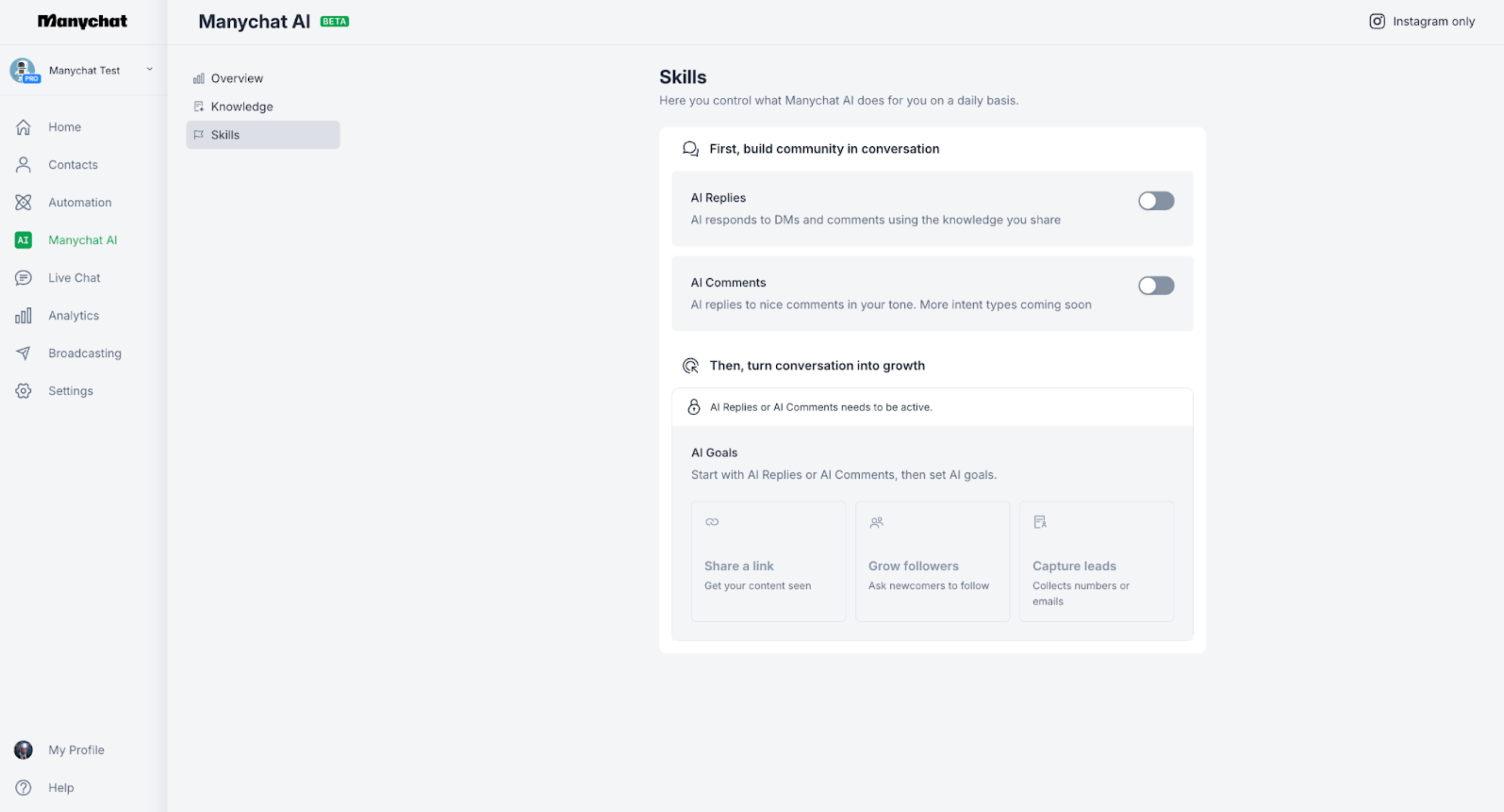
ManyChat has introduced more AI features, but they still sit inside a closed SaaS product whose center of gravity remains campaign automation. For many teams, that is fine because AI only needs to help with copy generation, lightweight replies, or basic qualification inside an existing marketing motion. The issue is not whether AI exists, but how far the product lets AI participate in real execution before users hit product-shaped limits. If your expectation is an AI-enhanced funnel builder, ManyChat can be enough.
ChatbotX treats AI as part of the platform direction rather than an add-on to a social messaging automation tool. The combination of agentic workflows, open architecture, MCP alignment, and CLI-friendly thinking gives technical teams more ways to shape how intelligence connects to data and action. That matters when AI needs to retrieve context, trigger systems, or behave like part of an operating model instead of a convenience layer inside a visual builder. For businesses that want AI to become more central over time, ChatbotX creates more strategic room to grow.
Live chat, team inbox, and routing
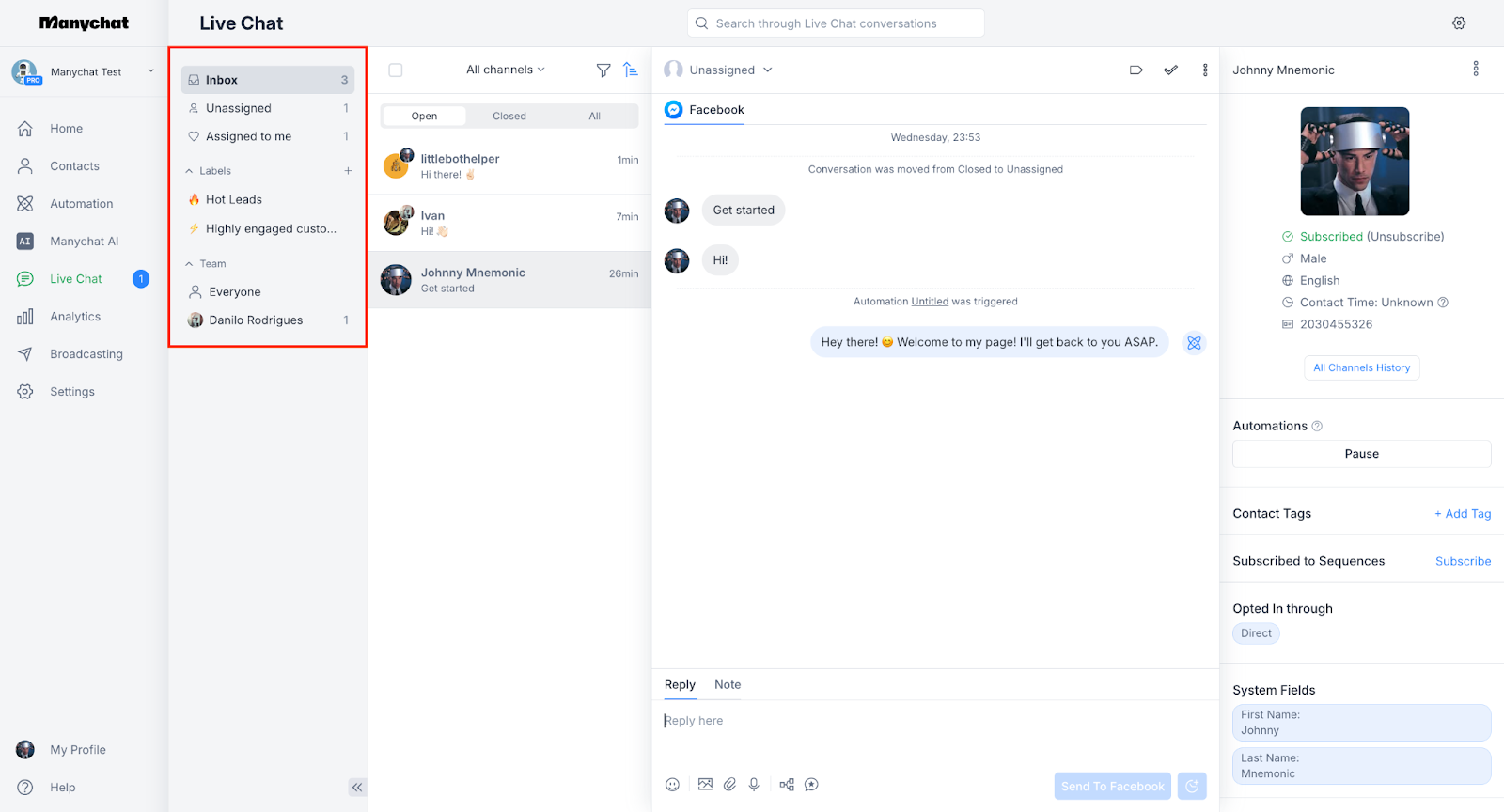
ManyChat now has a clearer team inbox story than many older summaries suggest. Manychat Inbox supports assigned and unassigned views, team folders, labels, manual assignment, and auto-assignment for teams that need to coordinate conversations after automation has done the first pass.
That gives ManyChat enough operational depth for marketing-led teams that still need humans to step in, especially when the conversation flow stays close to campaign or lead-response use cases.
- Useful when the team needs seats, assignments, and assignment rules inside Manychat Inbox.
- Works well when inbox collaboration supports acquisition, nurture, and fast lead response.
- Still feels more like an extension of campaign tooling than a full operations workspace.
ChatbotX becomes stronger when inbox operations have to live next to flows, AI agents, and integrations as part of one architecture.
Instead of treating the inbox as an add-on to a growth product, it can sit inside a wider messaging layer that supports support workflows, qualification logic, and custom business actions.
- Better when inbox behavior is strategically important, not just a fallback after automation.
- Stronger for teams that need conversations to move cleanly between automation, humans, and systems.
- More complete when handoff, routing, and follow-up all need to share the same platform logic.
Channels and growth tools
This is ManyChat at its strongest. Comment automations, Instagram and Messenger growth tactics, story interactions, and social entry points are exactly the kinds of workflows the product is built to make easy.
At the same time, ManyChat is no longer limited to just those surfaces. Official help documentation now frames it as a multichannel product spanning Messenger, Instagram, WhatsApp, Telegram, SMS, and Email, even if its clearest center of gravity is still social-led marketing.
- Excellent fit for social growth and campaign execution.
- Strong around comment-to-DM, story interactions, and other social entry points.
- Best when the channel strategy still centers on audience growth and campaign loops.
ChatbotX is built for teams that want one shared chatbot account to work across Messenger, WhatsApp, Instagram, Zalo, and Webchat.
That makes it easier to keep one logic layer, one customer context, and one operating model instead of breaking the experience into channel-led bot setups.
- Better when one chatbot account needs to support multiple channels together.
- Stronger when logic, routing, and customer context should be reused across channels.
- More durable once the roadmap moves beyond isolated growth campaigns.
Integrations, API, and developer flexibility
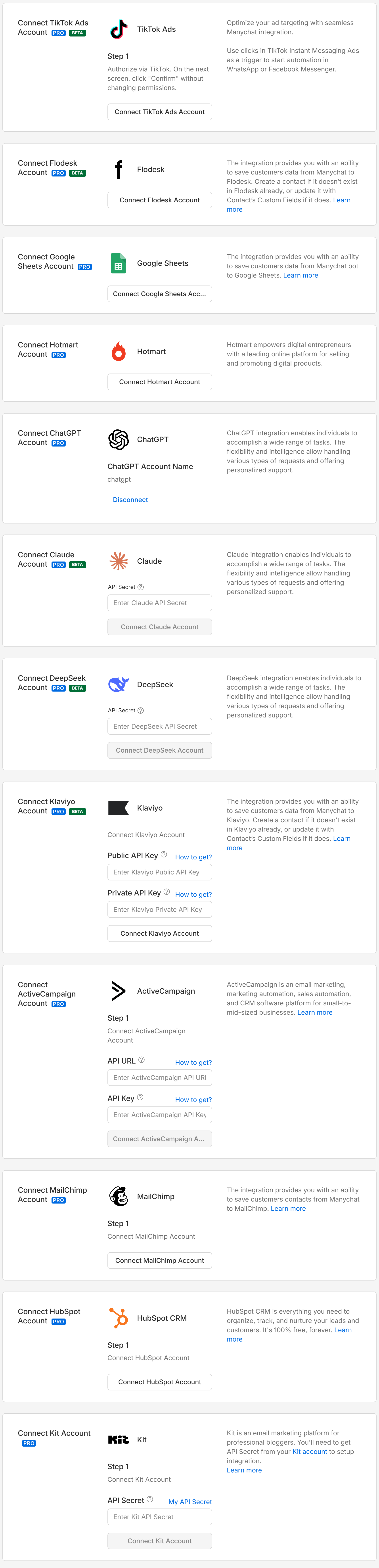
ManyChat can connect outward through integrations, APIs, and webhooks, but developer extensibility is not the product's center of gravity.
The platform is still designed to make the majority of value available without code, which is a benefit for marketing teams but a limitation for engineering-heavy use cases.
- Good for practical integrations that support campaigns.
- Less ideal when engineering needs to shape product behavior deeply.
- Focused on basic app integrations rather than an Agent-First architecture.
ChatbotX is built for teams that expect APIs, custom logic, and workflow extensibility to be first-class.
That makes it easier to think about messaging as part of the product and data architecture, not just a downstream campaign tool.
- A stronger fit for engineering-led organizations.
- More natural for CLI, MCP, and custom workflow thinking.
- Better when teams want deeper control over flow logic and system connections.
Pricing, analytics, templates, and support
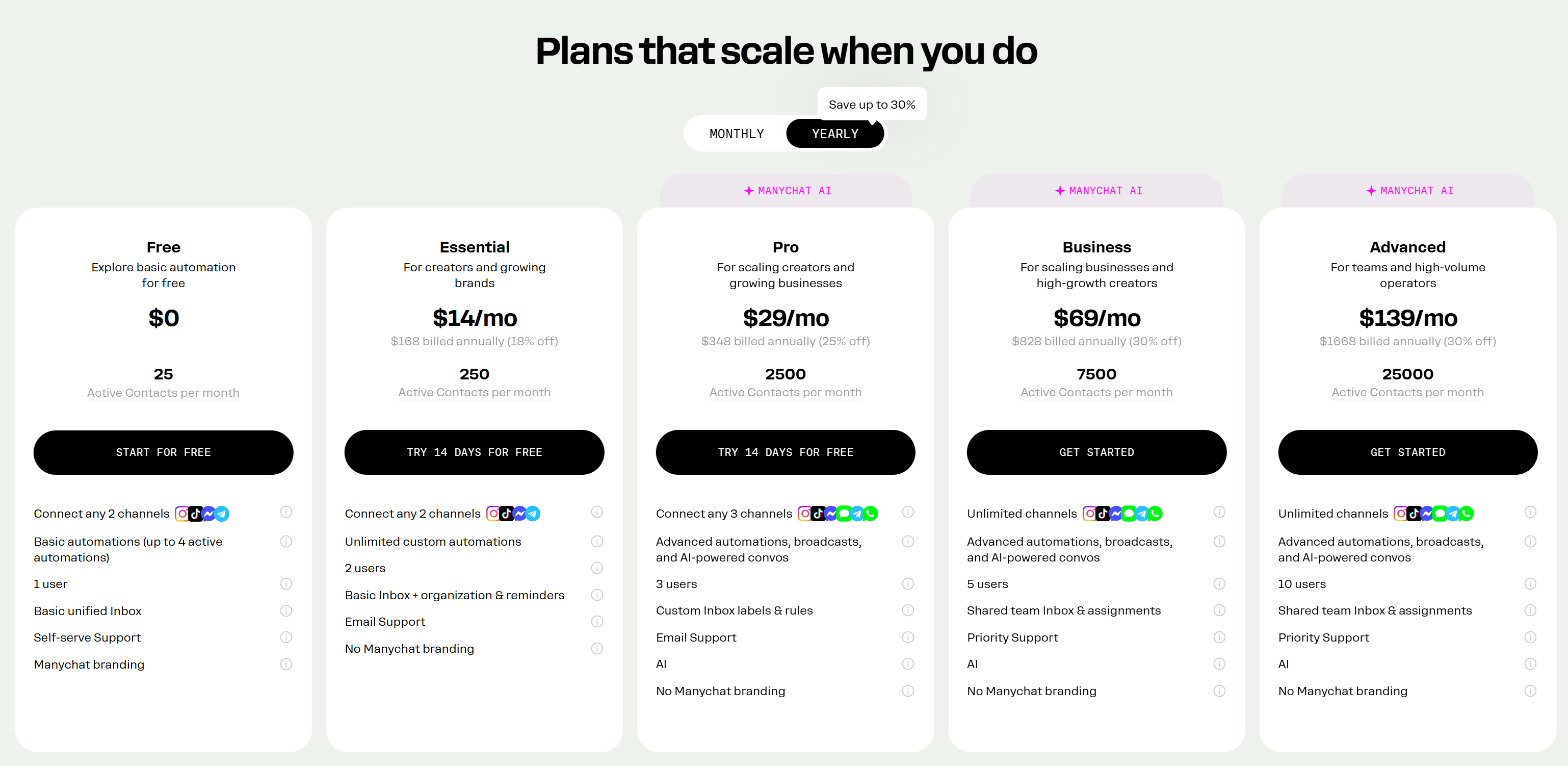
ManyChat remains attractive because it is easy to buy, easy to understand, and easy to launch. The newer official plan structure now separates accounts across Free, Essential, Pro, Business, and Advanced tiers, with differences in Active Contacts, user and Inbox seat limits, channel access, AI automation, integrations, and lead routing.
Teams also need to understand that Manychat Inbox can be priced separately. If you subscribe to Inbox, it starts with 3 seats, and additional seats are paid on top, which makes the buying picture more nuanced than older one-price summaries suggest.
- Commercial story is still easy to grasp for marketing teams.
- Templates and ecosystem support reduce setup anxiety.
- Pricing is now more version-sensitive because the March 2, 2026 model and separate Inbox pricing can both affect the real cost picture.
ChatbotX is less about buying pre-shaped convenience and more about buying architectural flexibility.
That can feel heavier at the start because the value is not mainly in templates or plug-and-play polish, but in ownership, extensibility, and the ability to evolve without being boxed into one vendor-shaped model.
- Stronger for teams making a platform decision, not only a tool decision.
- More compelling when long-term control matters more than launch convenience.
- Easier to justify over time if messaging is becoming core infrastructure.
Bottom line
Choose ManyChat if your center of gravity is creator-led growth, comment automation, and social messaging campaigns that need to launch fast.
Choose ChatbotX if the business needs one shared chatbot account across channels, open-source control, agentic AI, and a messaging layer that can evolve into real operational infrastructure.
If your main question is whether ManyChat can be white-labeled for agency resale, read the ManyChat white label guide .
FAQ
Is ManyChat still the easier tool to launch with?
Yes. ManyChat is still easier for teams that want to launch social messaging automation quickly without much technical work. The product is optimized for marketer-friendly setup, especially when the goal is to get comment triggers, DMs, and campaign follow-up live with minimal engineering involvement.
ChatbotX usually asks for more planning at the beginning because it is better suited to teams thinking beyond campaign setup and toward longer-term workflow ownership.
What kinds of teams usually prefer ManyChat?
ManyChat is a natural fit for creators, ecommerce operators, and growth teams whose daily work revolves around social engagement, comment automation, and conversion-focused messaging.
If the main job is to capture demand from Instagram, Messenger, or short campaign cycles without introducing a heavier operating model, ManyChat often feels more immediately useful than a broader platform.
What changed in ManyChat pricing on March 2, 2026?
ManyChat introduced a new pricing model on March 2, 2026 for accounts created on or after that date. Official plan documentation now describes tiers such as Essential, Pro, Business, and Advanced, while noting that plan availability may vary by region.
That is only part of the story, though, because Manychat Inbox is also priced separately. If a team needs Inbox features, seat counts, and additional seat expansion, the real commercial picture can differ from older summaries that treat ManyChat as one simple subscription.
Where does ManyChat start to feel limiting?
The main limit appears when messaging needs to behave like a connected business system rather than a campaign engine. That usually shows up when teams need deeper routing logic, closer ties to internal tools, or AI behavior shaped by more than marketing flows.
At that point the product can still be useful, but the center of gravity remains social messaging automation rather than broad workflow orchestration.
When is ChatbotX the better ManyChat alternative?
ChatbotX becomes the stronger choice when the business wants one shared chatbot account to run across Messenger, WhatsApp, Instagram, Zalo, and Webchat with the same logic, context, and open-source control.
It is a better fit when messaging is evolving into infrastructure for support, qualification, and orchestration rather than staying a social growth engine.
Related comparisons
Compare Chatfuel vs ChatbotX for lightweight sales automation, shared inbox workflows, and open-source extensibility.
Read comparisonCompare Wati vs ChatbotX for WhatsApp-first operations, team inbox depth, and omnichannel flexibility.
Read comparisonCompare Respond.io vs ChatbotX for team inbox maturity, AI workflows, and platform ownership.
Read comparison