

Quick summary: A hashtag is any keyword or short phrase written directly after the # symbol – for example, #ContentMarketing or #HomeWorkout – that turns a plain word into a clickable, searchable topic label on social media. The concept was introduced on Twitter in 2007 by Chris Messina, became platform infrastructure by 2009, and today operates differently on every network. A 2024 TikTok content audit revealed that nearly 28% of all videos carry zero hashtags, a signal that strategic tagging – not maximum tagging – is what matters now.
Launch agentic chat marketing in minutes with ChatbotX














What Exactly Is a Hashtag?

At its simplest, a hashtag is a content label. You create one by placing the pound symbol (#) immediately before a word or phrase – no spaces allowed – and that combination transforms from plain text into a hyperlink that groups your post with every other public post using the same tag.
Think of it this way: social media platforms handle millions of posts every hour. Without some form of organization, content would be an impenetrable wall of noise. Hashtags act like subject lines in a filing system, giving both the platform and the audience a fast way to sort, locate, and navigate content by topic.
Three things a hashtag accomplishes at once:
- Categorization – tells the algorithm what your post is about
- Discoverability – connects your post to a topic page anyone can search
- Community signal – signals that you’re participating in an ongoing conversation, not just broadcasting
A real-world scenario
Imagine you run a small candle brand and post a short Reel showing your pouring process. Without any hashtag, that post reaches primarily your existing followers. Add #CandleMaking and your post now appears alongside thousands of other candle-making videos that users actively browse. Add the more specific #SoyWaxCandles and you’re in a tighter, more motivated community – people who care deeply about exactly what you make.
The lesson here is not that more hashtags always mean more reach. It’s that the right hashtag connects the right post to the right audience at the right moment.
Core principle: A hashtag is a targeting tool, not a decoration. Use it to describe who should find this post, not just what the post contains.
Understanding how hashtags fit into the bigger picture of content distribution is essential. Once you’ve mastered tags, the next logical step is understanding how every platform’s ranking system responds to content – a topic covered in depth in How Social Media Algorithms Really Work in 2026 by ChatbotX.
The Origin Story: From IRC to Twitter to Everywhere
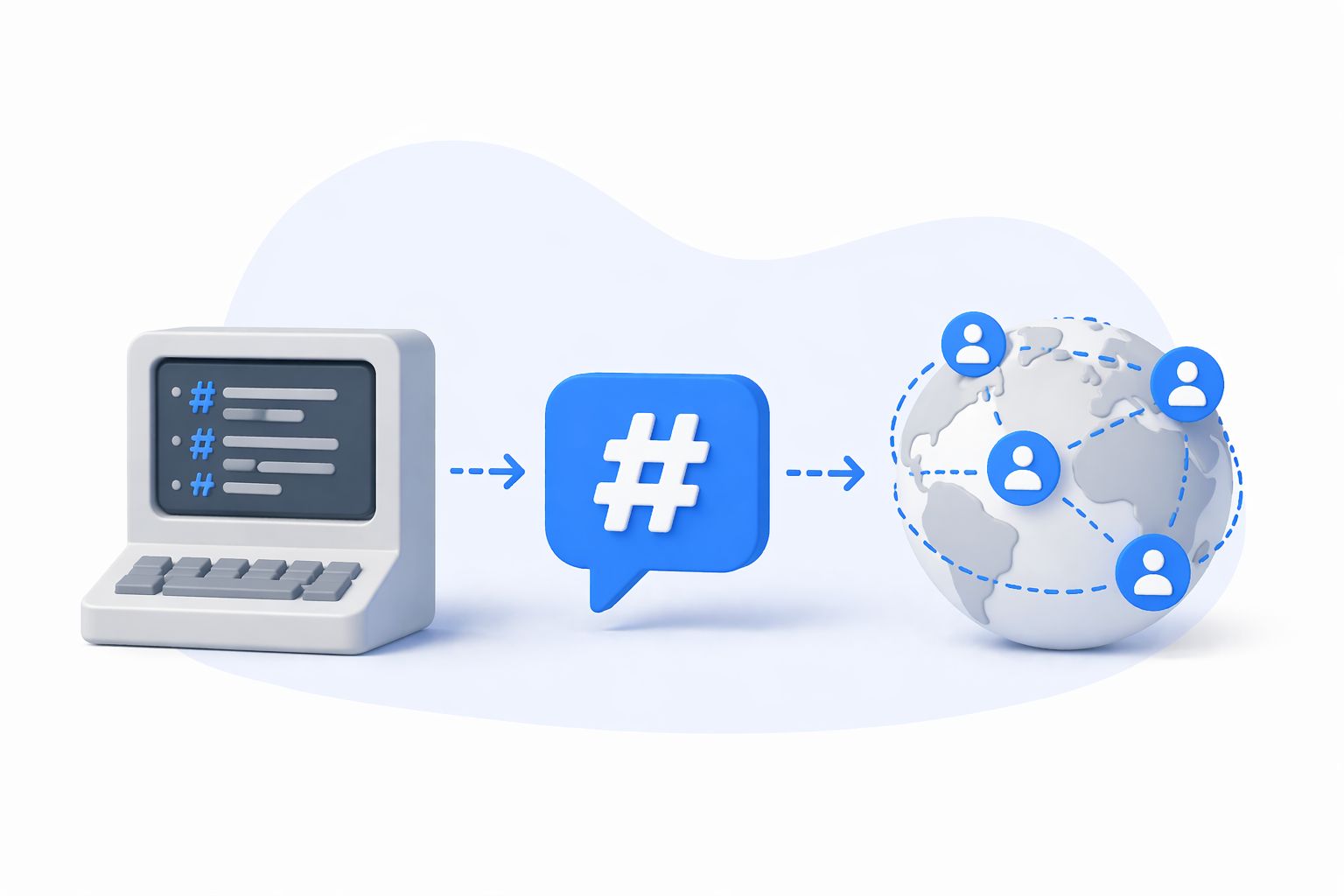
Before Twitter: the # symbol in online spaces
Long before anyone used hashtags for brand campaigns, the # character already had a job. In IRC (Internet Relay Chat) – the predecessor to modern messaging platforms – channels were named with a # prefix. Joining #photography or #coding meant entering a room dedicated to that subject. The symbol was a structural tool for organizing group conversations, not a trend.
That same logic carried forward when social media arrived. The documented history of the hashtag on Wikipedia traces these roots in detail, from IRC conventions through the Twitter era and into current multi-platform use.
2007: Chris Messina’s idea that changed social content forever
On August 23, 2007, a developer and open-source advocate named Chris Messina posted a deceptively simple question on Twitter: “how do you feel about using # (pound) for groups? As in #barcamp?”
His reasoning was practical, not visionary. Twitter at the time had no built-in way to organize conversations. People at events, conferences, or around shared interests had no mechanism to follow a collective thread. Messina proposed borrowing the IRC convention – use # to self-tag content – and letting the community adopt it organically.
Crucially, Messina did not patent the idea. He described it as something “owned by the commons,” which is exactly why it spread. Because no one owned it, every platform could adopt it.
2009: The infrastructure shift
Twitter made hashtags officially clickable in 2009. That single engineering decision turned a user convention into platform architecture. Clicking a tag no longer just showed a search result – it opened a live, updating topic feed. The hashtag stopped being a suggestion and became a navigation system.
By 2010 and 2011, Instagram and other emerging networks had adopted the convention, each adapting it to their own content types and discovery mechanics. What started as one developer’s workaround became one of the defining features of how the internet organizes public conversation.
How Hashtags Actually Work Under the Hood
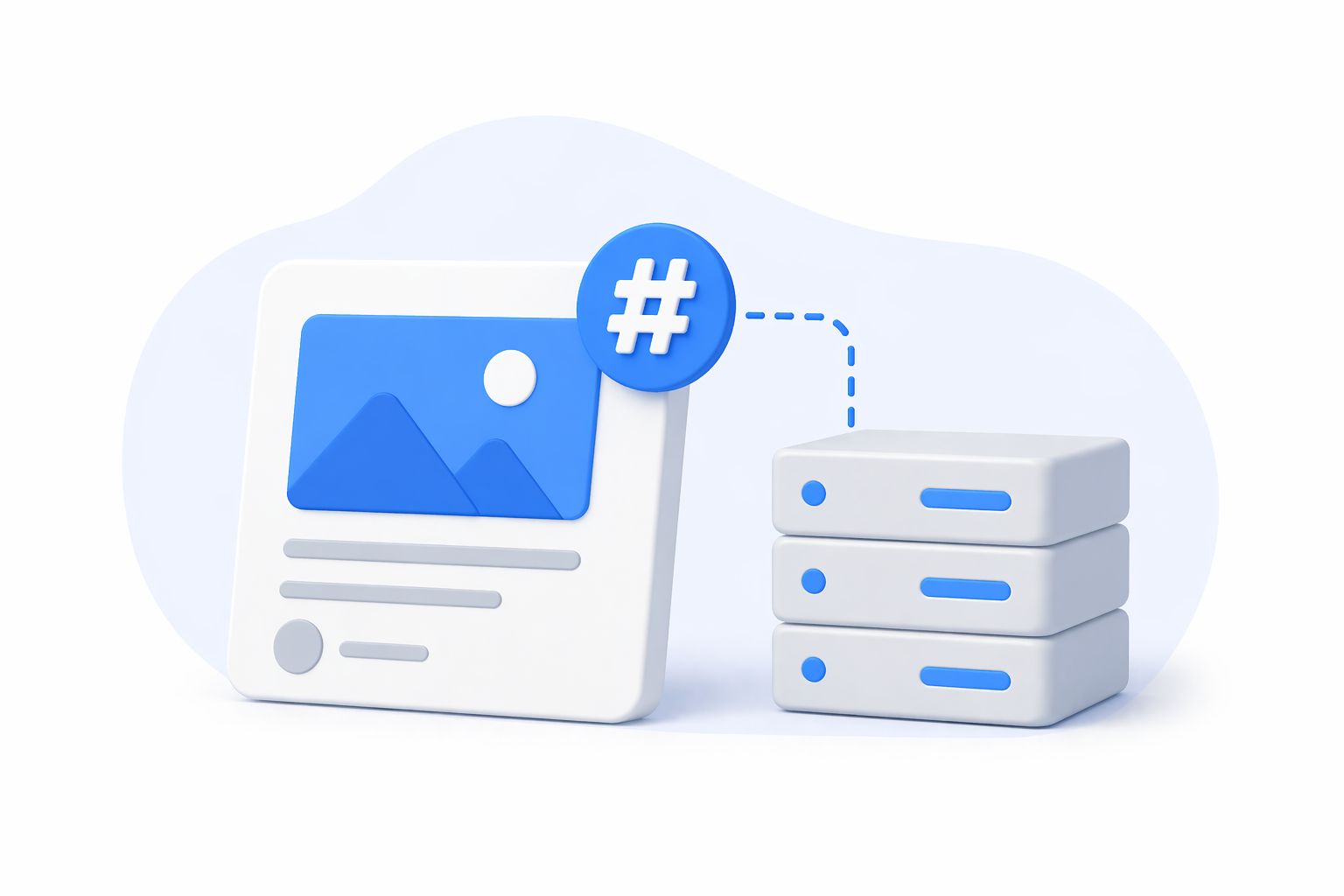
Hashtags as metadata
In technical terms, a hashtag is a form of user-generated metadata – data that describes other data. Your post is the primary content. The hashtag is a secondary layer of information that tells the platform’s indexing system: “this piece of content belongs in this topical bucket.”
When you publish a post with #RemoteWork, the platform’s systems register that term as a topic tag, associate it with your post, and add it to the pool of content surfaced when someone searches or browses that tag.
The four-step discovery loop
Here’s a simplified breakdown of what happens from publish to discovery:
- You publish a post containing
#SustainableFashion - The platform indexes that hashtag as a searchable topic tied to your post
- A user searches or browses
#SustainableFashionon the platform - Your post appears in their topic feed alongside other relevant content
The strength of that final step depends on many factors – account authority, post engagement rate, content quality signals – but the hashtag is the entry point that makes the chain possible.
Why relevance beats volume every time
A common beginner mistake is treating hashtags like lottery tickets: the more you add, the better your odds. The reality is the opposite.
Adding 30 loosely related hashtags to a single post sends diluted signals to the algorithm. It’s harder for the system to classify your content precisely, and it’s more likely to surface your post to audiences who click the tag expecting something different – which drives up bounce rates and suppresses engagement.
A smaller set of highly relevant tags sends a cleaner signal and tends to produce better topic-match quality.
Quick self-audit: For each hashtag on your post, ask: “If someone tapped this tag, would my post feel like a natural fit in that feed?” If the answer is no, remove it.
The role of hashtags alongside AI-driven recommendations
One important evolution in 2026: most major platforms now use AI content understanding to read your captions, analyze visual content, and interpret audio – not just parse your hashtags. This means hashtags are no longer the only classification signal. They remain one signal among several.
For creators, this actually makes hashtag strategy easier. You no longer need to “trick” the system with keyword stuffing. You need to add tags that genuinely reinforce what the rest of your content is already communicating.
Once a post earns engagement through hashtag discovery, the next challenge is turning those interactions into ongoing conversations. The ChatbotX unified inbox is designed specifically for this – helping brands centralize every inbound message from WhatsApp, Messenger, Instagram, and more into one dashboard so no lead from a hashtag-driven post ever goes unanswered.
Hashtag Rules on Every Major Platform in 2026
There is no universal hashtag playbook. Each platform has its own culture, algorithm, and best practices. Here is a current breakdown.
Instagram remains one of the highest-value environments for hashtag-driven discovery. Topic feeds are still active, and niche communities are built around specific tags.
- Recommended count: 5–15 highly relevant tags per post (quality over quantity)
- Placement: Either in the caption or the first comment – both work; choose based on your workflow
- Strategy tip: Mix one broad category tag, several niche-specific tags, and one branded tag per post
- What to avoid: Banned or overused generic tags that spike post views briefly and then flatline
X (formerly Twitter)
On X, hashtags function primarily as conversation connectors rather than discovery tools. The platform’s real-time structure means hashtags are most powerful during live events, trending topics, and news cycles.
- Recommended count: 1–2 per post
- Placement: Woven naturally into the post text, not appended as a block at the end
- Strategy tip: Use event-specific or moment-specific tags; generic ones rarely add value
- What to avoid: Tagging unrelated trending topics to borrow visibility – audiences notice and disengage
LinkedIn’s algorithm has become more sophisticated in recent years, reading full post context rather than relying heavily on hashtags. That said, relevant tags still help with professional topic classification and can surface your content to followers of those tags.
- Recommended count: 3–5 professional, industry-relevant tags
- Placement: End of post body or final lines
- Strategy tip: Use industry language, not consumer slang; LinkedIn audiences respond to professional terminology
- What to avoid: Trendy social tags that don’t translate to a professional context
TikTok
TikTok’s For You Page algorithm is primarily behavior-driven, not hashtag-driven. Watch time, completion rate, shares, and re-watches are the dominant ranking signals. Hashtags play a supporting role in content classification, but they are not the main lever.
A 2024 TikTok hashtag audit found that 28% of high-performing TikTok videos contained no hashtags at all – a significant data point that challenges the assumption that more tags equal more reach on the platform.
- Recommended count: 3–5 if you use them; test zero-hashtag versions too
- Placement: In the caption
- Strategy tip: Test posts with minimal or no hashtags against tagged versions to measure your actual performance difference
- What to avoid: Stacking a dozen broad tags assuming they will drive the For You Page – they won’t
For teams managing Instagram and TikTok accounts simultaneously while also handling customer DMs and comment replies, centralizing those conversations is essential. The ChatbotX omnichannel inbox handles all channels from a single workspace, removing the need to context-switch between platform apps.
Platform comparison at a glance
| Platform | Suggested Count | Primary Function | Key Consideration |
|---|---|---|---|
| 5–15 | Topic discovery, niche communities | Relevance and specificity matter most | |
| X / Twitter | 1–2 | Real-time conversation participation | Timing and trending context are key |
| 3–5 | Professional topic classification | Match industry language exactly | |
| TikTok | 3–5 (optional) | Content context signal | Behavior signals outweigh hashtag signals |
| YouTube | 3–5 | Search and topic surfacing | Use in title and description too |
| 2–5 | Board and search alignment | Keyword-style tags perform best |
Building a Hashtag Strategy That Delivers Results
The three-tier hashtag framework
The most reliable approach to hashtag selection is organizing your tags into three distinct layers, each serving a different purpose.
Tier 1: Broad category tags
These describe the general subject area of your content. Examples: #Marketing, #Fitness, #InteriorDesign.
These tags have massive audience pools, which also means heavy competition. Your content is unlikely to stay visible for long in a broad tag feed. Use them sparingly – one or two per post – primarily to establish category context.
Tier 2: Niche and topic-specific tags
These are the workhorses of any good hashtag strategy. Examples: #B2BContentMarketing, #RunningForBeginners, #ScandinavianMinimalism.
Niche tags attract smaller but more intentional audiences. A person browsing #ScandinavianMinimalism is much more likely to engage meaningfully with a relevant post than someone scrolling a generic #HomeDecor feed. These tags drive quality discovery over raw volume.
According to Sprout Social’s in-depth hashtag guide, mid-range hashtags consistently outperform oversized ones for accounts that are still building their reach – because the competition is lower and the audience intent is more specific.
Tier 3: Branded and campaign tags
These are custom tags unique to your brand, product line, or content series. Examples: #YourBrandName, #CampaignName2026, #WeeklyTipSeries.
Branded tags don’t generate discovery on their own until they have audience adoption. Their real value is in organizing your own content ecosystem, enabling user-generated content campaigns, and making it easy to track a campaign’s reach over time.
How to research the right hashtags
Step 1: Start with your audience, not the topic. Ask yourself what your target audience searches for, not just what you’d call your content. A nutritionist’s audience might search #GutHealthTips more than #Nutrition.
Step 2: Browse competitor content. Look at high-performing posts from accounts in your niche. Note which tags appear repeatedly and which seem to drive strong engagement.
Step 3: Check tag volume on the platform. Most platforms show post counts when you search a hashtag. Use this to gauge competition level and audience size.
Step 4: Build sets, not one-offs. Instead of picking hashtags fresh for every post, create 4–6 pre-built tag sets aligned to your main content categories. This makes publishing faster and more consistent.
Step 5: Rotate and test. Avoid using the identical tag block on every post. Platforms may deprioritize repetitive hashtag patterns. Rotate between your sets and track which combinations perform best.
Once your hashtag strategy is bringing in new followers and inbound messages, the next challenge is managing that engagement at scale. ChatbotX is an open-source omnichannel platform that lets brands automate first responses, segment contacts, and run follow-up campaigns across WhatsApp, Messenger, and Instagram – so every person who discovers you via a hashtag receives a timely, relevant reply.
What makes a hashtag underperform
Several patterns reliably produce poor hashtag results:
- Using oversaturated tags – your post disappears within seconds into a feed of millions
- Mismatched tags – confusing the algorithm and delivering your content to the wrong audience
- Copying competitor tag lists blindly – their audience fit may not match yours
- Using the same set on every post forever – reduces variety signals and can create a stale pattern
- Treating tags as an afterthought – deciding them in 10 seconds right before publishing means they’re rarely well-considered
Integrating Hashtags Into Your Publishing Workflow
Strategy only matters if it survives daily execution. The gap between a good hashtag plan and actual publishing is where most teams lose consistency.
Build a hashtag library by content pillar
Map your recurring content categories and create a pre-approved tag set for each. For example:
| Content Pillar | Sample Tag Set |
|---|---|
| Educational how-to posts | #HowTo[Topic] + 3–4 niche tags + 1 branded tag |
| Behind-the-scenes content | #BTS[Industry] + process-specific niche tags |
| Product or service highlights | Category tag + product-specific niche tags + branded tag |
| Community and engagement posts | Audience-language tags + campaign tag |
With a library in place, the publishing team selects the right pre-built set rather than inventing tags from scratch under deadline pressure.
Test systematically, not randomly
If you want to improve hashtag performance, set up a simple A/B rhythm. Over a two-week period, alternate between two different tag sets for the same content pillar. Compare engagement rate, reach to non-followers, and profile visits. Over time, patterns emerge that are specific to your audience – not generic best practices from articles written for everyone.
Caption placement vs. first comment – settle this debate
This question comes up constantly, especially for Instagram. The practical answer: it does not significantly affect reach or discovery. Both placements work. The right choice depends on your team’s workflow.
If your captions are already long and you want a cleaner reading experience, first comment keeps the caption visually uncluttered. If your team publishes fast and scheduling tools are involved, keeping everything in the caption is simpler and reduces the chance of forgetting to post the comment.
Pick the approach your team will execute consistently. Inconsistent execution hurts performance far more than caption vs. comment placement.
From hashtag discovery to real conversations
Hashtags are the first step – they bring people to your content. What happens next determines whether that traffic converts. When a new follower DMs your brand after discovering you via #SustainableFashion, your response time and quality matter enormously.
This is where ChatbotX AI Agents become relevant for social-first businesses. Rather than letting inbound DMs stack up, AI agents can respond instantly with relevant information, capture lead details, and route complex queries to the right human agent – all without your team needing to monitor every channel manually.
For brands running large-scale hashtag campaigns where awareness is high but follow-through needs automation, ChatbotX broadcast messaging allows you to follow up with opted-in contacts at scale across WhatsApp, Messenger, and more – turning a hashtag campaign into a measurable conversion flow.
Connect social touchpoints to your CRM
A common gap in social media strategy is that hashtag-driven traffic generates DMs and comments that never make it into a structured sales or support pipeline. For teams that want to fix this, the Facebook Messenger CRM integration guide for 2026 on ChatbotX explains step-by-step how to connect conversation data from social channels directly to your CRM – so every hashtag-sourced lead is tracked, scored, and followed up systematically.
Schedule reviews to retire stale tags
Tag communities evolve. A hashtag that drove strong discovery 12 months ago may be inactive, over-saturated, or associated with content that no longer reflects your brand. Build a quarterly review into your workflow to audit your tag library and replace underperforming or irrelevant sets.
Frequently Asked Questions

Are hashtags still worth using in 2026?
Yes – selectively. Hashtags are no longer the single most important discovery signal on most platforms, but they remain one useful signal among several. On platforms like Instagram, they still support niche topic discovery. On LinkedIn, they help with professional classification. On TikTok, they play a supporting role. The key shift is moving from “add as many as possible” to “add the right ones for each specific post and platform.”
Do hashtags cause shadowbanning?
The evidence for this is largely anecdotal. What is consistently documented is that using irrelevant, spammy, or banned hashtags can send poor quality signals to an algorithm – which may result in reduced distribution to non-followers. The safest approach is straightforward: use tags that accurately describe your content, avoid banned tags, and don’t repeat the identical tag block on every single post indefinitely.
How many hashtags should I use per post?
It varies by platform (see the comparison table above), but a general principle holds across all of them: a small set of highly relevant tags outperforms a large set of loosely related ones. For most platforms, 3–10 well-chosen tags will outperform 20–30 generic ones.
Should I use hashtag generator tools?
Generator tools are useful for discovering tags you haven’t considered – especially niche phrases or community-specific language you might miss. Their weakness is that they don’t understand your specific audience, post context, or brand voice. Treat any generator output as a starting shortlist, not a final decision. Always review and filter manually before publishing.
The Hootsuite guide on how to use hashtags effectively walks through a practical evaluation method for assessing a tag community before committing to it – a useful step that most teams skip.
How do I know if a hashtag is working?
Most platforms provide post-level analytics that show how many impressions came from hashtag discovery (sometimes labeled “from hashtags” or “hashtag reach”). Monitor this metric over 2–4 weeks for posts using a specific tag set. If hashtag-driven impressions are consistently low or declining, rotate to a different set and compare.
Can I use hashtags on platforms that don’t highlight them visually?
Yes. Even on platforms where hashtags are less visually prominent – like YouTube or Pinterest – they still function as indexing signals in the backend. Including 3–5 relevant tags in descriptions or captions on these platforms can support search visibility without cluttering the visual presentation.
How does hashtag strategy connect to broader social marketing tools?
Hashtags solve the discovery problem, but discovery is just the beginning. If you’re evaluating how tools compare for managing the full social marketing cycle – from content discovery to automated follow-up – the ChatbotX alternatives comparison page offers a clear breakdown of how different platforms (ManyChat, Chatfuel, Wati, Respond.io) approach the challenge, and where a more flexible, open-source option fits.
Final Takeaway
A hashtag is one of the most durable tools in social media – not because it’s magic, but because it solves a persistent, practical problem: how does a post find an audience that’s already interested in its topic?
In 2026, the mechanics are more nuanced than they were in 2007. Algorithms are smarter, platforms are more differentiated, and audience behavior is harder to predict. But the core logic of the hashtag hasn’t changed. A relevant, well-placed tag still creates a pathway between your content and the people most likely to care about it.
The creators and brands winning at hashtag strategy share one habit: they treat tag selection as a targeting decision, not an afterthought. They research, test, iterate, and build systems – instead of copying lists and hoping for viral results.
One final tool worth knowing as you scale this approach: ChatbotX is an open-source, agentic omnichannel chat marketing platform that connects WhatsApp, Messenger, Instagram, Zalo, Telegram, and Webchat into a single workspace. Once your hashtags start driving discovery and inbound DMs, ChatbotX lets you automate first responses with AI agents, segment leads by behavior, and launch broadcast campaigns to opted-in contacts – without your team being stretched across every platform simultaneously. It’s the infrastructure layer that sits between “someone discovered you via a hashtag” and “that person becomes a paying customer.” You can start for free and scale without vendor lock-in.
Start with smart hashtags to get found. Use the right automation to make sure every discovery counts.