Ask any content creator, marketing manager, or solo entrepreneur where the real pain lives, and they’ll all point to the same place: the brutal stretch between having a great idea and shipping the finished asset. Recording, editing, formatting, captioning, scheduling – every step demands attention, expertise, and time that most teams simply don’t have.
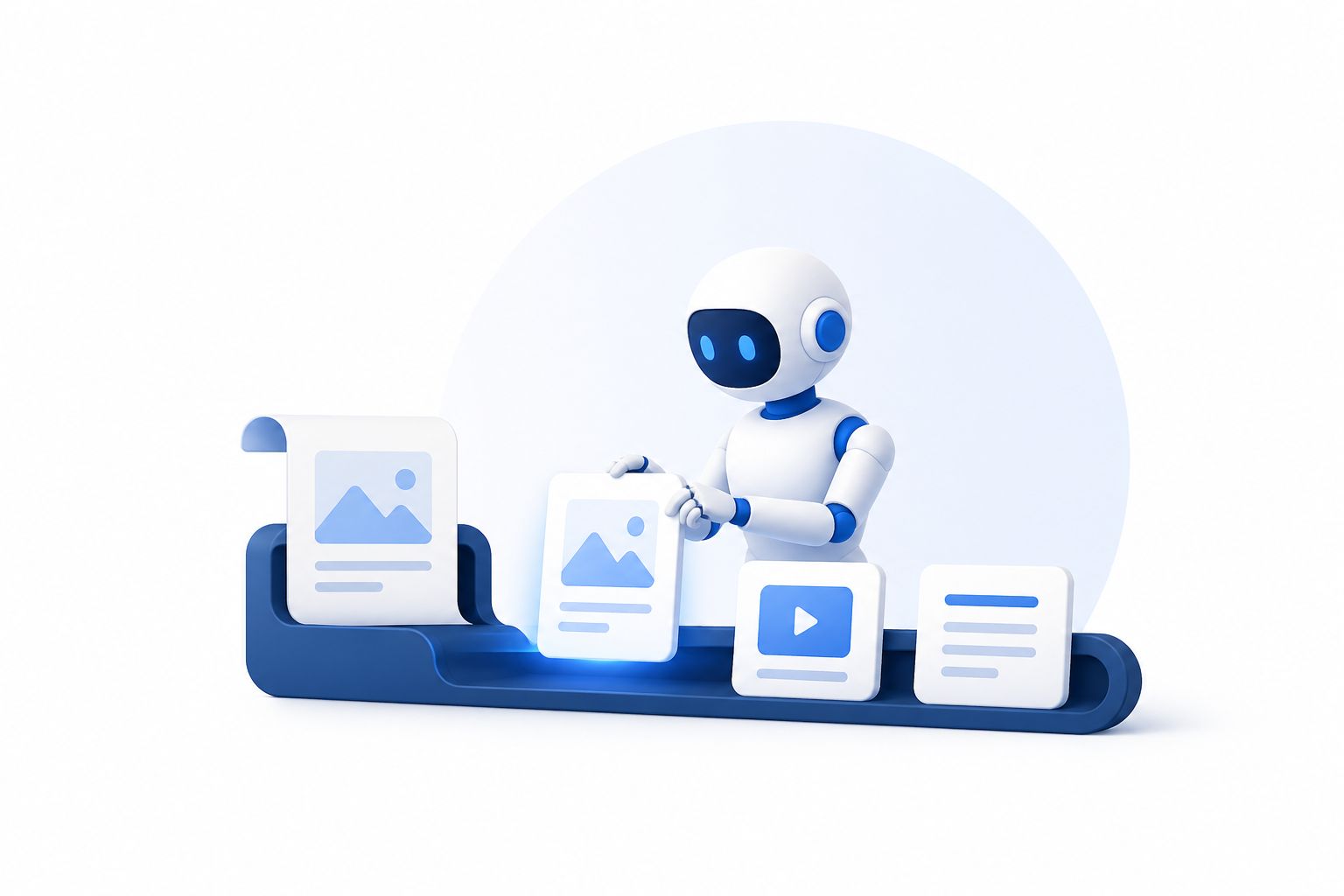
That long, grinding middle is now disappearing. Not because AI tools can suddenly do creative work better than humans, but because AI agents can now coordinate the entire production chain autonomously – handling every handoff, API call, and file transfer while you focus on what actually requires your judgment.
This is not incremental improvement. It’s a structural change in how content gets made.
Launch agentic chat marketing in minutes with ChatbotX














1. What Changed: From AI Tools to AI Agents
For the past few years, “AI for content” meant one thing: a text generator you prompted, edited, and then copy-pasted into your workflow. Useful, but fundamentally passive. You still had to glue every stage together manually.
The shift happening right now is categorically different. Agentic AI describes systems that don’t just respond to a prompt – they pursue multi-step goals, make decisions mid-task, call external tools, recover from failures, and loop back until the objective is complete. According to Gartner, agentic AI represents one of the top strategic technology trends of 2025–2026 precisely because it moves automation from single-shot tasks to end-to-end workflows.
In the context of content creation, this distinction matters enormously. A tool can generate a script. An agent can take that script, produce a voice-over, synchronize it to a video avatar, overlay motion graphics, and deposit the finished file into your distribution queue – all without a single human action in between.
The question is no longer “which AI tool should I try?” It’s “how do I wire these capabilities together into a pipeline that runs itself?”
Related reading: How AI Is Reshaping Workflow Automation for Modern Businesses →
2. The Core Tech Stack Powering Autonomous Production
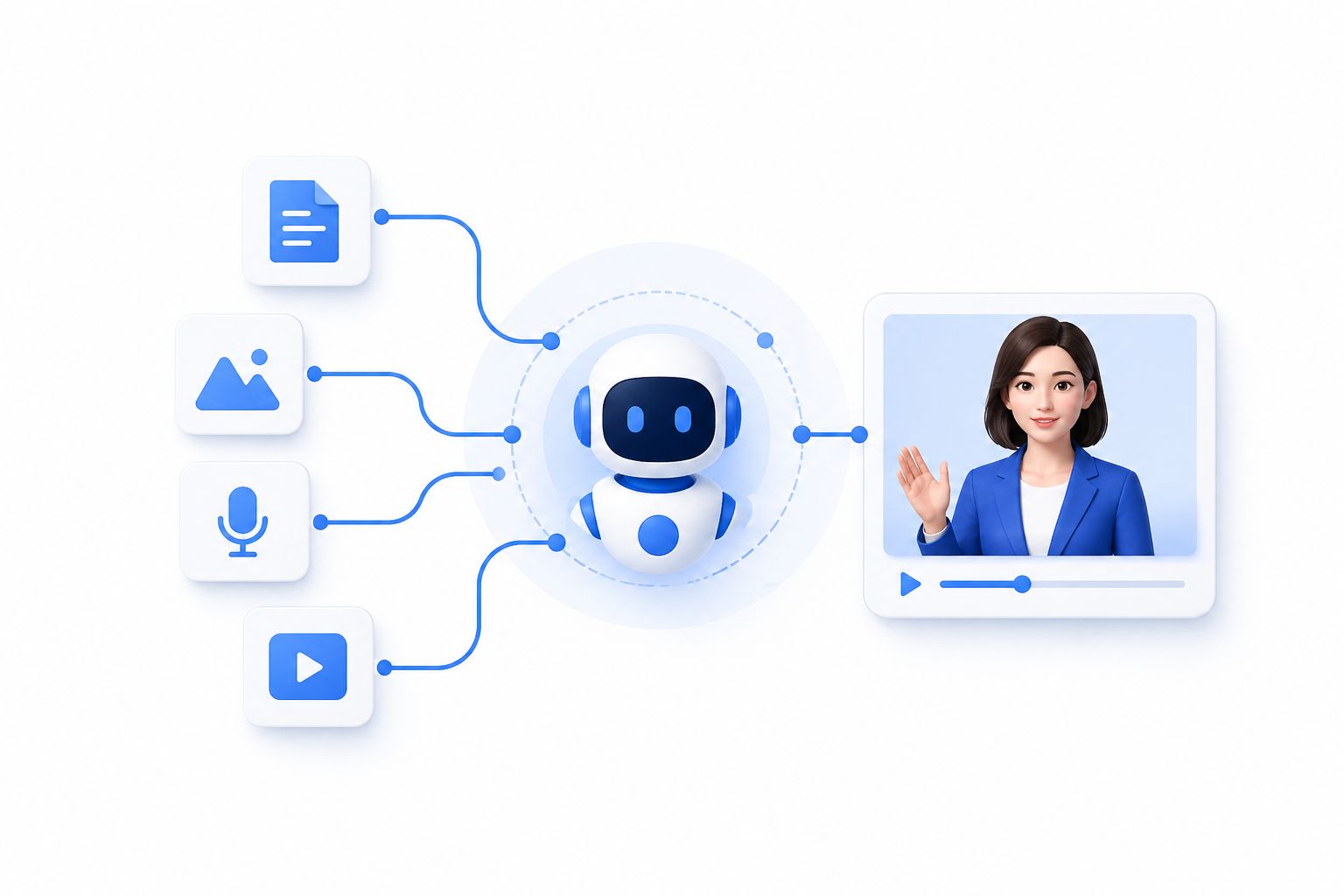
Modern agentic content pipelines are built from a small number of specialized components – each excellent at exactly one task, and none of them requiring the others to function. The agent’s job is to be the connective tissue.
Avatar & Visual Layer
AI-generated video avatars have matured dramatically. Current models can produce a convincing digital twin from a brief recorded clip, capturing subtle facial cues – micro-expressions, natural eye movement, minor head shifts – that earlier versions made look robotic. For educational content, training videos, and facecam-style tutorials, this has crossed the threshold from “interesting experiment” to “production-viable.”
The critical variable is how you supply source footage. A short clip yields a serviceable avatar. Hours of real broadcast footage yield something that’s increasingly difficult to distinguish from the real presenter in a standard viewing context.
Voice Synthesis Layer
High-quality voice cloning has similarly crossed a practical threshold. With sufficient training audio, modern synthesis engines reproduce speaker inflection, pacing, and even characteristic hesitations convincingly enough for most content formats.
One operational constraint that experienced pipeline builders have flagged: voice synthesis quality tends to degrade noticeably when a single generation request runs beyond roughly 60 seconds. The practical workaround is to chunk the script at natural sentence breaks into segments of 45–60 seconds each, process them individually, and stitch the results together downstream. This constraint actually shapes the entire downstream pipeline architecture – it sets the natural “unit size” that every subsequent step is designed around.
Programmatic Video Editing
Remotion and similar code-driven editing frameworks allow you to define an entire video edit – timed text overlays, animated graphics, transition logic, caption rendering – as a configuration file rather than a manual timeline. Feed it a transcript with timestamps and it synchronizes visual elements to the exact spoken word automatically. For content that follows repeatable formats (tutorials, explainers, product demos), this removes the editing stage from the human workload entirely.
The Orchestration Model
None of these layers communicate with each other natively. An LLM-based orchestrator – typically accessed via an agent framework like Claude Code or similar – acts as the project manager: reading the script, calling each API in the right sequence, passing outputs from one stage as inputs to the next, handling errors, and completing the job.
Explore further: Explore AI Agent Resources & Guides on the ChatbotX Blog →
3. How an AI Agent Actually Runs the Pipeline
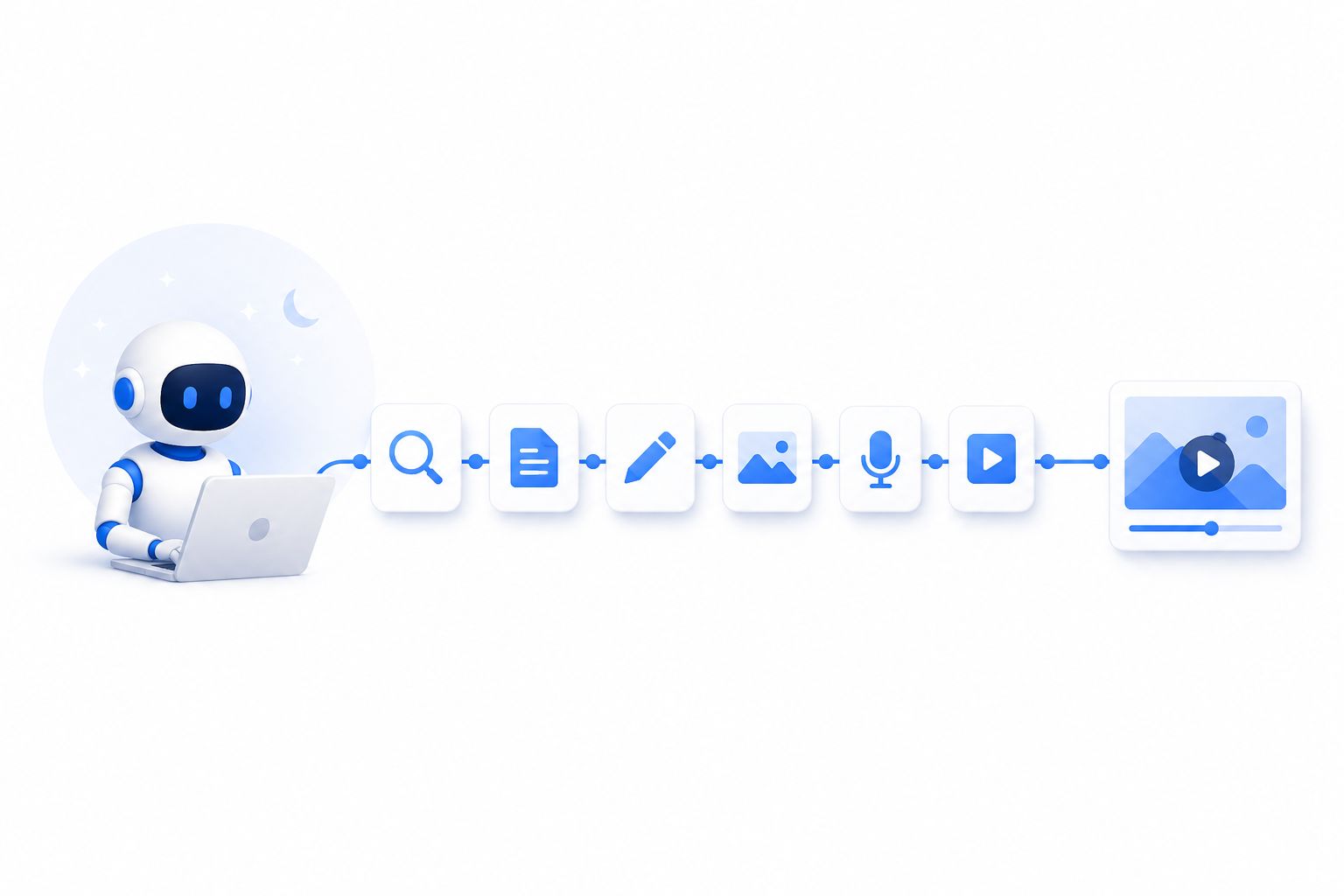
Here’s where the abstraction becomes concrete. When someone says an AI agent “runs the content pipeline overnight,” what is it literally doing?
A single lesson or episode might follow this execution sequence:
Step 1 – Source retrieval. The agent reads the script from a designated location (cloud storage, a Google Drive folder, a project management tool).
Step 2 – Chunking. It splits the text at sentence boundaries into segments sized within the 45–60 second voice-synthesis sweet spot.
Step 3 – Audio generation. Each chunk is sent to the voice synthesis API. The agent collects the audio files as they complete and checks each one for drift or quality issues before proceeding.
Step 4 – Avatar rendering. Each audio file is fed into the video avatar system with the configured visual identity. If the preferred model isn’t available via API for a particular request, the agent can spin up a browser automation script – Playwright, Puppeteer – to interact with the dashboard interface directly: navigating to the project, selecting the right model version, triggering the render, and downloading the output.
Step 5 – Assembly. Finished clips are passed to the programmatic editor along with a timestamped transcript. Motion graphics, lower thirds, and captions render automatically.
Step 6 – Output. A single finished video file is deposited in the delivery folder or immediately handed to the distribution layer.
The remarkable thing about this sequence is not its technical sophistication – each individual step is straightforward. What’s remarkable is that this entire sequence used to require four to six different people: a recording operator, an audio engineer, an avatar artist, a video editor, a producer, and a scheduler. The agent doesn’t replace any of them individually. It replaces the coordination layer that connected them, which was always the most expensive and time-consuming piece.
According to McKinsey’s State of AI research, workflow orchestration and cross-functional automation represent the highest-value AI use cases for businesses in 2025–2026 – precisely because eliminating coordination overhead compounds savings across every downstream stage.
Learn how to automate your content workflow: Explore ChatbotX Features for Marketing & Content Automation →
4. The Real Bottleneck Has Shifted — And So Has the Work

Understanding what changes here requires understanding what was the bottleneck before.
Production was the wall. For most creators and teams, the constraint on output volume wasn’t ideas – it was the physical reality that recording, editing, and publishing a ten-minute video took most of a day. So strategy was shaped by production capacity. You picked the one idea per week you could actually ship, and you optimized everything else around that constraint.
When production collapses to an overnight batch job, the entire logic inverts.
Suddenly you can ship five pieces for every one you shipped before. But that doesn’t automatically make the output better – and this is the failure mode that’s easy to miss. An efficiently produced bad idea is still a bad idea. A polished avatar reading mediocre content generates mediocre results faster.
The bottleneck moves upstream – into the idea itself, into the angle, into the editorial judgment about what deserves to exist in someone’s feed. Human creative direction doesn’t become less important when production becomes cheaper. It becomes the differentiator, because everything else has been commoditized.
This has a significant implication for content teams: the people you need aren’t fewer. Their skills need to shift. The premium moves from execution skills (editing, recording, post-production) toward strategy skills (audience insight, idea quality, distribution intelligence). Teams that recognize this will reallocate resources effectively. Teams that don’t will produce more content that nobody reads.
Related reading: Discover Smart Content Strategies on the ChatbotX Blog →
5. The Honest Cost Breakdown
AI tool marketing has a tendency to lead with the exciting capability and bury the realistic total cost. Here’s a more grounded picture of what a full agentic content pipeline actually costs per month.
| Component | Estimated Monthly Cost |
|---|---|
| Avatar generation (mid-tier plan) | $30–$50 |
| Voice synthesis (creator tier) | $20–$25 |
| AI orchestration model (usage-based) | $20–$200 |
| Avatar API calls (per-video) | $4 per minute of output |
| Programmatic editor (open-source or hosted) | $0–$30 |
| Total range | $70–$300+ |
A fully loaded pipeline, with meaningful API usage volume, lands somewhere in the $200–$300/month range before per-video variable costs.
That number needs to be compared honestly. A freelance video editor charges between $35 and $75 per hour in most markets. A ten-minute polished tutorial – recorded, edited, captioned, and exported – typically represents three to six hours of skilled work, plus your own recording time. Traditional production for a single video easily exceeds $250–$400. The pipeline replaces that cost with a fixed monthly overhead plus a $30–$50 per-video API spend.
At a production volume of eight or more videos per month, the economics favor the pipeline. Below that volume, the savings are less dramatic, but the speed advantage – overnight turnaround versus multi-day production cycles – often justifies the cost independently.
There’s also a subtler value that doesn’t appear in cost spreadsheets: repeatability. A pipeline that runs consistently produces consistent output quality, at consistent volume, without depending on the availability of specific freelancers or the capacity of an in-house team. For businesses treating content as a compounding asset rather than one-off campaigns, that reliability has substantial strategic value.
6. Distribution: The Stage That Breaks Most Pipelines
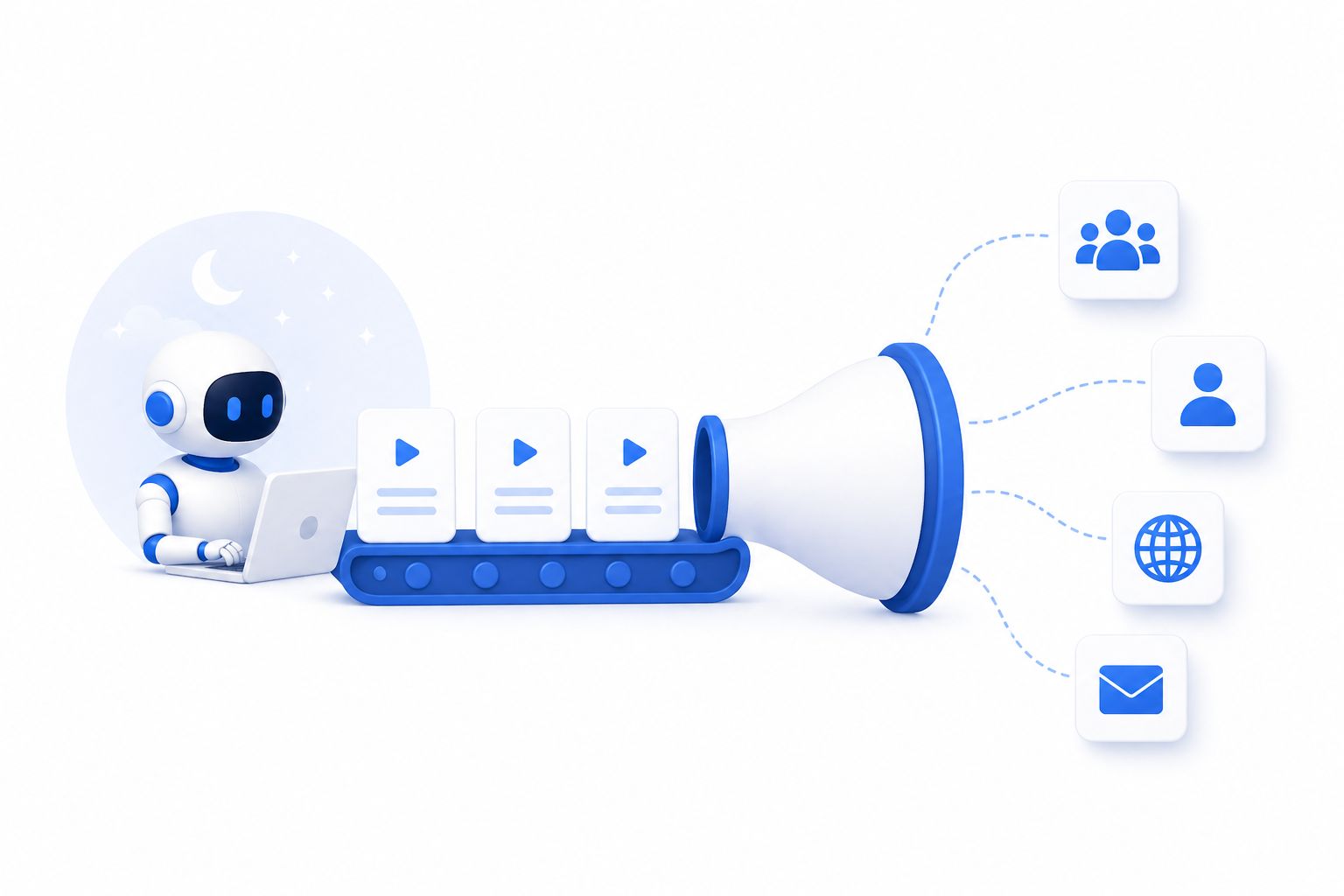
Here’s the step that most pipeline discussions skip, and it’s the one where the gains most often disappear.
You’ve built an automated production workflow. The agent processes scripts overnight. A finished video file appears in your output folder by morning. What happens next?
For most teams, what happens next is that someone – usually whoever was supposed to be freed up by all this automation – opens LinkedIn, then YouTube, then TikTok, then Instagram, and manually uploads the same file five or six times. They write platform-specific captions by hand. They pick posting times based on intuition.
This is not a small problem. HubSpot’s State of Marketing report consistently identifies manual content distribution as one of the top time sinks for marketing teams – consuming hours each week that should be directed toward strategic work.
The answer is to treat distribution the same way you treated production: make it programmable. The finished video shouldn’t land in a folder waiting for a human to pick it up. It should flow directly into a distribution layer that the same agent can orchestrate.
For content teams thinking about their own stack, this means evaluating distribution platforms on whether they expose a proper API and support programmatic scheduling across the channels that matter – not just whether they have a nice-looking calendar UI. The goal is for the agent that assembled the video to also be the agent that schedules and cross-posts it.
See how ChatbotX helps automate your content distribution workflow: ChatbotX – AI Automation for Content Teams →
7. What the End-to-End Pipeline Looks Like in Practice
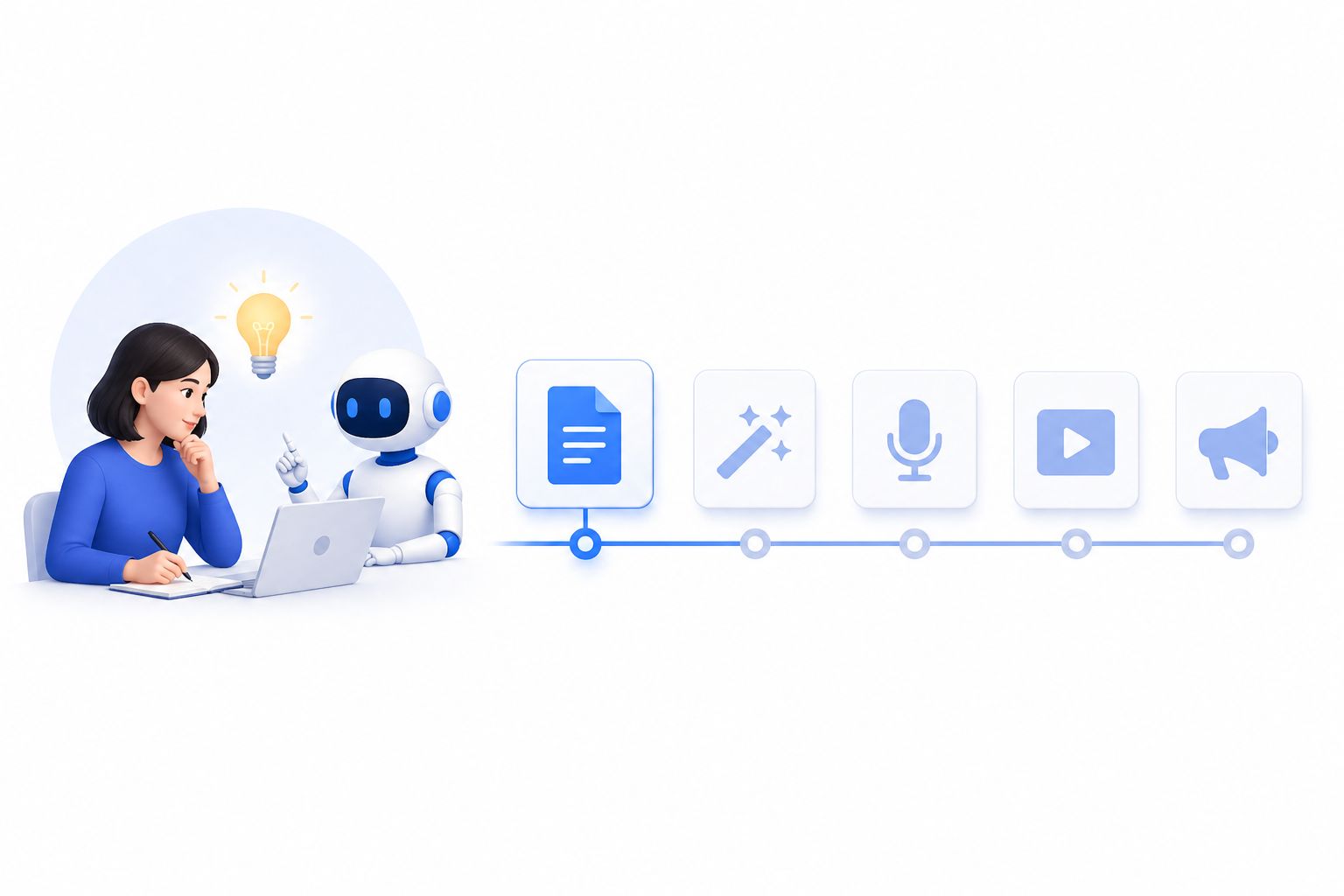
Pulling everything together, a production-ready agentic content pipeline has five stages, each designed to hand off cleanly to the next with minimal human touchpoints.
Stage 1: Idea Capture and Brief
This is where human judgment does its most important work. Topic selection, audience targeting, competitive angle, narrative frame – none of this should be delegated. Voice memos, a Notion doc, a short Loom recording – whatever format works for you. The brief is the contract between your creative thinking and everything the pipeline will produce downstream.
Stage 2: Script Development
AI assistance is genuinely useful here as a drafting accelerator – generating structure outlines, expanding bullet points, checking logical flow. But the final script should carry your perspective, your examples, and your editorial stance. A script that reads like a committee document performs like one.
Stage 3: Automated Production
The AI agent takes over here. It chunks the script, synthesizes the voice, renders the avatar, applies programmatic editing, and outputs a finished video file. This stage runs unattended – overnight, while you’re in another meeting, or across the weekend for a batch of episodes.
Stage 4: Automated Distribution
The finished file flows from the production agent directly to your distribution system via API. The same agent – or a coordinated downstream agent – schedules the content across platforms, applies per-channel caption formatting, and queues posts at times informed by historical engagement data.
Stage 5: Performance Feedback Loop
Analytics from published content inform the next iteration of Stage 1. Which topics drove the highest completion rates? Which formats generated the most shares? Which distribution times correlated with better organic reach? This feedback loop is what distinguishes a pipeline from a conveyor belt: it gets smarter over time.
Build your feedback loop with AI: Read More About AI-Powered Audience Engagement on the ChatbotX Blog →
The teams who will compound their advantage over the next 18 months are the ones building this loop now – not because the individual tools are inaccessible to competitors, but because the data advantage and the iteration speed they develop will be very difficult to replicate later.
8. Conclusion: Where Human Judgment Still Wins

There’s a version of this article that ends with “AI is taking over content creation and human creators are doomed.” That version is wrong.
What’s actually happening is more precise, and more interesting: the mechanical coordination work – the scheduling, the file transfers, the format conversions, the upload sequences – is being absorbed into agentic tooling. The work that required humans primarily because something had to do it is being automated away.
What’s left is the work that required humans because it required judgment – taste, curiosity, empathy with an audience, the editorial instinct that separates content that matters from content that merely exists.
Better cameras didn’t make better films. They made it possible for people with vision to execute that vision without fighting the equipment. Agentic production pipelines are doing the same thing for content at scale. The constraint moves upstream, and whoever has developed the strongest creative and strategic judgment will benefit most from the production constraint being removed.
The creators who thrive in this environment will be the ones who build pipelines, not just pieces. Who think in systems, not just sessions. Who treat their content operation as an asset that compounds – with every iteration making the next one sharper, faster, and more aligned with what their audience actually needs.
A Note on ChatbotX
If you’re building or scaling a content operation and looking for an AI layer that helps you understand your audience, automate conversations, and turn published content into ongoing engagement – ChatbotX is worth exploring.
ChatbotX is designed for businesses and content teams that want intelligent automation without the engineering overhead. It connects the dots between what you publish and how your audience responds – turning passive readers into active conversations, and turning those conversations into data that makes the next round of content sharper.
Whether you’re running a solo creator pipeline or managing content operations for a growing team, the ChatbotX blog covers the tools, strategies, and frameworks worth knowing as agentic workflows become the default.
The pipeline doesn’t end when the video publishes. The best content operations are the ones where publication is the beginning of the conversation – and that’s exactly where AI-powered engagement tools earn their place.
Frequently Asked Questions

What is an AI content creation pipeline? An AI content creation pipeline is an automated workflow in which artificial intelligence tools handle multiple sequential stages of content production – scripting, voice generation, video rendering, editing, and distribution – with minimal manual intervention between stages.
How much does it cost to build an agentic video production pipeline? A functional pipeline using voice synthesis, avatar generation, and programmatic editing typically costs between $70 and $300 per month in platform fees, plus variable API costs of roughly $4–$6 per minute of finished video output.
Do AI agents replace human content creators? No. AI agents replace the mechanical coordination work between production stages. The creative judgment – ideation, audience understanding, editorial direction – remains a distinctly human contribution and becomes more strategically valuable as production becomes more automated.
What is the “voice synthesis drift” problem? When AI voice generation processes audio segments longer than approximately 60 seconds in a single request, the output often begins to drift in pitch, pacing, or timbre. Experienced pipeline builders work around this by chunking scripts into 45–60 second segments and synthesizing each one independently.
How do AI agents handle errors during production? Well-designed agent orchestration includes branching logic for common failure scenarios – retrying failed API calls, switching to an alternative tool when a preferred one is unavailable, and flagging unresolvable errors for human review rather than silently producing corrupted output.
This article is part of the ChatbotX content series on AI automation and intelligent content workflows. Explore more at ChatbotX.io