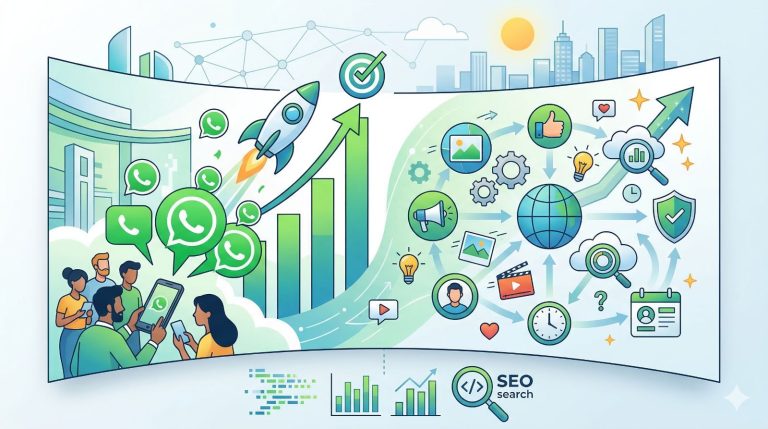

A Facebook content strategy for businesses is a structured plan to attract the right audience, increase engagement, and convert content into measurable results like leads and sales.
In 2026, success depends on combining short-form video, consistent posting, and data-driven optimization – not random updates. This guide shows you how to build, execute, and scale a strategy that delivers tangible ROI.
Launch agentic chat marketing in minutes with ChatbotX









Why Most Business Facebook Pages Are Stuck

There’s a pattern that almost every business owner recognizes: they open Facebook, write something, hit publish – and then nothing happens. A handful of likes, maybe a comment from their cousin, and then silence.
The problem isn’t Facebook. The problem is the absence of a real Facebook content strategy for businesses.
A proper strategy is far more than a posting schedule. It’s a deliberate system for connecting the right message to the right people at the right moment – and then doing it repeatedly, with intention, until it compounds into actual business results. We’re talking website traffic, inbound leads, brand authority, and a community of people who genuinely care about what you do.
Facebook Is No Longer a Social Network – It’s a Discovery Platform
This is the shift most businesses miss. Facebook has fundamentally changed. With over 3.07 billion monthly active users, it is no longer primarily a place where people catch up with friends. The algorithm has evolved into an interest-based recommendation engine, similar in behavior to TikTok or YouTube’s recommendation system.
To truly understand what’s driving this shift, it’s worth reading our in-depth breakdown of how Facebook’s interest-graph algorithm distributes content – and how to beat it in 2026 – including the specific signals Facebook uses to decide what content gets distributed and to whom.
That means content from pages a user has never followed can now appear prominently in their feed – if that content earns strong engagement signals. For businesses, this represents an enormous opportunity. Your potential audience is no longer capped by your follower count.
| What Facebook Used to Be | What Facebook Is in 2026 |
|---|---|
| A social graph – content from people you know | An interest graph – content matched to what you care about |
| Reach limited to your existing followers | Viral potential to audiences who’ve never heard of you |
| Measured by follower growth | Measured by engagement depth and content relevance |
| Text updates and link shares dominated | Short-form video (Reels) and interactive formats lead |
Understanding this distinction is the foundation of everything. If you still treat Facebook like a digital bulletin board where you pin announcements, you’ll keep getting minimal results. The businesses winning on Facebook in 2026 are treating it like a content media brand, not a marketing channel.
The Real Cost of Posting Without a Strategy
Random posting isn’t just ineffective – it’s actively damaging. Inconsistency trains the algorithm to deprioritize your page. Content that doesn’t match your audience’s interests signals irrelevance. And without clear goals, you have no way to improve because you don’t even know what “better” looks like.
A structured Facebook content strategy solves all three problems at once. It gives you a repeatable system, audience clarity, and measurable benchmarks. Tools like ChatbotX are built to make this system manageable – from planning your content calendar to scheduling and analyzing performance from one centralized dashboard.
Setting Goals and Understanding Your Audience

Before you write a single caption or film a single Reel, you need two things locked in: a clear destination and a precise map of who you’re guiding there. Without these, every post you create is essentially a guess wrapped in effort.
Define Goals That Connect to Real Business Outcomes
The biggest mistake businesses make is chasing metrics that feel good but don’t mean anything. Follower counts and post likes are not business results. Revenue, leads, and website traffic are.
Use the SMART framework to set goals that drive action:
- Specific – Define exactly what you want to achieve
- Measurable – Attach a number to it
- Achievable – Set an ambitious but realistic target
- Relevant – Connect it to a real business priority
- Time-bound – Give it a deadline
Here’s what that looks like in practice:
| Vague Goal | SMART Goal |
|---|---|
| “Get more engagement” | “Increase average post engagement rate from 1.2% to 2.5% within 90 days by testing Reels and interactive polls” |
| “Grow our following” | “Add 500 targeted followers in Q2 by publishing 3 Reels per week targeting homeowners aged 30–50” |
| “Drive website traffic” | “Generate 300 Facebook referral sessions per month to our blog by promoting one new article every Tuesday and Thursday” |
| “Build community” | “Grow our Facebook Group from 400 to 800 active members within 60 days using weekly live Q&A sessions” |
Each of these goals tells you exactly what to create, who to target, and whether your strategy is working.
Research Your Audience Beyond Demographics
Demographics – age, gender, location – are just the starting point. The businesses that build the most engaged Facebook communities go deeper. They understand their audience’s daily frustrations, aspirations, decision triggers, and content preferences.
Start with Meta Business Suite Audience Insights – Facebook’s official analytics dashboard. This tool reveals who’s already engaging with your page, what other pages they follow, and when they’re most active. Pay special attention to the “Pages Also Liked” section – it shows you exactly what competing interests your audience has, which is gold for content ideation.
Then layer in these additional research methods:
- Comment mining: Read through your most engaged posts and look for the exact language your audience uses to describe their problems
- Competitor analysis: Identify which posts on similar pages generate the most shares – shares are the highest-value engagement signal on Facebook
- Customer interviews: Talk to your five best customers and ask them what they wish they knew before buying from you
Pro Tip: The most powerful content answers questions your audience is actively asking. If you can identify those specific questions through research, you’ll never struggle for ideas.
Build Buyer Personas That Drive Creative Decisions
Once you’ve gathered your research, compress it into 2–3 vivid buyer personas. A good persona isn’t a demographic chart – it’s a character sketch that makes your content decisions feel obvious. For a practical framework on turning raw customer data into actionable profiles, see our guide on how AI transforms raw customer data into detailed buyer personas you can act on.
Example Persona – “Scaling Sarah”:
- Who: 34-year-old e-commerce store owner, selling handmade wellness products
- Pain Points: Feels overwhelmed managing social media alone; doesn’t know which platforms are worth her time; struggles to create content consistently
- Goals: Grow her Instagram and Facebook simultaneously; spend less than 2 hours per week on social media management
- Content She Loves: Behind-the-scenes videos, honest founder stories, quick tactical tips she can implement immediately
- Content She Ignores: Generic motivational quotes, overly polished corporate content, posts that feel like ads
With a persona like this defined, every content decision becomes easier. You’re not asking “what should I post?” – you’re asking “what would Sarah actually stop scrolling for?”
Building Your Content Pillars and Choosing the Right Formats

With your goals set and your audience understood, the next challenge is figuring out what to actually say – and how to say it. This is where content pillars become indispensable.
What Are Content Pillars and Why Do They Matter?
Content pillars are the 3–5 core themes your brand owns on Facebook. They represent the intersection of your business expertise and your audience’s genuine interests. When you define your pillars, you eliminate the daily scramble for ideas and ensure that every post contributes to a coherent brand narrative.
Think of your content pillars as chapters in an ongoing book your audience chooses to follow.
Example: A B2B Accounting Software Company
| Pillar | Description | Sample Post Ideas |
|---|---|---|
| Tax & Compliance Simplified | Break down complex regulations into clear, actionable steps | “3 Things Every Small Business Owner Gets Wrong About Quarterly Taxes” |
| Cash Flow Mastery | Practical tips for managing business finances day-to-day | “The 5-Minute Weekly Cash Flow Check That Saves Businesses From Crisis” |
| Founder Success Stories | Real client wins that build trust and social proof | “How a 12-Person Agency Cut Their Bookkeeping Time by 70%” |
| Industry News & Insights | Timely commentary on financial regulations and trends | “What the New IRS Digital Asset Reporting Rules Mean for Your Business” |
With four defined pillars, this company can map out months of content without a single brainstorming session. Each post reinforces expertise, serves the audience, and subtly positions the product as the solution.
Matching Content Formats to Your Goals
Pillars tell you what to talk about. Formats determine how to deliver it. In 2026, Facebook’s algorithm strongly favors certain formats – especially short-form video. According to HubSpot’s analysis of Facebook marketing statistics, Reels consistently generate significantly higher organic reach than any other content type on the platform. Ignoring this format means leaving an enormous amount of free visibility on the table.
But Reels aren’t right for every goal. Use this framework to match your objective to the optimal format:
| Business Goal | Best Format | Strategic Reason |
|---|---|---|
| Maximize organic reach & discovery | Reels (15–60 seconds) | Algorithm actively distributes Reels to non-followers based on interest signals |
| Build deep trust and authority | Facebook Live | Real-time interaction humanizes your brand and creates unscripted, authentic moments |
| Educate and generate leads | Carousel Posts | Users swipe through multiple slides, increasing dwell time and saving behavior |
| Drive website traffic | Single Image + Link Posts | Direct, scannable format with a clear CTA that invites clicks |
| Maintain top-of-mind awareness | Facebook Stories | 24-hour format creates daily touchpoints without cluttering the main feed |
| Build community and discussion | Question / Poll Posts | Low barrier to engagement; generates comments that boost algorithmic distribution |
The 4-1-1 Content Mix Rule
One of the most reliable frameworks for structuring your content mix is the 4-1-1 Rule:
- 4 posts that educate, entertain, or inspire your audience with zero sales intent
- 1 post that surfaces curated third-party content your audience would find valuable
- 1 post that directly promotes your product, service, or offer
This ratio keeps your feed valuable rather than promotional. It trains your audience to see your page as a trusted resource – which makes them far more receptive when you do ask for something.
How ChatbotX Accelerates Content Creation
Generating enough content ideas to fill a consistent calendar across multiple pillars and formats is one of the biggest practical challenges businesses face. This is where ChatbotX changes the game.
ChatbotX isn’t just a scheduling tool – it’s an AI-powered content intelligence platform. You input your pillar topic, and it generates targeted content angles: Reel scripts, carousel structures, caption variations, and post hooks. This dramatically reduces the time from idea to published post while maintaining the quality and relevance your audience expects.
With ChatbotX, you can plan, create, and schedule an entire month of Facebook content in a single focused work session – then spend the rest of your time engaging with your community and reviewing your data.
Creating a Content Calendar That Actually Works

A strategy without execution is worthless. And consistent execution without a system is unsustainable. The bridge between your strategy and your results is a content calendar – a practical, visual plan that tells you exactly what gets published, when, and why.
Why Consistency Beats Frequency Every Time
There’s a persistent myth that you need to post multiple times per day to succeed on Facebook. Independent research from Buffer on optimal social media posting frequency consistently demonstrates that content quality and relevance outperform volume – pages that post less frequently but with stronger engagement signals outrank high-volume accounts over time.
What the algorithm rewards is consistent reliability – pages that publish on a predictable schedule with content that earns genuine reactions from real people.
For most businesses, 4–5 posts per week is the sweet spot. This is frequent enough to maintain algorithmic momentum and stay visible to your audience, but sustainable enough to maintain quality without burning out your team.
Key Insight: Missing a week of posting and returning with “we’re back!” content does more damage than you realize. The algorithm treats gaps as signals of unreliability and deprioritizes your future distribution. Protect your consistency above everything else.
A Sample Weekly Content Calendar
Here’s a realistic weekly calendar for a mid-sized home renovation company with three content pillars: “Project Showcases,” “Expert Tips,” and “Client Stories.”
| Day | Pillar | Format | Content Idea | Primary Goal |
|---|---|---|---|---|
| Monday | Expert Tips | Reel (30 sec) | “The #1 Mistake Homeowners Make Before Starting a Renovation” | Reach & Discovery |
| Tuesday | Client Stories | Carousel (5 slides) | Before-and-after kitchen transformation with client quote on final slide | Trust Building |
| Wednesday | – | – | Rest day – engage with comments and DMs from Monday–Tuesday posts | Community |
| Thursday | Expert Tips | Link Post | New blog: “How to Choose the Right Contractor: 7 Questions to Ask” | Website Traffic |
| Friday | Project Showcases | Photo Post (album) | Gallery of a recently completed outdoor deck project | Brand Authority |
| Saturday | Client Stories | Facebook Stories | Quick poll: “Which kitchen style do you prefer? Modern or Farmhouse?” | Engagement |
Notice what this calendar achieves: it distributes content across all three pillars, uses a variety of formats, balances reach-focused content with trust-building content, and includes a dedicated engagement day rather than treating community management as an afterthought.
Building Your Calendar in ChatbotX
Manually managing a calendar like this across multiple team members is where things break down for most businesses. ChatbotX solves this with a visual content calendar that gives your entire team a shared view of what’s planned, what’s in draft, and what’s already live.
If you’re also looking to connect your social publishing workflow with email, CRM, and chat channels, our guide on how to build a full open source marketing automation stack that connects Facebook with email and CRM covers how businesses are building end-to-end automated marketing systems without expensive SaaS subscriptions.
Key workflow features in ChatbotX that make calendar management practical:
- Batch scheduling: Draft and schedule a full week’s content in one session, then let ChatbotX handle the publishing automatically at optimal times
- Best-time recommendations: ChatbotX analyzes your audience’s activity patterns and recommends the highest-engagement windows for each format
- Team collaboration: Assign posts to team members, add review stages, and leave feedback – all within the same platform
- Cross-platform publishing: Schedule your Facebook content alongside your Instagram, LinkedIn, and other channels from one unified dashboard
The goal isn’t to automate your personality – it’s to remove the logistical friction that causes businesses to fall off their posting schedule. When publishing becomes effortless, consistency becomes inevitable.
Measuring Performance and Optimizing Over Time

Creating and publishing great content is only half the job. The other half – the half that most businesses skip – is understanding what worked, what didn’t, and why. This is where a Facebook content strategy transforms from a creative exercise into a compounding growth engine.
The Metrics That Actually Matter in 2026
Facebook gives you access to dozens of metrics through Meta Business Suite. Most of them are distractions. Focus your attention on these five:
1. Engagement RateThe percentage of reach that converts into an action (like, comment, share, save). This is the most reliable signal of content quality. According to Sprout Social’s Facebook engagement rate benchmarks, a consistent rate above 1–2% indicates your content is genuinely resonating with your target audience. Dropping below 0.5% is a signal to revisit your content pillars or formats entirely.
Formula: (Total Engagements ÷ Reach) × 100
2. Reach vs. ImpressionsReach counts unique users who saw your content. Impressions count total views, including multiple views by the same user. Track reach to measure audience growth; watch the ratio between the two to identify content that’s being repeatedly consumed (a strong virality signal).
3. Click-Through Rate (CTR) For any post designed to drive traffic, CTR is your north star. It tells you how compelling your hook and call-to-action are. A CTR above 2% on organic posts is considered strong. If your reach is high but CTR is low, your content is failing to motivate action.
4. Video Retention RateFor Reels and longer videos, this metric reveals exactly where viewers drop off. If 80% of people stop watching within the first 3 seconds, your opening hook needs work. If drop-off spikes at 15 seconds, your content isn’t delivering on the promise of the intro. Retention data is one of the most actionable pieces of feedback the platform gives you.
5. Shares Per PostShares are the highest-value organic signal on Facebook. When someone shares your post to their timeline or a group, they’re vouching for your content to their entire network. Prioritize creating content that earns shares – educational infographics, relatable humor, surprising statistics, and genuinely useful how-to content.
How to Run Effective A/B Tests on Facebook
Optimization isn’t abstract. It’s a repeatable scientific process. A/B testing lets you isolate one variable, measure its impact, and carry the winner forward. Here’s a practical testing framework:
What to test:
- Hook/Opening line: The first sentence of your caption or first 2 seconds of your video
- Visual format: Static image vs. carousel vs. Reel for the same topic
- Call-to-action: “Learn more” vs. “Read the full guide” vs. “Grab your free checklist”
- Posting time: Same content published on Tuesday at 9am vs. Thursday at 6pm
- Caption length: Short punchy captions vs. long-form storytelling captions
The testing protocol:
- Select one variable to test – never change more than one thing at a time
- Publish Version A and record its metrics after 72 hours
- Publish Version B the following week at the same time
- Compare the same KPI for both (engagement rate, CTR, shares – match the metric to your goal)
- Document the winner and apply the insight to all future content in that category
Real example: A SaaS company tests two Reel openings for the same tutorial:
- Version A: “Here’s how to set up your dashboard in under 5 minutes.”
- Version B: “Most people set up their dashboard wrong. Here’s what they miss.”
Version B generates 34% higher retention. Insight: their audience responds more strongly to problem-framing than benefit-framing. This single data point now shapes every tutorial they create going forward.
Using ChatbotX Analytics to See the Full Picture
Meta Business Suite is useful, but it shows you data in isolation. ChatbotX aggregates your performance data across all your content pillars and formats into a unified analytics dashboard, making it far easier to spot patterns.
For example, ChatbotX might reveal that your “Expert Tips” pillar consistently outperforms your “Client Stories” pillar in reach – but Client Stories generate 3x more direct messages. That insight tells you something important: Expert Tips build your top-of-funnel awareness, while Client Stories trigger purchase intent. Both are valuable, but for different reasons – and knowing this lets you deploy each pillar more strategically.
One area many businesses underestimate is what happens after someone engages with your Facebook content. If your goal is lead generation through Messenger, connecting those conversations to a proper CRM pipeline makes a dramatic difference in close rates. Our guide on how to integrate Facebook Messenger with your CRM so no qualified lead falls through the cracks walks through the exact setup so no qualified lead falls through the cracks.
The Optimization Cycle: Month by Month
Effective Facebook content strategy isn’t a campaign – it’s a cycle. Here’s how to structure your monthly review:
- Week 1–3: Execute your content calendar as planned
- Week 4: Audit performance – identify your top 3 and bottom 3 posts and look for patterns
- Month 2: Double down on what worked; test a new variable in the underperforming category
- Month 3: Reassess your content pillars – do they still align with your audience’s top interests and your business goals?
This rhythm of creating, measuring, and refining is what separates businesses that plateau on Facebook from those that experience sustained, compounding growth.
Frequently Asked Questions

How long does a Facebook content strategy take to show measurable results?
Expect the first real traction between 3 and 6 months of consistent execution. Month one is about establishing your rhythm and calibrating your content to your audience. By month three, you’ll have enough data to identify which formats and pillars resonate most strongly. The compounding effect – where your growing engagement history boosts the reach of each new post – typically becomes clearly visible around the six-month mark.
If you’re not seeing any engagement growth after 60 days of consistent posting, the problem is almost always one of three things: you’re targeting the wrong audience, your content isn’t differentiated enough, or your posting frequency is too low to generate meaningful data.
How often should a business post on Facebook in 2026?
For most businesses, 4–5 times per week delivers the best balance of visibility and sustainability. The key word is “sustainable” – a schedule you can maintain for 12 months will always outperform an aggressive schedule you abandon after 6 weeks.
Mix your formats across the week: 1–2 Reels for reach, 1–2 carousels or photo posts for engagement, and 1 link post for traffic. Supplement with daily Stories if your audience is active on that format.
Should I boost my Facebook posts with paid ads?
Be selective. Boosting every post wastes budget on content that doesn’t have a clear conversion objective. Instead, let organic content do the community-building heavy lifting, and reserve paid promotion for posts tied to specific business goals.
Ideal candidates for boosting:
- A post that’s already outperforming organically (amplify proven winners)
- A product launch, limited-time offer, or event registration
- A lead magnet post targeting a cold audience you can’t reach organically
The synergy between strong organic content and strategic paid promotion is where Facebook marketing becomes genuinely powerful.
What are the most costly Facebook content mistakes businesses make?
Four patterns account for most failed Facebook strategies:
1. Inconsistency: Posting in bursts and then going silent. The algorithm penalizes gaps. Use a scheduling tool like ChatbotX to maintain consistency even when you’re busy.
2. Over-promoting: Constant product posts train your audience to ignore your content. Follow the 4-1-1 rule: four value posts for every one promotional post.
3. Ignoring video: If your content mix doesn’t include Reels, you’re missing the format the algorithm most aggressively distributes. Even simple, phone-shot videos consistently outperform polished static images in reach.
4. Neglecting community: Posting and disappearing is a dead-end strategy. Respond to every comment in the first hour – this signals to the algorithm that your post is generating active discussion, which extends its distribution significantly.
How can I turn Facebook engagement into actual sales and revenue?
Content gets people interested – but the conversion happens in the conversation. The highest-performing approach in 2026 is pairing your Facebook page content with a Messenger automation flow so that when someone comments, reacts, or clicks through, they’re immediately guided into a personalized chat sequence that qualifies them as a lead.
Our complete guide to Facebook Messenger automation flows that turn comments, clicks, and DMs into predictable revenue walks through how to design these flows, segment your audience, and build sequences that convert Facebook traffic into predictable revenue – without relying solely on paid ads.
How can I create high-quality Facebook content without a design team?
You don’t need a creative department. You need a clear visual system and the right tools.
Start with a brand kit: a consistent color palette (3–4 colors), one or two fonts, and a logo. Apply these consistently across all your graphics. Tools like Canva offer templates you can lock to your brand colors and fonts in minutes.
For video, authenticity frequently outperforms production quality on Facebook. A well-lit, clearly-spoken Reel filmed on a smartphone with a quiet background will outperform a polished studio production that feels like a TV commercial. People follow people – not brands.
Additionally, user-generated content (UGC) is one of the most underused resources in business Facebook strategies. When customers post about your product or service, that’s authentic social proof. Reach out, ask permission, and republish it. It costs nothing and it converts better than almost anything you’ll create yourself.
Build Your Facebook Presence with ChatbotX

A powerful Facebook content strategy doesn’t require a massive team or an unlimited budget. It requires clarity about your goals, a deep understanding of your audience, a consistent system for creating and publishing content, and the discipline to measure and improve over time.
That’s exactly what ChatbotX is built to support. From AI-powered content ideation to cross-platform scheduling, team collaboration, and unified analytics – ChatbotX gives you everything you need to turn your Facebook page from a passive presence into an active business growth engine. Stop posting and hoping.→ Get started with ChatbotX for free