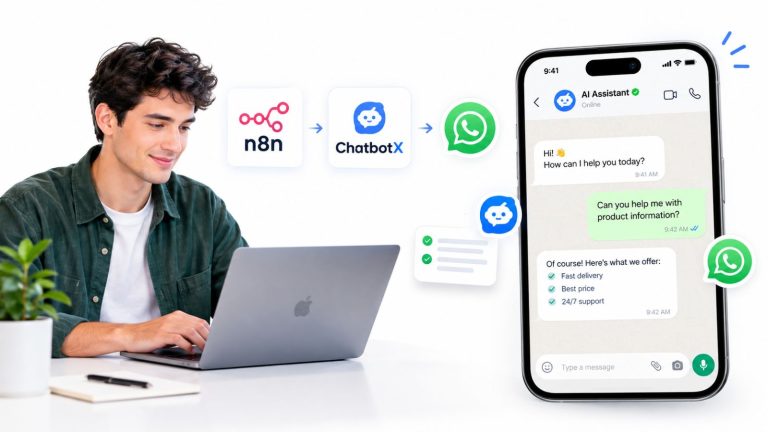

Whether you are a startup building your first customer-facing AI assistant or an enterprise mid-way through a multi-department rollout, the path from idea to high-performing chatbot is littered with avoidable traps.
The problem is rarely the technology. Modern AI chatbot platforms are more capable than ever. The problem is almost always strategic, organizational, or operational – decisions made before the first line of code is written, or neglect that sets in after the first deployment.
In this guide, we document 12 of the most consequential chatbot mistakes organizations make in 2026, why they happen, and precisely how to sidestep each one.
Launch agentic chat marketing in minutes with ChatbotX













1. Treating Your Chatbot as a One-Problem Tool

Most chatbot initiatives begin with a narrow brief: answer product FAQs, qualify inbound leads, or deflect Level-1 IT tickets. That focus is healthy at the start – but organizations that stop there are leaving substantial value on the table.
A chatbot infrastructure is not a single-purpose appliance. Once your team has validated the conversational logic, integration patterns, and brand voice for one use case, the cost of replicating that across a second or third use case drops significantly. The same platform, the same training data pipeline, the same analytics stack – repurposed for HR onboarding, sales enablement, or internal knowledge retrieval.
What to do instead: After your first successful deployment, conduct a cross-functional workshop. Map out every department that handles repetitive, dialogue-based interactions. Rank them by volume and cost-per-interaction. Your next chatbot use case will usually surface itself within the first hour.
📌 Related: See how ChatbotX’s multi-channel deployment features let you scale one bot across use cases without rebuilding from scratch.
2. Skipping Measurable Success Criteria
“We want the chatbot to improve customer experience.” That is a sentiment, not a KPI.
Organizations that launch without concrete, measurable targets consistently underestimate how their chatbot is performing – or overestimate it. When a quarterly review comes around, there is no baseline to compare against, and leadership has no evidence-based way to justify continued investment.
Strong chatbot KPIs share three characteristics:
- Specificity – “Reduce average ticket resolution time from 14 minutes to under 6 minutes by Q3.”
- Measurability – tied to data already being collected or easily instrumented.
- Ownership – a named person or team is accountable for each metric.
Common KPIs worth tracking include containment rate (percentage of conversations resolved without human escalation), time-to-first-response, cost-per-conversation, CSAT scores collected post-interaction, and lead qualification rate for sales bots.
According to research published by Gartner, organizations that define chatbot success criteria before build phase are 2.4× more likely to achieve measurable ROI within the first year.
3. Assigning Ownership to the Wrong Person
A chatbot project handed to a single junior team member – regardless of enthusiasm or raw talent – is a project set up for trouble. This is not a critique of junior developers; it is a recognition of project complexity.
Enterprise chatbot deployments involve natural language understanding, API integration with internal systems, security review, UX design, stakeholder alignment, and post-deployment analytics. These are not parallel tasks that one person can juggle while handling other responsibilities.
What does a healthy chatbot team look like?
| Role | Responsibility |
|---|---|
| Technical Lead (1–2 devs) | Architecture, integrations, deployment |
| Product/Business Analyst | Use case scoping, process redesign, KPI tracking |
| Conversation Designer | Dialogue flows, tone-of-voice, edge case handling |
| QA / Testing Lead | Regression testing, user acceptance testing |
| Project Sponsor | Executive alignment, budget, escalation path |
For smaller organizations, these roles can overlap. The point is that each responsibility area must have an accountable owner, not a single generalist stretched across all of them.
4. Ignoring the Developer–Business Alignment Gap

Developer-first tools give engineering teams tremendous flexibility. Business-friendly tools give non-technical stakeholders a way to iterate on content and logic without raising a ticket every time. The tension between these two approaches has derailed more chatbot projects than most practitioners admit publicly.
When developers choose a platform optimized for code, business teams feel locked out of a tool that directly affects their customer interactions. When business teams choose a low-code builder, developers hit hard limits the moment an enterprise integration is required.
The right platform for 2026 is one that provides a visual interface for content and logic management alongside a robust API and scripting layer for custom integrations. Neither side should have to compromise core functionality.
Questions to ask when evaluating platforms:
- Can a marketing manager update a response without a deployment cycle?
- Can a developer write custom middleware and business logic within the same environment?
- Is there a shared workspace where both sides can review conversation flows?
📌 Self-host with full control: ChatbotX’s open architecture is built for this balance. Check the ChatbotX Docker Compose repository if your team prefers a fully self-hosted setup where developers control the stack and business teams own the content layer.
5. Allocating an Unrealistic Budget
There is a persistent myth in the market that AI chatbots are cheap to build and free to maintain. This belief, driven partly by free-tier products and partly by vendor marketing, leads organizations to underfund projects in ways that guarantee failure.
A chatbot is a software product. Like any software product, it requires design, development, testing, integration, security review, and ongoing maintenance. The entry price varies enormously based on scope, but here is a rough framework:
| Chatbot Tier | Scope | Estimated Annual Investment |
|---|---|---|
| Basic FAQ Bot | Static responses, no integrations | $5,000 – $15,000 |
| Transactional Bot | CRM/ERP integration, human handoff | $20,000 – $80,000 |
| Enterprise AI Agent | Multi-system, multi-language, analytics | $100,000+ |
The numbers above include platform licensing, development hours, QA, and a realistic maintenance budget. Organizations that budget only for the build phase and ignore maintenance are planning their own technical debt.
According to McKinsey Digital, conversational AI implementations that include ongoing optimization budgets see 30–45% higher customer satisfaction scores over a 24-month period compared to static deployments.
6. Treating Deployment as the Finish Line

Go-live is not graduation day. It is orientation week.
The most dangerous period in a chatbot’s lifecycle is the first 60–90 days after deployment. User behavior rarely matches the assumptions built into the dialogue during development. Unexpected phrasings, edge cases that were dismissed during scoping, and integration failures under real-world load all surface in this window.
Organizations that declare victory at launch miss the feedback signal that would transform a mediocre bot into a high-performing one.
A healthy post-deployment cadence looks like:
- Week 1–2: Daily review of conversation logs, fallback triggers, and escalation rate.
- Month 1: Weekly stakeholder report. A/B test on underperforming conversation branches.
- Month 2–3: Full KPI review against baseline. Iteration sprint based on observed failure patterns.
- Ongoing: Monthly content reviews, quarterly model retraining or knowledge base updates.
7. Failing to Redesign Workflows Around the Bot
Adding a chatbot to an existing workflow without adjusting the surrounding process is like installing a high-speed assembly arm in a factory that still uses manual conveyors. The new component is only as effective as the system it operates within.
If your chatbot resolves 40% of inbound support queries autonomously, but your ticketing system still routes all conversations through a human triage queue first, you have not actually reduced the human workload – you have just added a layer.
Process redesign questions to answer before launch:
- What happens to a conversation the bot cannot resolve? Is there a defined handoff protocol?
- Have the human agents whose workload is being reduced been retrained for higher-complexity interactions?
- Is the chatbot’s output (lead data, support tickets, user signals) feeding into downstream systems automatically?
A chatbot embedded meaningfully into your operations will become indispensable. A chatbot grafted on top of unchanged processes will be quietly disabled within six months.
8. Setting Expectations That Destroy Credibility

The pressure to win internal buy-in leads well-meaning project champions to make promises that no chatbot – regardless of underlying model – can keep on day one.
Overpromising takes two forms. The first is performance-based: claiming intent accuracy rates of 95%+ when production benchmarks for well-tuned bots in complex domains hover between 78–88%. The second is timeline-based: telling leadership a fully integrated enterprise bot will be ready in three weeks when the realistic minimum is six to ten.
Both forms erode the trust your chatbot program needs to survive its first realistic milestone review.
The fix is simple: present a range, not a number. “We expect containment rates between 55–70% in month one, improving to 75–85% by month six as we refine training data.” That is honest, defensible, and sets up a success narrative rather than a disappointment.
Harvard Business Review consistently identifies expectation mismanagement as a leading cause of digital transformation project failures – chatbot programs are no exception.
9. Delegating All Conversation Design to Generative AI
LLMs have made it genuinely tempting to skip the conversation design phase entirely. Why map out dialogue flows when the model can improvise a coherent, grammatically sound response to almost any input?
The answer is that improvisation at scale, without guardrails, produces inconsistent brand voice, regulatory risk in sensitive industries, and user experiences that feel generic rather than intentional.
Generative AI handles language generation. It does not automatically enforce your brand’s tone-of-voice guidelines, stay within the scope of what your business has authorized the bot to discuss, or know when a user’s emotional state calls for a different interaction pattern.
Conversation design in 2026 means:
- Defining the bot’s persona: how it introduces itself, how it handles frustration, how it escalates.
- Mapping high-stakes conversation branches (complaint handling, refund requests, sensitive topics) with explicit human oversight.
- Creating content governance rules that sit on top of the LLM’s generation capability.
📌 Read more: The ChatbotX Blog publishes practical conversation design guides for teams building production-grade AI assistants.
10. Compressing Timelines Beyond Reason
Project pressure is real. So is the desire to ship something fast and prove value. But artificially compressed chatbot timelines produce bots that are technically live and operationally broken.
A realistic build-to-launch timeline for an enterprise chatbot with backend integrations:
| Phase | Minimum Duration |
|---|---|
| Discovery & scoping | 2–3 weeks |
| Dialogue design & content creation | 2–4 weeks |
| Technical development & integration | 3–6 weeks |
| Internal testing & QA | 2–3 weeks |
| Staged rollout & soft launch | 1–2 weeks |
| Total (conservative minimum) | 10–18 weeks |
Any stakeholder pushing for a two-week deployment on a complex integration is planning a demo, not a product. Set that expectation clearly early.
📌 Want to accelerate safely? ChatbotX’s platform is designed to reduce development overhead without sacrificing integration depth – explore how teams cut build time without cutting corners.
11. Confusing No-Code Convenience with Enterprise Readiness

No-code chatbot builders have their place. For proof-of-concept demos, simple FAQ bots, or event-based assistants with a shelf life measured in weeks, a drag-and-drop builder is entirely appropriate.
For anything that touches customer data, integrates with core business systems, or needs to scale to thousands of concurrent conversations, no-code solutions introduce constraints that are painful to discover after you have built on top of them.
The constraints typically manifest in three areas:
- Integration depth – pre-built connectors rarely cover custom internal APIs or legacy systems.
- Customization limits – business logic that deviates from the platform’s assumptions hits a wall.
- Data sovereignty – many no-code platforms host your conversation data on shared infrastructure with limited export or deletion controls.
📌 For teams that need full infrastructure control: The ChatbotX Docker Compose setup on GitHub gives you a production-ready self-hosted environment where you own every layer of the stack – data, compute, and configuration. This is enterprise readiness that no-code tools simply cannot offer.
12. Neglecting Data Privacy and Compliance from Day One
This mistake is conspicuously absent from most chatbot advice articles – and it is arguably the most expensive one to fix after the fact.
Chatbots are, by nature, data collection systems. Every conversation logs user intent, behavior patterns, and frequently personal information. In 2026, with GDPR enforcement at record levels, emerging AI-specific regulations across the EU and Asia-Pacific, and state-level privacy laws multiplying in the United States, retrofitting compliance into an already-deployed chatbot is a legal and engineering nightmare.
Compliance decisions to make before development begins:
- Where will conversation logs be stored, and for how long?
- Is the platform GDPR/CCPA-compliant, and can you demonstrate that to a regulator?
- Does your chatbot collect any data that triggers consent requirements?
- Who has access to conversation transcripts, and is that access logged and auditable?
- Is PII masked or encrypted at rest and in transit?
Building these answers into your architecture from day one is far less costly than rebuilding a live system around them later.
FAQ

What is the most common reason chatbot projects fail?
The most frequent cause of chatbot project failure is not technical – it is strategic. Projects that lack clearly defined KPIs, proper team ownership, and a post-deployment iteration plan consistently underperform, regardless of the underlying AI technology used.
How long does it realistically take to build an enterprise chatbot?
A production-ready enterprise chatbot with backend system integrations, proper QA, and a staged rollout typically requires 10 to 18 weeks from initial scoping to go-live. Projects compressed below this threshold tend to launch with significant unresolved issues.
Do I need coding skills to build a useful chatbot?
For basic FAQ or scripted response bots, no-code tools are sufficient. However, any chatbot that integrates with CRMs, ERPs, databases, or custom APIs will require developer involvement. The more business-critical the bot, the more important it is to have technical resources involved throughout the project.
How do I measure whether my chatbot is actually working?
Key performance indicators to track include containment rate (conversations resolved without human escalation), average handling time, CSAT scores collected post-conversation, fallback rate (how often the bot fails to understand the user), and cost-per-conversation compared to human-handled equivalents.
What is the difference between a chatbot and a conversational AI agent?
A traditional chatbot follows scripted or rule-based decision trees. A conversational AI agent uses large language models to interpret user intent dynamically, maintain context across multi-turn conversations, and take autonomous actions (such as querying a database or triggering a workflow). In 2026, the distinction is increasingly relevant for enterprise deployments.
Can I self-host an enterprise chatbot for data sovereignty?
Yes. Self-hosting gives you full control over where conversation data is stored and processed. For teams evaluating this option, the ChatbotX Docker Compose repository provides a production-ready infrastructure template designed for organizations with strict data residency requirements.
Conclusion
Every chatbot mistake documented in this guide is recoverable – but recovering from them costs more in time, money, and stakeholder trust than avoiding them in the first place.
The pattern behind nearly all of these pitfalls is the same: organizations approach chatbot deployment as a technical event rather than an ongoing organizational capability. The technology is the easy part. The strategy, the team structure, the realistic budgeting, the compliance foundations, and the commitment to iteration after launch – that is where the work actually lives.
If you are building or scaling a chatbot program in 2026 and want a platform designed to eliminate these failure modes from the start, take a look at ChatbotX.
ChatbotX is built for teams that need the flexibility of a developer-grade platform alongside the accessibility of a visual interface – whether you are deploying on managed infrastructure or running a fully self-hosted stack via the ChatbotX Docker Compose setup. It handles multi-channel deployment, deep backend integrations, conversation analytics, and compliance-ready data architecture – so your team can focus on building experiences that actually work.
Explore the ChatbotX blog for more implementation guides, conversation design frameworks, and AI strategy resources updated for 2026.