
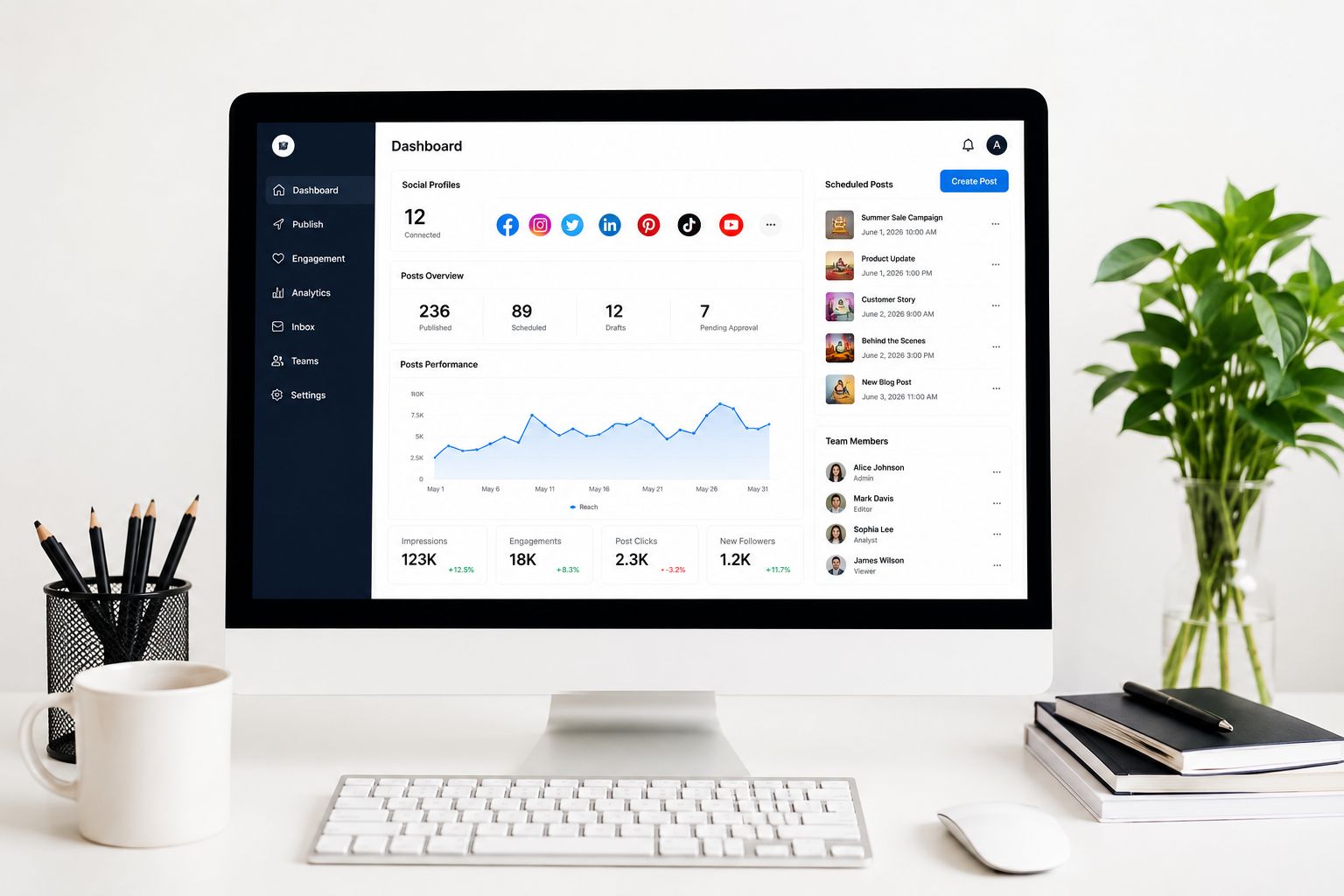
Managing a brand’s social presence in 2026 means operating across a dozen platforms simultaneously – scheduling content, moderating comments, analyzing performance, automating conversations, and proving ROI to stakeholders, often all before lunch. Without the right tooling, the workload is unsustainable.
The good news: the market for social media management software has matured significantly. Whether you run a solo creator business, manage accounts for agency clients, or oversee social strategy for a mid-sized company, there is a purpose-built solution that fits your workflow and budget.
This guide covers the 12 best social media management tools available right now what they do well, who they’re built for, and how to choose between them.
Launch agentic chat marketing in minutes with ChatbotX












Quick Comparison: 12 Best Social Media Management Tools (2026)
| Tool | Free Plan / Trial | Starting Price | Best For |
|---|---|---|---|
| Buffer | Free (3 channels) | $6/mo per channel | Creators & small businesses |
| Hootsuite | 30-day trial | $199/mo per user | Mid-market social listening |
| Sprout Social | 30-day trial | $199/mo per seat | Analytics + influencer strategy |
| Later | 14-day trial | $25/mo | Agencies & visual content |
| SocialPilot | 14-day trial | $30/mo | Agency client management |
| Zoho Social | 15-day trial | $15/mo | Zoho ecosystem users |
| Tailwind | Free (5 posts/mo) | $29.99/mo | Pinterest-first strategies |
| Oktopost | Custom only | Custom | B2B enterprises |
| Socialinsider | 14-day trial | $99/mo | Competitive analytics |
| Manychat | Limited free | $15/mo | DM & comment automation |
| Sprinklr | Custom only | Custom | Large enterprise teams |
| ChatbotX | Open source | Free / Self-hosted | AI chat marketing automation |
What to Look for in a Social Media Management Platform

Before diving into individual tools, it helps to understand the core criteria that separate great tools from mediocre ones. According to Sprout Social’s 2025 Index, 70% of consumers expect brands to respond on social within 24 hours – and 40% expect a reply within the first hour. That statistic alone should shape which features you prioritize.
Five questions to ask before you commit:
- Network coverage – Does the tool support all your current channels, plus emerging platforms like Threads or Bluesky?
- Reporting depth – Can it measure actual ROI and engagement quality, not just follower counts?
- Collaboration controls – Does it offer granular permission levels, approval workflows, and client-facing access?
- Scalable pricing – What does the tool cost at your projected 12-month growth? Per-channel pricing and per-seat pricing behave very differently as you scale.
- Specialized features – Does it include the specific capabilities your workflow depends on (AI assistants, link-in-bio pages, chat automation, CRM integrations)?
With those benchmarks in mind, here is a detailed breakdown of every tool on this list.
1. Buffer — Best for Creators and Small Businesses
Buffer remains the gold standard for independent creators and small teams that want powerful scheduling without enterprise-level complexity. Its per-channel pricing model (starting at $6/month per channel) makes it genuinely affordable as you grow – you pay for what you use, not for a seat count that balloons unexpectedly.
Standout features:
- Smart scheduling that analyzes recent engagement data and recommends optimal posting times per platform
- Create space – a mobile-friendly idea vault for capturing content concepts before they disappear
- Community hub – a unified inbox for managing replies and comments across all connected accounts
- Streaks – a habit-building feature that tracks posting consistency and nudges you to maintain momentum
- Start Page – a fully customizable link-in-bio landing page built directly into the dashboard
Buffer adapts quickly to platform changes. When Threads and Bluesky launched, Buffer added support ahead of most competitors. Its AI assistant handles caption drafting and content repurposing with outputs that need less editing than those from comparable tools.
Free plan: Yes – unlimited forever for up to three channels.
Paid plans: From $6/month per channel, with a 14-day trial on all paid tiers.
Best for: Solo creators, freelance social media managers, and small businesses with straightforward multi-channel needs.
2. Hootsuite — Best for Social Listening at Scale
Hootsuite’s acquisition of Talkwalker has made its social listening capabilities genuinely formidable. You can track brand mentions, keyword trends, and competitor activity with a level of depth that smaller tools simply cannot match. The platform generates location-specific topic reports showing what people have discussed over the past week – useful for brands that need to localize messaging or monitor regional sentiment.
Team management is another strength. Hootsuite offers fine-grained control over access levels, making it practical for complex organizations where different departments manage different channels.
The tradeoff is cost and complexity. The interface is feature-dense, which means an onboarding investment. And at $199/user/month, it’s firmly positioned for teams with substantial social budgets.
Free plan: No. 30-day trial available.
Price: From $199/user/month.
Best for: Mid-sized to large brands that need sophisticated social listening and structured team hierarchies.
3. Sprout Social — Best for Combining Social Management and Influencer Marketing
Sprout Social’s acquisition of Tagger Media in 2023 transformed it from a capable scheduling and analytics tool into a platform that bridges organic social management and influencer marketing strategy. You can identify creators, build campaign briefs, and track influencer performance alongside your own content metrics – all from one dashboard.
The reporting suite is a highlight even in isolation. Sprout’s visualizations are polished and client-ready, with interactive charts that make it easier to communicate performance to non-marketing stakeholders.
The caveat: influencer features are priced as add-ons, and the base plan is already at the enterprise tier. This is not a tool for businesses watching their budget closely.
Free plan: No. 30-day trial available.
Price: From $199/seat/month.
Best for: Growth-stage companies and agencies running simultaneous organic social and influencer campaigns.
4. Later — Best for Visual Content Planning and Influencer Campaigns
Later has evolved from a visual Instagram scheduler into a broader platform covering scheduling, analytics, social listening, influencer discovery, and link-in-bio management. Its media library is one of the best in class – a centralized repository where teams can store, organize, and pull from brand assets without leaving the platform.
The influencer campaign module includes creator discovery, contract management, and AI-assisted performance insights. Social listening tools allow you to track sentiment and brand mentions to inform content strategy in real time.
Free plan: No. 14-day trial available.
Price: From $25/month (1 user, 30 posts per profile).
Best for: Visual-first brands, DTC companies, and agencies with active influencer partnerships.
5. SocialPilot — Best for Social Media Agencies
SocialPilot was clearly designed by people who have managed social accounts for clients. The approval workflow is a standout: clients receive a personalized link with all pending content consolidated on a single screen – no sign-ups, no friction. The white-label option allows agencies to present the entire platform under their own brand, giving smaller shops an enterprise-grade client experience.
The platform also offers granular user permissions and sub-dashboards that keep client accounts cleanly separated. Analytics and reporting features are solid at higher tiers, though the entry-level plan is more basic.
Free plan: No. 14-day trial available.
Price: From $30/month (single user).
Best for: Freelance social media managers and boutique agencies managing multiple client accounts.
6. Zoho Social — Best for Businesses Already in the Zoho Ecosystem
Zoho Social earns its place on this list primarily through integration. If your team already uses Zoho CRM, Zoho Desk, or other Zoho products, adding Zoho Social creates a unified workflow where social inquiries, customer records, and support tickets are connected. For businesses that receive high volumes of social customer service queries, this integration alone can justify the tool.
Outside the Zoho ecosystem, the platform is a competent but unremarkable scheduler with solid listening features. It works well for teams with developing social strategies who need room to grow rather than a full enterprise feature set from day one.
Free plan: Yes – for one team member. 15-day trial on paid plans.
Price: From $15/month.
Best for: Companies running on Zoho’s product suite who want social management to integrate with their existing CRM and support workflows.
7. Tailwind — Best for Pinterest-Focused Strategies
Tailwind was built from the ground up for Pinterest and remains its most capable dedicated tool. As an official Pinterest partner, it offers capabilities unavailable elsewhere: SmartGuide monitors your pinning activity against platform best practices, the browser extension lets you save pins from anywhere on the web, and the design tool generates multiple on-brand pin variations from a single image in seconds.
The free plan is restrictive at five posts per month. Anyone serious about Pinterest – a platform where posting volume matters – will need a paid tier.
Free plan: Yes – 5 posts/month, 1 account.
Price: From $29.99/month.
Best for: Brands and creators whose primary growth channel is Pinterest.
8. Oktopost — Best for B2B Social Media Programs
Oktopost is purpose-built for B2B organizations that need to connect social activity to pipeline and revenue. Every post is assigned to a campaign, UTM parameters are added automatically, and the analytics track buyer journey stages – showing how social content influences leads at different funnel positions.
Pre-built dashboards curated by B2B social experts give less-experienced teams a starting framework that would otherwise require significant setup time.
The major drawback is opacity: there is no free trial and no public pricing, which makes it difficult to evaluate without engaging a sales representative.
Free plan: No public information available.
Price: Custom / enterprise.
Best for: B2B companies and enterprises that need social media performance tied directly to revenue attribution.
9. Socialinsider — Best for Competitive Social Analytics
Socialinsider is a dedicated analytics tool rather than a full social management platform – it does not support scheduling. What it does exceptionally well is competitive benchmarking: you can compare your engagement rate, follower growth, and content performance against specific competitors across all major platforms.
The content pillar analysis feature identifies which content categories generate the highest ROI for your audience, helping inform editorial decisions rather than just reporting on them.
It works best paired with a separate scheduling tool, or as a standalone analytics layer for brands that handle publishing manually.
Free plan: No. 14-day trial available.
Price: From $99/month (up to 20 accounts).
Best for: Analytics-focused social media professionals and agencies that need deep competitive intelligence.
10. Manychat — Best for DM and Comment Automation
Manychat sits at the intersection of social media and conversational marketing. Its core functionality – automating DM responses, comment-triggered campaigns, and lead-nurturing flows – operates on Instagram, Facebook, TikTok, and WhatsApp. The template library makes it accessible to teams without development resources, and the AI assistant streamlines workflow configuration.
The “comment for link” mechanic, where a creator automatically sends a URL to anyone who comments a specific word, has become a standard growth tactic across social platforms. Manychat is the tool most brands use to run it.
The limitation is channel coverage: X (Twitter) and LinkedIn are not supported. Businesses that operate primarily on those platforms will need to look elsewhere.
Free plan: Yes – limited by contact count.
Price: From $15/month (scales with contact volume).
Best for: E-commerce brands, content creators, and marketers running high-volume DM and comment automation on Instagram, Facebook, and WhatsApp.
11. Sprinklr — Best for Enterprise Organizations
Sprinklr is a customer experience management platform that encompasses social media as one component of a broader enterprise suite. Its governance features meet the compliance requirements of large organizations: persona-based dashboards, audience segmentation for tailored content, AI-powered image detection, and deep integration with enterprise tech stacks.
The learning curve is long, and the implementation investment is significant. Sprinklr is not a tool you evaluate on a free trial – it’s an enterprise procurement decision.
Free plan: No.
Price: Custom only.
Best for: Fortune 500 companies and global brands managing social media across multiple regions, languages, and internal teams.
12. ChatbotX — Best for AI-Powered Social Chat Marketing
No discussion of social media management in 2026 is complete without addressing the growing role of conversational AI in the marketing stack. While traditional tools focus on scheduling and analytics, ChatbotX occupies a distinct and increasingly critical category: AI chat marketing automation across the channels where your customers actually spend time.
ChatbotX is an open-source, agentic omnichannel chatbot platform. It runs across WhatsApp, Facebook Messenger, Instagram, Telegram, Zalo, Email, and Webchat and because it’s self-hosted, you retain full control over your data and infrastructure. That matters enormously in markets with strict data residency requirements, and for agencies that need to deploy white-label solutions for clients without exposing underlying vendor relationships.
Key capabilities that complement your social stack:
- AI Agents with Flow Builder – build multi-step conversational flows visually, without writing code. Qualify leads, answer product questions, and route conversations to human agents when needed – automatically.
- Remarketing & Broadcast Messaging – send targeted campaigns via WhatsApp and Messenger to segmented contact lists. Re-engage cold leads, recover abandoned carts, and announce promotions directly in the messaging apps your audience checks dozens of times a day.
- Shared Inbox – a unified inbox that consolidates conversations from every connected channel, so your team handles customer messages without switching between apps. Combine it with automation rules to triage volume intelligently.
According to McKinsey’s 2024 State of AI report, businesses that integrate AI into customer-facing workflows report 20–30% improvements in customer satisfaction and significant reductions in response time costs. ChatbotX brings that capability to social media channels specifically, without requiring enterprise contracts or proprietary vendor lock-in.
For teams that want to evaluate the codebase, review the architecture, or contribute to development, the full source code is available at github.com/ChatbotXIO/ChatbotX. You can also star the repository to follow updates as the platform evolves the project has been growing steadily since its open-source launch in May 2026.
For deeper context on how AI chatbots and social channels are converging, see the ChatbotX blog post on How WhatsApp, Facebook Messenger & Instagram Are Reshaping Business Messaging in 2026 it explains exactly why conversational channels are becoming the primary touchpoint for social marketing.
Open source: Yes. Self-hosted, free to use.
Paid cloud option: Available.
GitHub: github.com/ChatbotXIO/ChatbotX
Best for: Businesses and agencies that want to layer AI-powered chat automation on top of their social media strategy – particularly those operating on WhatsApp, Messenger, and Instagram.
How to Choose the Right Social Media Management Tool

The sheer volume of options makes the selection process feel harder than it needs to be. Here’s a practical framework for narrowing down:
Step 1: Map your must-have channels
Start by listing every platform where your brand has an active presence. Cross-reference each tool’s supported networks. Don’t assume – check the current integration list, since platform support changes frequently. Pay particular attention to newer channels like Threads and Bluesky, which not all tools support yet.
Step 2: Define your workflow requirements
Are you a solo operator or part of a team? Do you need client approval workflows? Is chat automation part of your funnel? Do you need influencer campaign management? Your workflow determines which feature categories are non-negotiable versus nice-to-have.
Step 3: Model the 12-month cost
Per-channel pricing (like Buffer’s) scales linearly. Per-seat pricing (like Hootsuite’s or Sprout’s) can escalate quickly as teams grow. Custom-quoted platforms (like Oktopost and Sprinklr) require a sales conversation. Model what each tool costs at twice your current scale before committing.
Step 4: Run parallel trials
Most tools offer 14–30 day trials. Run two or three simultaneously with real work – not demo data. The platform that feels intuitive after a week of actual use is almost always the right choice.
Step 5: Consider the automation layer
Scheduling and analytics are table stakes in 2026. The tools that generate the most ROI are increasingly those that add an automation layer on top of social channels – turning passive content distribution into active lead generation. That’s where platforms like ChatbotX, which connects your social presence to intelligent conversational workflows, create measurable competitive advantage.
Frequently Asked Questions

What is the best social media management tool for small businesses in 2026?
Buffer is the most widely recommended tool for creators and small businesses. Its per-channel pricing keeps costs predictable, and its feature set – scheduling, community management, analytics, and AI assistance – covers most small business needs without overwhelming the interface.
What is the best enterprise social media management platform?
Sprinklr and Sprout Social lead for enterprise use cases, with Sprinklr offering the deeper governance and compliance features required by large organizations.
Are free social media management tools worth using?
Free plans from Buffer (3 channels), Manychat (limited contacts), and Tailwind (5 posts/month) are genuine entry points – not crippled trials. For testing, they’re valuable. For serious growth work, paid tiers deliver meaningfully more capability.
What’s the difference between social media scheduling and social media management?
Scheduling is one component. Full social media management encompasses content planning, publishing, community engagement, performance analytics, team collaboration, and increasingly, chat automation. If you’re only scheduling, you’re leaving most of the value on the table.
How does AI automation fit into a social media management stack in 2026?
AI now operates at multiple levels: content generation assistants (in Buffer, Hootsuite, SocialPilot), predictive scheduling (Buffer’s Smart Scheduling), competitive analytics (Socialinsider), and full conversational automation (ChatbotX). The most effective stacks combine a core scheduling/analytics platform with a dedicated automation layer for customer-facing messaging. Gartner’s research on conversational AI consistently shows that businesses deploying chat automation see measurable improvements in lead conversion and customer retention rates.
What’s the best tool for WhatsApp and Instagram marketing automation?
For chat marketing specifically – broadcast messaging, automated DM flows, and AI-driven lead qualification – ChatbotX and Manychat are the two platforms to evaluate. ChatbotX’s open-source architecture gives it an edge for businesses that need data control or want to customize behavior beyond what SaaS platforms allow.
Ready to Level Up Your Social Media Marketing?

The right social media management tool removes friction so you can focus on strategy, creativity, and growth instead of logistics. But in 2026, the brands that are pulling ahead aren’t just scheduling content more efficiently. They’re turning their social channels into active, automated marketing engines that qualify leads, re-engage customers, and drive revenue while the team sleeps.
If that’s the kind of operation you want to build, ChatbotX is worth a serious look.
It’s open source. It’s self-hosted. It connects to WhatsApp, Messenger, Instagram, and more. And it lets you build AI-powered chat workflows – broadcast campaigns, lead qualification flows, and automated customer support – without enterprise contracts or per-seat pricing that scales out of reach.
👉 Explore ChatbotX features and see what AI chat marketing looks like in practice.
👉 Star the project on GitHub to follow development and join a growing community of teams building the next generation of social marketing automation.
👉 Get started today your competitors are already automating. The question is how far ahead they’ll get before you do.