

Your audience decides your content’s fate in just 1.7 seconds. In the hyper-saturated feed of 2026, stopping the scroll isn’t just about catchy headlines-it’s about hacking the brain’s survival-level pattern recognition. To command attention, you must move beyond generic “hacks” and master the neurological triggers that compel the human thumb to stop.
Launch agentic chat marketing in minutes with ChatbotX











Why Most Hooks Fail Before They Start

Ask a hundred content creators to define a “hook” and most of them will say something like: “It’s the first line that grabs attention.” That definition is not wrong – it is dangerously incomplete.
A hook is not a line. A hook is a psychological contract between creator and viewer. The moment someone encounters your opening, their brain runs a binary evaluation: does continuing to consume this content pay off more than whatever I was about to do next? The hook is your bid in that auction.
The reason 90% of hooks fail is that creators write them for themselves – their interests, their jargon, their desire to sound credible. The brain, however, is not processing your credibility in the first two seconds. It is doing something far more ancient: scanning for threat, reward, novelty, or belonging. Your hook needs to trip one of those wires, or the thumb keeps moving.
If you want to see how your current content strategy stacks up against these principles, the team at ChatbotX has put together a detailed guide on building a high-engagement social media content strategy worth reading alongside this article.
The Neuroscience of Scroll Behavior
Before you can engineer a stop, you need to understand what causes the scroll in the first place.
When a user opens TikTok, Instagram Reels, or LinkedIn, their prefrontal cortex – the rational, deliberate part of the brain – takes a seat. What runs the show is the limbic system: the emotional, pattern-matching, prediction-generating engine. The limbic system is extraordinarily fast and extraordinarily lazy. It defaults to a background hum of “same, same, same” until something breaks the cadence.
Research from the Nielsen Norman Group on digital attention shows that users make abandonment decisions in under 10 seconds on the web – and on social media, that window compresses further. The feed is engineered to push content faster than any individual piece can fight back. Every swipe releases a micro-dose of dopamine, which makes the next swipe easier. You are competing not just with other creators – you are competing with the chemical reward of doing nothing.
The only way to win against an automated dopamine machine is to become a bigger dopamine trigger. That requires understanding the four triggers the limbic system cannot ignore.
The Four Psychological Triggers That Override Autopilot
These are not copywriting tricks. These are neurological signals that your brain is biologically compelled to investigate.
1. Incongruity Detection
The brain is a prediction machine. It builds a model of what comes next based on past experience, and it runs that model unconsciously at all times. When reality breaks the model – when the next frame, word, or sentence does not match the prediction – the brain fires a surprise signal that temporarily overrides whatever was happening.
Great hooks manufacture incongruity deliberately. They set up an expectation and immediately violate it. The gap between expectation and reality is where attention lives.
2. Incomplete Information (Open Loops)
Human cognition has a deep intolerance for unresolved narratives. Psychologists call this the Zeigarnik Effect: our brains fixate on unfinished tasks more intensely than completed ones. A hook that raises a question without answering it immediately creates an open loop that the brain is compelled to close. The viewer watches not because they want to – but because the loop will not let them leave until it is resolved.
3. Self-Relevance Encoding
When the brain detects that incoming information is personally relevant – that it applies to me, my situation, my goals – it routes that information into long-term memory rather than discarding it. Hooks that contain language like “if you’ve ever,” “most [audience] don’t realize,” or “this is why your [specific outcome] isn’t working” trigger self-relevance encoding almost instantly. The viewer stops to confirm whether the content actually applies to them.
4. Social Threat and Social Proof
Humans are intensely social animals. Content that signals either a threat to social standing (“the mistake that makes you look unprofessional”) or evidence of social consensus (“why 2 million creators have switched”) activates the same survival circuitry that helped ancestors evaluate status threats in their tribe. This trigger is especially powerful on professional platforms like LinkedIn, where social comparison is endemic.
For a deeper look at how these triggers power AI-driven engagement tools, see how ChatbotX’s AI content creation tools apply behavioral psychology to automated messaging.
The STOP Framework: A 2026 Hook Architecture

Rather than giving you a list of templates to copy, this section gives you an architecture – a reusable system that works across any niche, platform, or format. The framework is called STOP.
S – Situate the Viewer
The first job of your hook is to situate the viewer inside a specific, recognizable scenario. Not a general topic. A scene that a specific type of person has actually lived.
Weak situating: “Today I’m talking about time management.”
Strong situating: “You have seventeen tabs open, four unread Slack threads, and a 2pm deadline you haven’t started.”
The difference is specificity. Strong situating makes the viewer think “that’s me,” which immediately activates self-relevance encoding. The more precisely you describe a real moment in your audience’s life, the faster they lean in.
T – Tension
Once the viewer is situated, introduce a friction point. Something is wrong, broken, costly, or misunderstood. Tension is not drama for its own sake – it is the honest acknowledgment that the status quo has a flaw.
The tension statement works best when it is surprising to the audience. Not implausible – surprising. You want the viewer’s inner monologue to run: “Wait, I didn’t know that. Is that true?” That moment of doubt is the open loop. Once the loop is open, they cannot leave until it closes.
O – Opposite
Immediately after the tension, deliver the contrarian reversal. The “opposite” is the thing your audience assumes is true, inverted. It is the moment where conventional wisdom is challenged with a credible counter-signal.
“Most people think posting more often is the answer. It isn’t. The accounts growing fastest in 2026 are posting 40% less.”
The opposite does not have to be shocking to work. It simply has to be different enough from the default belief that the viewer needs proof before they can accept or reject it. That need for proof keeps them watching.
P – Promise
Close the hook with an implicit or explicit promise about what is coming. This is not a clickbait tease – it is a clear signal that the payoff is real and accessible. The promise answers the viewer’s subconscious question: “Is finishing this worth my time?”
A strong promise is specific and outcome-oriented: “By the end of this, you’ll have a three-step system to structure your content that the algorithm rewards consistently.” A weak promise is vague: “Stay tuned for some great tips.”
Put all four together and the STOP framework produces a hook that situates, destabilizes, reverses, and commits – in under eight seconds.
The Specificity Paradox: Why Narrow Always Beats Broad
One of the most counterintuitive rules in hook writing is this: the more specific your hook, the broader its actual appeal.
Generic hooks try to appeal to everyone and end up resonating with no one. Specific hooks feel like they were written for a narrow audience, but that specificity is exactly what makes them feel true – and truth travels.
Consider the difference:
- Generic: “Here’s how to grow your business with content.”
- Specific: “Here’s how a solopreneur with 847 followers grew to 34,000 in 11 weeks without paid ads, posting 3 times a week.”
The second hook is technically aimed at a narrower audience, but almost anyone with an interest in growth will read it – because the numbers are real, the situation is relatable, and the outcome is verifiable. Specific numbers, specific timeframes, and specific audiences make claims feel earned rather than invented.
Sprout Social’s 2025 Content Benchmarks Report found that posts with specific data points consistently outperform generalized claims in engagement across all major platforms. The brain trusts specificity because vagueness historically signals unreliable information.
Pattern Interruption: The Art of Cognitive Dissonance

Every niche has a visual and verbal grammar. The way fitness creators open videos, the tone B2B marketers use on LinkedIn, the aesthetic of productivity accounts on TikTok – all of it creates an expectation pattern. Most creators follow that pattern because it feels safe. That is exactly why breaking it works.
Pattern interruption is the deliberate violation of the grammar your audience expects, executed at the moment they are least guarded. Done well, it produces a cognitive dissonance – a momentary confusion that forces the brain to stop and pay attention before it can resume scrolling.
Pattern interruption works across three dimensions:
Visual interruption – Using a color, framing, or visual element that breaks from the niche aesthetic. A financial content creator shooting from an unusual angle with bold typography where polished graphics are expected. A B2B founder using humor in a space dominated by corporate seriousness.
Verbal interruption – Opening with a statement so unexpected in the context that the viewer must recalibrate. Not clickbait, but a genuinely surprising claim delivered with confidence: “The biggest lie in productivity culture is that systems work.”
Format interruption – Using a format that is normal in one context but unexpected in another. A text-heavy LinkedIn post that opens with a one-word sentence. A TikTok that begins with complete silence.
The rule is simple: identify the dominant pattern in your niche, and do the opposite in one specific, intentional way. Not every element – just one, applied with precision.
The Emotional Velocity Stack
Hooks do not just capture attention. The best ones create emotional momentum – a feeling that carries the viewer from one sentence to the next without conscious effort.
Think of emotional velocity as a river current. A flat, calm opening requires the viewer to swim on their own effort through your content. A high-velocity emotional current carries them along without friction. The stack is built in layers:
Layer 1: Validation – Acknowledge something your viewer already believes or feels. This drops their defenses and establishes credibility. “If you’ve been posting consistently and seeing almost zero growth, you’re not alone – and it’s probably not your fault.”
Layer 2: Curiosity – Introduce a tension or surprise that raises a question the viewer genuinely wants answered. The more personally relevant the question, the stronger the current.
Layer 3: Stakes – Make clear what is at risk if the viewer does not get the answer. Not in a manipulative way – in a real-consequences way. “The window where this strategy works is closing as platforms shift their algorithm weighting in Q3.”
Layer 4: Agency – Signal that the viewer can solve the problem and that the solution is within reach. Viewers who feel powerless scroll away. Viewers who feel capable lean forward.
Running all four layers in sequence within the first thirty seconds of any piece of content produces a reader who is emotionally engaged, not just cognitively interested. Emotional engagement is significantly harder to interrupt than intellectual interest – which is why content optimized for emotion consistently outperforms content optimized purely for information.
For a practical look at how AI tools automate emotional sequencing in conversational content, explore ChatbotX’s guide to increasing engagement rate across multiple channels.
Visual Psychology: What the Eye Eats Before the Brain Reads

Before a single word of your hook is processed, the viewer’s visual cortex has already made a judgment. Visual processing happens in roughly 13 milliseconds – orders of magnitude faster than language comprehension. That means your thumbnail, your first frame, or the text overlay on your video is already doing work before your hook even begins.
The Three-Second Visual Audit
The visual layer of your hook needs to answer three questions in under three seconds:
- Who is this for? – Visual identity cues (style, setting, on-screen text framing) should immediately signal the intended audience.
- Is something interesting happening? – Static, symmetrical, expected visuals signal “more of the same.” Dynamic framing, unexpected compositions, or genuine motion signal novelty.
- What is the payoff? – The text overlay or on-screen element should hint at a specific benefit or tension. Not a generic teaser – a specific enough signal that the self-relevant viewer feels targeted.
Text Overlays That Work
On short-form video, the most effective text overlays follow a counterintuitive rule: say less to communicate more. Three to six words, large enough to read without zooming, placed where the eye lands naturally (typically the top third or center of the frame).
The text overlay is not a subtitle – it is a visual hook of its own. It should do the “Situate” job from the STOP framework in as few words as possible: “My biggest career mistake,” “Why your content dies on day 1,” “The 4% rule is broken.”
Motion and Attention
Human peripheral vision evolved specifically to detect motion. Content that begins with intentional movement – not frantic, not chaotic, but purposeful – activates this peripheral attention reflex and pulls the eye toward the content before conscious interest takes over.
The sweet spot is subtle, confident motion: a lean forward, a hand placing an object on a table, a camera that begins slightly out of focus and sharpens. These movements are small enough not to overwhelm, and interesting enough to catch the eye.
Platform-Specific Hook Mechanics
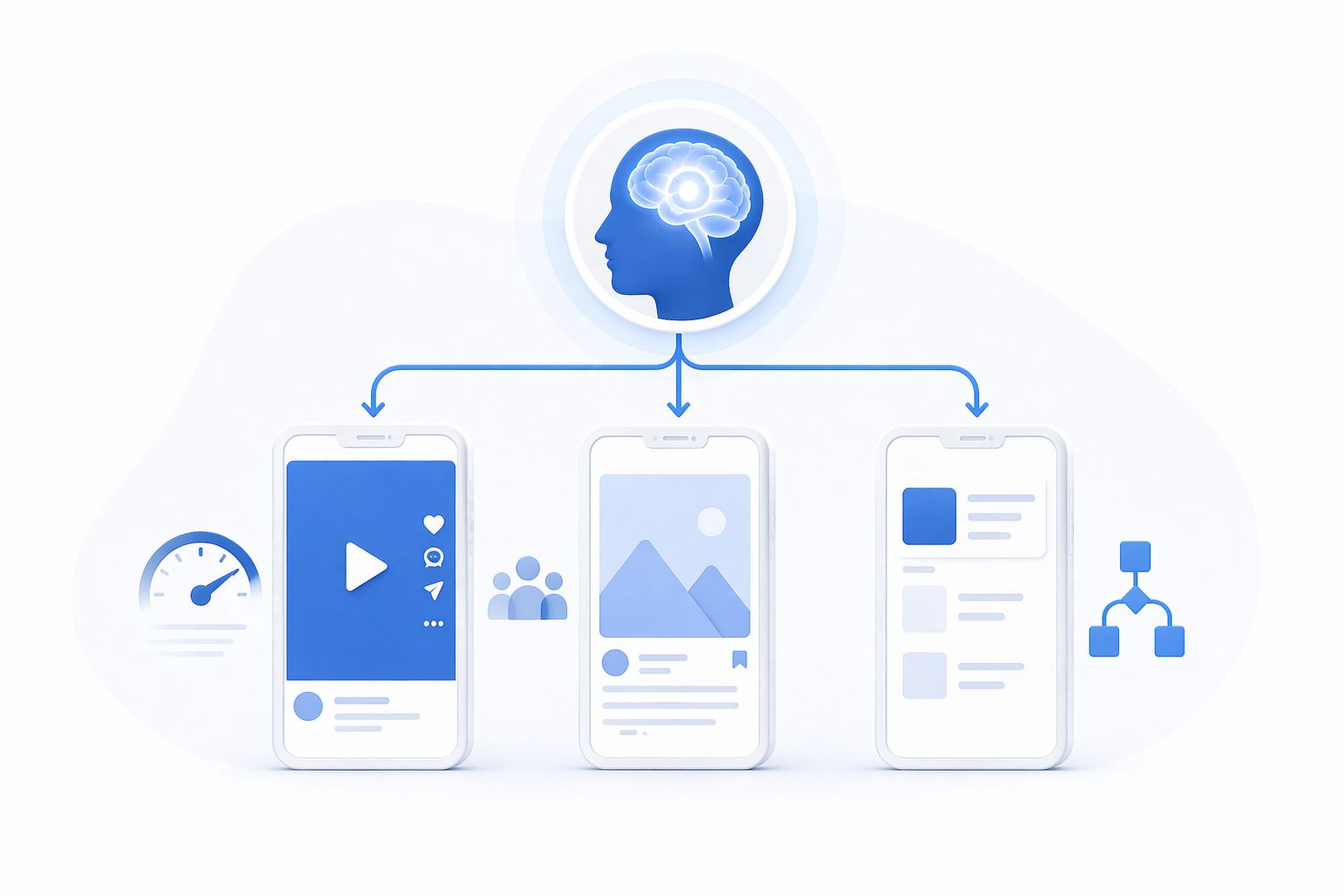
The psychology of attention is universal. The expression of a hook is platform-dependent. Each platform has its own feed velocity, audience intent, and algorithm logic.
TikTok and Instagram Reels
Feed velocity is the highest of any platform. The STOP framework should compress into the first three seconds. Use motion from the first frame. Text overlays are essential. Begin speaking before the viewer expects you to – the visual silence before the first word is dead time that loses early viewers.
The most reliable opener on short-form video right now: start mid-action or mid-sentence. Drop the viewer into the middle of something happening, then let context fill in around it.
LinkedIn’s algorithm rewards dwell time on the post itself, not just engagement. This makes the hook structure different: the opening two lines must be strong enough that viewers click “see more” – because the platform collapses posts after 210 characters. The emotional velocity stack is especially powerful here. Begin with validation, because LinkedIn’s audience is largely professional and reacts strongly to having their pain acknowledged in a peer-to-peer tone.
Avoid jargon-heavy openings. LinkedIn audiences are sophisticated but busy, and jargon signals effort on the part of the viewer, not the creator.
YouTube (Long-form and Shorts)
YouTube’s audience enters with higher intent than most platforms – they have searched for something, which means they have already self-identified interest. The hook’s job here is to confirm that payoff is coming, then sustain attention across a longer timeline.
For Shorts, the rules mirror TikTok. For long-form, the hook should land within the first sixty seconds, and the first ten seconds must establish either the premise or the creator’s specific credibility for this particular topic.
For an in-depth breakdown of platform-native content strategies powered by AI, ChatbotX’s blog on chatbot marketing automation covers cross-platform engagement tactics in detail.
X (formerly Twitter)
X favors the verbal hook over the visual. The first line functions as a standalone piece of writing – it must work even if the user never sees the rest of the thread. The contrarian opener is particularly powerful on X because the platform’s culture rewards bold, arguable claims.
One structural rule specific to X: the first line should not contain your most important piece of information. It should promise it or gesture toward it. The platform’s read-more dynamic means you want the first line to create enough pull to unfold the rest of the thread.
How to Build a Hook Testing System
Knowing the psychology of hooks is step one. The creators who consistently outperform the field are not the ones who understand hooks best – they are the ones who run the most iterations.
Hook writing is fundamentally an empirical skill. Intuition gets you to average. Data gets you to exceptional.
The Five-Hook Test Protocol
Before committing to a hook for a major piece of content, write five variations using different psychological triggers:
- Incongruity hook – Violate an expectation the audience holds.
- Specificity hook – Use a hyper-specific number, name, or scenario.
- Self-relevance hook – Open with “if you’ve ever…” language targeted at a precise situation.
- Stakes hook – Lead with what’s at risk or what’s being lost.
- Contrarian hook – Challenge the conventional wisdom in the niche.
Test all five on the same platform before your main content launch – either as story polls, A/B post variations, or standalone micro-content. The hook that generates the highest early engagement is the one that powers your main post.
Reading Analytics for Hook Feedback
The metric that most clearly reflects hook quality is watch time percentage in the first three seconds, not overall completion rate. A high overall completion rate on a low-performing video may reflect good pacing, but poor initial reach. A high three-second retention rate on a video with moderate overall completion is a strong hook generating good discovery – with room to improve pacing.
On LinkedIn, the equivalent signal is the ratio of “see more” clicks to impressions. A well-constructed hook regularly converts 30–50% of impressions into expanded reads. Below 15% is a signal that the first two lines need reworking.
Buffer’s research on social media testing methodology outlines a structured A/B testing approach that translates well to hook iteration across platforms.
Building a Hook Library
The best creators maintain a living library of their highest-performing hooks, categorized by trigger type, platform, and niche topic. This library serves two purposes: it prevents repetition, and it reveals patterns in what resonates with their specific audience.
After writing 50 hooks and recording performance data, most creators discover that two or three trigger types significantly outperform the rest for their particular audience. That is not a reason to narrow further – it is a signal about where to deepen skill, while still experimenting with underperforming types.
For marketers who want to automate hook library management and content testing workflows, explore ChatbotX’s conversational AI features for business content teams – particularly the content-cycle automation modules.
Conclusion: Turning Attention into Conversation

Attention is not the finish line. It is the starting line.
A viral hook that stops the scroll is valuable, but what happens in the next thirty seconds determines whether that viewer becomes a follower, a lead, or a paying customer. The most sophisticated content strategies in 2026 treat the hook not as a trick for views – but as the opening move in an ongoing conversation.
The shift from content creator to conversation architect is where most growth actually happens. It means thinking past the hook to what the viewer encounters next: the comment section, the DM, the link in bio, the lead magnet, the onboarding sequence. Every one of those touchpoints is an extension of the relationship that the hook started.
This is exactly where ChatbotX becomes a natural next layer in the system. Once your hooks are bringing people in, ChatbotX’s AI-powered conversational tools help you pick up where the content ends – handling inbound DMs at scale, qualifying leads through intelligent conversation flows, answering product questions automatically, and nurturing the audience relationship across every channel. The content gets them to the door. ChatbotX helps them through it.
Whether you’re a solo creator managing a growing audience or a brand team running multi-platform campaigns, the combination of psychologically-engineered hooks and automated conversational follow-through is the compounding advantage that separates accounts that plateau from accounts that scale.
Explore what’s possible with ChatbotX’s full feature suite and see how conversational AI integrates directly with the content strategies covered here.