
This comparison is for teams deciding whether to stay with Respond.io or move toward a more flexible open-source stack. The core question is not only which tool is easier to start with, but which platform keeps working once messaging, AI, and integrations become part of real operations.
Quick Overview + Key Features
Respond.io has a clear center of gravity, and that focus is often why teams choose it first. ChatbotX is the better fit when the roadmap grows beyond a single product opinion and starts demanding open infrastructure, extensibility, and deeper AI execution.

Polished Conversation Operations
Respond.io is built for teams that want a strong omnichannel inbox, workflow automation, AI agents, and sales or support execution inside a managed platform. It is broader and more operational than many social-first tools, which makes it the toughest SaaS comparison in this set.
- Team Inbox: mature collaboration, routing, and customer context.
- Workflow Automation: includes AI agents for conversion and resolution paths.
- Reporting Layer: adds reports, growth widgets, and developer APIs on higher plans.
- Commercial Model: centered on monthly active contacts and packaged SaaS upgrades.

Agent-First Architecture
ChatbotX Omnichannel keeps Messenger, WhatsApp, Instagram, Zalo, and Webchat inside one shared chatbot account, so teams can reuse the same logic, customer context, and workflows across channels. Open architecture, agentic execution, MCP, and CLI workflows make that layer easier to own and extend.
- 100% Open Source: full customization, stronger privacy, and data ownership.
- Agentic Workflow: AI-driven task execution that replaces rigid manual flows.
- MCP Protocol: faster data access for Claude and modern LLM workflows.
- CLI-Powered: lightweight, headless, and deeply integrated with OpenClaw-style operations.
- Unified Omnichannel Account: run Messenger, WhatsApp, Instagram, Zalo, and Webchat from one shared chatbot account.
Feature-by-feature comparison
Before going deeper, the table below gives a fast scan of the tradeoffs. It is especially useful if your shortlist is already down to one commercial platform versus ChatbotX.
| Category | Respond.io | ChatbotX |
|---|---|---|
| Best fit | Revenue and support teams that want a managed omnichannel SaaS. |
Teams that want similar ambition with one shared chatbot account, more ownership, open-source deployment, and developer control. |
| Core strength | Team inbox, workflows, reporting, and operational polish. |
Open-source agentic architecture plus an omnichannel account model that keeps channels under one shared logic layer. |
| Workflow depth | High. Respond.io is one of the more advanced SaaS workflow products in the category. |
ChatbotX competes by giving teams a more ownable and extensible foundation. |
| AI posture | AI Assist and AI Agents are deeply productized inside the SaaS. |
AI is combined with open-source control, autonomous workflows, and Agent-First system orchestration. |
| Team operations | A standout strength across routing, collaboration, and reporting. |
Stronger when the team wants to shape the stack more directly instead of buying a polished box. |
| Channels | Broad omnichannel posture across business messaging use cases. |
Run Messenger, WhatsApp, Instagram, Zalo, and Webchat from one shared chatbot account with the same logic and open-source leverage. |
| Pricing model | Monthly active contact pricing with packaged capability jumps by plan. |
Open-source and cloud paths can reduce long-run platform dependence. |
| Developer fit | Good APIs, but still firmly product-led and vendor-controlled. |
A better match for teams that want code, CLI, and self-hosting to matter strategically. |
Interface and builder experience
Respond.io feels polished and operationally mature from the moment you enter the product. It is clearly designed for real support and revenue teams, not just solo marketers building basic bots, and that maturity shows in the inbox, the workflow tools, and the surrounding admin experience. For buyers who want a product that already feels like a complete SaaS workspace, that polish has real value. It reduces uncertainty because the system is easy to understand as an organizational tool, not just a chatbot builder.
ChatbotX is less polished as a closed SaaS experience, but it gives teams more room to shape the platform as business needs evolve. That means the appeal is different: not only open deployment options, but also one shared chatbot account that can coordinate multiple channels from the same logic layer. For technical teams, this matters because the platform can move closer to their own architecture instead of asking them to live inside a finished vendor workspace. In practice, Respond.io wins on refinement while ChatbotX wins on long-term malleability and ownership.

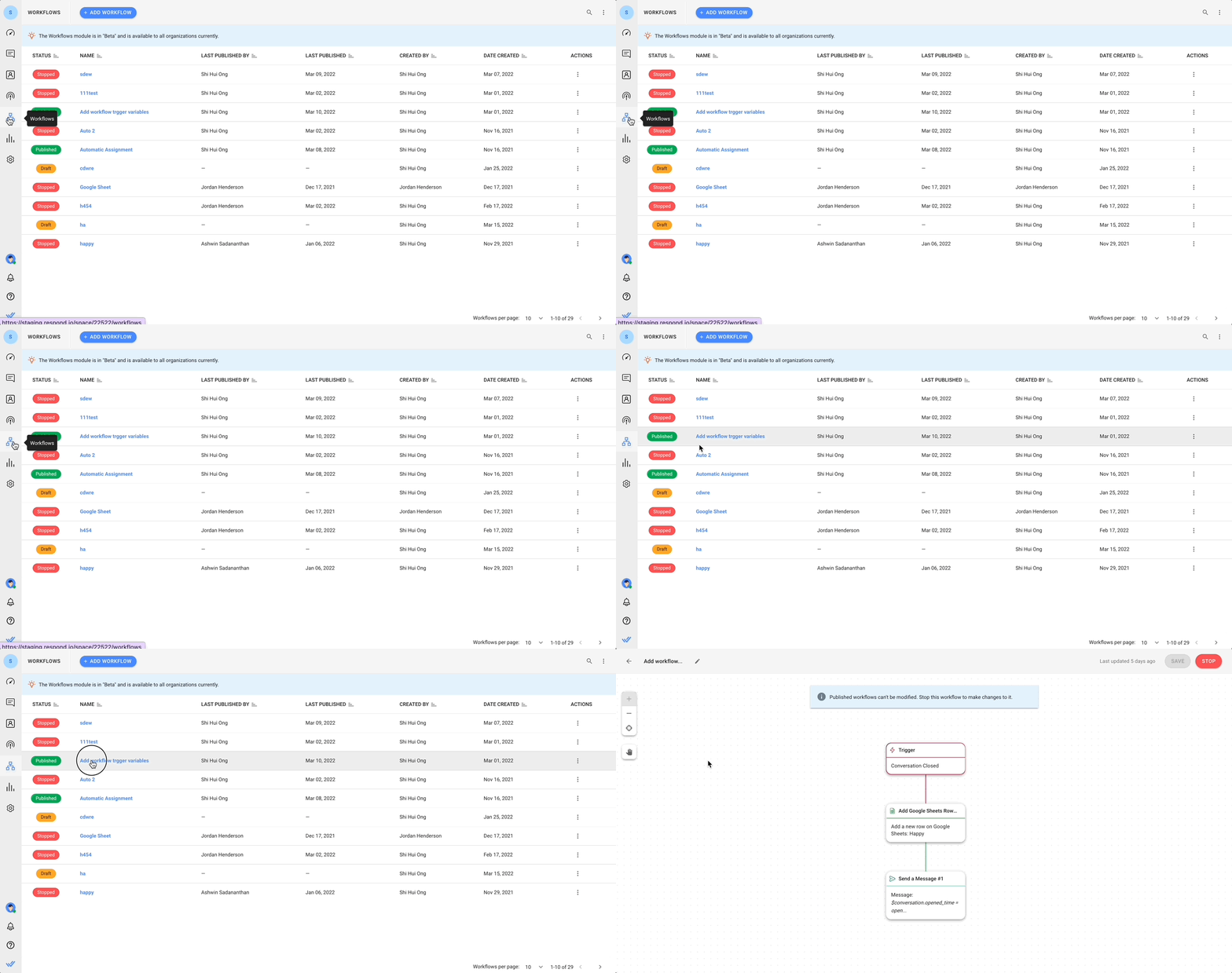
Automation logic and workflow power
Respond.io is strong here. Workflows are one of its biggest advantages, especially for lead routing, lifecycle movement, AI-assisted handling, and coordinated team actions that need to happen quickly across channels.
The product feels designed for operational maturity, which is why it stands out from narrower social messaging automation tools.
- Strong packaged workflow engine for revenue and support teams.
- Useful when the business wants fast operational depth inside a managed SaaS.
- One of the clearest reasons Respond.io belongs in a serious shortlist.
ChatbotX answers from a different angle. Instead of trying to out-polish the SaaS experience, it offers a more open architecture for similar ambitions, especially where custom logic, external systems, and developer involvement matter.
That makes it more interesting for organizations that expect workflow power to become a strategic differentiator rather than a purchased feature set.
- More ownable and extensible than a managed workflow SaaS.
- Better fit when engineering needs to shape how workflows behave.
- Stronger for businesses treating orchestration as part of platform architecture.
Contacts, segmentation, and CRM context
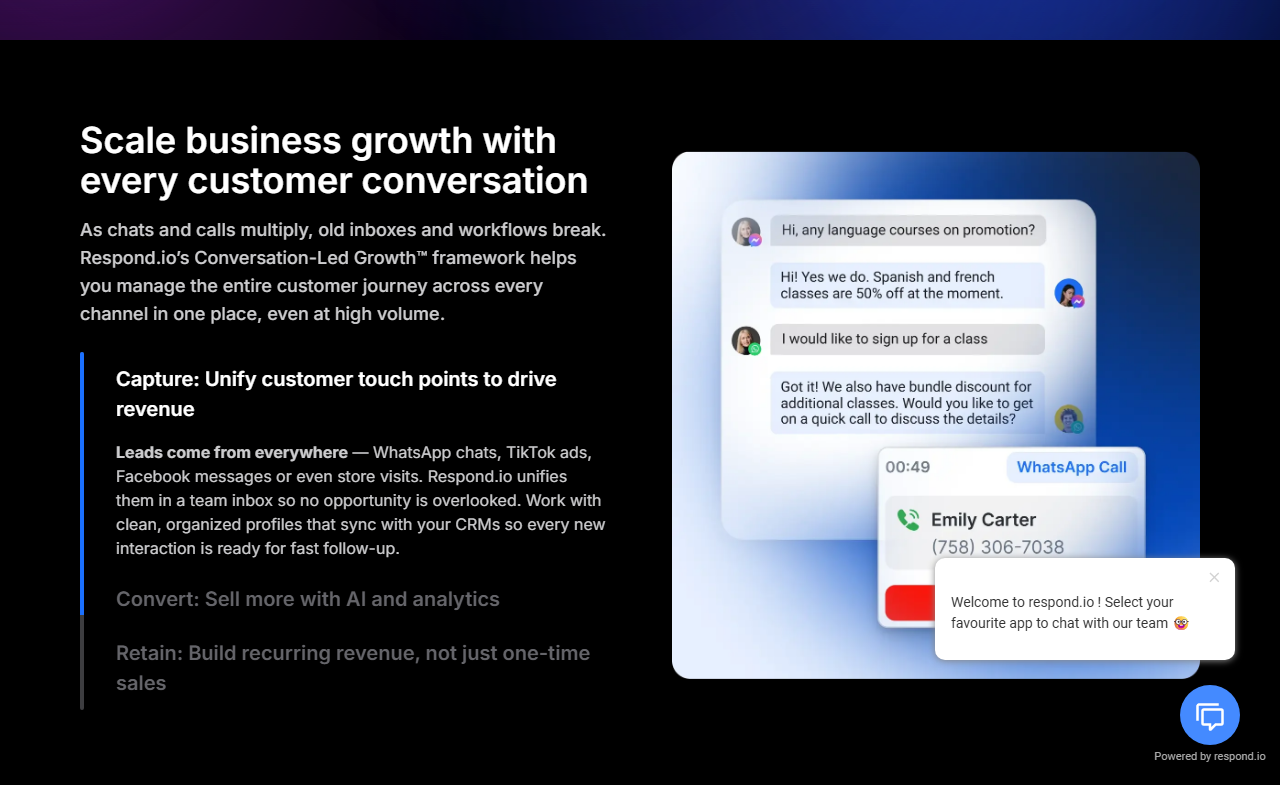
Respond.io is built for contact-centric operations, and it does a good job of keeping inbox context, contact history, and workflow state close together.
That makes the product feel like a true operations workspace rather than a simple messaging layer, especially for teams that care about lifecycle visibility and coordinated execution.
- Strong when teams want contact history, workflow state, and inbox context in one managed workspace.
- Useful for businesses that prioritize lifecycle visibility and coordinated execution.
- A major advantage if the goal is buying cohesion instead of building it.
ChatbotX is a better fit when that context has to live in a more open environment and tie into developer-managed workflows, internal systems, and custom operational logic.
Instead of relying on a vendor-owned workspace to define how contact context should behave, teams can shape the way profile data interacts with automation and AI over time.
- Better when contact logic must remain portable and customizable.
- Stronger for organizations building internal capability rather than relying entirely on vendor defaults.
- More suitable if profile data needs to drive custom workflow and AI behavior over time.
AI features, memory, and extensibility
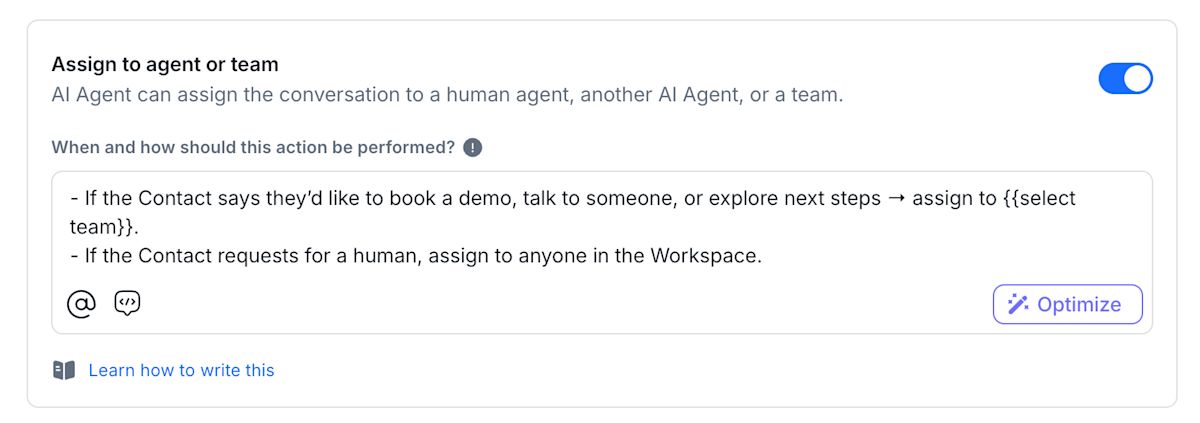
Respond.io is pushing hard on AI and operational automation, with AI Agents and AI Assist integrated into the product direction. That gives customers a polished, productized version of AI inside a managed environment, which is exactly what many teams want: faster execution without needing to assemble their own architecture. The value is convenience and clarity. You buy into a product direction that already knows how it wants AI to behave.
ChatbotX is stronger for teams that want AI behavior to remain more open, more portable, and more developer-shaped. The advantage is not that AI exists at all, but that it can connect more naturally to an open-source stack, agentic workflows, and deployment models the team controls more directly. That matters when AI stops being a feature and becomes part of the system design. Respond.io productizes AI well; ChatbotX gives technical teams more say in how AI should actually work.
Live chat, team inbox, and routing
This is Respond.io's headline strength. Routing, collaboration, context, team assignment, and reporting combine into a serious operations product that feels purpose-built for businesses running meaningful conversation volume.
It is not hard to see why many teams treat Respond.io as the premium SaaS benchmark in this category.
- Premium packaged inbox and routing story.
- Strong for organizations buying a mature operations workspace.
- Safer choice if the business wants managed polish over platform ownership.
ChatbotX competes here by connecting inbox operations to open-source workflows, AI agents, and deployment freedom rather than trying to out-SaaS the SaaS.
That creates a different kind of value proposition: one based less on polished workspace design and more on ownership of the underlying system.
- Stronger when the foundation itself needs to stay ownable.
- Better fit if inbox behavior must connect deeply to custom workflows and systems.
- More compelling for teams that want to shape operations rather than only configure them.

Channels and growth tools
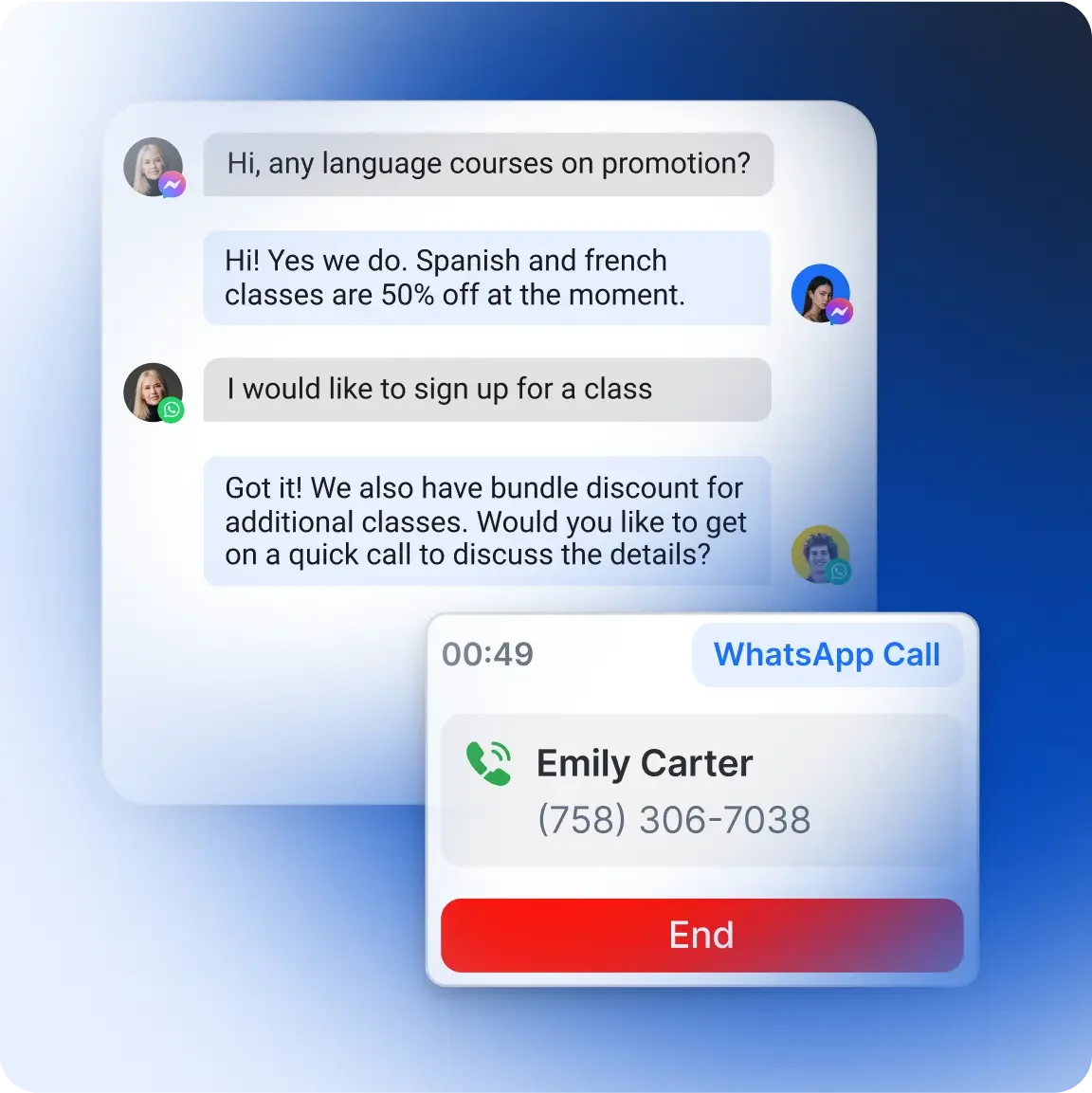
Respond.io supports a broad business messaging posture and is much less narrow than tools built around one social channel or one campaign use case.
That broader channel stance is one reason it belongs in a more serious shortlist: the product is clearly designed for organizations that need coordinated messaging operations rather than isolated automation.
- Strong for businesses treating conversations as an operational function, not just a growth tactic.
- Useful when multiple messaging channels need one managed workspace.
- A more complete SaaS competitor than most social-first products.
ChatbotX is comparable in strategic direction, but with an open-source, Agent-First architecture that appeals to teams who do not want to live entirely inside vendor rules.
The sharper difference is that one shared chatbot account can stay at the center while Messenger, WhatsApp, Instagram, Zalo, and Webchat reuse the same logic, context, and ownership model.
- Better when one chatbot account needs to support multiple channels together.
- Stronger when teams want to shape channel behavior over time.
- More appealing when control and extensibility matter as much as managed breadth.
Integrations, API, and developer flexibility
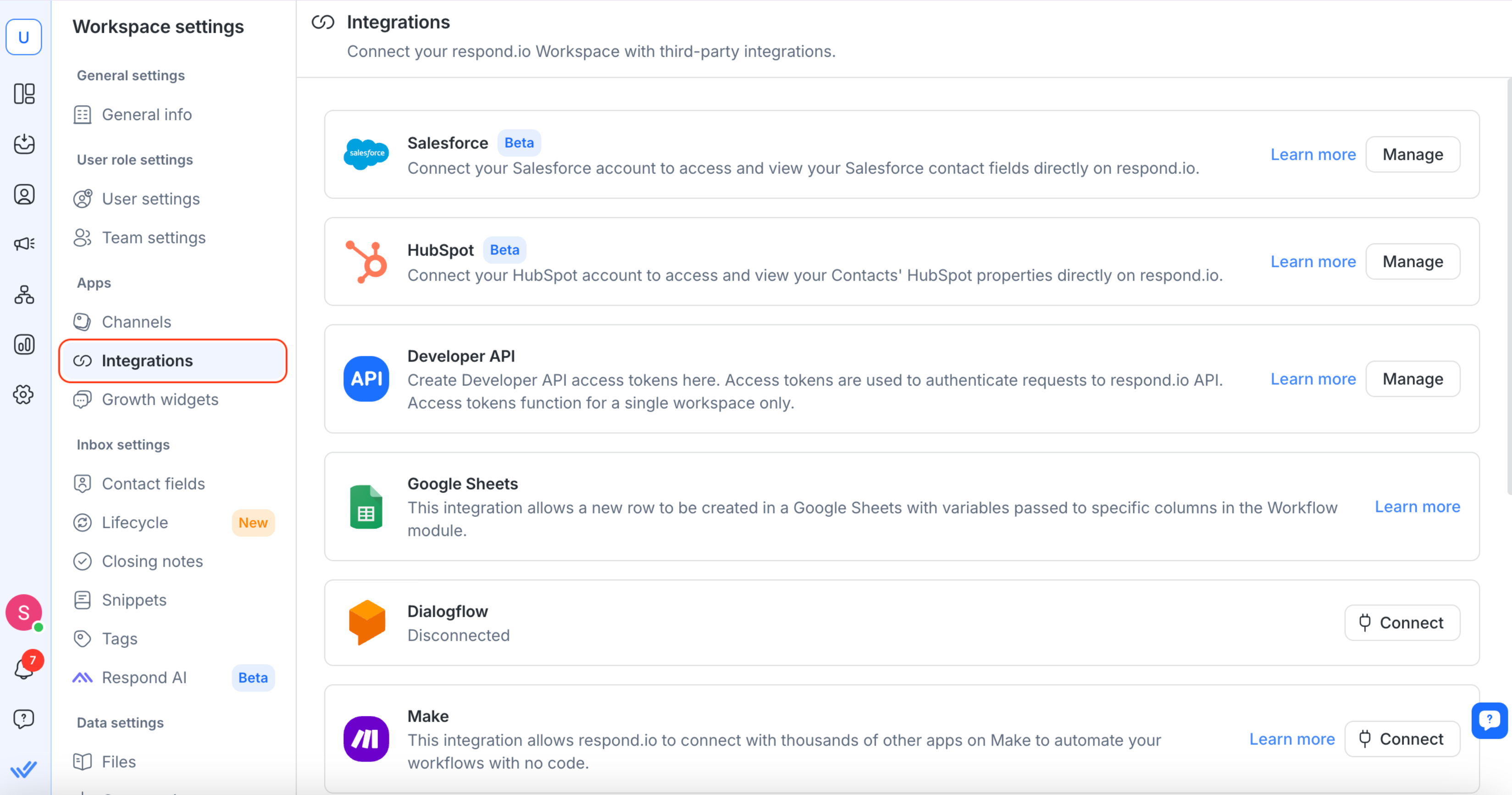
Respond.io offers meaningful integration and API capability, especially on higher plans, and for many businesses that is enough to cover the practical needs of a revenue or support operation.
The key point is that those capabilities still live inside a managed commercial boundary.
- Good API and integration story for a packaged SaaS.
- Useful when the team mainly wants to extend an already-polished workspace.
- Still constrained by vendor packaging and plan boundaries over time.
ChatbotX is the better fit when engineering wants a more direct role in shaping integrations, workflows, and deployment.
Instead of asking how much a SaaS platform can be bent, teams can ask how the messaging layer itself should be built, owned, and connected.
- Better when engineering needs deeper leverage over platform behavior.
- Stronger for organizations with stricter requirements around flexibility and control.
- More compelling if long-term architectural freedom matters more than SaaS polish.
Pricing, analytics, templates, and support
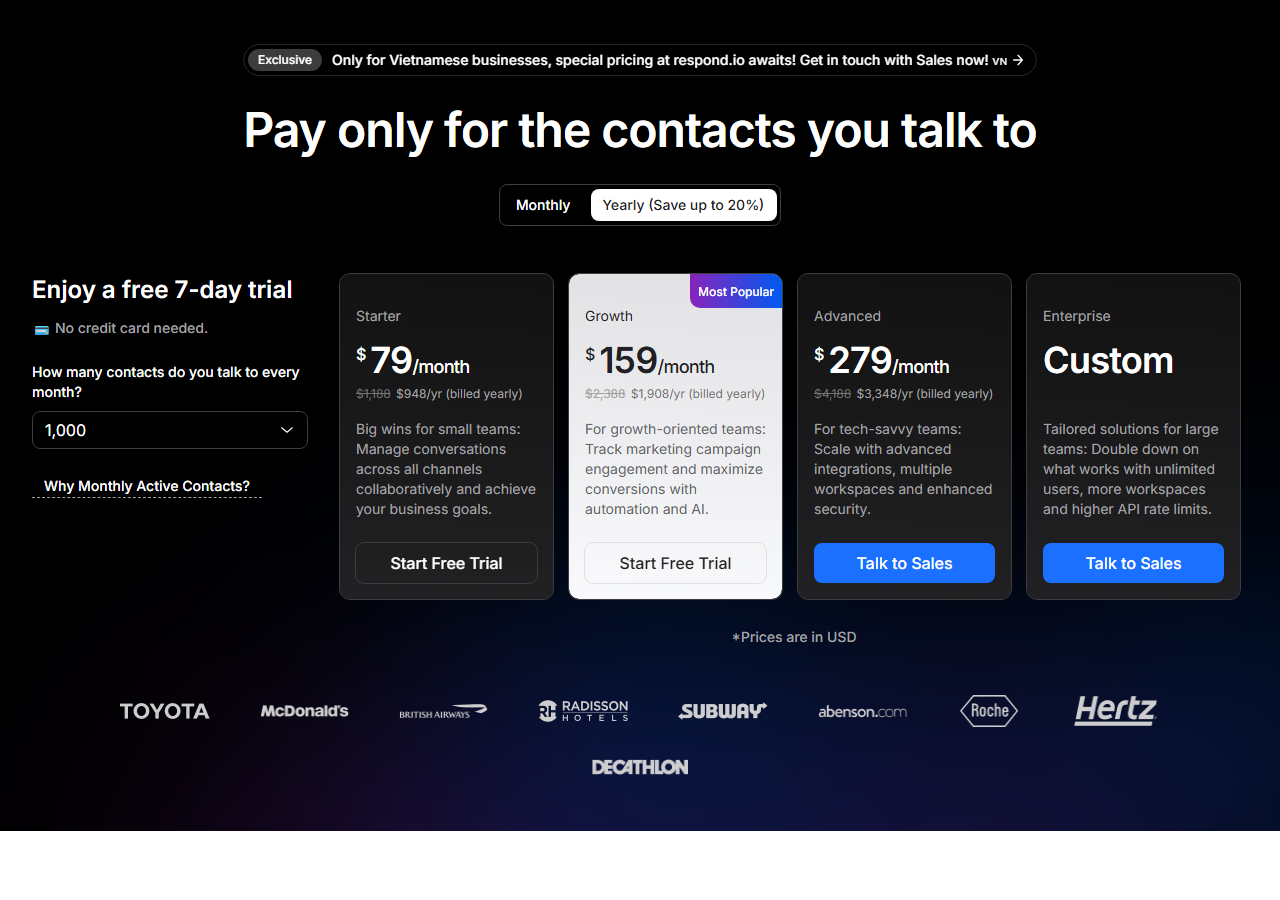
Respond.io is commercially sophisticated. The product has real reporting depth, strong operational polish, and a pricing model that feels credible for the category, but monthly active contact packaging can become strategically significant as usage grows.
That means the product can scale operationally while still creating commercial considerations that matter over time.
- High-confidence managed SaaS choice for teams wanting polish.
- Commercial model is understandable, but becomes more strategic at scale.
- Reporting and operational maturity are major strengths.
ChatbotX trades some of that packaged polish for ownership, open-source portability, and a product direction that feels more native to technical teams building for the long term.
The decision is less about who has the cleaner SaaS wrapper and more about what kind of platform relationship your business wants.
- More compelling when platform control matters strategically.
- Better for teams that want portability and self-directed evolution.
- Stronger if the business wants to shape messaging architecture as part of its own roadmap.
Bottom line
Choose Respond.io if you want one of the most mature managed SaaS products for inbox operations, workflows, and AI-assisted revenue execution.
Choose ChatbotX if you want similar ambition with one shared chatbot account across channels, open-source ownership, self-hosting paths, and an Agent-First architecture that gives your team more strategic control.
FAQ
Is Respond.io the toughest SaaS comparison here?
Yes. Compared with the other three, Respond.io is the most mature omnichannel SaaS competitor in this set.
That makes the comparison less about surface capability and more about ownership, deployment, extensibility, and whether the business wants a polished managed workspace or a platform it can shape more directly.
What does Respond.io do especially well?
Respond.io does especially well when a business wants a polished team inbox, strong routing, workflow automation, reporting, and AI-assisted operations inside one managed environment.
Its appeal comes from how complete the workspace feels for revenue and support teams that want operational maturity without having to assemble their own architecture.
How does Respond.io price the platform?
As of March 25, 2026, official pricing is positioned around monthly active contacts, with Starter from $79, Growth from $159, and Advanced from $279 before Enterprise discussions.
That pricing model is easy to understand at first, but it can become strategically meaningful as usage scales because packaged capability and contact volume move together.
Where might a team prefer ChatbotX over Respond.io even if Respond.io feels more polished?
A team may still prefer ChatbotX when ownership, deployment flexibility, and engineering control matter more than buying the cleanest managed SaaS experience.
That is usually the case when messaging logic has to live closer to internal systems or when the business wants more freedom to shape AI and workflow behavior over time.
When is ChatbotX the better Respond.io alternative?
ChatbotX is the better alternative when your team wants one shared chatbot account to coordinate multiple channels with the same logic, open-source deployment, and more say over AI and workflow behavior.
It is especially relevant for organizations that view messaging as part of architecture, not just as a polished SaaS workspace to subscribe to.
Related comparisons
Compare ManyChat vs ChatbotX for creator-first growth automation, social messaging depth, and platform ownership.
Read comparisonCompare Chatfuel vs ChatbotX for lightweight sales automation, built-in CRM, and extensibility.
Read comparisonCompare Wati vs ChatbotX for WhatsApp-first operations, team inbox depth, and omnichannel expansion.
Read comparison