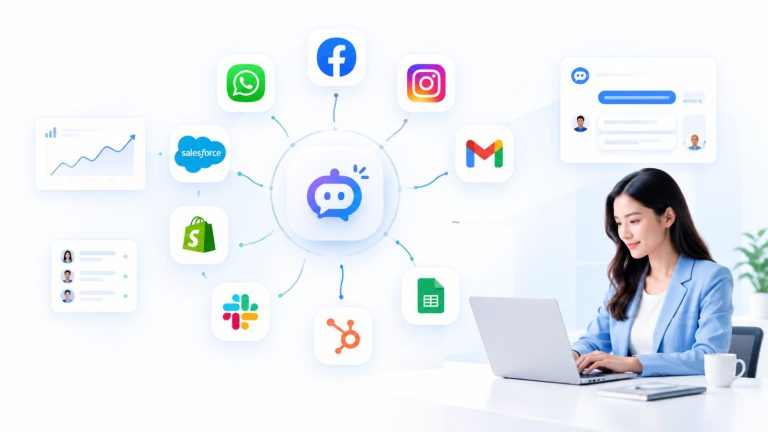

Chat apps stopped being just a place to say “hey” to friends a long time ago. In 2026, they’re where deals close, support tickets get resolved, and repeat customers are made. For any brand trying to sell across borders, picking the right mix of messaging channels – and running them without chaos – is now a core growth decision, not a side project for the social media team.
This guide walks through the messaging apps that actually matter for business in 2026, breaks down where each one wins and where it falls short, and shows how to run all of them from one place instead of five different logins.
Quick summary
- The world’s messaging apps split into two camps: everyday communication tools (WhatsApp, Messenger, LINE, WeChat) and interest-based communities (Telegram, Discord, Snapchat).
- Winning locally means picking the app your target market already lives in – WhatsApp for most of the world, LINE for Japan and Taiwan, WeChat for mainland China.
- The highest-performing brands don’t pick one channel; they let each platform do what it’s best at and connect the dots with a single backend.
- An omnichannel AI chatbot platform turns that backend into a single shared inbox instead of a pile of separate apps.
Launch agentic chat marketing in minutes with ChatbotX












What Counts as a Messaging App Today?
A messaging app lets people exchange text, voice, photos, video, and files over the internet in real time, regardless of where either person is standing. That part hasn’t changed since the category was invented.
What has changed is the business layer sitting on top. Nearly every major app in this list now ships with a commerce toolkit: verified business profiles, catalog browsing, in-chat checkout, and – increasingly – always-on AI agents that can answer a question at 2 a.m. without waking anyone on the support team.
Everyday Messaging Apps: Where Real Relationships Live

These are the apps people already use to text their mom, their coworker, and their landlord. Because trust is already built in, they’re the strongest channel for direct 1-on-1 support and closing sales.
WhatsApp remains the world’s dominant messenger, with roughly three billion users accessing the app on a monthly basis as of late 2025. It’s the default channel across most of Europe, Latin America, and Australia, and it’s the backbone of business messaging in dozens of other markets. Companies can apply for the official WhatsApp Business Platform, which unlocks a verified green badge, template messages, and automated replies at scale.
- Strengths: Massive global reach, a dedicated business tier, and message open rates that consistently beat email.
- Limitations: Standard groups cap out at a modest member count, and registration requires a real phone number – a mild privacy trade-off for some users.
Facebook Messenger
Messenger sits inside Meta’s Messenger Platform and connects directly to Facebook Pages and ad campaigns, which makes it a natural landing spot for social ad traffic. Meta’s own Messenger Platform documentation covers how businesses can build automated flows on top of it.
- Strengths: Tight integration with Facebook ads, so a click on an ad can drop a shopper straight into a conversation.
- Limitations: Only reachable by people who still maintain an active Facebook account, which skews older in some markets.
Instagram Direct Message
IG DM is where visual-first brands win. Product tags, Stories replies, and shoppable posts all funnel into direct chats, making it a favorite for fashion, beauty, and lifestyle sellers targeting younger buyers.
- Strengths: High engagement from a young, visually driven audience.
- Limitations: No clickable links inside standard captions, and voice notes are capped at a short duration.
LINE
LINE is essentially daily infrastructure in Japan and Taiwan. Official Accounts come with sticker culture, in-app shopping, and LINE Pay, all wrapped into one familiar interface for local shoppers.
- Strengths: Deep local trust and a built-in payment rail for frictionless checkout.
- Limitations: The web client is thinner than competitors, which can slow down larger support teams.
WeChat is the closest thing to an operating system for daily life in mainland China, combining chat, social feed, payments, and Mini-Programs that let brands run a full storefront without ever leaving the app.
- Strengths: A self-contained commerce ecosystem – chat, discovery, and payment in a single tap.
- Limitations: Access is restricted or inconsistent in several countries outside China, including parts of North America and Europe.
Signal
Signal is built entirely around privacy – no ads, no tracking, end-to-end encryption by default.
- Strengths: The gold standard for privacy-conscious users.
- Limitations: No business marketing tools and no behavioral data, so mass outreach isn’t really an option here.
Kakao Talk
Kakao Talk owns South Korea, installed on the overwhelming majority of smartphones in the country.
- Strengths: Practically mandatory for any brand entering the Korean market.
- Limitations: Many of its commerce perks (payments, ride-hailing) are locked to local users only.
Community-Driven Messaging Apps: Where Fans Gather

These platforms aren’t built around your phone contacts – they’re built around shared interests, servers, and public groups. That makes them ideal for brand communities, superfan groups, and Gen Z reach rather than 1-on-1 sales conversations.
Snapchat
Snapchat’s audience skews heavily toward 13–34 year-olds, and its AR lens technology remains unmatched for playful, visual product marketing.
- Strengths: Best-in-class AR engagement among younger demographics.
- Limitations: Content disappears fast, so it’s a poor fit for keeping a permanent support record.
Telegram
Telegram is known for speed, generous file-sharing limits, and enormous group capacity – some public groups run into the hundreds of thousands of members.
- Strengths: Perfect for hosting a large, highly engaged community around a brand or niche.
- Limitations: Oversized groups get noisy fast, and important announcements can get buried in the scroll.
Discord
Discord organizes people into “servers” with separate channels for different topics, plus strong voice-chat quality that gamers and hobbyist communities rely on daily.
- Strengths: Easy to structure conversations by topic (announcements, product questions, general chat).
- Limitations: Users can freely change nicknames per server, making identity verification tricky.
How to Choose the Right Channel Mix

Match the App to the Market
- Western markets and most of the world: Lead with WhatsApp. Its reach and trust make it the default support and sales channel almost everywhere outside a handful of regions.
- Japan and Taiwan: LINE isn’t optional – it’s the standard.
- Mainland China: WeChat Mini-Programs plus WeChat Pay is the expected shopping experience.
Let Each Channel Play Its Position
Instead of betting everything on a single app, the smarter move is running several channels in parallel, each doing what it does best:
- Awareness and ad-driven traffic (Messenger, IG DM, Snapchat): Use these to catch attention and auto-reply the moment someone comments or messages, then route hot leads onward with a discount code or product catalog.
- 1-on-1 sales conversations (WhatsApp, LINE): Once someone shows real intent, move them into a direct channel for personalized follow-up, cart-recovery nudges, or order updates – all without forcing them through a signup form first.
- Community and loyalty building (Telegram, Discord): Use these for superfans, early-access drops, and organic word-of-mouth that platform algorithms can’t throttle.
Running It All Without Losing Your Mind

Multi-channel messaging is great for reach and terrible for operations if your team is manually toggling between five apps all day. That’s the exact problem an open-source, agentic omnichannel platform like ChatbotX is built to solve.
One Inbox, Every Channel
ChatbotX’s shared inbox pulls WhatsApp, Messenger, Instagram, Telegram, and more into a single collaborative workspace, so agents stop losing track of who said what where. Both the WhatsApp and Messenger channel integrations connect natively, meaning no separate tab-switching between platform dashboards.
AI Agents That Actually Handle Things
Rather than a scripted bot that only answers a handful of pre-set questions, ChatbotX’s AI Agents can hold a real conversation, pull product information, and hand off to a human only when it genuinely needs to. That means qualified leads get a reply at 3 a.m. instead of waiting until business hours.
Built to Grow With You
Because ChatbotX is open-source, teams can inspect the codebase on GitHub, self-host if data residency matters to them, or extend it with custom flows. Release notes and version history are tracked publicly in the project’s GitHub releases, so there’s no black box between you and the platform running your customer conversations.
For teams that want a deeper look at how channel choice plays out market by market, our earlier breakdown on messaging apps for business in 2026 and our playbook on unifying WhatsApp, WeChat, and LINE across the Greater Bay Area both dig further into cross-border channel strategy.
Conclusion
There’s no single “best” messaging app – there’s only the right combination for your market, your audience, and your sales motion. Get the local anchor app right, let each channel specialize, and stop forcing your team to babysit five separate inboxes. That last part is where most of the wasted hours disappear, and it’s exactly the gap a unified, AI-powered platform is meant to close.
Ready to stop juggling apps and start converting conversations into revenue? Get started with ChatbotX and bring every channel – WhatsApp, Messenger, Instagram, Telegram, and beyond – into one workspace your whole team can actually keep up with.
FAQ
What are the main messaging apps businesses use in 2026?
Everyday communication apps include WhatsApp, Facebook Messenger, Instagram DM, LINE, WeChat, Signal, and Kakao Talk. Community-driven apps include Snapchat, Telegram, and Discord.
How do I decide which messaging app to prioritize?
Start with whichever app dominates your target market (WhatsApp for most regions, LINE for Japan/Taiwan, WeChat for mainland China), then layer in social platforms for top-of-funnel reach and community apps for loyalty building.
How can a growing team manage multiple messaging channels without missing messages?
An omnichannel platform that merges every channel into a single shared inbox – with AI agents handling repetitive questions – is the most practical fix, letting a small team cover coverage that would otherwise require round-the-clock staffing.