
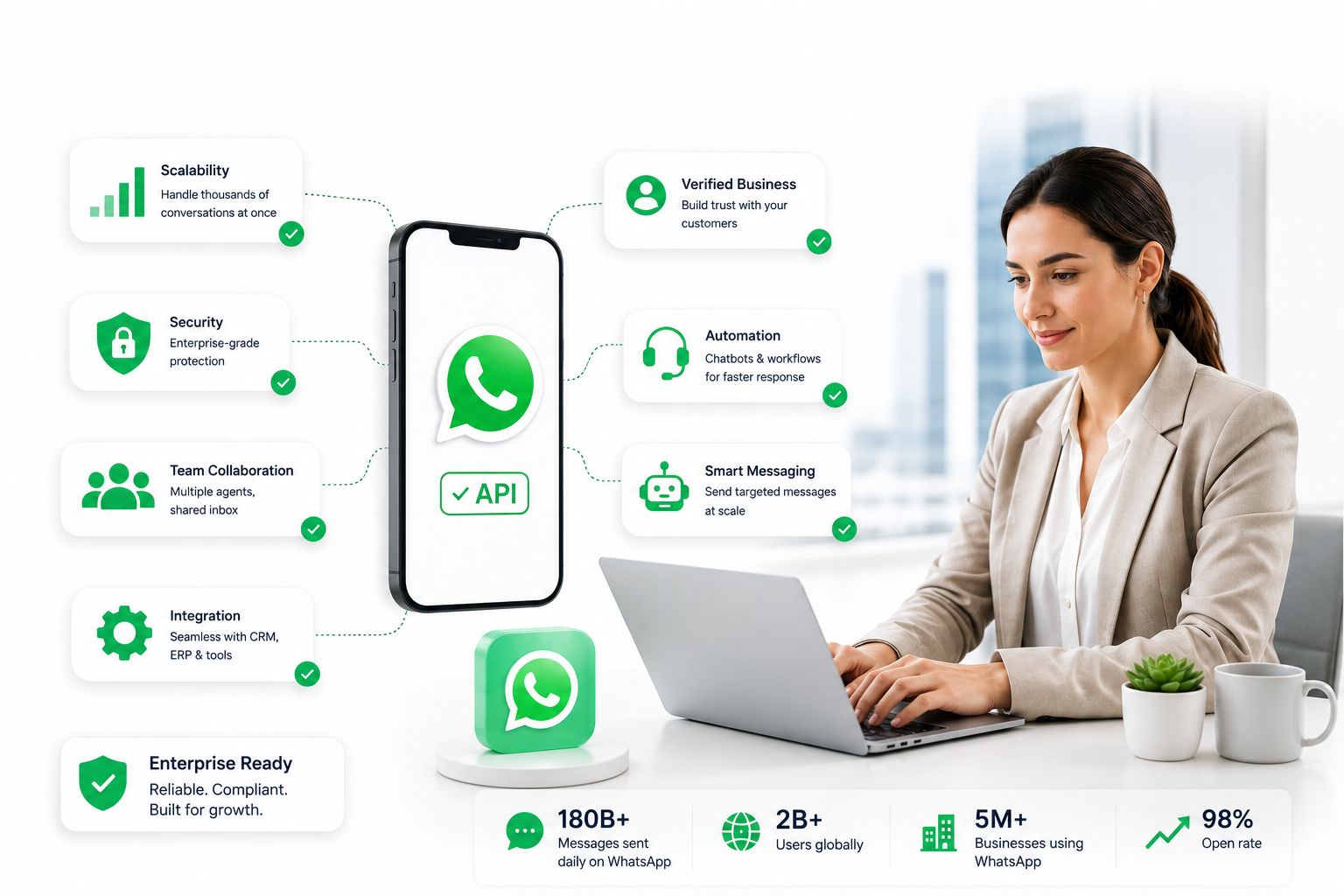
Customers no longer tolerate email threads that sit unread for days or SMS blasts that feel like spam. They want a real-time conversation, and increasingly, that conversation happens on WhatsApp. For enterprises, the question isn’t whether to be on WhatsApp – it’s whether to run it through the free consumer app or through the official WhatsApp Business API. In 2026, that decision has become a strategic infrastructure choice, not a technical footnote.
Quick summary:
- The free WhatsApp Business app is built for micro-businesses, not scaling organizations – it caps devices, blocks CRM sync, and offers almost no automation.
- The WhatsApp Business API removes broadcast caps and lets enterprises run AI-driven messaging at thousands-of-conversations-per-day volume.
- Enterprise-grade governance – encryption, role-based access, and data-processor agreements – makes the API viable for regulated industries.
- The API is what makes Online-Merge-Offline (OMO) attribution possible, connecting digital chats to in-store or field-sales revenue.
- A unified AI workspace turns WhatsApp into a single operating layer for marketing, sales, and support instead of three disconnected tools.
Launch agentic chat marketing in minutes with ChatbotX














The Free App Was Never Built for Enterprise Scale
The confusion between the WhatsApp Business app and the WhatsApp Business API is one of the most common – and costly – missteps enterprises make when planning their messaging strategy.
The free app was designed for a shop owner managing a handful of daily chats from one phone. It caps you at a small number of linked devices, restricts broadcasts to saved contacts only, and has no meaningful integration path into a CRM, order management system, or support desk. Push past those limits and you risk having your number flagged or suspended entirely.
The API removes those ceilings. It supports unlimited concurrent agents, connects natively into your existing tech stack, and gives AI systems – not just humans – the ability to hold structured, policy-compliant conversations at scale.
| Comparison Point | Free WhatsApp Business App | WhatsApp Business API |
|---|---|---|
| Ideal for | Solo operators, local shops | Mid-market and enterprise teams |
| Device / user limits | A handful of linked devices | Unlimited concurrent agents on one platform |
| CRM and data sync | None – data stays on the device | Bidirectional sync with CRM and e-commerce systems |
| Broadcast capacity | Capped, saved-contacts only | Unlimited template-based broadcasting |
| Compliance controls | Minimal, no admin oversight | Audit trails, role-based permissions, data-processor terms |
| Automation depth | Basic away messages | Multi-step AI agents and conditional flows |
What Enterprises Actually Gain by Moving to the API
A Verified, Trustworthy Identity
Impersonation and phishing attempts against brand accounts are a real and growing risk. Official API access unlocks Meta’s verified badge, which visually separates a legitimate enterprise account from a copycat. That single green checkmark does more to reassure a wary customer than any amount of in-chat reassurance text.
Security and Compliance Built for Regulated Industries
Every message sent through the API – order confirmations, one-time passwords, account alerts – travels through end-to-end encryption, so sensitive payloads stay unreadable in transit. Just as importantly, when messages route through Meta as an authorized data processor rather than a data controller, message content cannot be mined for advertising and stays outside the scope of general data harvesting. That distinction is what lets the architecture align with frameworks like the EU’s GDPR and similar regional data-protection laws, rather than leaving compliance entirely to internal policy.
Broadcasting Without the Ceiling
Manually sending individual messages does not scale past a few hundred customers. The API is engineered for high-volume, templated sends without triggering the account-health penalties that hit free-app users the moment their message volume looks suspicious to Meta’s systems. Message costs and category rules for these sends are governed directly by Meta’s official WhatsApp pricing documentation, which is worth reviewing before committing to a broadcast cadence at enterprise volume.
Modern platforms take this further with agentic AI. Instead of a marketer manually building each campaign, an AI Agents engine can take a single-line brief – “recover abandoned carts for our skincare line” – and autonomously draft the copy, select the media, and configure the conditional routing logic, compressing a task that once took a full day of campaign-ops work into a matter of minutes.
One Operating Layer for Marketing, Sales, and Support
Disconnected tools for each department – one for campaigns, one for the help desk, one for the CRM – create blind spots and duplicated customer effort. A mature API deployment collapses those silos into a single conversational thread:
- Marketing teams use a visual Flow Builder to design multi-step journeys – product discovery, loyalty offers, gamified promotions – without writing a line of code.
- Sales teams trigger cart-recovery sequences the instant a checkout is abandoned, and let customers complete purchases from inside the same thread via native catalog and payment support.
- Support teams route repetitive tickets to AI first, with full context handed off to a human agent only when a query genuinely needs one, all visible from a Shared Inbox rather than scattered across separate tools.
For businesses weighing which vendor can deliver this kind of unified automation without stitching together five separate point solutions, this comparison of leading WhatsApp Business Solution Providers breaks down the feature gaps between platforms in detail.
Bridging Digital Chats and Physical Storefronts
Perhaps the clearest ROI case for enterprise WhatsApp is Online-Merge-Offline (OMO) commerce. A digital conversation can hand a high-intent shopper directly to a physical store associate, who closes the sale in person – and because the handoff is tracked, leadership finally gets clean attribution on how much offline revenue a chat channel actually drives.
The reverse works just as well: a QR code at checkout or printed on packaging pulls an in-store customer into the brand’s digital ecosystem, where automated remarketing, loyalty nudges, and repeat-purchase offers keep the relationship active long after they leave the building. A single walk-in becomes a recurring digital touchpoint instead of a one-time transaction.
Governance That Scales With Your Org Chart
Large, distributed teams need permission structures that match their organization, not a flat list of users on one shared login. The API supports scoped access tokens so that a regional director, a store manager, and a support rep each see only what their role requires – protecting the broader customer database even as frontline headcount grows.
Turning Conversations Into Business Intelligence
Chat logs are only useful if they translate into decisions. Pairing the API with a proper CRM contacts layer and analytics engine means leadership can ask direct, conversational questions – “how did last week’s broadcast perform against revenue?” – instead of exporting spreadsheets by hand.
Getting that measurement architecture right matters more than the messaging volume itself. Enterprises that skip conversation-level tracking end up with vanity metrics – read rates, subscriber counts – that say nothing about pipeline or retained revenue. According to Gartner’s research on agentic AI in customer service, organizations deploying AI-driven automation are able to meaningfully cut support costs – but only when the underlying data pipeline is built to capture attribution correctly from day one. Enterprises building out that measurement framework can find a step-by-step model in this guide to WhatsApp Business KPIs and revenue attribution.
Scaling Through CRM Integration, Not Around It
Messaging that lives in a vacuum, disconnected from customer history, caps how personal a conversation can get. The real differentiator of API-based deployments is a live, bidirectional data sync with existing CRM and e-commerce systems: customer tier, purchase history, and support tickets flow into the chat before an agent or AI ever replies, while every new conversation, tag, and click-through writes back to the CRM automatically. That loop is what Salesforce’s research on customer experience points to when it finds that customers weigh the overall experience a company delivers as heavily as the product itself – and a fragmented, context-free chat is precisely the kind of experience that erodes trust.
Where ChatbotX Fits Into This Shift
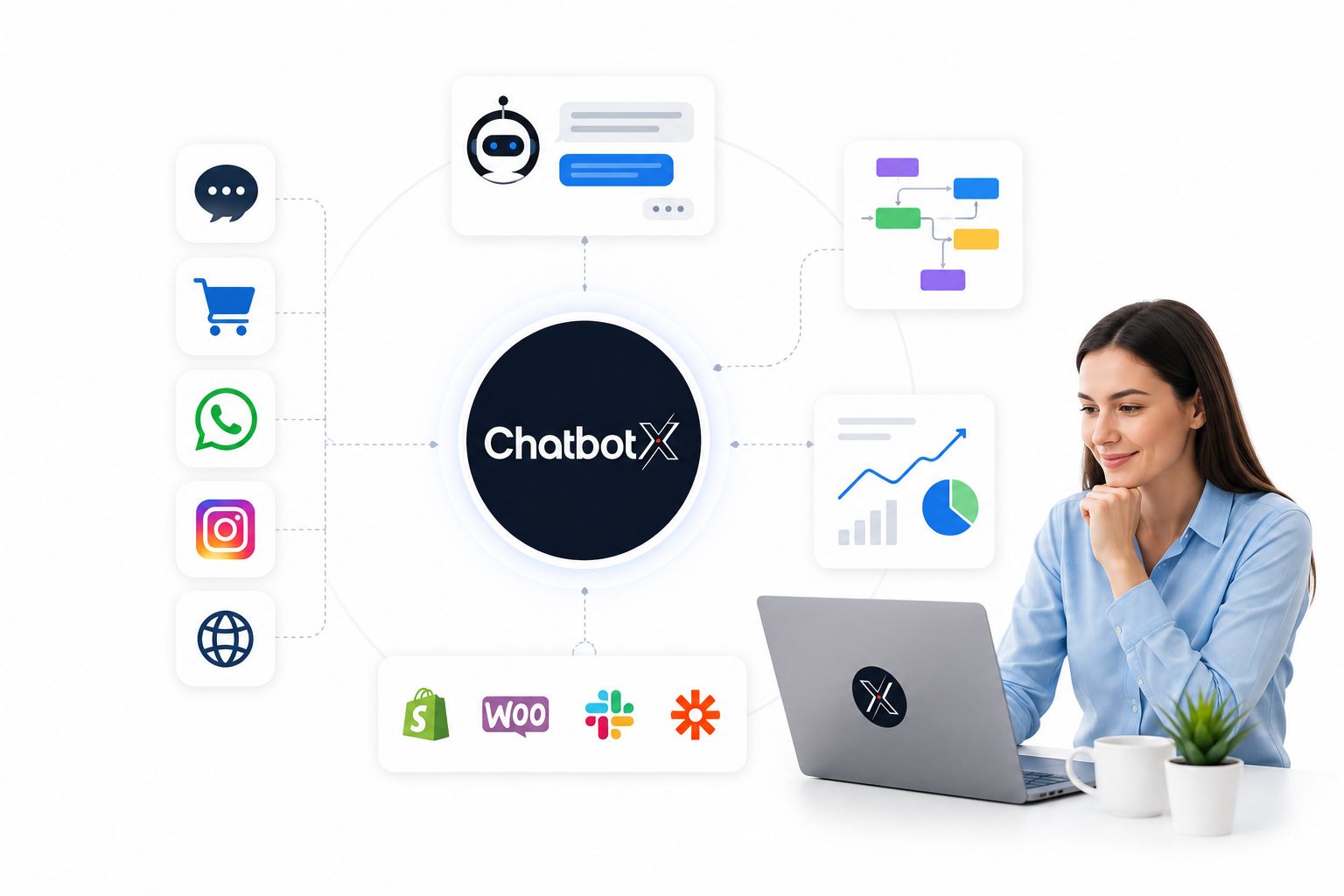
ChatbotX is an open-source, agentic omnichannel platform built to run this entire stack – WhatsApp, Messenger, Instagram, and more – from one workspace. Instead of stitching together a chatbot builder, a CRM connector, and a separate analytics tool, teams get AI agents, a no-code flow builder, a shared inbox, and revenue attribution reporting natively in one place, with the full source available on GitHub for teams that want to inspect, self-host, or extend the platform. Release history and version notes are tracked publicly in the project’s changelog, which is worth a look for any engineering team evaluating deployment options before committing.
Moving to the API Is No Longer Optional
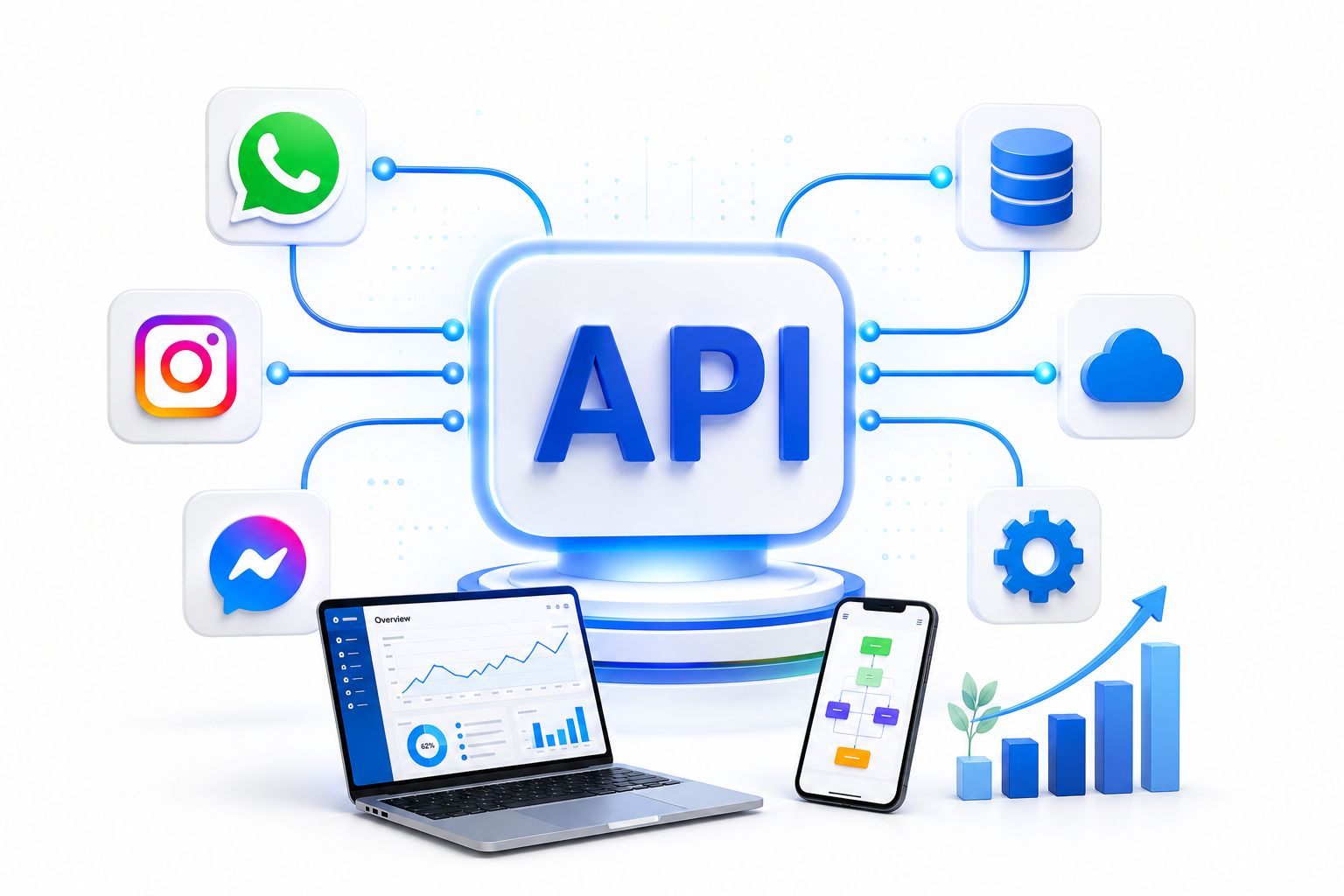
The gap between a free chat app and enterprise-grade conversational infrastructure has only widened in 2026. Businesses that keep operating on the consumer app are trading away CRM visibility, automation depth, and account stability – three things that directly determine whether WhatsApp becomes a genuine revenue channel or stays a side project.
If your team is still routing enterprise volume through a personal WhatsApp number, the upgrade path is worth mapping out now, before a broadcast limit or a compliance gap forces the decision. Book a free ChatbotX consultation and see how an AI-native WhatsApp Business API deployment can fit your existing CRM, support desk, and marketing stack – usually within a matter of weeks, not quarters.