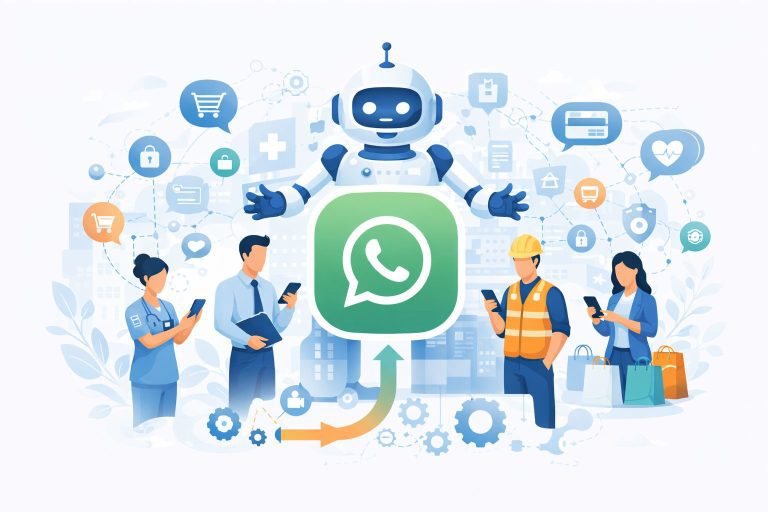
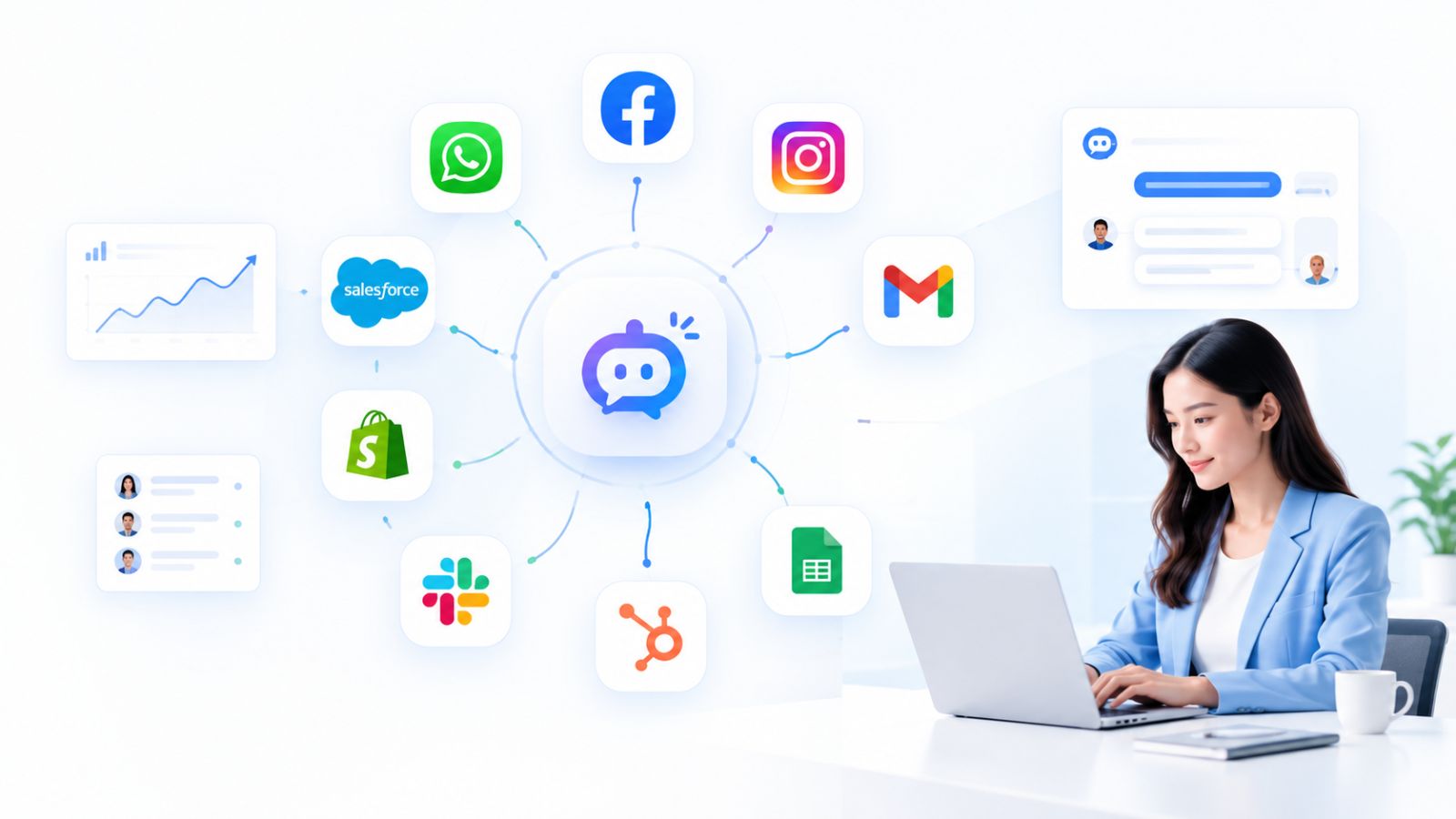
Quick answer: A connected business platform is a single hub – usually built around a CRM or an omnichannel messaging system – where sales, marketing, support, and finance tools share the same customer data in real time. The integrations worth prioritizing first are: unified messaging and inbox, AI agents, contact/CRM data, calendar and payment tools, and analytics. Get those five talking to each other before you add anything else.
Every new app you bolt onto your business stack arrives with the same pitch: it will save time, close more deals, or make support faster. Six months later, your team is toggling between eleven browser tabs, copy-pasting customer details from one system into another, and nobody can say for certain which channel a lead actually came from.
That’s not a tooling problem. It’s a connection problem – and it’s the reason “central business platform” has become one of the most searched terms among small business owners this year.
Launch agentic chat marketing in minutes with ChatbotX










What a Connected Business Platform Actually Means
A connected business platform isn’t just a CRM with a handful of plug-ins attached to it. It’s the layer that sits underneath sales, marketing, support, and commerce, letting every one of those functions read and write to the same customer record in real time.
Recent research on SMB technology adoption backs up why this matters so much right now. Businesses are no longer short on software – the average company already juggles well over a hundred different SaaS tools, and buyers increasingly choose vendors based on how easily those tools plug into everything else they already run, not on feature lists or price alone.
When your customer data lives in one connected system instead of six disconnected ones, that system stops being a passive database. It becomes the thing that tells your team what to do next: which lead to call first, which conversation needs a human instead of a bot, and which customer is about to churn.
The Integrations Small Businesses Should Prioritize First

Not every integration deserves the same amount of attention. The ones that actually move the needle are the ones that remove manual, repetitive work sitting between the systems your team touches every day.
Unified Messaging and Omnichannel Inbox
Customers today reach out wherever is convenient for them – WhatsApp, Messenger, Instagram DMs, Zalo, a website chat widget, or plain email – and they expect the business on the other end to remember the conversation regardless of channel. Splitting those conversations across separate inboxes means duplicated replies, missed messages, and agents who have no context when a customer switches channels mid-conversation.
A shared, omnichannel team inbox solves this by pulling every channel into one dashboard, so support and sales can collaborate on the same thread instead of hunting through five different apps for the same customer.
AI Agents That Actually Understand Intent
Generic chatbots that only match keywords are quickly becoming the weakest link in a modern stack. What’s replacing them are goal-oriented AI agents that detect intent, hold context across a conversation, qualify a lead, and hand off to a human only when the conversation genuinely needs one.
Recent research from McKinsey on generative AI’s productivity impact makes the underlying point clearly: the biggest gains don’t come from AI doing an isolated task once, they come from AI being woven into workflows that used to require several manual handoffs. ChatbotX’s AI agents are built around exactly that idea – agents that plug straight into your existing flows rather than living in a separate app you have to check on their own.
This is also where a lot of businesses are quietly rebuilding their entire top-of-funnel. Our guide to how AI CRM modules are changing customer loyalty walks through why pairing AI with CRM data – rather than treating them as separate tools – is what actually drives repeat purchases in 2026.
Contact Data and CRM Sync
Every integration above is only as useful as the contact record behind it. If your CRM contacts, your marketing tags, and your support history live in three different systems, no AI agent and no shared inbox can fully compensate for that gap.
ChatbotX’s CRM Contacts module keeps tags, custom fields, segmentation, and full conversation history attached to a single contact profile, so a sales rep opening a chat already sees what marketing sent that lead last week and what support resolved for them last month.
Automation, Triggers, and API Connections
The integrations that eliminate the most manual work are usually the invisible ones: a form submission that automatically tags a contact, a payment confirmation that triggers a receipt message, a support ticket that escalates itself after two hours of silence.
For teams building deeper automations, triggers and actions combined with public API, CLI, and MCP access let developers wire ChatbotX into whatever else the business already runs – an accounting tool, an internal dashboard, or a custom-built app – without waiting on a native integration to be built for them.
Zapier’s own analysis of ten thousand AI-powered automations found that the businesses getting the most value weren’t using AI for one-off tasks – they were connecting AI steps across an entire workflow, from lead capture through to follow-up, so nothing had to be re-entered by hand at any stage.
Analytics That Cover the Whole Journey
Toggling between five dashboards to understand how the business is actually performing wastes time leadership doesn’t have. Pulling data from every channel, every campaign, and every AI conversation into one live view is what turns raw activity into a decision leadership can actually act on the same day it happens.
Where Marketing Fits Into a Connected Platform
Sales and support tend to get the spotlight in these conversations, but marketing is usually the function generating the most disconnected data of all – ad clicks in one dashboard, email opens in another, social replies in a third. Our breakdown of marketing workflow management in 2026 covers how to stop good campaign ideas from getting stuck between the brainstorm and the launch – which, in practice, almost always comes down to the same connection problem described above.
The same logic extends into outbound prospecting. Sales reps are hired to sell, yet most of their week disappears into list-building and manual follow-ups long before a real conversation happens. Our piece on how AI BDRs automate prospecting is a useful next read if outbound is where your team is losing the most hours.
Expanding Your Stack Without Starting Over

As a business grows, its integration needs grow with it. The advantage of choosing an open, self-hostable platform is that you’re never boxed into whatever a vendor decides to build next.
ChatbotX is developed entirely in the open on GitHub, which means the roadmap, the release history, and the underlying code are all visible rather than locked behind a closed product team. Anyone evaluating the platform can review the full release history to see exactly what’s shipped and how frequently, rather than relying on a sales deck’s promises.
That openness matters more than it might seem. A report on B2B integration trends found that the ability to fit cleanly into a company’s existing stack is now one of the strongest factors in a software buying decision – often ahead of price or feature count. Self-hosting and public APIs are how you keep that flexibility long after the initial purchase decision is made.
How ChatbotX Brings It All Together
ChatbotX is an open-source, agentic omnichannel platform built specifically to be that connective layer – the ManyChat alternative you can self-host, white-label, and resell, without ever being locked out of your own customer data. Instead of stitching together a separate inbox tool, a separate CRM, and a separate chatbot builder, ChatbotX centralizes omnichannel messaging, AI agents, contact management, broadcasting, and automation into a single self-hosted stack that connects to WhatsApp, Messenger, Instagram, Telegram, Zalo, TikTok, email, and website chat from day one.
Because it’s open-source, you’re never dependent on a single vendor’s release schedule to get the integration you need – you can extend it yourself, or lean on the community already doing exactly that.
Frequently Asked Questions
What is a connected business platform?
A connected business platform is a system – typically centered on a CRM or an omnichannel messaging hub – where sales, marketing, support, and finance tools share the same customer data in real time, instead of operating as separate, disconnected apps.
Which integrations should a small business set up first?
Start with the ones that eliminate the most manual work: a unified omnichannel inbox, AI agents that can qualify and route conversations, and a CRM that keeps every contact’s history in one place. Automation triggers and analytics come next once those three are talking to each other.
Do I need a developer to connect everything?
Not for the basics. Channel connections, shared inboxes, and AI agent setup are typically configurable without code. Deeper, custom automations benefit from API, CLI, or MCP access, which is where a developer becomes useful.
Can a small business build this without an IT team?
Yes. Platforms designed for self-hosting and guided setup, like ChatbotX, are built specifically so a small team can get a connected system running without a dedicated technical department – and can add complexity gradually as the business grows.
How does AI fit into a connected platform?
AI is only as useful as the data it can see. Once your channels, contacts, and workflows are connected, AI agents can qualify leads, answer routine questions, and flag conversations that need a human – all with the full context of who the customer is and what’s already happened.
Ready to Connect Your Stack?
If your team is still juggling a dozen tabs to manage one customer conversation, the fix isn’t another standalone tool – it’s a platform that already connects the pieces you need. Get started with ChatbotX for free, or explore the documentation to see how fast a connected stack comes together.