
Small businesses have always operated on the same competitive instinct: figure out how to punch above their weight class. In 2026, that instinct has a powerful new outlet – the agentic enterprise model.
What was once an operating strategy available only to companies with hundred-person engineering teams and seven-figure software budgets is now accessible at any scale. Thanks to the rapid maturation of autonomous AI agents, a two-person startup can deploy the same caliber of intelligent workflow automation that Fortune 500 companies use. And in many cases, lean teams move faster with it than large organizations burdened by legacy systems.
This guide breaks down exactly what the agentic enterprise means for growing businesses, why the opportunity is right now, and how to put the model into practice – starting today.
Launch agentic chat marketing in minutes with ChatbotX












What Is the Agentic Enterprise?
The agentic enterprise is an operating model where human teams and autonomous AI agents work together continuously inside structured business systems. Unlike basic automation – which follows rigid rules and pre-written scripts – agentic AI can reason through novel situations, access live business data, make contextual decisions, and execute multi-step tasks without constant human oversight.
Think of it less like a conveyor belt and more like a self-directed employee: one that reads the situation, decides on a course of action, executes it across multiple systems, and reports the outcome – all within seconds.
According to McKinsey’s 2025 State of AI report, organizations that have deployed agentic AI frameworks report 30–40% efficiency improvements in customer-facing workflows within the first year. The same report notes that companies with fewer than 500 employees are adopting these tools at a faster rate than mid-market firms, largely because they have fewer legacy constraints to overcome.
For small businesses, the core proposition is straightforward: agentic AI is the mechanism through which a 10-person team can deliver the output and responsiveness of a 50-person team.
Why the Timing Is Right for SMBs

Three forces are converging in 2026 that make this the ideal moment for small businesses to act:
1. Agentic AI has become deployable without deep technical expertise.
The infrastructure that once required a data science team is now available through no-code and low-code platforms. You don’t need to fine-tune a model or build pipelines from scratch – you configure behavior, connect your data, and deploy.
2. Customer expectations have shifted dramatically.
Consumers in 2026 expect instant, personalized responses around the clock. The gap between what customers expect and what small businesses can deliver without automation is widening. Agentic AI closes that gap.
3. Cost parity has arrived.
Enterprise-grade AI capabilities are no longer enterprise-priced. Open-source platforms and SaaS tools have democratized access to the same foundation models used by the largest companies in the world.
The Stanford AI Index 2026 confirms this shift, noting that the cost of deploying production-grade AI agents has dropped by over 80% in the past two years, driven by open-source model releases and infrastructure commoditization.
Four Business Functions Where Agentic AI Delivers Immediate ROI

1. Customer Support – 24/7 Without the Overhead
The most immediate win for any small business. An AI agent handling customer inquiries does not take sick days, does not burn out at 11 PM when a customer in a different time zone submits a complaint, and does not require a salary.
More importantly, a well-configured agentic support system does not just respond – it resolves. It can check order status, process a return request, update a CRM record, escalate to a human agent with full context pre-loaded, and send a follow-up confirmation – all within a single conversation.
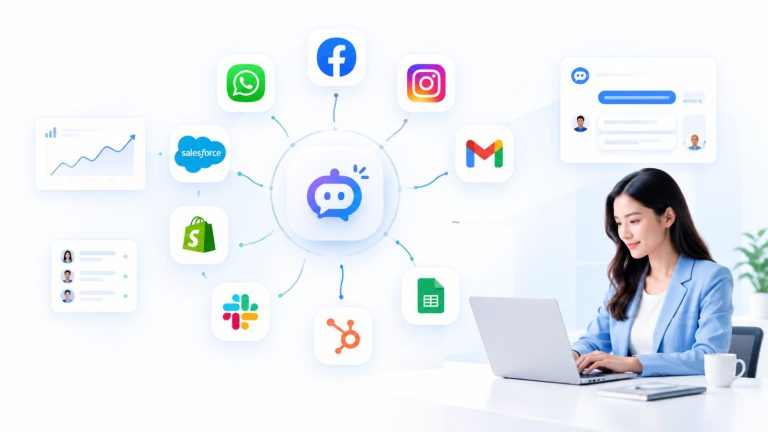
Tools like ChatbotX’s AI Agents are purpose-built for exactly this use case. ChatbotX is an open-source agentic omnichannel platform that lets small businesses deploy intelligent agents across WhatsApp, Messenger, Instagram, Telegram, TikTok, and web chat from a single unified system – no enterprise contract required.
2. Lead Qualification and Sales Enablement
Generating leads is only half the battle. The bottleneck for most small sales teams is the time it takes to research, qualify, and prioritize inbound prospects.
Agentic AI eliminates that bottleneck. A sales agent can profile a new lead using publicly available data, score them against your qualification criteria, draft a personalized outreach message, and route the conversation to the right team member – before your human rep even opens their inbox in the morning.
This is not hypothetical: Harvard Business Review research shows that sales teams using AI-assisted qualification reduce average time-to-first-meaningful-contact by 67%, while improving close rates on qualified leads by 22%.
3. Marketing Automation – From Reactive to Predictive
Traditional marketing automation triggers messages based on time or simple behavioral rules. Agentic marketing goes further: it identifies behavioral signals, predicts intent, and acts proactively.
A customer who has browsed your pricing page three times in four days without converting is not just a data point – an agentic marketing system recognizes the pattern and triggers a targeted re-engagement sequence tailored to their behavior, not a generic drip campaign.
ChatbotX’s Remarketing feature gives small businesses exactly this capability – automating follow-up sequences across channels based on user behavior, without requiring a full marketing operations team to maintain them.
4. Operations – Keeping the Single Source of Truth Intact
One of the most underappreciated costs in a growing business is data entropy: information that gets captured late, entered incorrectly, or siloed in one team member’s head. Agentic AI addresses this by updating records in real time, at the point of action.
When a customer confirms a delivery, the order management system updates. When a support ticket is resolved, the CRM notes the resolution and tags the contact for a satisfaction follow-up. When a sales call ends, the agent logs the outcome and schedules the next step – automatically.
This operational continuity is what allows lean teams to scale without proportionally scaling their headcount.
Moving Beyond the Chatbot: What Makes AI Truly Agentic
The distinction between a chatbot and an agentic AI is not a matter of branding – it is a fundamental architectural difference.
A traditional chatbot responds. An agentic system acts. It holds goals, breaks them into steps, uses available tools (APIs, databases, messaging platforms), evaluates the results of each step, and adjusts course when something does not go as expected.
For small businesses, this distinction is critical. A chatbot that can answer “What are your hours?” saves a few minutes per day. An agentic system that can identify a high-value customer about to churn, reach out with a personalized retention offer, process their response, and update their contact record without any human involvement – that generates measurable revenue impact.
ChatbotX’s Flow Builder makes this level of agentic workflow construction accessible to non-technical teams, offering a visual interface for building multi-step conversation flows that connect to external data sources and trigger downstream actions.
For teams that want to go deeper on the technical side, ChatbotX’s open-source repository on GitHub provides full access to the platform’s source code, enabling custom integrations, self-hosting, and community-driven extensions – a major advantage for businesses with unique workflow requirements.
The Omnichannel Imperative

One detail that separates effective agentic deployment from fragmented automation is channel coherence. A customer who contacts you on WhatsApp, follows up via Instagram DM, and then emails your support team should receive a consistent, continuous experience – not three disconnected threads handled by different tools.
This is why the omnichannel architecture of the agentic enterprise matters. When your AI agents operate from a unified data layer across all customer touchpoints, every interaction is informed by the full history of that relationship. The agent that responds to a WhatsApp message already knows about the Instagram inquiry from two days ago.
This cross-channel continuity is one of the core design principles behind ChatbotX. Its unified inbox and shared context model ensure that regardless of which channel a conversation starts on, your team – and your AI agents – have complete visibility.
For a deeper look at how this plays out in practice, see the ChatbotX blog’s coverage of WhatsApp AI in 2026: How Agentic Chatbots Transform Sales, Support, and Marketing and the guide on Chatbot Workflow Engine: The Complete Guide to Automating Conversations at Scale.
A Practical Roadmap: Getting Started Without Overbuilding
The most common mistake small businesses make when adopting agentic AI is trying to automate everything at once. A better approach is to start with the highest-friction, highest-volume workflow in your business and build from there.
Here is a practical sequence:
| Phase | Focus | Outcome |
|---|---|---|
| Week 1–2 | Deploy an AI agent for your top 10 FAQ use cases | Immediate reduction in repetitive support volume |
| Week 3–4 | Connect your agent to live data (orders, inventory, CRM) | Agents can resolve, not just respond |
| Month 2 | Add proactive workflows (re-engagement, lead nurturing) | Shift from reactive to predictive engagement |
| Month 3+ | Expand to additional channels and refine agent behavior | Full omnichannel agentic coverage |
The key principle: measure before you expand. Each phase should produce quantifiable results that justify the next. Agentic AI is not a one-time deployment – it is an operating capability that compounds in value as you train it on more of your business context.
Common Questions About Building an Agentic Enterprise as a Small Business

Do I need developers to deploy agentic AI?
Not necessarily. Platforms like ChatbotX offer no-code flow builders and pre-built agent templates that allow non-technical teams to deploy sophisticated automation. For more complex customization, the open-source codebase on GitHub gives developers full flexibility.
How do I keep customer data secure when using AI agents?
Reputable platforms operate with data isolation principles – your business data is not used to train shared models, and customer interactions are processed within your defined infrastructure. When evaluating any agentic AI platform, verify their data handling policies explicitly.
Will AI agents replace my customer-facing team?
The evidence consistently points to the opposite: AI agents handle repetitive, low-complexity tasks, freeing human team members to focus on high-judgment interactions – the kind that build lasting customer relationships. Teams that adopt agentic AI well tend to grow their human headcount strategically rather than shrink it.
Can a small business actually compete with enterprise brands using these tools?
Yes – and this is the central thesis. Agentic AI levels the playing field on service speed, personalization, and operational efficiency. A well-configured agentic system can deliver response times and personalization depth that match or exceed what enterprise brands achieve with large support teams.
What is the difference between agentic AI and traditional automation?
Traditional automation executes fixed rules: if X happens, do Y. Agentic AI can reason: given the goal of achieving Z, determine the best path through X, Y, and any other available tools, handle unexpected situations, and report the result. The difference is the capacity for contextual judgment.
The Competitive Window Is Open — But It Will Not Stay That Way
In every significant technology shift, there is a window where early adopters gain durable advantages that later entrants struggle to close. Agentic AI is in that window right now.
The businesses building these capabilities today – mapping their workflows to agentic systems, training agents on their specific customer data, iterating on what works – are accumulating an operational advantage that compounds over time. Their agents get better. Their data layer gets richer. Their teams get faster.
Businesses that wait will find themselves adopting the same tools later, but without the institutional knowledge and workflow maturity that early adopters have already built.
The good news: the barrier to entry has never been lower. You do not need an enterprise IT budget, a data science team, or a year-long implementation timeline. You need clarity on where your biggest operational friction is – and a platform capable of addressing it.
Start Building Your Agentic Enterprise Today
If you’re ready to see what an agentic AI setup looks like for a business at your stage, ChatbotX is a practical place to start. It’s open-source, omnichannel, and built specifically for teams that need enterprise-grade automation without enterprise-grade complexity.
Here’s your invitation:
→ Explore the platform at chatbotx.io – no enterprise contract, no long-term commitment.
→ Deploy your first AI agent in under a day using the visual Flow Builder and pre-built templates.
→ Join the community building the future of agentic business on GitHub – star the repo, contribute, or fork it for your own use case.
The agentic enterprise is not a destination reserved for large companies. It is an operating model available to any business willing to adopt it. The only question is whether you move now – or catch up later.