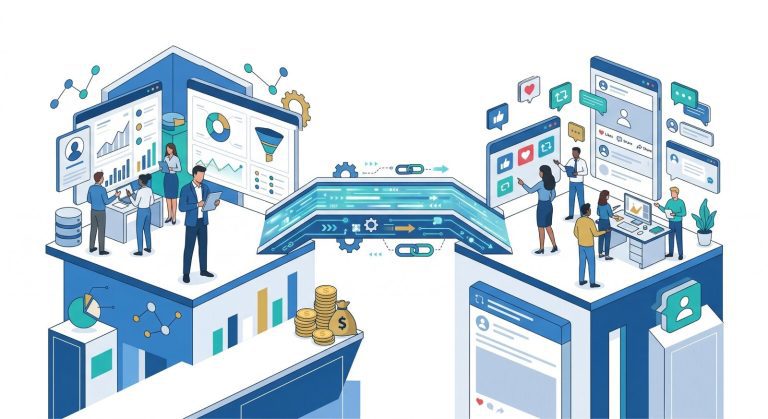
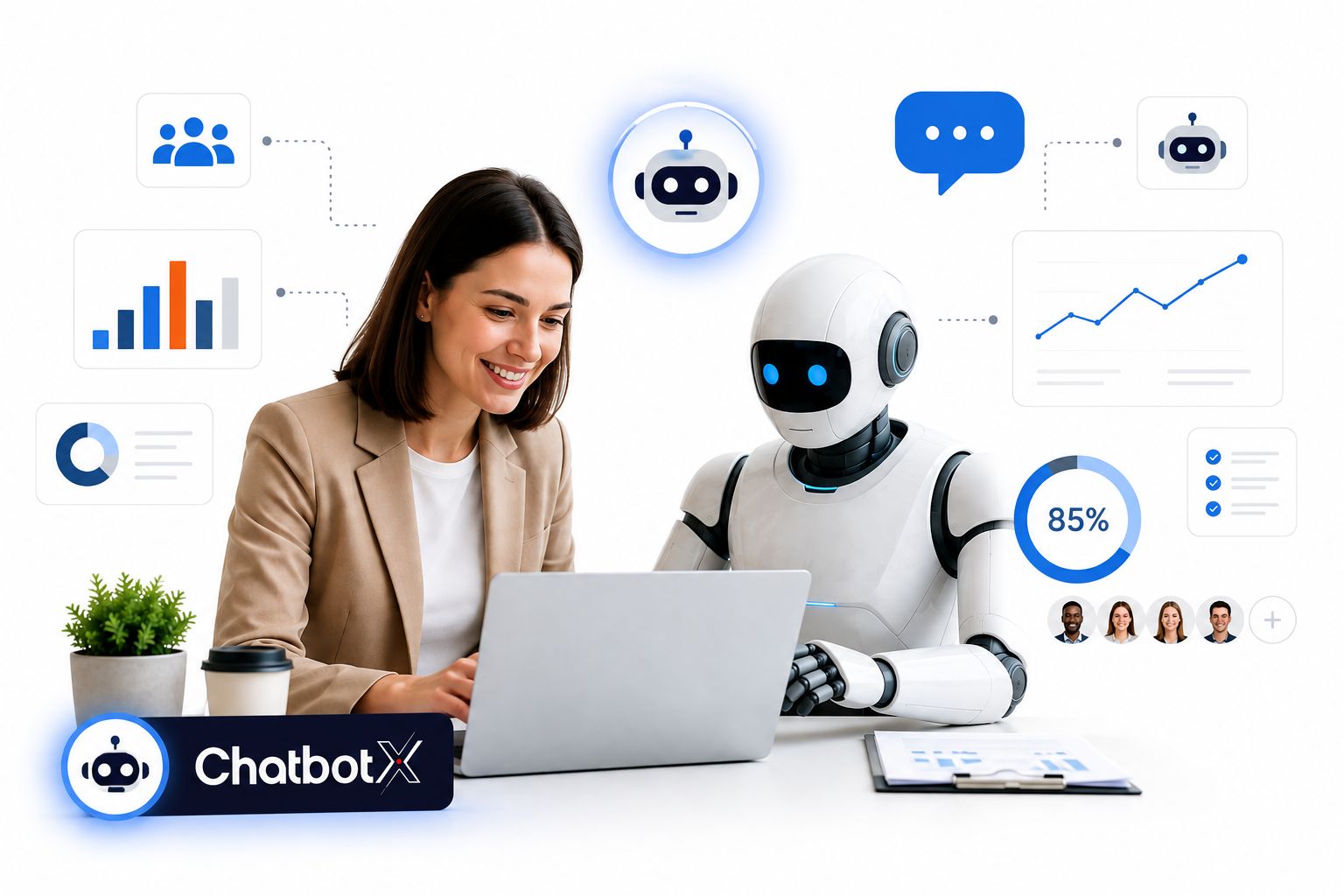
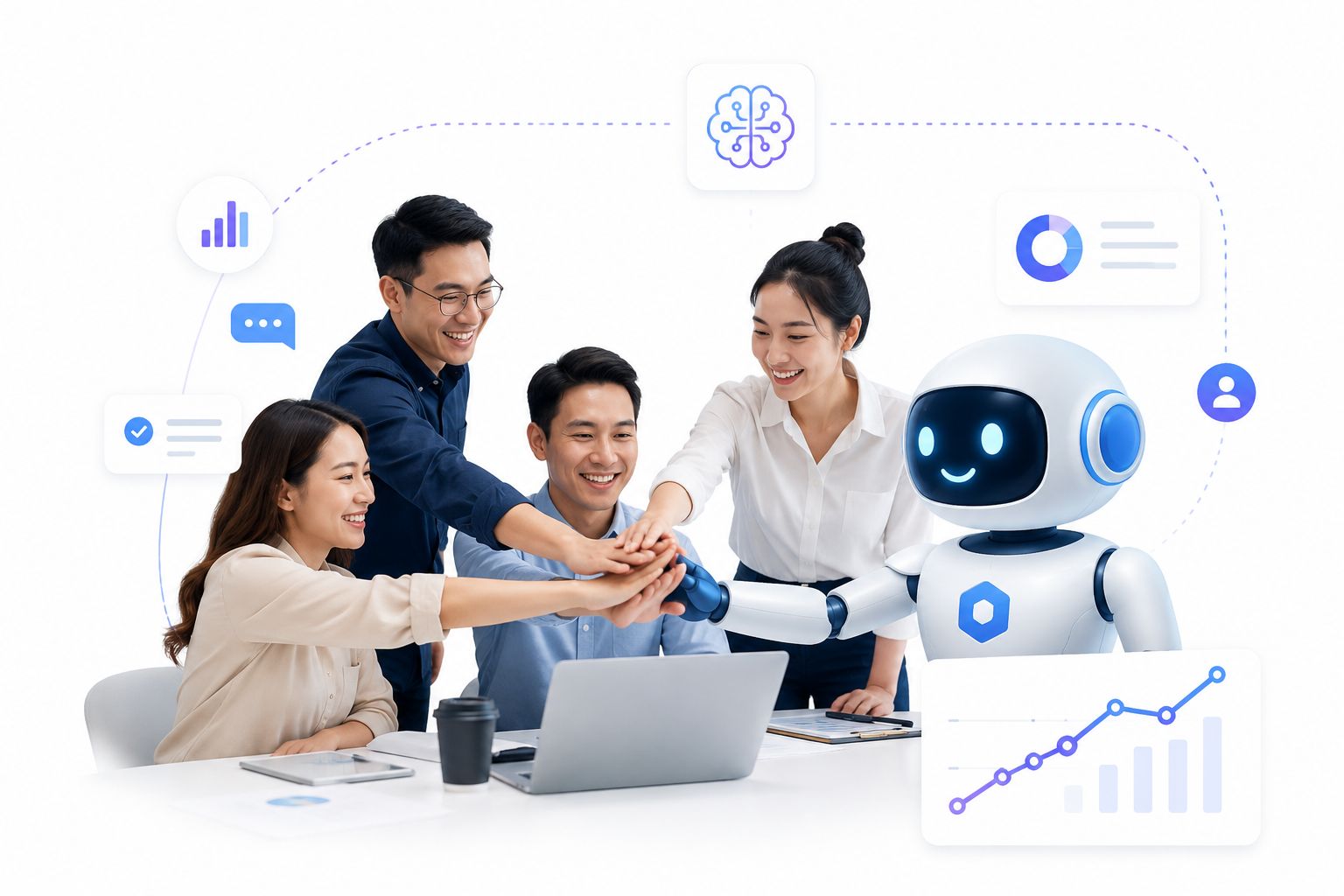
Picture your best week at work. Every teammate knew exactly what to do, nothing fell through the cracks, and you actually had time left over for the work that moves the needle. Now add one more teammate to that picture – one that never sleeps, never forgets a follow-up, and never gets overwhelmed by a spike in messages. That’s what a human-AI team looks like in practice, and for lean small businesses, it’s quickly becoming the difference between teams that scale calmly and teams that burn out trying.
A lot of founders hear “add AI to the team” and immediately picture layoffs and complexity. In reality, the businesses pulling ahead in 2026 aren’t swapping people for software – they’re building a division of labor where humans and AI each do what they’re naturally best at. Below, we’ll break down what that partnership actually looks like, why trust is the hidden variable that makes or breaks it, and how small teams are putting it to work today.
Launch agentic chat marketing in minutes with ChatbotX













What a Human-AI Team Actually Looks Like
Human-AI collaboration isn’t a slogan – it’s an operating model. According to McKinsey’s research on skill partnerships in the age of AI, work is shifting toward a partnership where machines take on repeatable, high-volume tasks while people apply judgment, framing, and interpretation on top of what the machines produce.
Splitting the Work by Strength, Not by Headcount
Your people are irreplaceable at empathy, context, and high-stakes decisions. AI is irreplaceable at speed, consistency, and processing more data than any team could review manually. Once you stop treating this as a competition, it becomes a lot easier to plan around.
- People: Your team sets the direction – training the AI, reviewing edge cases, and stepping in for conversations that need real judgment, negotiation, or emotional intelligence.
- AI agents: Purpose-built AI Agents handle the repetitive, always-on work – answering FAQs, qualifying leads, and routing conversations so nothing sits in a queue overnight.
- Together: The team shifts from doing everything by hand to directing a system, which is how a five-person shop starts operating like a much bigger one without the payroll to match.
Trust Is the Bottleneck in AI Business Adoption

Here’s the part most “AI for business” articles skip: the technology is rarely what slows teams down. Trust is. A recent Harvard Business Review Analytic Services study, covered by Fortune, found that only a small fraction of companies fully trust AI agents to run core processes without supervision – most still keep them confined to low-risk, routine tasks.
That caution is reasonable, and it starts with your data. If your contact records are scattered across spreadsheets and three different chat apps, your AI is working from a partial picture – and your team can’t fully trust what it produces either. Small businesses that get this right usually start by consolidating conversations and customer records into one place, like a Shared Inbox that keeps every WhatsApp, Messenger, and web chat thread visible to the whole team. For a deeper look at what “trustworthy” AI actually requires before agents start acting independently, this breakdown of why business AI agents need a trust framework is a useful next read.
Where Small Teams Are Already Seeing ROI with AI

Small business AI adoption isn’t a future trend – it’s already mainstream. The U.S. Chamber of Commerce’s latest Empowering Small Business report found that well over half of small businesses now use generative AI in day-to-day operations, a sharp jump from just a couple of years ago. That growth is concentrated in a few departments doing the smartest division of labor.
Sales: Faster First Response, More Time for the Close
Sales reps are best spent on negotiation, relationship-building, and reading a prospect’s real objections. Meanwhile, an AI-driven flow can score incoming leads, send the first reply within seconds, and hand off only the qualified conversations – so your team stops chasing cold leads and starts closing warm ones.
Support: Coverage Around the Clock, Escalation When It Matters
Customers expect an answer at 11 p.m. on a Sunday, not just during business hours. Routine questions – order status, pricing, business hours – can be resolved instantly by an automated flow, while anything nuanced gets escalated to a human without the customer having to repeat themselves. For a closer look at what separates a genuinely useful support setup from a bare-bones chatbot, this buyer’s guide to AI customer service software breaks down what to look for.
Marketing: Content and Segmentation at Scale
Your marketing lead should be spending time on positioning and campaign strategy, not manually tagging thousands of contacts. Pairing a marketer with automated segmentation – powered by clean CRM contact data – lets a single person run campaigns that would normally require a much bigger team. If you want to see how this plays out with real customer voice instead of generic AI copy, this piece on brand storytelling in the AI era is worth a read.
Essential Skills for Human-AI Team Collaboration
Getting your team comfortable working alongside AI isn’t just a tooling decision – it’s a skills one. A few capabilities matter more than the rest:
- Prompt clarity – writing instructions specific enough that the AI’s output needs little to no rework.
- Data literacy – reading dashboards and knowing which numbers actually predict growth.
- Judgment on when to intervene – recognizing which conversations genuinely need a human touch.
- Translating output into action – turning what the AI produces into a decision your business can act on.
None of these require hiring specialists. Most teams build them on the job, starting with one workflow, measuring the result, and expanding from there once the early win is obvious.
Scaling Human-AI Teams with Open-Source ChatbotX
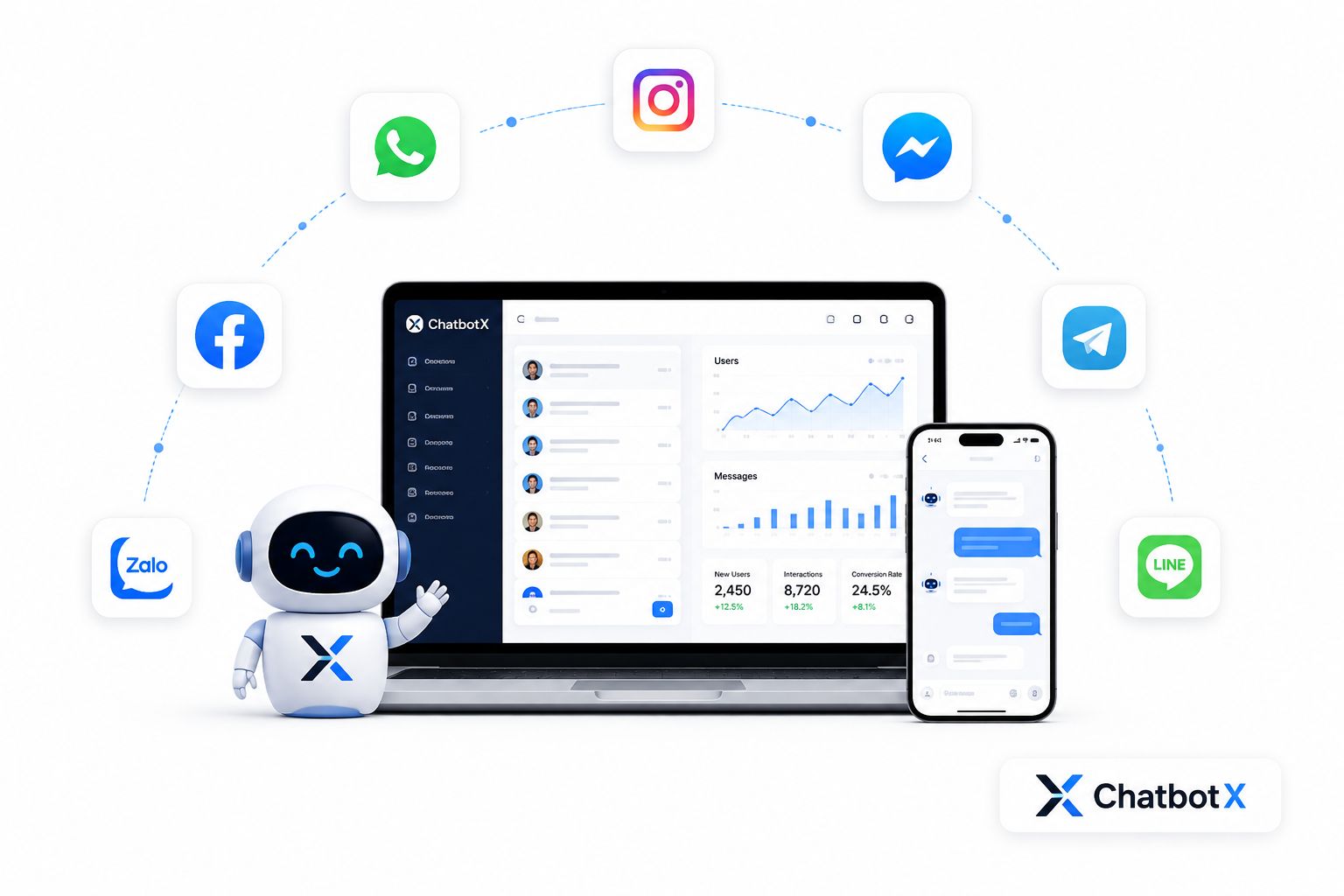
This is usually where the conversation stalls: teams agree AI could help, but nobody wants to stitch together five different tools to make it happen. That’s the gap ChatbotX is built to close. It’s an open-source, agentic omnichannel platform that puts your Shared Inbox, AI Agents, CRM contacts, and campaign tools in one dashboard instead of scattered across a dozen tabs.
Instead of bolting AI onto your existing stack, ChatbotX lets a small team run WhatsApp, Messenger, Instagram, and web chat through a single set of flows – with Analytics that show exactly which conversations are converting and which need a human’s attention. Because it’s open source and self-hostable, you also keep full control over your customer data instead of handing it to a closed platform, which goes a long way toward solving the trust problem covered above. Developers can dig into the full codebase on GitHub, including the latest releases and changelog, to see exactly how the AI agents, flow engine, and integrations are built.
Frequently Asked Questions
Does building a human-AI team mean replacing staff?
No. The businesses seeing the strongest results use AI to absorb repetitive volume so existing staff can focus on higher-value work, not to shrink headcount.
How do I get my team comfortable with AI tools?
Start with one clear, repetitive workflow – like first response on support tickets – and let the early time savings build confidence before expanding further.
What’s the difference between a chatbot and an AI agent?
A basic chatbot follows a fixed script. An AI agent can interpret intent, pull from your data, and take multi-step actions, closer to a junior team member than a static FAQ widget.
Is my small business ready for this?
If you have customer data in reasonably good shape and at least one repetitive task eating up your team’s time, you already have enough to start with a single use case.
Ready to Scale Your Business with a Human-AI Team?
You don’t need a big IT budget or a six-month rollout to get started. ChatbotX lets you launch your first AI-powered flow in an afternoon, connect the channels your customers already use, and keep every conversation in one inbox your whole team can see. Spin up a free workspace, connect a channel, and let your first AI agent handle the next inbound message – while your team gets back the hours that used to disappear into repetitive replies.