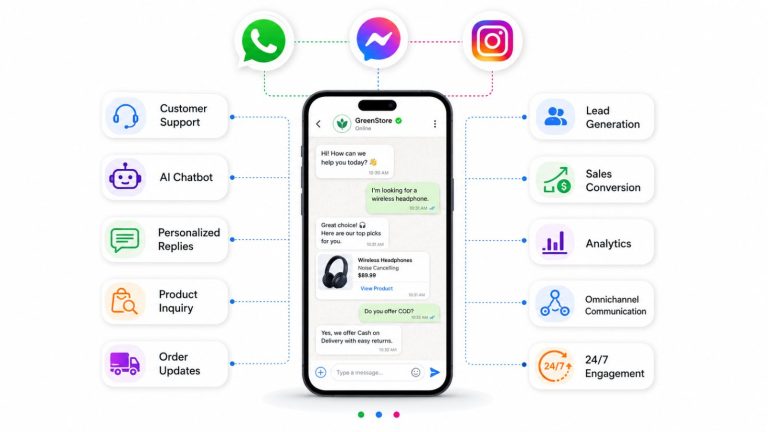

A support ticket lands at 11:40 p.m. on a Saturday. The customer is frustrated, the agent on duty is asleep, and the answer is buried in three different tools nobody bothered to connect. This is the exact moment most businesses realize their support stack was never built to keep up and it’s why so many teams are quietly walking away from closed, per-seat helpdesk software in favor of something they can actually own.
That’s the pitch behind an open source AI customer service platform: instead of renting a black box, you get the source code, the freedom to self-host, and an AI layer you can shape around your own workflows. In 2026, that shift isn’t a fringe preference anymore it’s becoming the default expectation for teams that are tired of paying per-resolution fees for software they can’t inspect or modify.
Launch agentic chat marketing in minutes with ChatbotX













What “Open Source” Actually Means for Customer Support Software
Open-source customer service software publishes its codebase publicly, usually on GitHub, so any developer can read it, extend it, or run their own instance. That’s fundamentally different from proprietary SaaS tools, where you’re stuck with whatever roadmap the vendor decides on and whatever pricing tier they choose to gate features behind.
For a growing number of support and product teams, that difference matters for three concrete reasons:
- No vendor lock-in. If a company changes its pricing overnight or shuts down, your data and workflows aren’t trapped inside someone else’s infrastructure.
- Full customization. You can modify conversation logic, add integrations, or rebuild the interface without waiting on a vendor’s feature request queue.
- Transparent security. A public codebase means the community not just an internal team can audit how customer data is handled.
Why Businesses Are Moving Toward Open-Source AI Support Tools in 2026

The pressure on customer service teams has changed shape. Customers now expect a reply within minutes regardless of channel, whether that’s WhatsApp, Instagram DMs, live chat, or email, and they expect the agent human or AI to already know their order history. Meeting that bar with disconnected, closed tools is getting harder, not easier.
Industry data backs up the urgency. Companies deploying AI agents for support are already reporting meaningful drops in ticket volume and resolution time, and the shift toward generative AI in service organizations is accelerating fast, with analysts projecting that the large majority of customer service teams will be running generative AI in production within the next couple of years.
At the same time, buyers are getting sharper about what they’ll actually pay for. Instead of committing to rigid annual contracts with usage caps, teams increasingly want:
- A platform they can self-host on their own infrastructure for compliance or cost reasons.
- AI agents that reason across every channel a customer might use, not just one.
- A shared inbox that keeps human agents and AI working from the same conversation history.
- The ability to automate flows and triggers without needing a developer for every small change.
This is exactly the gap an open-source, omnichannel AI chatbot platform is built to close.
Core Features to Look For in an Open-Source AI Customer Service Platform

Not every open-source project labeled “AI chatbot” is ready for production support work. When evaluating one, look past the GitHub star count and check whether it actually covers the fundamentals:
AI agents that understand context, not just keywords. A modern support agent needs to hold context across a conversation, reference past orders, and know when to hand off to a human. ChatbotX’s AI Agents are built for exactly this – reasoning over conversation history instead of matching rigid intents.
A visual flow builder for non-technical teams. Support and marketing teams shouldn’t need to write code to update a greeting message or fix a broken decision branch. A drag-and-drop Flow Builder lets teams iterate on automation without opening a pull request.
One inbox for every channel. When WhatsApp, Messenger, and webchat conversations all land in separate tools, agents lose context and customers repeat themselves. A unified Shared Inbox keeps every channel’s history in one place, whether the reply comes from a human or an AI agent.
Developer-level extensibility. Open source only pays off if it’s actually extensible. Look for a platform with an API, CLI, and MCP layer, so engineering teams can plug the chatbot into internal tools, CRMs, or custom dashboards without fighting the platform.
How Open-Source Platforms Compare to Closed SaaS Tools
Closed platforms like Zendesk, Intercom, or ManyChat are polished and easy to start with, but that convenience comes with trade-offs: per-resolution or per-seat pricing that scales unpredictably, data that lives entirely on someone else’s servers, and a feature set you can’t touch even when it’s almost right for your use case.
Open-source alternatives flip that equation. You trade a bit of initial setup time for long-term control – self-hosting keeps sensitive customer data inside your own infrastructure, and because the code is public, you’re not depending on a single vendor’s roadmap or uptime. For teams evaluating this trade-off in more depth, our breakdown of the best AI customer service software options for 2026 walks through how the leading platforms stack up on pricing, channels, and AI capability.
Smaller teams weighing round-the-clock coverage against headcount costs will also find useful context in our guide to AI customer service assistants for small businesses, which looks at how automation changes the math for teams without a 24/7 support staff.
Real-World Impact: What the Data Shows

The case for AI-assisted, open infrastructure isn’t just theoretical. Independent analysis of AI agent platforms has found that teams adopting open-source, self-hosted AI agents can cut support ticket volume and resolution time significantly, while avoiding the per-resolution markups that closed platforms often charge on top of usage. Broader industry forecasting points the same direction: according to Gartner-backed research on connected support technology, teams that implement AI-assisted support tooling are expected to see meaningful efficiency gains in contact center performance by 2026.
That efficiency doesn’t come from replacing every human agent – it comes from giving both AI and human agents the same shared context, something a well-built omnichannel platform is designed to do by default. Comparative research into service software confirms the same pattern: connecting AI capabilities directly into existing workflows lets agents summarize tickets, draft replies, and trigger automations without switching tools, turning individual requests into work that moves the whole business forward.
Getting Started with an Open-Source AI Chatbot
If you’re ready to move off a closed platform, the fastest way to evaluate an open-source option is to actually run it. ChatbotX is fully open source, and the entire codebase – including the AI agent logic, flow engine, and channel integrations – is available on GitHub for anyone to self-host, audit, or contribute to. You can also track ongoing improvements and new capabilities through the project’s release history to see how actively the platform is maintained.
A few practical steps for teams testing the waters:
- Start with one channel. Connect a single high-volume channel, like WhatsApp or webchat, before rolling automation out everywhere.
- Map your top 10 repeat questions. These become your first automated flows the fastest way to prove ROI.
- Keep a human in the loop. Route anything the AI agent isn’t confident about straight into the shared inbox instead of guessing.
- Measure before and after. Track first-response time and ticket deflection rate for 30 days to see the real impact.
Final Thoughts
Customer expectations in 2026 aren’t slowing down, and neither is the cost of running support on closed, inflexible software. An open-source AI customer service platform gives teams a rare combination: the transparency to know exactly how their data and automations work, and the AI power to actually keep up with round-the-clock demand across every channel customers use.
Ready to see it in action? Get started with ChatbotX for free, connect your first channel in minutes, and give your customers the fast, always-on support they already expect – without handing your data or your roadmap to someone else.