Quick Answer: Model Context Protocol (MCP) is an open standard, originally released by Anthropic in November 2024, that gives AI models a single, consistent way to connect with outside tools, files, and live business data – instead of forcing every chatbot or app to ship a one-off, custom-built connector for each system it needs to reach. By late 2025, MCP had grown large enough that Anthropic handed stewardship of the protocol to the newly formed Agentic AI Foundation under the Linux Foundation, and heading into 2026 it now sits behind tens of thousands of public integrations and close to 100 million monthly SDK downloads. For a business messaging platform, MCP is what lets an AI Agent pull a real order status, update a CRM record, or check a booking calendar mid-conversation, rather than just generating a plausible-sounding guess.
Launch agentic chat marketing in minutes with ChatbotX












Why MCP Exists: The Problem Before the Protocol
Before MCP, connecting a language model to outside data was a one-off engineering job every single time. Want your chatbot to read from Google Sheets? Build a connector. Want it to also query a support ticketing system? Build another one. Add a CRM, a calendar, an inventory database – each new source meant another bespoke integration, maintained separately, breaking separately, and rarely reusable across projects.
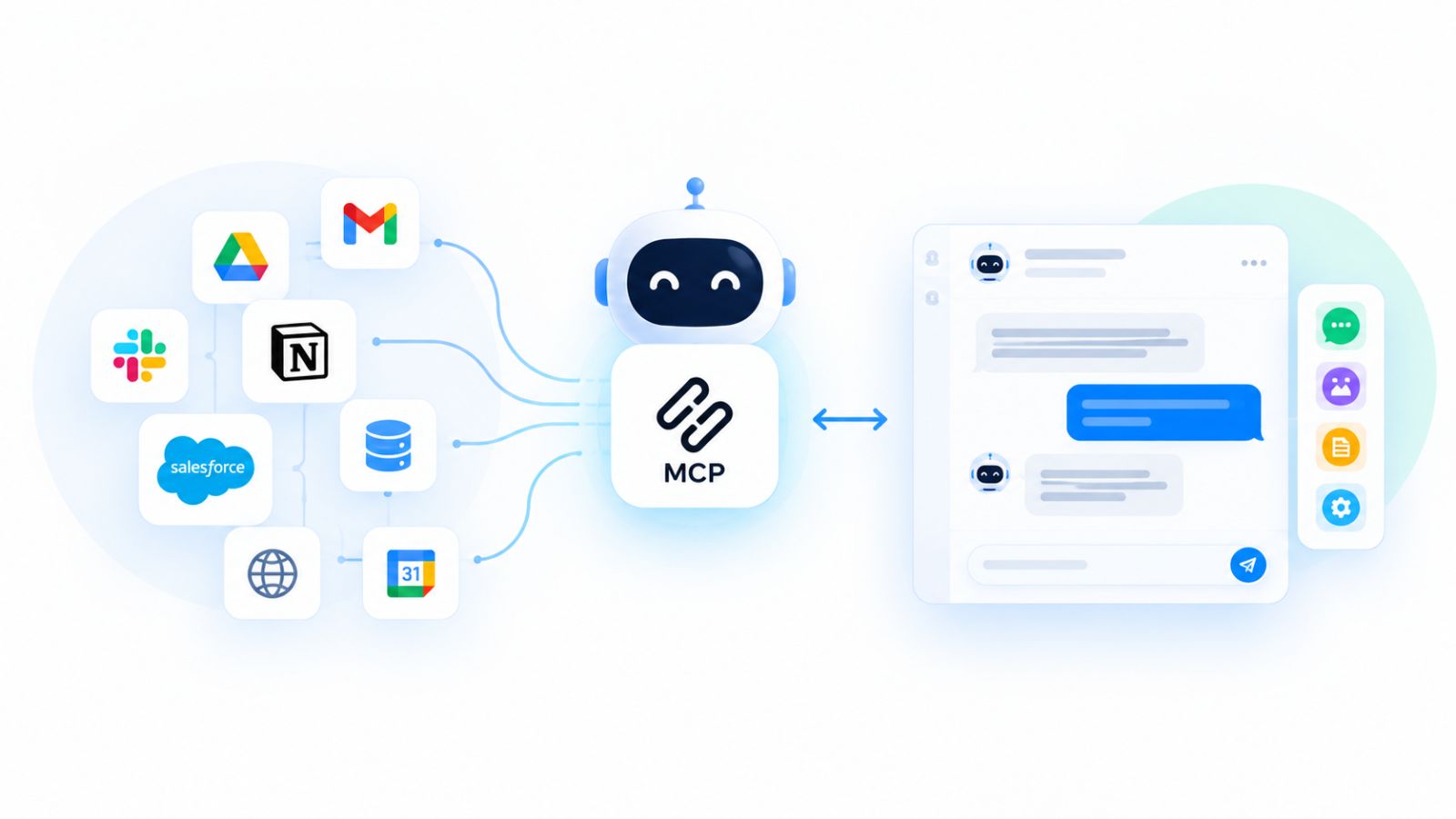
Anthropic described this as an “N×M” problem: N different AI applications, each needing to talk to M different data sources, meant N-times-M separate integrations. MCP flattens that math. A single MCP server exposes a tool or dataset once, using one shared specification, and any MCP-compatible AI application can plug straight into it – no per-model, per-vendor rework required.
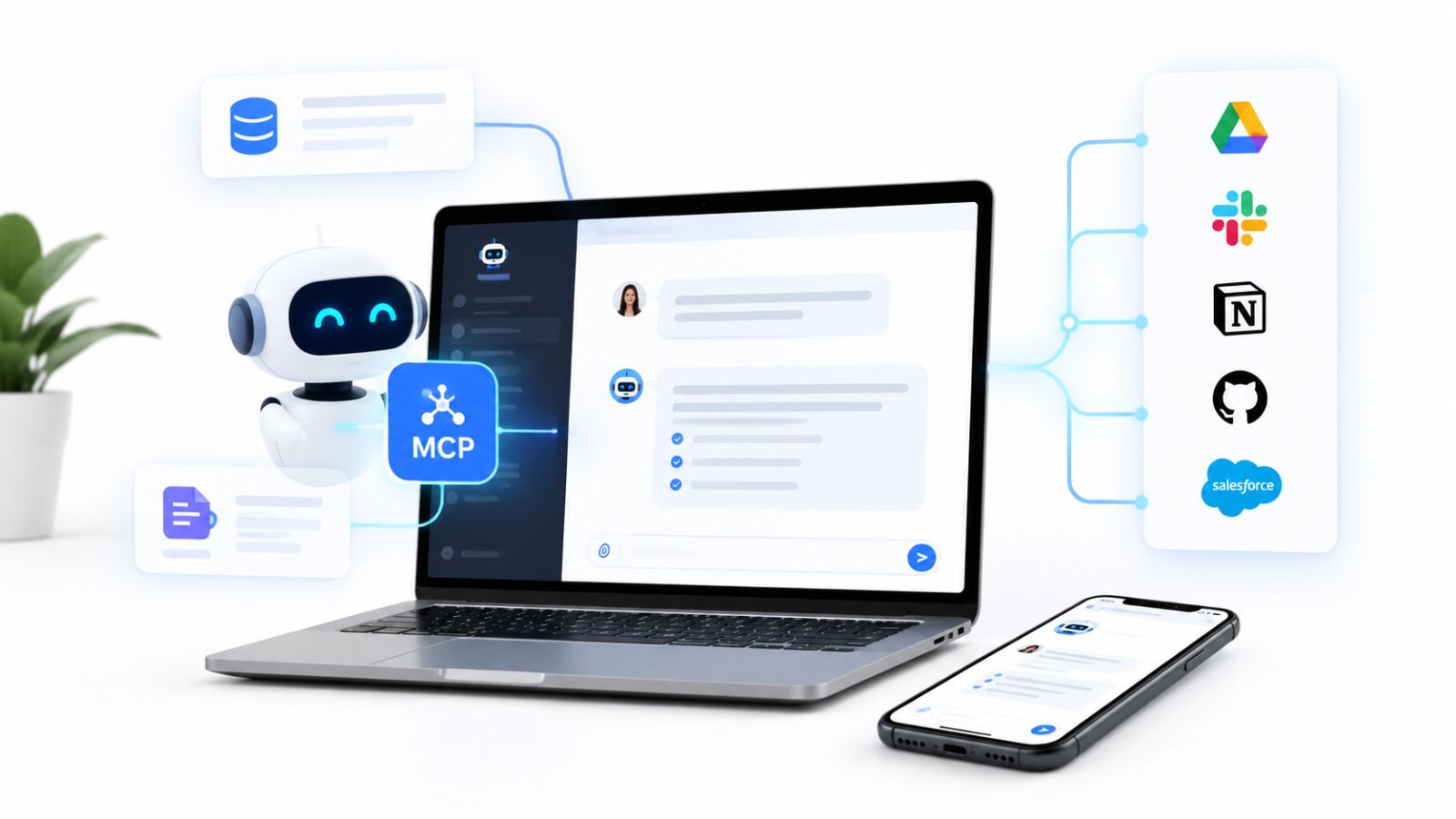
The comparison people reach for most often is a USB-C port: one physical connector standard that works across laptops, phones, monitors, and chargers, regardless of who manufactured the device. MCP aims to do the same job for AI systems and the tools they need to reach.
How MCP Actually Works: Hosts, Clients, and Servers
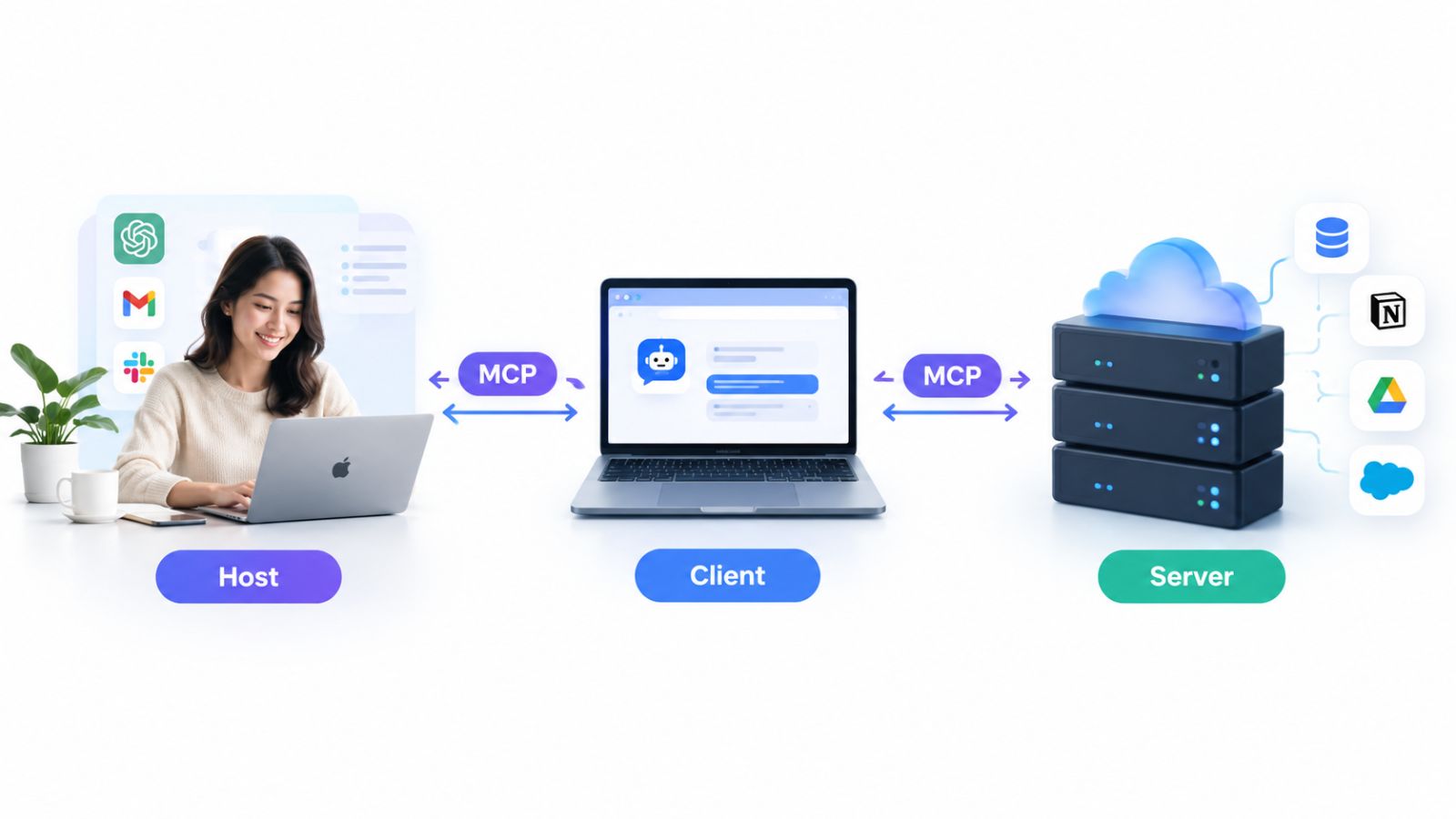
Strip away the marketing language and MCP’s architecture comes down to three moving parts:
- Host – the AI application the person is actually using (a chat interface, an IDE, a customer-support bot).
- Client – the connector living inside the host that speaks the MCP protocol and manages one connection to one server.
- Server – a lightweight program that exposes a specific capability: reading a file, querying a database, calling an internal API, searching a knowledge base.
A server can expose three kinds of building blocks: resources (data the model can read, like a document or a record), tools (actions the model can trigger, like creating a ticket or sending a message), and prompts (reusable instruction templates). Communication runs over JSON-RPC, and the newest revisions of the spec favor a stateless, streamable HTTP transport – a change the community pushed for once MCP moved from developer experiments into production traffic at scale.
Crucially, none of this is Anthropic-only anymore. It works the same way whether the model behind it is Claude, GPT, Gemini, or an open-weight model running locally.
From Anthropic Side Project to Industry Standard
MCP’s trajectory over roughly two years is unusually fast for a technical standard:
- November 2024 – Anthropic open-sources MCP along with SDKs, a spec, and local server support in Claude Desktop.
- Early-to-mid 2025 – OpenAI and Google DeepMind both announce they will support the protocol, quickly followed by Microsoft baking MCP support into Copilot, Windows, and Visual Studio Code.
- December 2025 – Anthropic donates MCP to the newly created Agentic AI Foundation (AAIF), a directed fund under the Linux Foundation co-founded with Block and OpenAI, with Google, Microsoft, AWS, Cloudflare, and Bloomberg signing on as supporters. Governance moves from a single company to a neutral, vendor-independent foundation – the same structure that stewards Kubernetes and Node.js.
- 2026 – the ecosystem passes 10,000+ active public MCP servers and tens of millions of monthly SDK downloads across Python, TypeScript, Java, and half a dozen other languages, with client support now standard across ChatGPT, Claude, Cursor, Gemini, Copilot, and VS Code.
That last point matters for anyone doing content or product planning around AI: MCP is no longer a “Claude thing.” It has become closer to an infrastructure layer, the same way HTTP or OAuth quietly sit underneath most of the software people use.
Real-World Model Context Protocol Examples for Chatbots
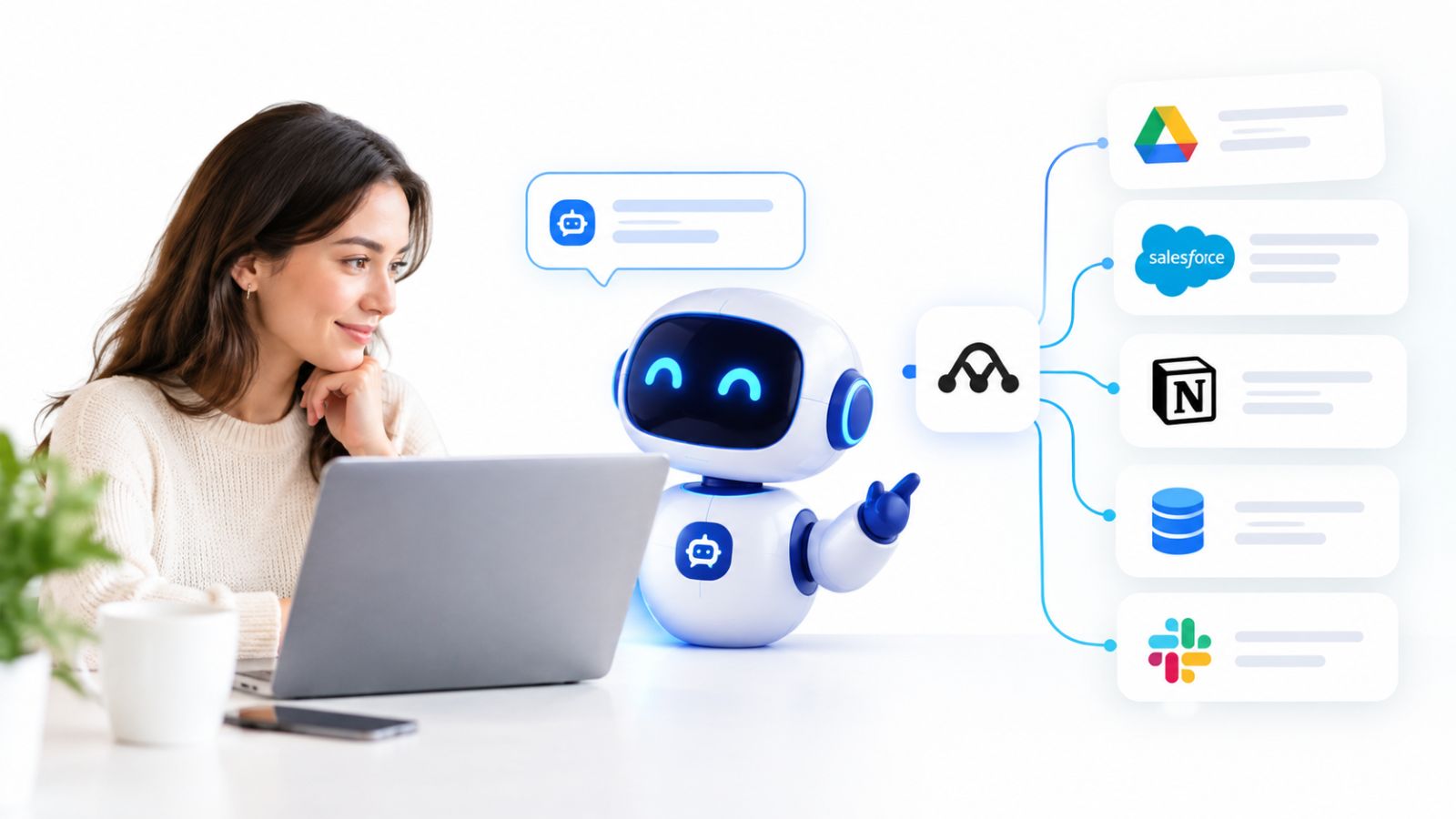
Reading a spec is one thing – seeing what it changes in a live conversation is another. Here are concrete Model Context Protocol examples that map directly onto agentic messaging use cases:
- Order and shipment lookups. A customer messages “where’s my order?” and the AI Agent calls an MCP server connected to the storefront’s order database, then replies with the actual current status – not a canned “please check your email” response.
- CRM record updates. A lead answers a qualifying question in chat, and instead of a human copying that detail into a spreadsheet later, the agent writes it directly into CRM Contacts through an MCP tool call, tagging and segmenting the contact in the same step.
- Live calendar and booking checks. A clinic or salon bot checks real appointment slots through an MCP-connected calendar server before offering times, instead of guessing availability.
- Internal knowledge base retrieval. Support questions get answered from an up-to-date internal wiki or document store, pulled live through MCP rather than baked into a static prompt that goes stale.
- Multi-step triggers. An MCP tool call can kick off a downstream action – creating a support ticket, notifying a human agent, or firing a Trigger – so the conversation and the back-office system stay in sync automatically.
Each of these examples shares the same shape: the model isn’t just generating text, it’s reaching out, reading something real, and sometimes changing something real, all inside one conversational turn.
How to Set Up a Claude MCP Server: The Practical Steps
A Claude MCP server setup follows a predictable sequence, whether you’re wiring up a Google Sheet or a full CRM:
- Pick or write the server. Start from an existing open-source MCP server for the system you need (there are already thousands published) or write a minimal one using the official SDK – most teams get a working server running in well under a day.
- Define the tools and resources it exposes. Be specific: “get_order_status(order_id)” is far more useful to a model than a vague “access the database” tool, because narrow, well-described tools cut down on the model guessing wrong.
- Connect the server to your host. In Claude Desktop or another MCP-compatible client, register the server’s endpoint so the client knows it exists and what it can do.
- Test tool calls in isolation first. Before wiring the server into a live customer-facing flow, run it against sample requests to confirm the responses come back in the shape you expect.
- Add it to your agent’s toolset. Once verified, the MCP server becomes just another capability the AI Agent can reach for mid-conversation, alongside your existing flows and channels.
The pattern scales the same way for a solo builder connecting one spreadsheet as it does for a team wiring an agent into a full CRM, a support desk, and a billing system at once.
MCP vs. Traditional API Integrations
| Traditional custom integration | Model Context Protocol | |
|---|---|---|
| Setup per new AI app | Rebuild the connector for each app | Reuse the same MCP server everywhere |
| Maintenance | Fragmented, one codebase per pairing | Centralized, one server to maintain |
| Tool discovery | Hard-coded in advance | Dynamic – the model can discover what’s available |
| Vendor lock-in | Often tied to one AI provider’s format | Works across Claude, GPT, Gemini, and others |
| Governance | Whatever the vendor decides | Open standard under the Linux Foundation |
This isn’t an argument that APIs are obsolete – MCP servers often call existing APIs under the hood. The difference is the interface the AI model sees: one consistent shape, instead of a different contract for every tool.
Why MCP Matters for Agentic Chatbots Like ChatbotX
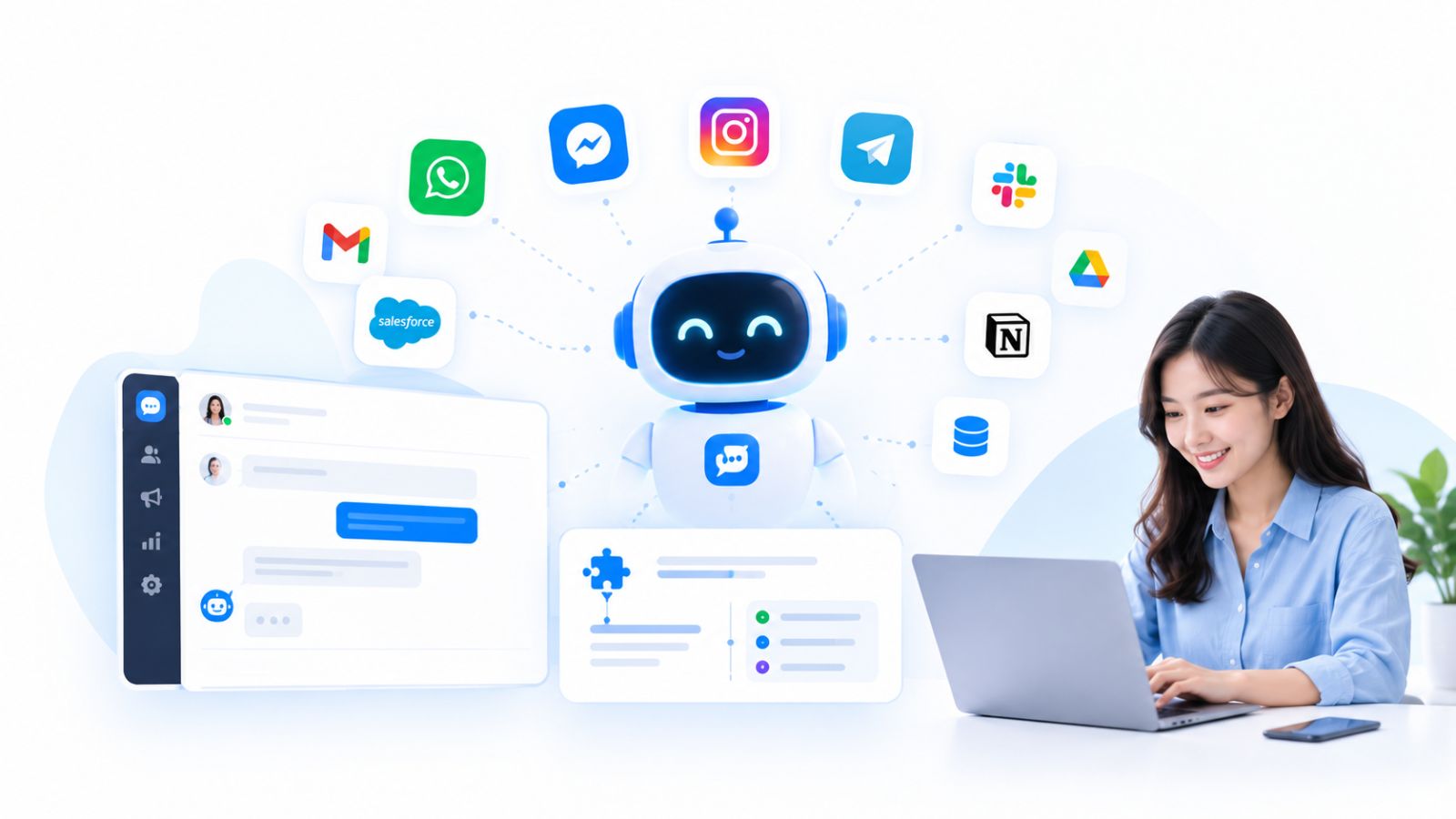
For a business trying to move past scripted, button-driven bots, MCP is the piece that turns a chatbot into something closer to a coworker. ChatbotX is built as an agentic chat marketing platform, and its API, CLI & MCP layer lets you bring your own OpenClaw, Hermes, or Claude agents and connect them straight into live business systems – the same MCP-compatible pattern covered throughout this guide, rather than a proprietary format that only works inside one walled garden.
Paired with a visual flow builder, an MCP-connected AI Agent can sit inside a larger conversation flow: handling free-form questions itself, then handing off to a structured step – a form, a human agent, a payment link – exactly when it needs to. Because ChatbotX is open-source and self-hostable, teams that need full control over where their data goes and how their agents are configured aren’t stuck depending on a closed platform’s roadmap.
If you’ve already read our guide on designing AI agent workflows for small business, MCP is effectively the wiring that connects the “tools and data” step in that workflow to something real. And if social channels are more your focus, our piece on Social Media MCP walks through the same protocol applied to content and comment automation specifically.
Common Mistakes When Adopting MCP
- Exposing too broad a tool. A tool called “run_database_query” is powerful but risky and hard for a model to use safely. Narrow, purpose-built tools produce far more reliable behavior.
- Skipping authentication and scoping. An MCP server should only expose what the specific use case needs – not blanket access to an entire system.
- Treating MCP as a Claude-only feature. Building an integration that only works with one vendor’s client throws away the main advantage of an open, cross-model standard.
- No fallback path. If a tool call fails or times out, the conversation should still be able to hand off gracefully – to a flow step, a form, or a human – rather than stall.
- Never revisiting the toolset. As your performance data shows which requests the agent handles well and which it stumbles on, the tool definitions themselves are worth revising, not just the prompts.
Frequently Asked Questions
Is Model Context Protocol only for Claude?
No. MCP was created by Anthropic, but it’s an open, vendor-neutral standard now stewarded by the Linux Foundation’s Agentic AI Foundation. OpenAI, Google, and Microsoft products all support it.
Do I need to know how to code to use MCP-connected chatbots?
To build or deploy an MCP server, yes, some development work is involved. To use a platform that already ships MCP support – like connecting an AI Agent to your CRM inside a no-code flow builder – you generally don’t need to write the underlying server yourself.
What’s the difference between an MCP tool and a regular chatbot flow step?
A flow step follows a fixed, pre-built path. An MCP tool is something the AI model chooses to call, on its own, based on what the conversation actually needs at that moment – closer to how a human employee decides which system to check.
Is MCP secure enough for handling customer data?
Security depends on how a given server is built and scoped, not on the protocol itself. Following least-privilege principles – narrow tools, proper authentication, and scoped data access – is the standard practice recommended across the ecosystem.
How is MCP different from a plain REST API?
A REST API is a fixed contract built for a specific integration. MCP standardizes how any AI model discovers and calls tools across any number of systems, so the model can reason about what’s available rather than needing every integration pre-wired by a developer in advance.
Bring MCP Into Your Own Chatbot
Model Context Protocol is quickly becoming the connective tissue behind serious AI agent deployments – not a research curiosity, but the default way modern AI systems reach real business data. If you’re building or rebuilding your messaging automation for 2026, this is the right moment to plan for it rather than bolt it on later.
ChatbotX gives you that foundation already built in: an open-source, self-hostable, agentic chat marketing platform with native API, CLI & MCP support, so you can bring your own Claude, OpenClaw, or Hermes agents and connect them to the tools your business already runs on. Explore the source code on GitHub or check the latest releases to see how fast the platform is moving, and when you’re ready, spin up a workspace and start wiring your first MCP-connected agent today.