The rules of search engine optimization are being rewritten and chatbots are at the center of that transformation. In 2026, Google’s Search Generative Experience (SGE), AI Overviews, and conversational search have fundamentally changed how websites rank and how users interact with content online.
If you’re not thinking about chatbot SEO yet, you’re already behind. This complete guide breaks down everything you need to know: what chatbot SEO means, why it matters, how to implement it, and how platforms like ChatbotX are helping businesses win in this new landscape.
Launch agentic chat marketing in minutes with ChatbotX












What Is Chatbot SEO?
Chatbot SEO refers to the practice of optimizing AI-powered chatbots – and the pages they live on – to improve search engine visibility, user engagement, and organic traffic. It also encompasses strategies to make your content more discoverable within AI-driven search interfaces like Google SGE and Bing Copilot.
In plain terms, chatbot SEO operates on two levels:
Level 1 – On-page SEO for chatbot interfaces: Structuring chatbot conversations, landing pages, and FAQ schemas so search engines can crawl and index chatbot-related content effectively.
Level 2 – Chatbots as SEO tools: Using chatbots to reduce bounce rate, increase session time, collect zero-party data, and improve the user engagement signals that Google uses as ranking factors in 2026.
Both levels matter. Ignoring either leaves significant organic growth on the table.
Why Chatbot SEO Matters More Than Ever in 2026
Google’s algorithm has shifted decisively toward experience signals. Core Web Vitals remain important, but behavioral metrics – how long users stay, how deeply they engage, how often they return – now carry greater weight.
Chatbots directly influence these metrics. According to Salesforce’s State of the Connected Customer report, 88% of customers expect companies to provide a seamless digital experience. A well-deployed chatbot is one of the most efficient ways to meet that expectation at scale.
Meanwhile, Gartner predicts that by 2027, chatbots will be the primary customer service channel for roughly a quarter of all organizations. Businesses that establish chatbot SEO infrastructure today will hold a compounding advantage as that shift accelerates.
There is also the rising reality of Answer Engine Optimization (AEO). When users type questions into Google, they increasingly get AI-generated answers rather than a list of blue links. Structuring your chatbot’s knowledge base and FAQ content to align with these answer formats is no longer optional – it is the new baseline for SEO.
Core Components of a Chatbot SEO Strategy

1. Conversational Keyword Research
Traditional keyword research focuses on short-tail and long-tail phrases. Chatbot SEO requires a third layer: conversational queries – the natural-language questions real people type (or speak) into search engines.
Tools like Google’s “People Also Ask” boxes, AnswerThePublic, and your chatbot’s own conversation logs are goldmines for conversational keywords. Mine your bot’s chat history to discover exactly what questions your audience is asking, then build content and structured FAQ schemas around those queries.
Practical tip: Segment conversational queries by intent – informational, navigational, transactional, and commercial investigation. Map each intent to a specific chatbot flow or landing page, then optimize that page for the corresponding query cluster.
2. Structured Data and Schema Markup
Google cannot read a chatbot conversation the same way it reads a static web page. To help search engines understand your chatbot content, implement the following schema types:
- FAQPage schema – for any chatbot FAQ module or help center content
- HowTo schema – for step-by-step chatbot onboarding flows published as web content
- SpeakableSpecification schema – for voice search optimization, signaling which content is suitable for text-to-speech
- Chatbot / SoftwareApplication schema – to surface your chatbot platform in branded searches
Structured data is the bridge between your conversational content and Google’s ability to feature it in rich results.
3. Page Experience and Core Web Vitals
Chatbot widgets affect page load performance. A poorly optimized bot script can inflate Largest Contentful Paint (LCP) or cause Cumulative Layout Shift (CLS), both of which are direct Google ranking factors.
Best practices for chatbot performance SEO in 2026:
- Load the chatbot widget asynchronously using
deferorasyncscript attributes - Use lazy initialization – trigger the bot only when a user scrolls or interacts
- Keep the initial chat widget payload under 50KB
- Serve chatbot assets from a CDN with sub-100ms TTFB
Platforms like ChatbotX’s drag-and-drop flow builder are designed with performance-first architecture, ensuring widgets load without blocking page render.
4. Engagement Metrics Optimization
Google’s Helpful Content System rewards pages where users find what they’re looking for. Chatbots are uniquely positioned to improve every key engagement metric:
| Metric | How Chatbots Help |
|---|---|
| Session Duration | Conversational engagement keeps users on-page longer |
| Bounce Rate | Instant answers prevent users from hitting the back button |
| Pages per Session | Chatbots can recommend related content contextually |
| Return Visits | Personalized bot experiences increase loyalty |
| Conversion Rate | Guided flows move users through the funnel faster |
A chatbot that answers user questions before they leave is, functionally, an SEO tool.
5. Content Freshness Through Chatbot Data
One underrated chatbot SEO tactic: using conversation data to identify content gaps and trigger content updates. When your chatbot consistently fails to answer a question – or routes users to “I don’t know” – that is a signal that a piece of content is missing from your site.
Build a feedback loop between your chatbot analytics and your editorial calendar. Every unanswered question is an SEO opportunity waiting to be written.
Chatbot SEO for Different Search Environments
Traditional Web Search (Google/Bing)
For traditional search, focus on the fundamentals: fast-loading pages, structured data, conversational content that matches user intent, and internal linking from chatbot-related pages to high-authority content on your domain.
AI-Powered Search (SGE, Perplexity, ChatGPT Search)
In AI-powered search, the goal is citation visibility – getting your content referenced as a source inside AI-generated answers. To achieve this:
- Write in clear, authoritative, factual language
- Use headers, bullet points, and numbered lists that AI models can easily parse
- Include statistics, data points, and quotes from credible sources
- Ensure your site has clean crawlability (robots.txt, sitemap, canonical tags all in order)
Voice Search
Voice queries are inherently conversational and long-tail. Optimizing your chatbot’s FAQ content for natural language also optimizes it for voice. Target question-based queries (“How do I…”, “What is…”, “Can I…”) and provide concise, direct answers in the first sentence.
How to Build an SEO-Optimized Chatbot in 2026
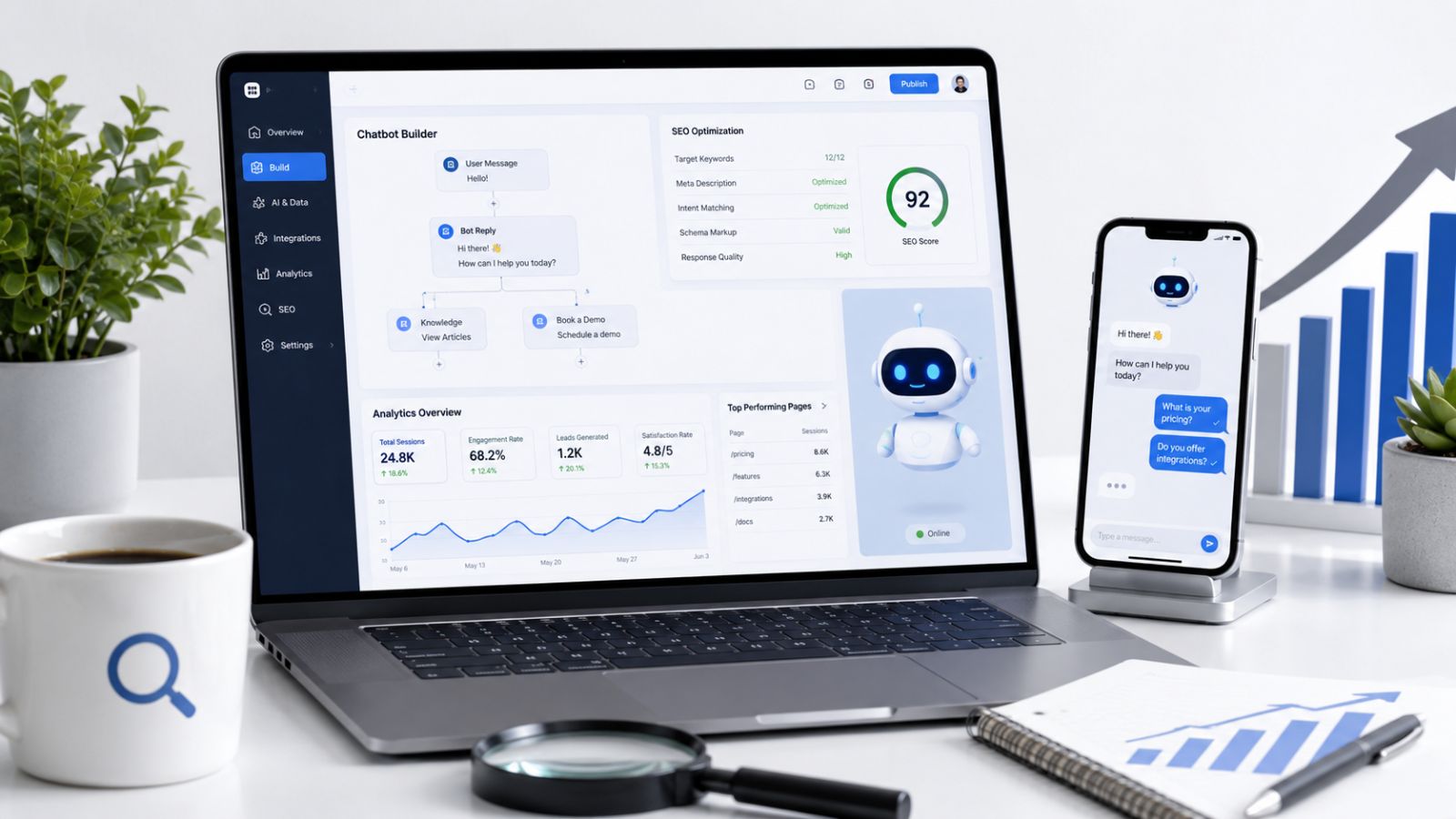
Step 1: Define Your Chatbot’s Content Architecture
Map out every topic your chatbot will cover. Treat this like a content sitemap. Each major topic branch should correspond to existing high-authority content on your website, creating a closed-loop internal linking structure.
Step 2: Write Chatbot Copy for Dual Audiences
Every chatbot response should serve both the user and the search engine. Write answers that are helpful to humans, but structure them so they can also be surfaced as rich snippets or featured answers. Short, declarative first sentences work best.
Step 3: Implement FAQ Schema on Chatbot-Adjacent Pages
For every landing page that features your chatbot, add FAQPage schema using the top 5–10 questions your bot handles most frequently. This creates an immediate path to featured snippets.
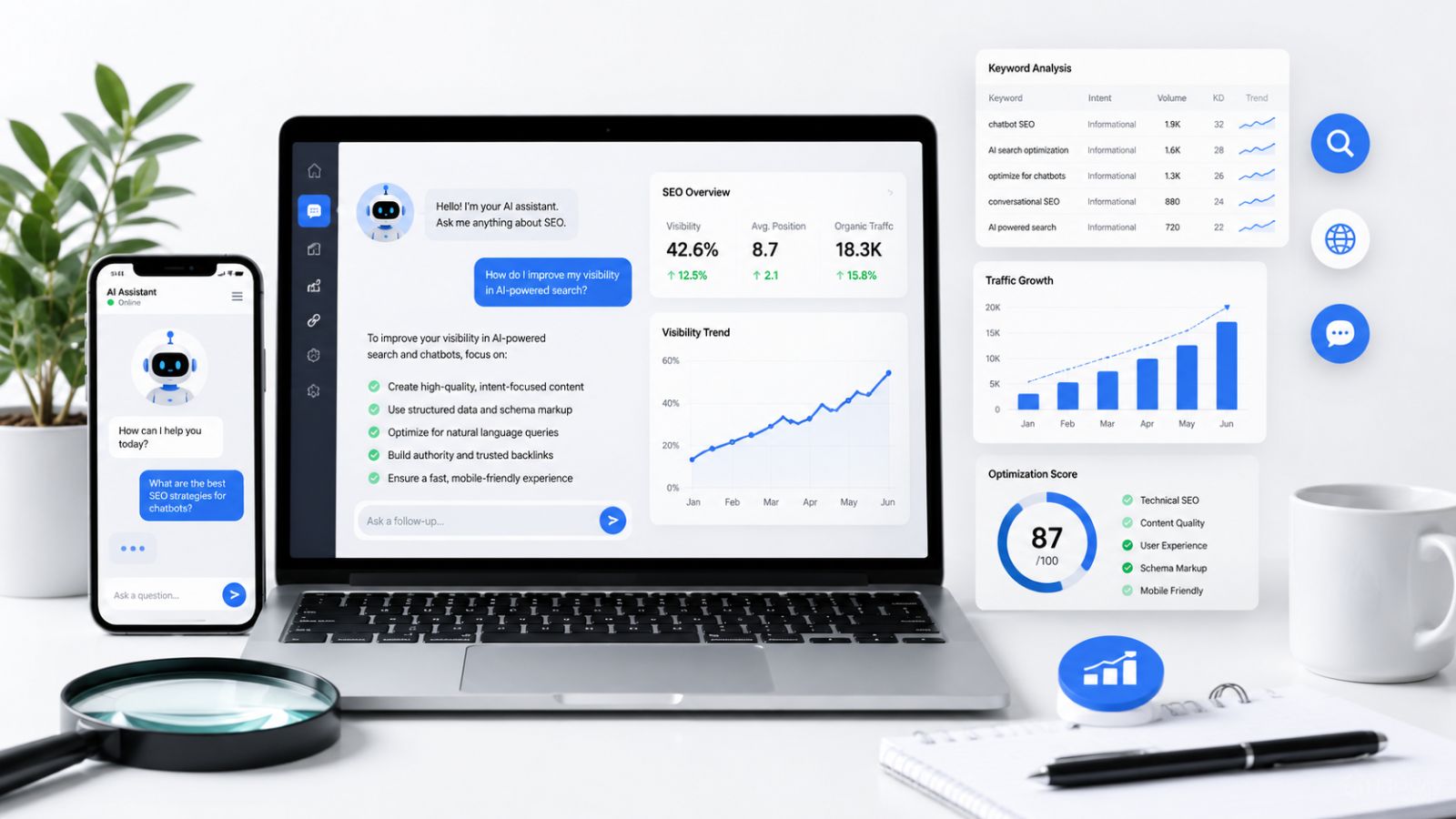
Step 4: Connect Chatbot Analytics to Your SEO Dashboard
Use UTM parameters inside chatbot conversation flows to track which interactions lead to organic search conversions. Platforms like ChatbotX’s analytics and reporting tools provide conversation-level data that can be mapped directly to your SEO KPIs – giving you a complete picture of how chatbot engagement affects organic performance.
Step 5: Iterate Based on Real Conversation Data
SEO is not a one-time project. Review your chatbot conversation logs monthly. Look for new question patterns, identify recurring unanswered queries, and update your content accordingly. This continuous feedback loop is one of the highest-ROI SEO activities available in 2026.
ChatbotX: Built for SEO-Driven Chat Marketing
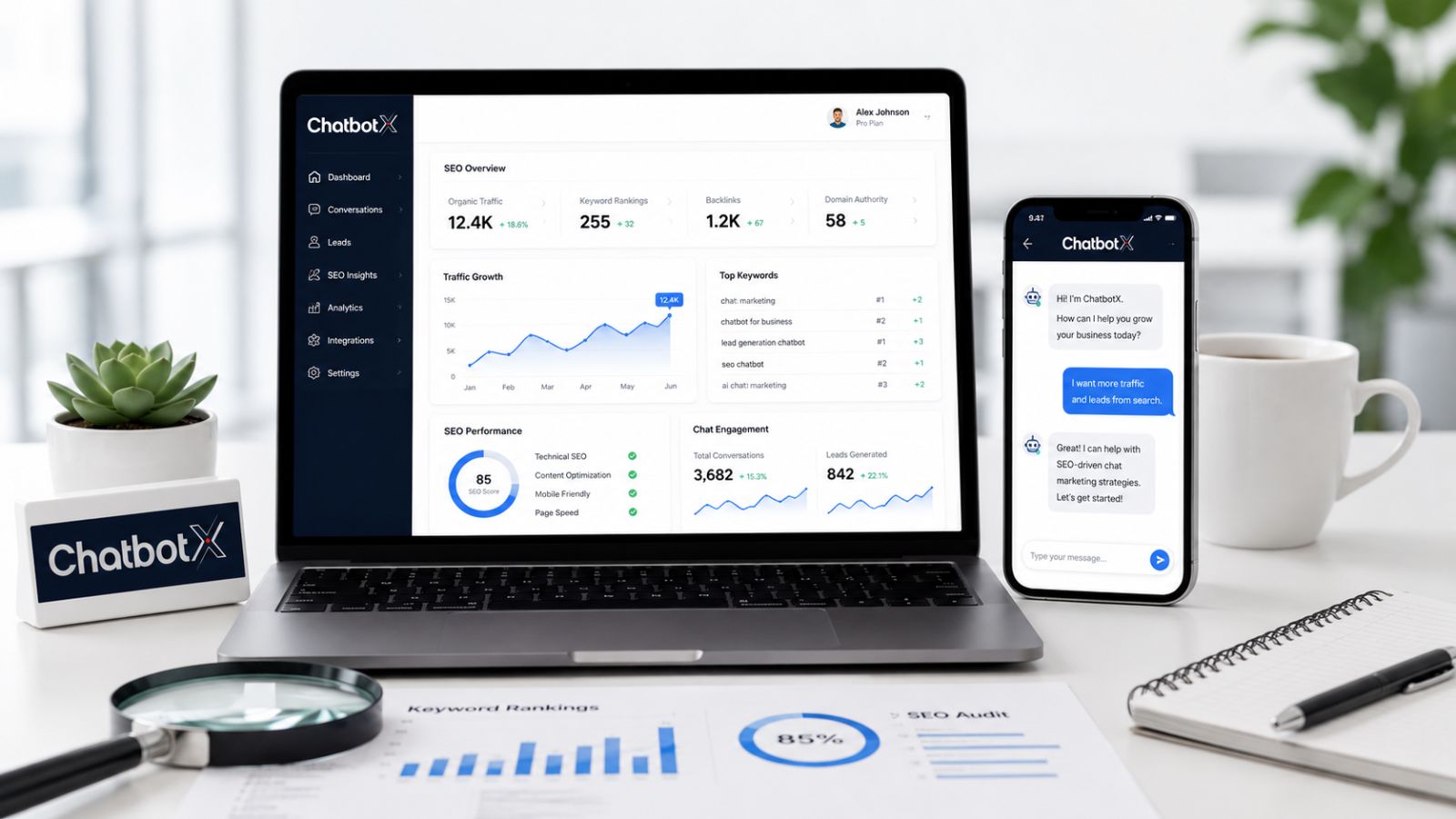
ChatbotX is an open-source AI-powered chat marketing automation platform designed for businesses that want to grow organic and paid traffic through intelligent conversational experiences.
What makes ChatbotX particularly well-suited for chatbot SEO in 2026:
Multi-channel automation – ChatbotX deploys across your website, Facebook Messenger, Instagram DMs, and WhatsApp from a single platform, meaning your conversational content strategy works across every touchpoint where users discover you.
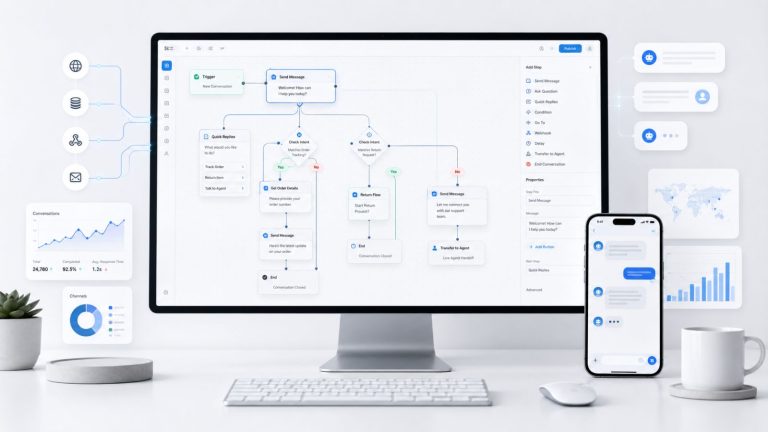
Flow builder with SEO-friendly architecture – The visual flow builder lets you design conversation paths that mirror your content hierarchy, making it straightforward to align chatbot flows with your SEO structure.
Open-source flexibility – Because ChatbotX is open source, technical teams can customize chatbot behavior, integrate with CMS platforms, and build structured-data pipelines directly from the codebase. You can review the full source and contribute at the ChatbotX GitHub repository.
Broadcast and segmentation – With ChatbotX’s broadcast and audience segmentation features, you can deliver targeted content to re-engage users who arrived through organic search, turning one-time visitors into returning audiences – a powerful signal for Google’s user behavior models.
For teams evaluating chatbot platforms, the ChatbotX GitHub repository is the fastest way to evaluate the code quality, community activity, and integration options before committing.
Common Chatbot SEO Mistakes to Avoid
Blocking chatbot content from crawlers. If your chatbot FAQs are loaded dynamically via JavaScript with no server-side rendering fallback, Google may not index them. Use SSR or pre-rendering for SEO-critical chatbot content.
Keyword stuffing in chatbot responses. Chatbot copy should read naturally. Over-optimized, robotic responses hurt user experience – which now hurts rankings.
Ignoring mobile performance. More than 60% of searches happen on mobile. Your chatbot widget must be fully responsive and must not degrade mobile Core Web Vitals scores.
No structured data. Deploying a chatbot FAQ without FAQPage schema is a missed ranking opportunity. Always mark up chatbot-adjacent content with appropriate schema.
Siloing chatbot data. If your chatbot analytics and your SEO analytics live in separate dashboards with no integration, you’re making decisions without the full picture. Connect them.
Measuring Chatbot SEO Performance
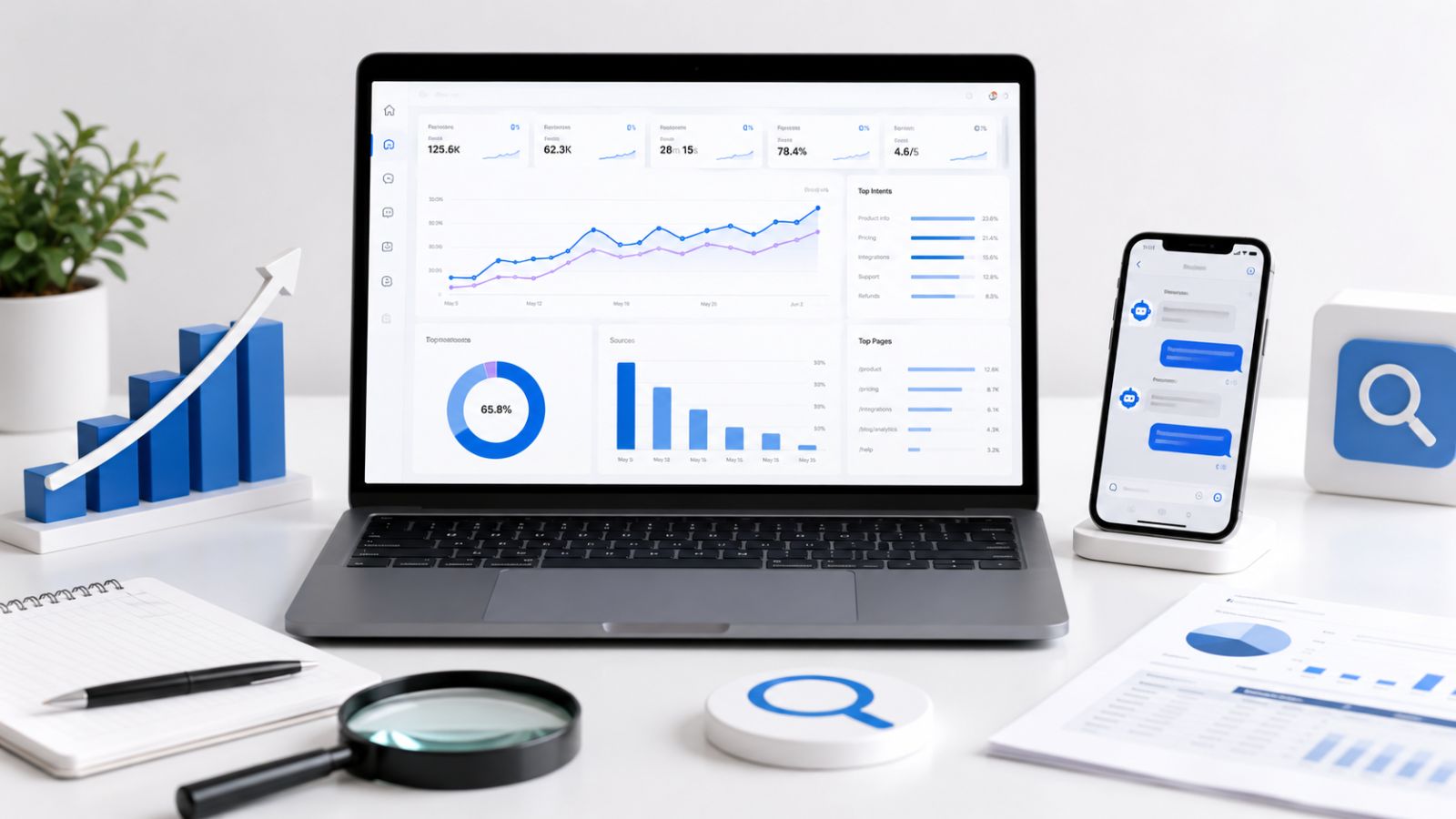
Track these KPIs to measure the impact of your chatbot SEO strategy:
- Organic traffic to chatbot landing pages (Google Search Console)
- Featured snippet appearances for FAQ schema content
- Session duration uplift on pages with active chatbot engagement
- Bounce rate reduction on chatbot-enabled pages vs. non-chatbot pages
- Chatbot-assisted conversions from organic sessions (via UTM attribution)
- FAQ schema click-through rate in Google Search Console’s rich results report
- Crawl coverage of chatbot-adjacent pages (Screaming Frog or Sitebulb)
Review these metrics quarterly and align them with your broader SEO reporting cadence.
Frequently Asked Questions
Does a chatbot directly affect Google rankings?
Not directly – Google does not give ranking boosts for having a chatbot. However, chatbots improve user engagement metrics (time on site, bounce rate, return visits) that are indirect ranking signals. The SEO benefit is real, but it works through experience quality rather than as a technical ranking factor.
Can Google index chatbot conversations?
Google can index chatbot content that is rendered in HTML on the page. Dynamically loaded chat conversations that are not server-side rendered may not be indexed. To ensure indexability, publish key chatbot FAQ content as static HTML with FAQPage schema.
What is the difference between chatbot SEO and conversational SEO?
Conversational SEO is the broader practice of optimizing content for natural-language queries, including voice search and AI-powered search. Chatbot SEO is a subset of conversational SEO focused specifically on chatbot interfaces, their content, and their impact on engagement metrics.
How long does it take to see SEO results from a chatbot?
Engagement metric improvements (bounce rate, session duration) can appear within weeks of deploying a well-optimized chatbot. Structured data and featured snippet gains typically materialize within 2–3 months as Google recrawls and reindexes the updated pages.
Is open-source chatbot software better for SEO?
Open-source chatbots give technical teams full control over rendering, structured data implementation, and CMS integration – all of which have direct SEO implications. Closed-platform chatbots may limit customization in ways that affect SEO performance.
Final Thoughts: Start Building Your Chatbot SEO Advantage Today
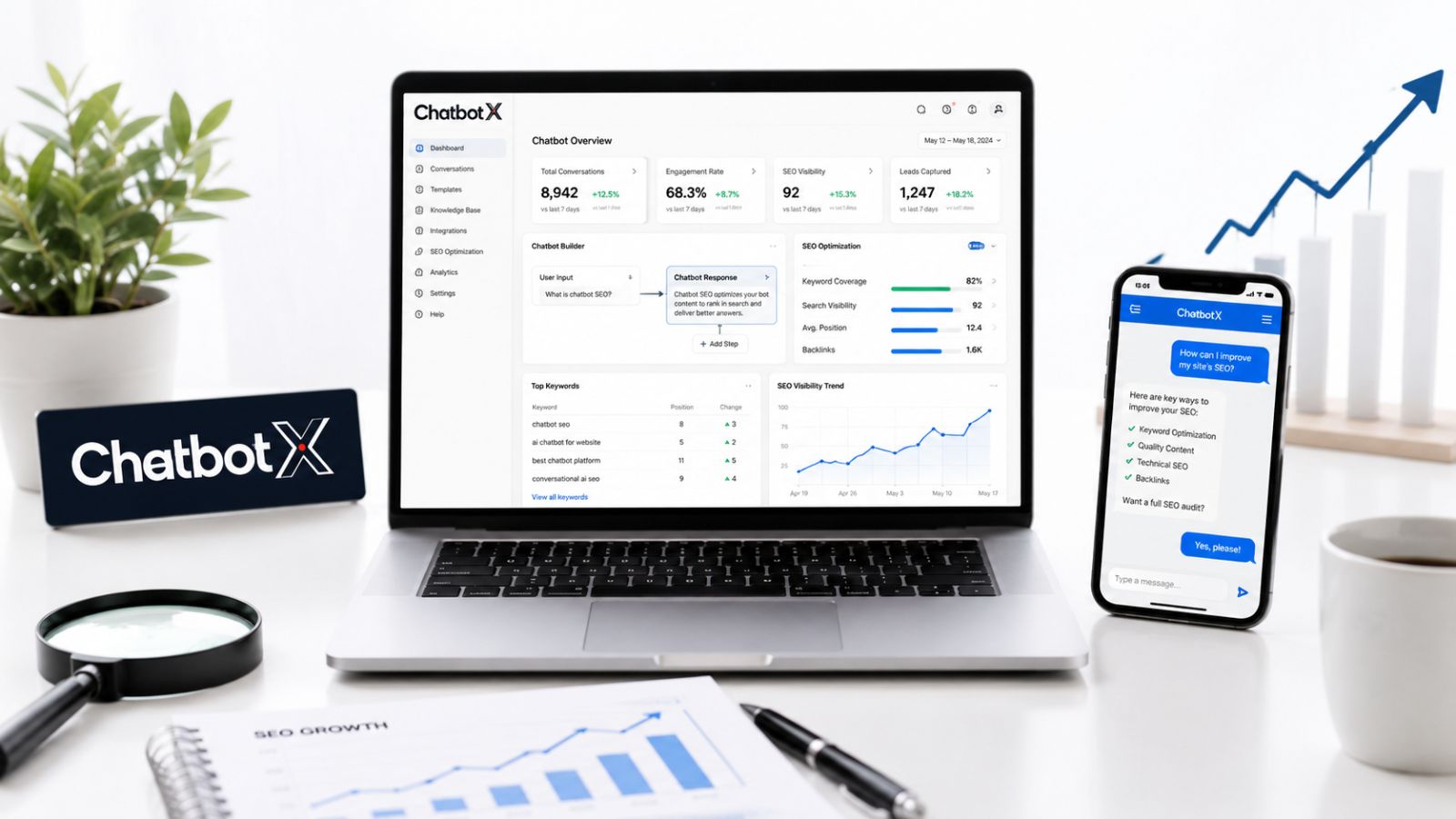
Chatbot SEO is not a niche tactic. In 2026, it sits at the intersection of the two most powerful forces in digital marketing: AI-driven search and conversational user experiences. Businesses that build chatbot SEO infrastructure now will compound their advantages as both trends accelerate.
The strategic playbook is clear: optimize your chatbot content for conversational queries, implement structured data, protect your Core Web Vitals, and close the loop between chatbot analytics and SEO performance.
Ready to put this into practice? ChatbotX gives you everything you need – an open-source, multi-channel chat marketing platform with the flexibility, analytics, and automation capabilities to turn your chatbot into a genuine SEO asset.
👉 Get started with ChatbotX for free and launch your first SEO-optimized chatbot flow today. No coding required. Full source code available at github.com/ChatbotXIO/ChatbotX for teams who want complete ownership of their chatbot infrastructure.