WhatsApp has quietly become the world’s most powerful B2C communication channel. With over 2.9 billion monthly active users and open rates that consistently exceed 90%, it dwarfs email and traditional social media advertising by a significant margin. For businesses operating in Asia, the Middle East, Latin America, and Europe, WhatsApp is no longer a supplementary channel – it is the primary customer touchpoint.
Yet for most organizations, the channel remains massively underutilized. Customer service teams answer the same questions repeatedly. Sales reps miss follow-up windows. Marketing campaigns go out manually, one broadcast at a time. The solution is no longer simply “use WhatsApp” – it is using WhatsApp with AI.
This guide covers everything you need to know about WhatsApp AI in 2026: what it actually means, how autonomous AI agents work across the customer journey, what automated marketing flows look like in practice, and how human-AI collaboration models are reshaping enterprise customer engagement.
Launch agentic chat marketing in minutes with ChatbotX












What Does “WhatsApp AI” Actually Mean?
WhatsApp AI is the deployment of autonomous AI agents – conversational models capable of reasoning, decision-making, and taking action – within the WhatsApp Business API infrastructure. It is categorically different from the keyword-trigger chatbots that defined the previous decade.
Where traditional bots operate on rigid decision trees (“if customer says X → respond with Y”), modern WhatsApp AI agents understand intent at a semantic level. They can process ambiguous questions, maintain context across multi-turn conversations, retrieve relevant product data, and hand off to human agents at precisely the right moment – all without scripted workflows.
According to Meta’s own business research, a significant and growing share of consumers in key markets now prefer to contact brands through messaging apps rather than phone or email. Businesses that meet customers on WhatsApp with intelligent, responsive AI agents are seeing measurable advantages in satisfaction scores, conversion rates, and repeat purchase behavior.
The transition from rule-based chatbot to autonomous AI agent is the single most important operational upgrade a business can make to its WhatsApp presence in 2026.
Five AI Agent Types That Cover the Full WhatsApp Customer Journey
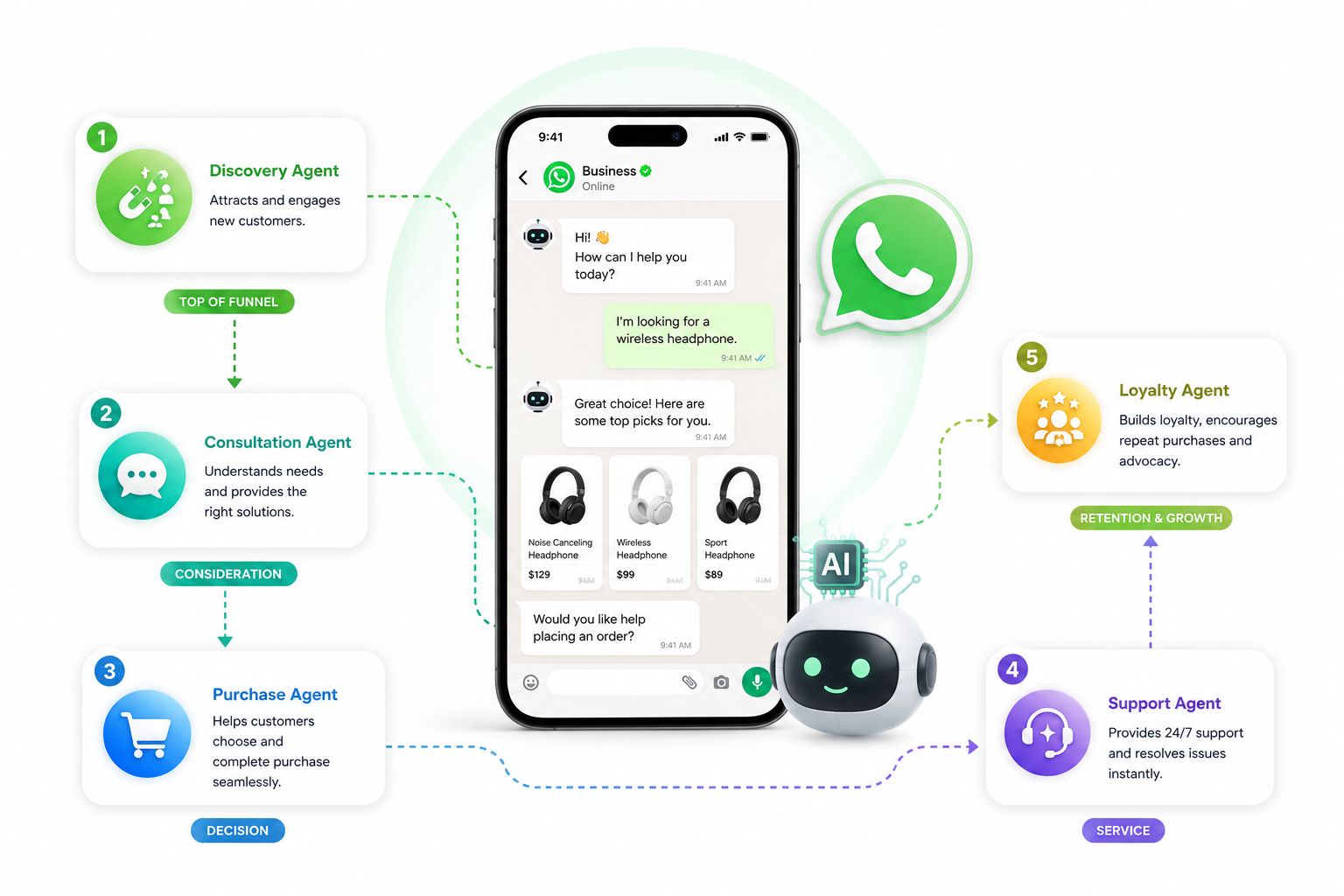
Effective WhatsApp AI deployment is not a single bot doing everything – it is a coordinated ecosystem of specialized agents, each purpose-built for a distinct stage of the customer lifecycle.
1. Customer Service Agent
The customer service agent handles the volume work: FAQs, order status requests, return and refund inquiries, warranty claims, and general product questions. Operating 24 hours a day across time zones, it eliminates wait times for the majority of inbound contacts and frees human agents to focus on escalations and complex cases.
The critical differentiator from legacy chatbots is context retention. A customer who mentions their order number three messages earlier should not need to repeat it. A customer switching between questions about sizing and delivery should receive coherent, connected answers – not a restart of a scripted menu. Modern AI agents handle this naturally.
2. AI Shopping Agent
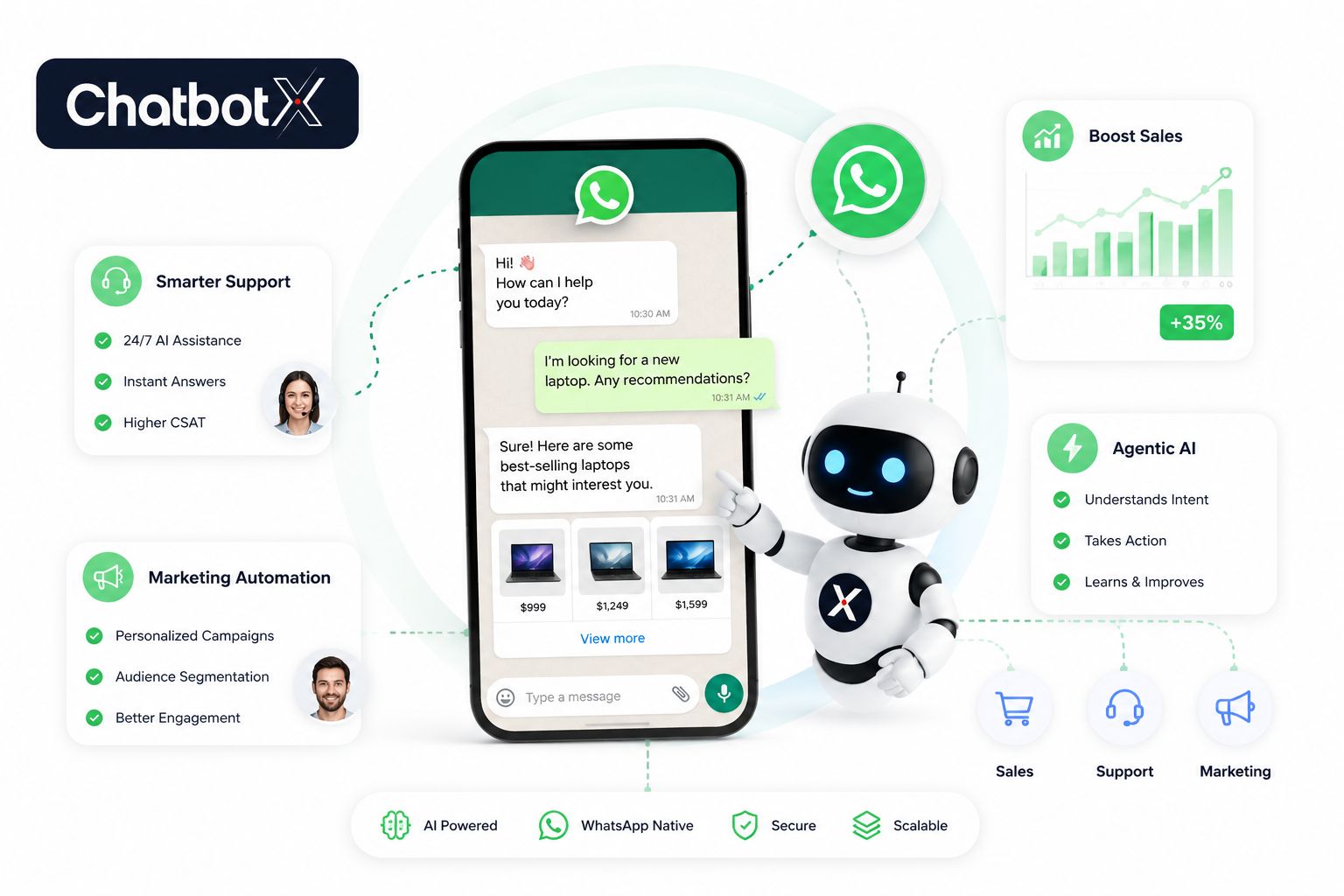
The shopping agent transforms WhatsApp into a transactional channel. By analyzing conversation signals – product mentions, stated preferences, past purchase data from integrated CRM systems – the agent delivers personalized product recommendations directly in chat. It can generate payment links, share product cards with images and pricing, apply promotional codes, and guide customers from discovery to checkout without leaving the WhatsApp interface.
This is particularly impactful for fashion, beauty, electronics, and FMCG brands where impulse purchase windows are short and friction kills conversions.
3. Marketing Campaign Agent
Planning and executing WhatsApp marketing campaigns has historically required significant coordination between copywriters, designers, and technical teams. An AI marketing agent collapses this workflow.
By ingesting brand guidelines and campaign objectives, the agent autonomously generates message copy, recommends audience segmentation parameters, proposes campaign timing based on historical engagement data, and produces visual assets for multimedia messages. The result is campaigns that can go from brief to broadcast in hours rather than weeks.
4. Intelligent Booking and Scheduling Agent
For service businesses – hospitality, healthcare, automotive, professional services – appointment scheduling is a persistent operational burden. The booking agent handles the entire reservation flow conversationally: gathering requirements, checking real-time availability, confirming details, sending reminders, and managing rescheduling requests. Integration with calendar systems and booking platforms means the agent operates as a fully functional scheduling coordinator, not just a message router.
5. Customer Loyalty and Retention Agent
Customer retention is significantly more cost-efficient than acquisition, yet most businesses still manage loyalty programs through email sequences that go unread. A WhatsApp loyalty agent delivers rewards, points updates, personalized reactivation messages, and exclusive member offers directly into the customer’s most-checked inbox. Triggered by behavioral signals – days since last purchase, cart abandonment, membership milestone – these agents maintain engagement throughout the lifecycle automatically.
How WhatsApp AI Marketing Campaigns Work in Practice
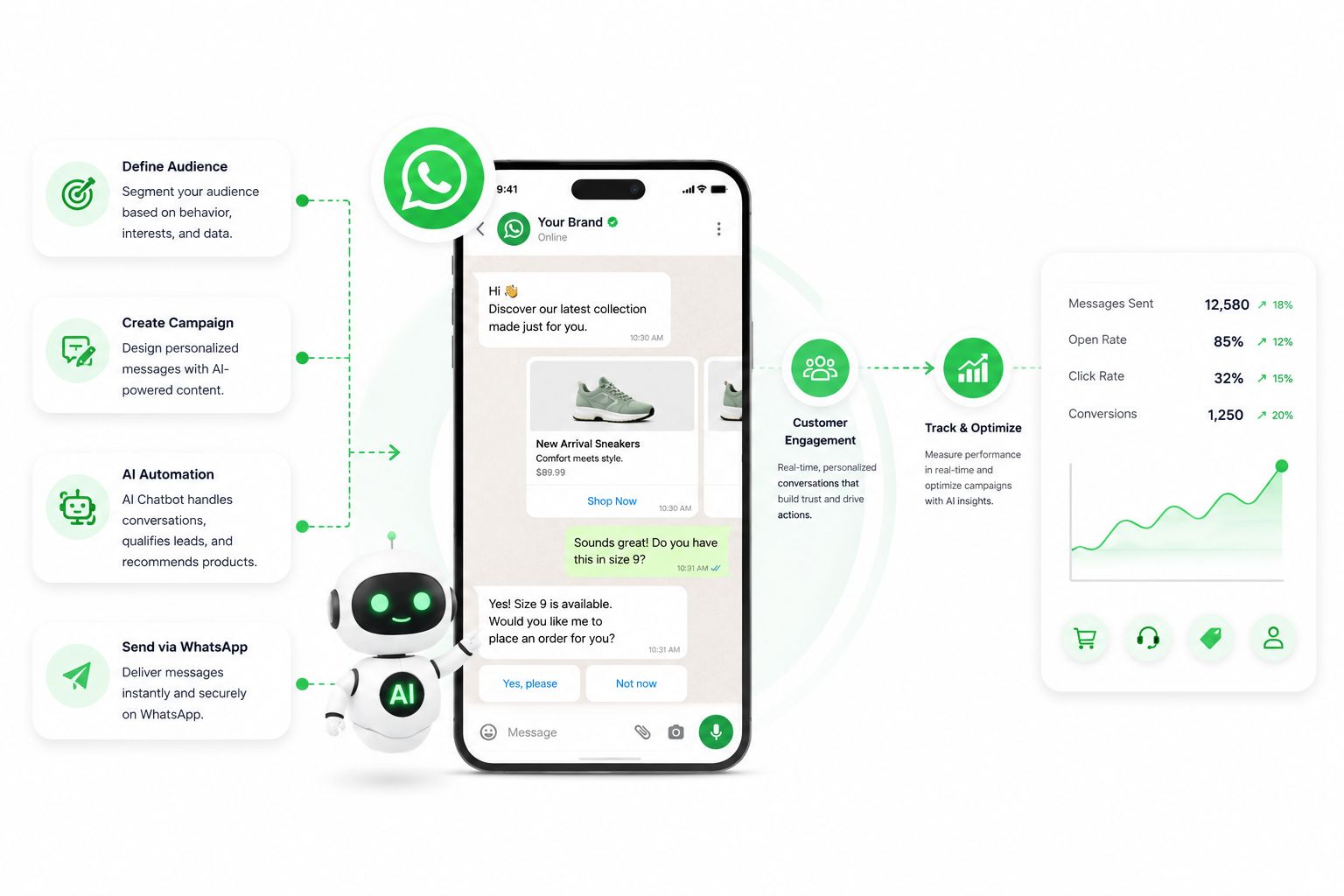
The traditional workflow for a WhatsApp marketing campaign looks roughly like this: strategy meeting → brief → copywriting → design → technical setup of broadcast → approval cycle → send → manual reporting. For a mid-market business, this might take two to three weeks and involve four or five team members.
With an AI-powered campaign flow, the process compresses dramatically. A marketer inputs a campaign goal – “reactivate lapsed customers with a seasonal discount offer” – along with brand assets and any customer segment parameters. The AI agent generates a complete campaign proposal: message copy in the appropriate brand voice, visual assets optimized for WhatsApp’s display format, a suggested send time based on past engagement patterns, and a conversation flow that handles replies from recipients.
The campaign goes from concept to broadcast in a fraction of the time, with zero coding and no dependency on technical or design resources. More importantly, the AI continues to work post-send – tracking responses, segmenting engaged recipients for follow-up flows, and routing interested customers to the sales or shopping agent.
ChatbotX’s Flow Builder provides the visual drag-and-drop interface for constructing these automated campaign journeys across WhatsApp and every other major messaging channel – without writing a single line of code. For development teams who want deeper customization, the ChatbotX GitHub repository provides full access to the open-source codebase, enabling custom AI workflow extensions and enterprise-grade integrations.
WhatsApp AI for Retargeting and Automated Customer Journeys
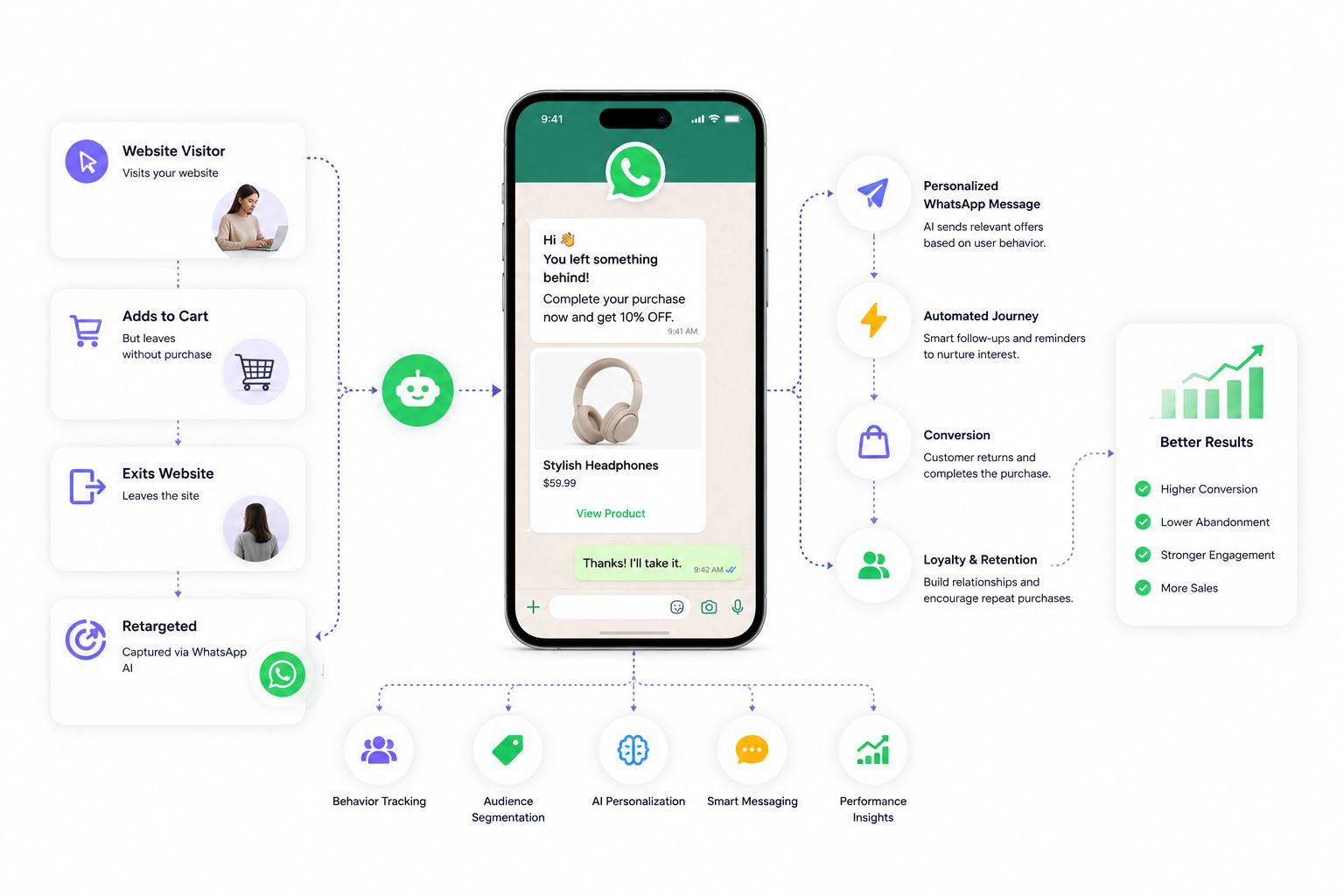
Beyond outbound campaigns, some of the highest-ROI applications of WhatsApp AI are in behavioral retargeting and automated lifecycle journeys.
Abandoned Cart Recovery
E-commerce abandonment rates hover around 70% globally, according to Baymard Institute research. The window to recover an abandoned cart is narrow – typically measured in hours, not days. WhatsApp AI agents can monitor cart activity in real time and trigger personalized recovery messages within minutes of abandonment, including product reminders, answers to likely objections, and time-limited incentives. The conversational format of WhatsApp makes these messages feel personal rather than automated, significantly improving recovery rates compared to email.
Post-Purchase Automation
The customer journey does not end at payment. AI agents can automatically trigger shipping notifications, delivery confirmations, post-purchase check-ins, cross-sell recommendations based on the purchased product category, and satisfaction surveys – all sequenced appropriately and delivered through WhatsApp. This lifecycle approach turns transactional customers into loyal repeat buyers without requiring manual touchpoints at each stage.
AI Audience Segmentation and Nurture Sequences
Integrating WhatsApp AI with CRM and e-commerce data enables dynamic audience segmentation that updates in real time. New customers receive brand introduction sequences. High-value customers receive VIP communications. At-risk customers receive reactivation campaigns. Each segment receives content calibrated to their lifecycle stage – delivered automatically at optimized times.
ChatbotX’s Remarketing feature is purpose-built for exactly this type of behavioral targeting across WhatsApp and other connected channels, enabling businesses to run sophisticated retargeting sequences without building custom automation infrastructure.
The Human-AI Collaboration Model: Where Automation Ends and Relationship Begins
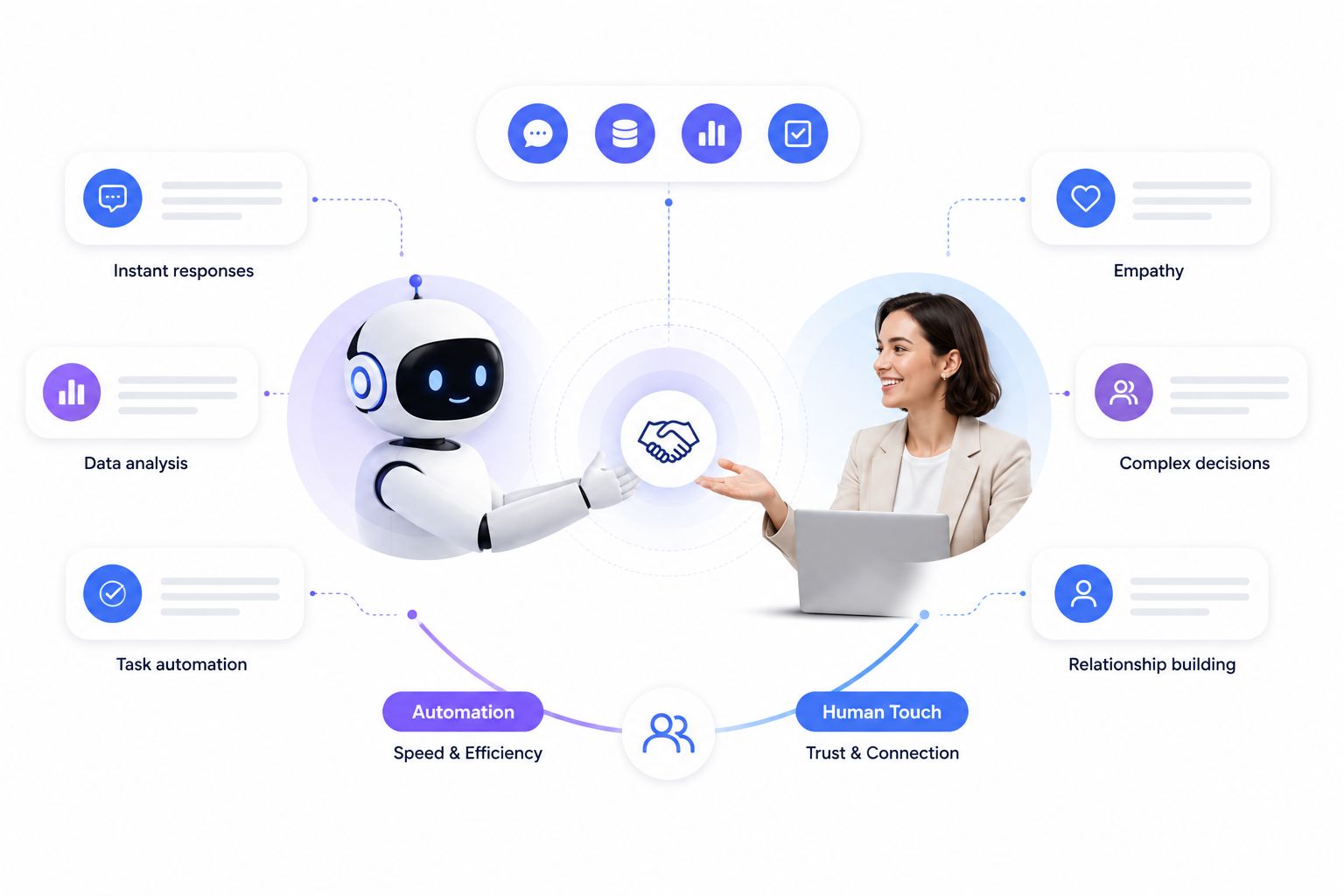
A common concern when businesses consider WhatsApp AI deployment is the loss of human connection for high-value customers. This concern is valid – but it reflects a misunderstanding of how modern AI systems are designed to operate.
The goal is not to replace human agents. It is to ensure that human agents spend their time exclusively on conversations where human judgment creates value, while AI handles everything else.
In practice, this means deploying AI agents to handle the predictable, high-volume work – standard inquiries, initial qualification, information gathering, appointment scheduling – while equipping human agents with AI-assisted tools that surface context, suggest responses, and flag priority conversations requiring personal attention.
When a high-value opportunity is identified – a customer expressing serious purchase intent on a high-ticket item, a complaint with escalation risk, a VIP member with a complex request – a human agent steps into the conversation seamlessly. Critically, the handoff is invisible to the customer: the conversation history is preserved, the context is fully available to the human agent, and the transition creates no friction or repetition.
This hybrid model – AI handles the front-line volume, humans own the high-value conversion – consistently outperforms either pure automation or purely manual operations in both efficiency metrics and customer satisfaction scores.
For teams looking for an open-source foundation to build this kind of hybrid workflow, the ChatbotX GitHub repository offers a fully extensible platform with shared inbox capabilities, AI agent integration, and human takeover controls built in.
Why ChatbotX Is Built for WhatsApp AI Deployment
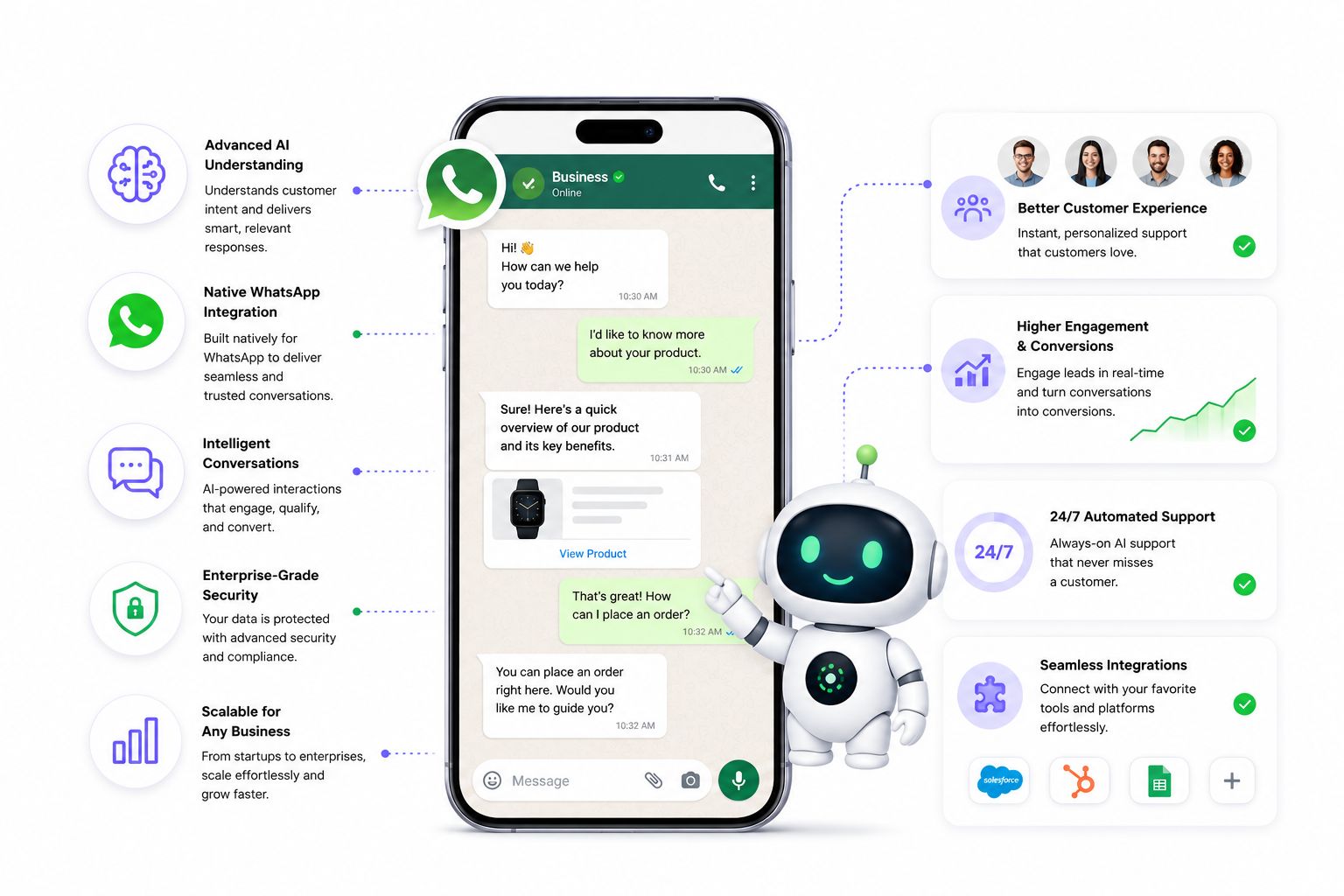
ChatbotX is an open-source agentic omnichannel AI chatbot platform designed specifically for the demands of modern business messaging. Unlike closed, proprietary solutions that lock businesses into specific vendor ecosystems, ChatbotX gives organizations full ownership of their automation infrastructure – including the ability to self-host, customize the codebase, and integrate with any AI model or third-party service.
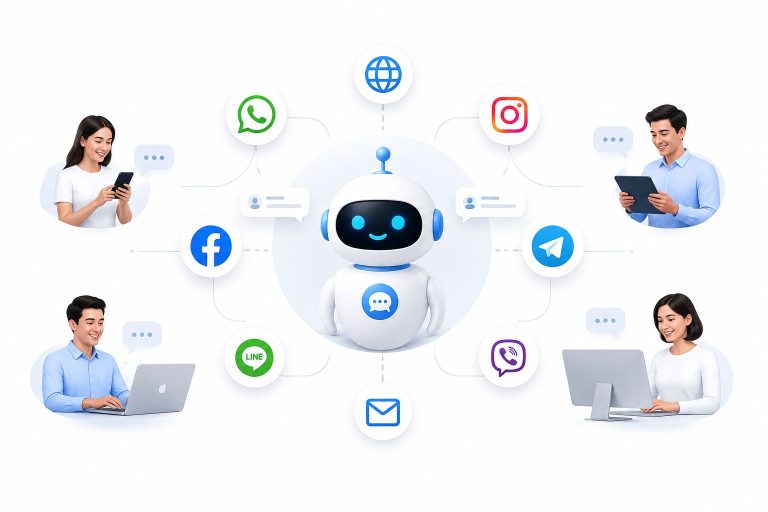
For WhatsApp specifically, ChatbotX provides native WhatsApp Business API connectivity alongside every other major messaging channel – Messenger, Instagram, Telegram, Zalo, TikTok, Email, and Webchat – from a single unified platform.
Key capabilities relevant to WhatsApp AI deployment include:
- AI Agents: Deploy specialized autonomous agents for customer service, sales, marketing, and support workflows across WhatsApp with full context retention and multi-turn conversation handling.
- Flow Builder: Visually construct complex automated conversation journeys without code, including conditional logic, time delays, and channel-specific optimizations.
- Shared Inbox with Human Takeover: Human agents monitor and intervene in live AI conversations through a unified inbox, with full conversation history and zero customer-facing disruption.
- CRM Contacts and Segmentation: Build dynamic audience segments from behavioral and CRM data for targeted WhatsApp campaigns and lifecycle automation.
- Remarketing: Run behavioral retargeting sequences across WhatsApp and connected channels from a single campaign interface.
For further reading on how AI agents fit into broader omnichannel strategy, the ChatbotX blog covers this in depth in Chatbot MCP Server: The Complete Guide to Building Agentic AI Workflows in 2026 and Chatbot SEO: Complete Guide for 2026.
Frequently Asked Questions
What is the difference between WhatsApp AI and a traditional chatbot?
Traditional chatbots use keyword matching and pre-scripted decision trees. They fail when customers ask questions outside their programmed scenarios and provide robotic, disconnected responses. WhatsApp AI agents use large language model technology to understand the meaning and context of customer messages, enabling natural, flexible conversations that handle complexity the same way a trained human agent would.
Do businesses need the WhatsApp Business API to deploy AI agents?
Yes. AI agent deployment at scale requires the WhatsApp Business API, which enables programmatic message sending, automation, and integration with third-party platforms. The free WhatsApp Business App is suitable for very small operations but lacks the API access necessary for automation, campaign broadcasting, or integration with CRM and e-commerce systems.
How does a WhatsApp AI agent handle sensitive customer situations?
Well-designed AI systems include escalation protocols that identify high-stakes situations – complaints, confusion, emotional distress, complex financial or medical questions – and route them to human agents immediately. The AI does not attempt to resolve what it cannot handle appropriately; it transfers the conversation with full context to a human, ensuring the customer always receives the right level of attention.
Can WhatsApp AI be integrated with existing CRM and e-commerce platforms?
Yes. Modern WhatsApp AI platforms, including ChatbotX, support integration with major CRM systems, e-commerce platforms, and data sources through APIs and native connectors. This integration enables the AI to access customer purchase history, loyalty status, open tickets, and behavioral data to deliver personalized, context-aware conversations.
Is WhatsApp AI suitable for small businesses or only enterprise deployments?
WhatsApp AI is viable at any scale, but the value proposition scales with volume. Small businesses benefit primarily from 24/7 availability and consistent response quality. Mid-market and enterprise businesses unlock additional value through campaign automation, advanced segmentation, multi-agent coordination, and operational efficiency at scale. Open-source platforms like ChatbotX make sophisticated WhatsApp AI accessible without enterprise-level licensing costs.
Ready to Transform Your WhatsApp Channel?
WhatsApp is already your customers’ preferred communication channel. The question is whether you are meeting them there with manual responses and missed follow-ups – or with intelligent AI agents that convert, retain, and delight around the clock.
ChatbotX gives you everything you need to build a production-grade WhatsApp AI system: autonomous agents, visual flow builder, behavioral retargeting, shared inbox with human takeover, and full open-source flexibility to customize every component for your specific use case.
👉 Get started with ChatbotX for free and deploy your first WhatsApp AI agent today.
👉 Explore the ChatbotX source code on GitHub – star the project and join a growing community of developers and businesses building the future of conversational AI.
Your WhatsApp channel should be a 24/7 revenue engine. With the right AI foundation, it can be.