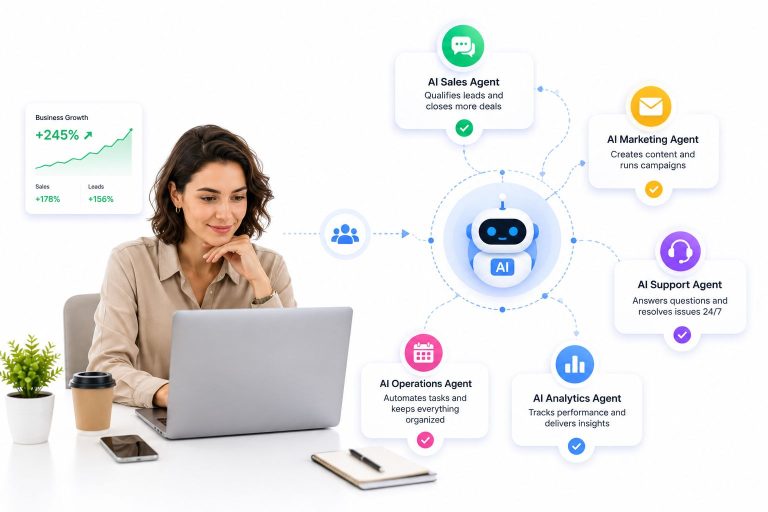

A customer messages you at midnight about a missing package. By morning, another thirty questions are sitting in your inbox. You have no overnight team, and you’re not about to hire one just to cover a handful of late-night pings. This is the exact tension that’s pushing small and mid-sized businesses toward one solution: AI customer service assistants that never clock out.
The market has moved quickly. Picking the wrong tool or sticking with a glorified FAQ bot now costs real money and real customers. Below, we unpack what actually separates a basic chatbot from a genuine AI service assistant, why that gap matters more for small teams than large ones, and how to evaluate your options heading into 2026.
Launch agentic chat marketing in minutes with ChatbotX













Chatbot, AI Chatbot, or AI Agent? The Difference That Actually Matters
Vendors throw these terms around interchangeably, but they describe three very different tools.
A classic chatbot runs on decision trees. Ask it something inside its script store hours, a tracking number format, a return policy and it performs fine. Step outside that script and the conversation stalls immediately.
An AI-powered chatbot layers natural language understanding on top, so it can interpret phrasing more loosely and hold a more natural back-and-forth. It’s still fundamentally reactive, though: it waits for input, matches intent, and replies.
An AI service agent is a different category entirely. Rather than just answering, it reasons through a request, pulls from live data sources, and takes action on its own. In practice, that looks like:
- Pulling answers from a knowledge base, order history, or CRM record in real time
- Completing multi-step tasks updating a contact, tagging a lead, triggering a follow-up message
- Recognizing when a case needs a human and routing it with full context attached
- Operating consistently across every channel a customer might use, not just one inbox
A simple analogy: a scripted chatbot is a vending machine press the right button, get the pre-set item. An AI agent behaves more like an experienced teammate who already knows the customer’s history and can actually close the loop.
This is the layer where a platform like ChatbotX’s AI Agents feature comes in built to reason across conversation history and business data rather than simply matching keywords, so smaller teams get agent-level support without hiring an agent-sized team.
Why “Good Enough” Chatbots Stop Being Good Enough
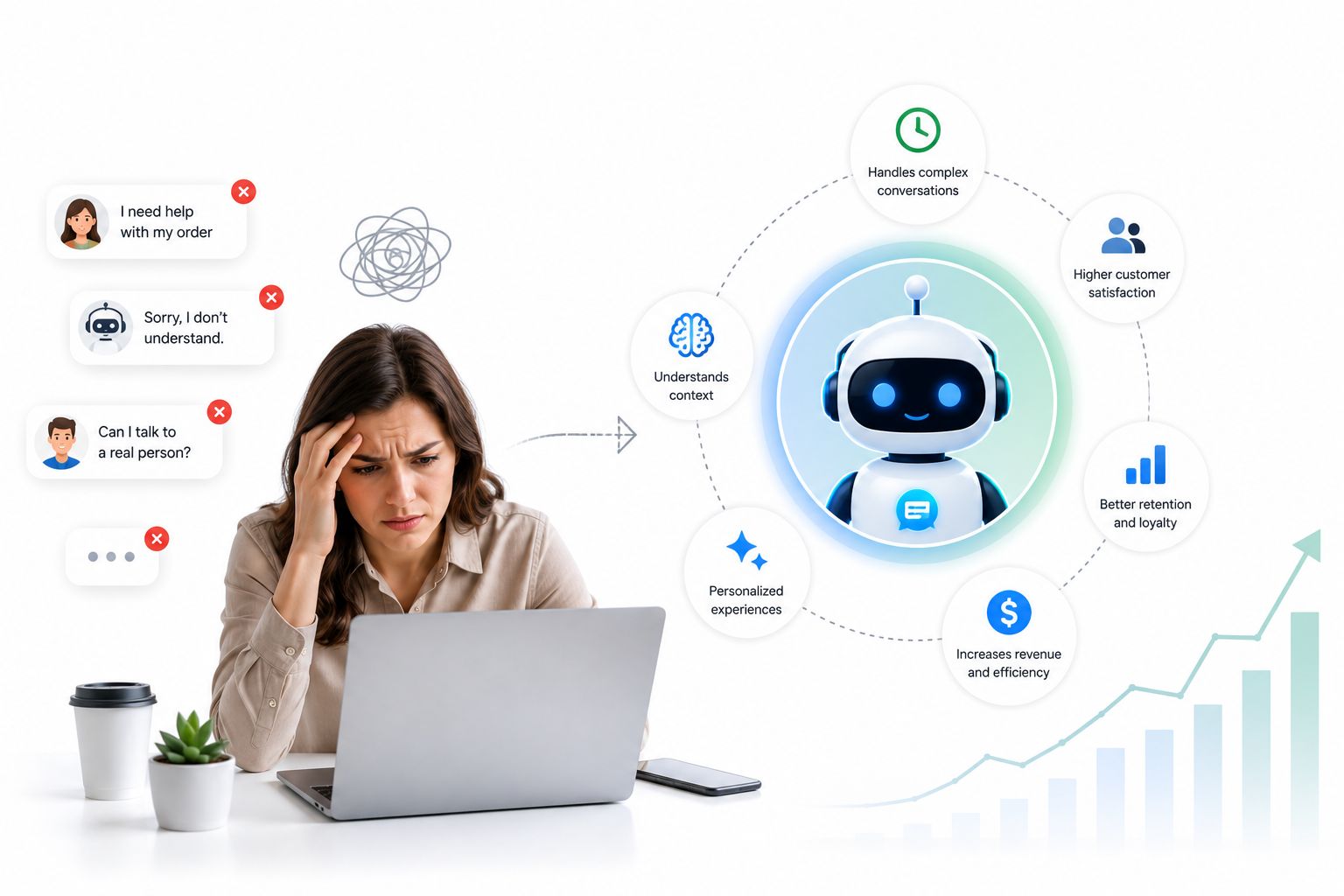
A rules-based bot can carry a brand-new business for a while. The cracks show up as soon as volume and channel count start climbing.
Modern buyers expect a fast, accurate, personalized reply no matter what time it is or which app they used to reach you. Recent industry data on AI customer support backs up how fast this shift is happening: the global AI customer service market is projected to reach roughly $15.12 billion in 2026, and separate research on adoption curves notes that the share of support teams running AI-powered tools has jumped from around 5% in 2020 to more than 80% by 2025. Small businesses that stay on rigid, script-only tools are effectively opting out of that shift.
The Real Price of a Dead-End Conversation
For a lean team, one bad support experience carries outsized weight. There’s no large support bench to absorb the fallout the way an enterprise call center can. A shopper who hits a wall with a rigid bot often doesn’t come back and is just as likely to mention the experience publicly.
An AI agent avoids that dead end by following a conversation across multiple turns, remembering context the person already gave, and pulling in relevant account or order details instead of asking them to repeat themselves. That’s precisely the gap a Shared Inbox built for unified, cross-channel conversation history is designed to close every message, regardless of platform, lands in one place with the full thread intact.
What Adoption Data Says About 2026
The numbers reinforce that this isn’t a hype cycle. One widely cited breakdown of 2026 support benchmarks found that companies now see roughly $3.50 in returns for every $1 spent on AI customer service, with resolution times dropping from hours down to minutes in leading deployments. A separate small-business AI trends report tells a similar story: after customer service, marketing and sales automation and general operations rank among the top current AI use cases for SMBs, showing that support is rarely where AI adoption stops it tends to spread into every customer-facing workflow once teams see the payoff.
Beyond the Help Desk: What an AI Assistant Can Do for the Whole Business
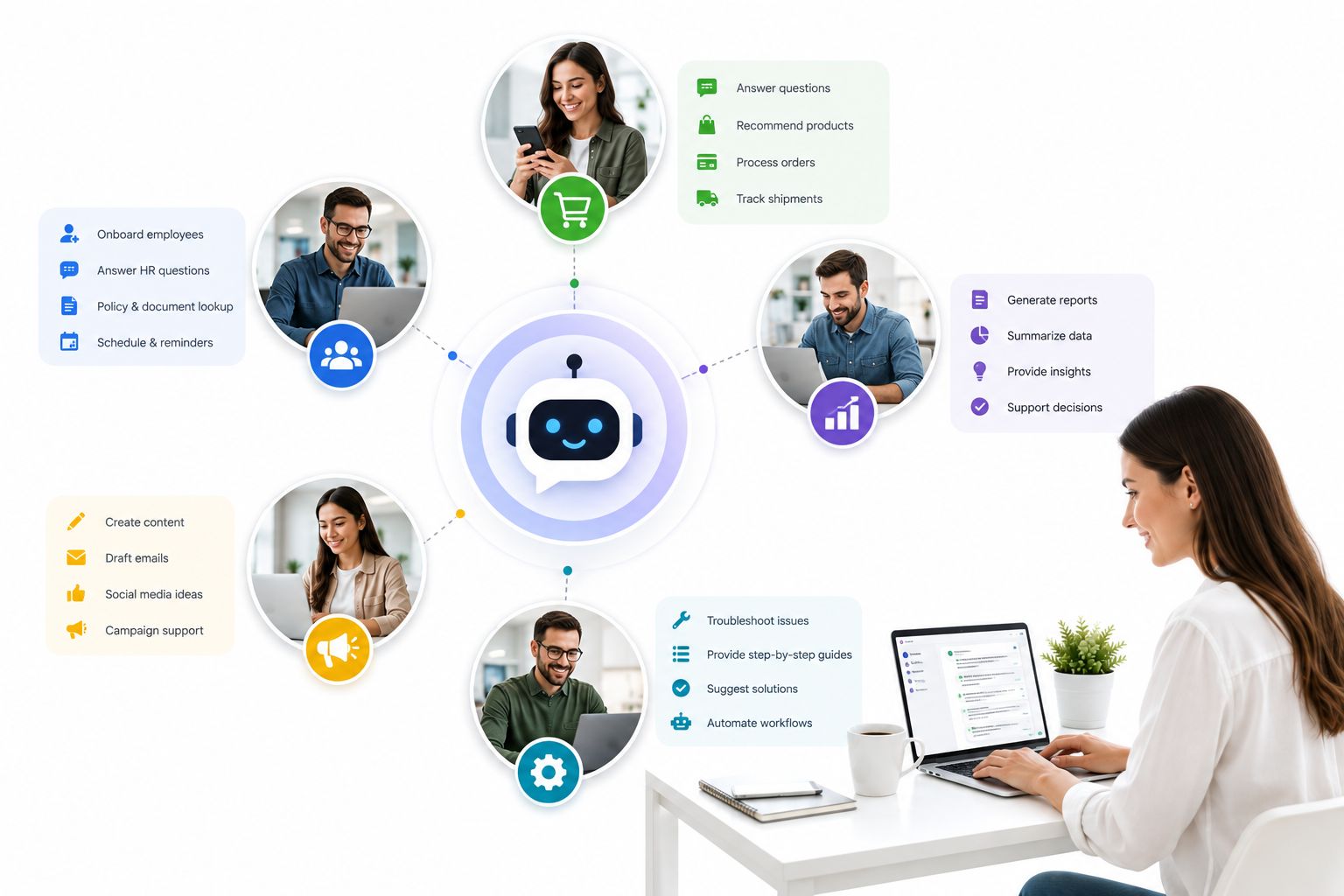
Once an AI assistant is wired into your actual data, it stops being a “support widget” and starts functioning as connective tissue across the business.
Automating the Follow-Through, Not Just the Reply
Answering a question is only step one. The harder part is acting on it tagging a lead as “hot,” scheduling a callback, sending a reminder before a subscription lapses. This is where automation rules matter as much as the conversation itself. ChatbotX’s Triggers & Actions feature lets a team define exactly what should happen after a specific customer signal, so the assistant doesn’t just chat – it moves the process forward without a human needing to click anything.
Keeping Every Channel in Sync
Customers rarely stick to one app. Someone might open with a comment on social media, continue over chat, and finish the purchase question by messaging a phone number. An assistant that only “lives” on one channel recreates the exact fragmentation that frustrated customers in the first place. A genuinely omnichannel setup the kind detailed in ChatbotX’s guide on customer support automation software keeps the thread continuous no matter where the conversation started.
Connecting Support to the CRM, Not Bolting It On
An assistant is only as useful as the data behind it. Without a live link to customer records, it’s guessing. With one, it can reference a past purchase, a subscription tier, or an open ticket the moment a conversation starts. ChatbotX’s piece on AI chatbots with CRM integration walks through exactly how that data flow should be structured for smaller teams that don’t have a dedicated ops person managing it.
Questions Worth Asking Before You Commit to a Tool

Not every AI assistant marketed to small businesses actually behaves like one. Before signing up, run the option through a short checklist:
- Does it connect natively to the CRM and customer data you already have?
- Can it hold a multi-step, multi-turn conversation, or does it reset after one question?
- Does it escalate to a human with the full conversation attached, or does context get lost at handoff?
- Is customer data handled securely, and is it clear where that data goes?
- Does it work across every channel your customers actually use, or just one?
- Is the setup something your team can maintain without hiring a developer?
An open, self-hostable option matters here too teams that want to inspect exactly how their assistant behaves, or extend it themselves, can review the ChatbotX source code on GitHub rather than relying on a closed black box, and check the release history to see how quickly the platform ships improvements.
The Bottom Line for 2026
The question small businesses are asking has quietly shifted. It’s no longer “should we bring in AI for support” it’s “which AI actually earns its place in our stack.” Recent CX research points the same direction: customer service in 2026 increasingly listens, remembers, and often resolves an issue before the customer finishes explaining it, and the businesses still leaning on static scripts are already noticeably behind.
Closing that gap doesn’t require an enterprise budget or a technical hire. It requires a platform that treats every channel, every customer record, and every follow-up action as one connected system rather than five disconnected tools.
Ready to see what always-on, context-aware support looks like for your business? Get started with ChatbotX and set up your first AI-powered conversation flow in minutes no credit card, no engineering team required.