
It’s 9:15 p.m. on a Friday. Your dining room is full, your phone is ringing with a reservation request, and a customer just asked on Instagram whether your kitchen can make a dish nut-free. Nobody on staff has a spare hand. By the time someone checks the message, the customer has already booked a table somewhere else.
This is the exact gap an AI chatbot for restaurants is built to close. Instead of losing bookings and inquiries to slow replies, a restaurant can now answer every guest instantly, at any hour, across every channel – without adding a single extra staff member.
This guide walks through what a modern restaurant chatbot actually does, the channels it should cover, the features worth paying for, and how to roll one out without disrupting your floor operations.
Launch agentic chat marketing in minutes with ChatbotX











What Is an AI Chatbot for Restaurants?
An AI chatbot for restaurants is a conversational assistant that understands natural guest questions – not just fixed keywords – and answers them using your restaurant’s own knowledge: your menu, hours, seating policy, delivery zones, and reservation calendar. It lives wherever your guests already message you: your website, WhatsApp, Instagram DMs, Messenger, or Google Business chat.
Unlike the rigid, button-based bots restaurants experimented with years ago, a 2026-generation chatbot is built on large language models. That means it can hold a real back-and-forth conversation, understand a guest who asks “is there anything vegan on the tasting menu that isn’t the salad,” switch languages mid-chat for tourists, and know exactly when a question is too sensitive or complex and should be handed to a human.
Why This Matters More in 2026 Than Ever

Guest expectations have shifted permanently toward instant messaging. A large share of reservation inquiries now arrive after the kitchen has already closed for the night, and phone lines routinely go unanswered during peak dinner service simply because every staff member is on the floor. Every one of those missed touches is a booking, an order, or a loyal customer that walks toward a competitor instead.
At the same time, staffing costs in hospitality keep climbing while margins stay thin, a pressure the National Restaurant Association tracks closely across the industry each year. Restaurants can’t simply hire another host to sit by the phone. An always-on chatbot solves both problems at once: it captures revenue that would otherwise be lost overnight, and it does so without adding headcount.
Core Use Cases: What a Restaurant Chatbot Actually Handles

1. Reservation Requests and Table Booking
This is usually the highest-value use case. The chatbot connects to your reservation system, checks availability in real time, confirms party size and timing, and sends automated reminders – cutting the number of no-shows that quietly eat into revenue every week.
2. Menu, Allergen, and Dietary Questions
Guests ask about ingredients, spice levels, allergens, and substitutions constantly. A well-trained chatbot answers these instantly and accurately from your menu data, instead of a server having to run back to the kitchen mid-shift to check.
3. Delivery and Online Ordering
For restaurants that deliver, the chatbot can walk a guest through the menu, confirm the delivery radius, and route the order to your existing platform, cutting down on back-and-forth messages before a customer even decides to order.
4. Catering and Private Event Leads
Catering inquiries are high value but easy to lose in a crowded inbox. A chatbot can qualify the lead immediately – guest count, date, budget range – and hand a ready-to-close conversation to your events manager.
5. Loyalty, Feedback, and Remarketing
After a meal, the same assistant can request a quick review, remind a guest about a loyalty reward, or send a personalized offer to bring them back for a slow Tuesday night – all without a marketing team manually managing the outreach.
Choosing the Right Channels
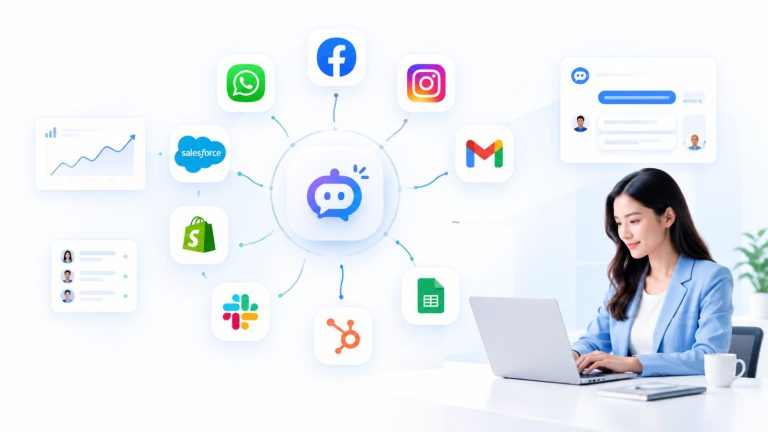
A restaurant’s guests rarely live in one app. In many international markets, WhatsApp is now the default channel guests expect to message a business on, and setting up the WhatsApp Business Platform is a standard first step for any restaurant serious about messaging automation. Instagram DMs dominate for younger diners discovering a restaurant through content. Website chat still matters for guests actively comparing menus and hours, and a properly configured Google Business Profile chat option catches people searching for you on Maps. The strongest setups run one chatbot logic across all of these channels instead of maintaining separate, disconnected bots for each one.
Must-Have Features When Evaluating a Restaurant Chatbot Platform

Not every chatbot builder is designed for hospitality. When comparing options, look for:
- Natural, LLM-based conversation handling rather than rigid decision trees, so guests can ask questions in their own words. Platforms built around AI agents rather than static scripts handle this far more gracefully.
- A visual flow builder that lets your team map reservation flows, FAQ paths, and escalation rules without writing code – something covered well by tools like ChatbotX’s flow builder.
- A shared inbox so your host, manager, and marketing team can see every conversation from every channel in one place, rather than juggling five separate apps – this is exactly what a unified shared inbox is designed for.
- Analytics and reporting to track response time, containment rate, and booking conversion, so you can prove ROI and continually refine the bot’s answers – capabilities detailed in ChatbotX’s analytics dashboard.
- Solid integrations with your existing reservation system, POS, and delivery platforms, so the bot isn’t operating in a silo.
How to Set One Up: A Practical Rollout Plan
- Map your guest journey. List every question guests ask before, during, and after a visit – hours, menu, allergens, parking, reservation changes, catering.
- Build your knowledge base. Feed the chatbot your complete menu with ingredients and allergens, your reservation policies, and your delivery zones.
- Connect your channels. Start with the one or two channels your guests already use most, then expand.
- Define escalation rules. Decide which questions – complaints, large private events, unusual allergy cases – should always route to a human.
- Launch, measure, and refine. Watch containment rate and guest satisfaction for the first few weeks, then adjust the bot’s answers based on what real guests are asking.
Restaurants that follow this order tend to go live in one to two weeks rather than months, because the bottleneck is almost always the knowledge base, not the technology itself.
Where ChatbotX Fits In

This is exactly the kind of workflow ChatbotX, an open-source, agentic omnichannel chatbot platform, is built for. Restaurants can run one AI agent across WhatsApp, Instagram, Messenger, and website chat, manage every guest conversation from a single shared inbox, and automate reservation confirmations, menu answers, and post-visit remarketing without stitching together separate tools. Because the project is open-source, teams that want deeper customization can review or extend the codebase directly on GitHub, and track new capabilities as they ship through the project’s release history.
For a closer look at how the same automation model plays out for other service businesses, see how AI customer service assistants help small businesses stay responsive around the clock, and how a complete customer support automation stack is typically structured.
Measuring ROI: The Metrics That Actually Matter
Don’t judge a restaurant chatbot on conversation volume alone. Track:
- Containment rate – the share of conversations the bot resolves without human help.
- Booking conversion rate – how many chatbot conversations turn into confirmed reservations.
- Average response time, especially outside business hours.
- No-show rate before and after automated reminders.
- Guest satisfaction (CSAT) on bot-handled conversations.
These numbers give you a concrete before-and-after picture, which matters both for justifying the tool internally and for spotting where the bot’s knowledge base needs improvement.
Common Mistakes Restaurants Make
- Launching without a real knowledge base. A chatbot is only as good as the menu, policy, and hours data behind it.
- Covering every channel at once. Start with where your guests actually are, then expand.
- No escalation path. A frustrated guest stuck in a loop with no human option will simply leave.
- Treating it as “set and forget.” The best-performing bots are reviewed monthly against real guest questions and refined continuously.
Frequently Asked Questions
Does an AI chatbot replace restaurant staff?
No. It handles repetitive, high-volume questions – hours, menu details, booking confirmations – so your team can focus on guests physically in the restaurant.
Which channel should a restaurant start with?
Most restaurants see the fastest return from WhatsApp or website chat first, since these tend to carry the highest volume of reservation and menu questions.
How long does setup take?
With a clear knowledge base ready in advance, most restaurants can go live within one to two weeks.
Can the chatbot handle multiple languages?
Yes, modern LLM-based chatbots can detect and respond in a guest’s language automatically, which matters for restaurants with international or tourist traffic.
Ready to Stop Losing Reservations After Hours?
Every unanswered message is a guest choosing somewhere else to eat. ChatbotX gives your restaurant one AI agent that handles reservations, menu questions, and catering leads across WhatsApp, Instagram, and your website – 24 hours a day. Get started free and see your first automated reservation confirmation go out today.