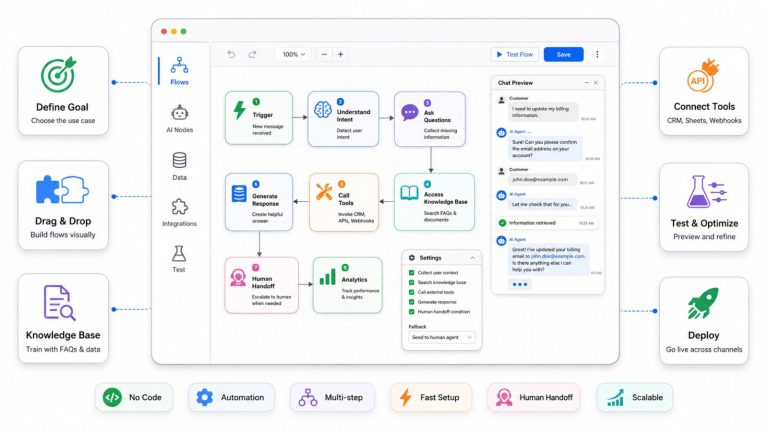

Support queues don’t shrink on their own. Tickets pile up on weekends, questions repeat themselves across five different channels, and every hour an agent spends copy-pasting the same answer is an hour they’re not spending on the one customer who actually needs a human. That pressure is exactly why AI customer service software has gone from a nice-to-have to a line item every support leader is expected to justify in 2026.
The market, though, is noisy. Dozens of vendors claim to “resolve tickets automatically,” and most of them are really just chat widgets with a canned-response generator behind them. This guide cuts through that noise: what AI customer service software actually does, the criteria that separate a real automation platform from a glorified FAQ bot, and where an open-source, omnichannel option like ChatbotX fits for teams that don’t want to be locked into a single vendor’s ecosystem.
Launch agentic chat marketing in minutes with ChatbotX













What AI Customer Service Software Actually Does
At its core, AI customer service software combines natural language processing, machine learning, and increasingly agentic automation to handle the parts of support that don’t need a human touch. That includes answering repetitive questions pulled straight from a knowledge base, routing complex tickets to the right team, flagging frustrated customers through sentiment detection, and summarizing long conversation threads so agents don’t have to re-read an entire chat history before replying.
The technology has matured well past keyword-triggered chatbots. Modern platforms parse intent the way a person would, which means a customer can ask a question in their own words instead of hunting for the exact phrase a script recognizes. The better tools also learn continuously: every resolved ticket and every piece of agent feedback becomes training data that sharpens future responses.
Where 2026 changed the conversation is the shift toward agentic AI – systems that don’t just suggest a reply for a human to approve, but can independently take multi-step actions: process a refund, update a shipping address, or reschedule an appointment, then log an audit trail so the action is explainable after the fact. As Lorikeet’s 2026 ranking of support platforms notes, analysts expect this shift to let AI agents autonomously handle the large majority of routine service issues within a few years, alongside a meaningful cut in day-to-day support costs.
If your business runs entirely on email and web chat, that agentic shift is already worth planning for. If a large share of your conversations already start on WhatsApp or Instagram, the deeper read is our own breakdown of how AI customer service assistants help small businesses cover support around the clock without hiring a night shift.
What to Actually Evaluate Before You Buy

Vendor comparison pages tend to bury the important questions under a wall of checkboxes. When you strip that away, four things determine whether a platform will actually work for your team:
- Real resolution rate, not just deflection. A tool that hands off 80% of “resolved” tickets to a human two messages later isn’t resolving anything – it’s delaying. Ask for resolution numbers broken out by channel, not a single blended figure.
- Omnichannel depth. Customers don’t stay on one channel. A shopper might open a conversation on Instagram, follow up on WhatsApp, and finish over email. If your platform can’t carry context across that journey, every handoff resets the clock and frustrates the customer.
- Human-in-the-loop control. The best platforms make it easy for a human to step in mid-conversation without the customer noticing a seam. Full autonomy sounds appealing until an AI agent confidently gives a wrong answer on a billing dispute.
- Integration and pricing transparency. A tool that connects cleanly to your CRM, help desk, and messaging channels saves months of engineering time. Usage-based pricing that scales unpredictably with ticket volume is worth stress-testing against your actual growth projections before you sign anything.
The Platforms Worth Shortlisting

The enterprise segment is currently dominated by a handful of names: Intercom’s Fin agent, which pairs conversational AI with one of the more mature native help desks in the category (notably, Salesforce agreed in mid-2026 to acquire Fin, so its roadmap may shift under new ownership); Zendesk AI and Ada for large-scale ticket deflection; Gorgias for Shopify-first ecommerce teams; and newer entrants like Lorikeet, Sierra, and Decagon that focus specifically on end-to-end task completion in regulated industries such as fintech and healthtech.
Freshworks’ Freddy AI and Help Scout sit a tier down in complexity, aimed at teams that want AI layered onto an existing ticketing workflow rather than a full agentic rebuild. These can be a reasonable starting point for smaller teams, though they often require stitching together multiple add-ons to cover chat, email, and social in one place.
Independent comparisons of the category tend to agree on one point: there’s no universal “best” pick, since the right platform depends heavily on channel mix and ticket volume, and enterprise teams, SaaS teams, and ecommerce teams routinely gravitate toward different shortlists, as Guideflow’s 2026 breakdown lays out. Front’s research makes a similar point: the platforms worth paying for are the ones that balance automation with human oversight rather than simply chasing response speed.
Where most of these platforms fall short for growing businesses is channel coverage outside the West: WhatsApp, Zalo, and Telegram support tends to be an afterthought bolted onto a primarily email-and-chat product. That’s the gap a purpose-built, open-source, omnichannel platform like ChatbotX is designed to close.
Where ChatbotX Fits

ChatbotX takes a different starting point: rather than adding AI on top of a legacy help desk, it’s built agentic and omnichannel from the ground up, covering WhatsApp, Messenger, Instagram, Telegram, Zalo, TikTok, email, and web chat inside a single inbox.
For support teams evaluating a platform, four capabilities tend to matter most:
- The AI Agents engine handles multi-step conversations autonomously, escalating to a human only when a case genuinely needs one.
- The Shared Inbox keeps every channel in one queue, so an agent isn’t switching between four browser tabs to answer one customer.
- The Flow Builder lets support and marketing teams design automated conversation logic visually, without writing code.
- The Analytics dashboard tracks resolution rate, response time, and channel performance, so you can see whether automation is actually reducing workload rather than just relocating it.
Because the platform is open-source, teams that need deeper customization or self-hosting can work directly with the codebase on GitHub rather than waiting on a vendor’s roadmap. Release notes and version history are published openly on the project’s GitHub releases page, which is worth checking before you commit to any AI vendor at all – an actively maintained changelog is one of the more honest signals of whether a tool will still be supported in two years.
AI Customer Service Software Comparison
| Platform | Best For | Standout Capability | Watch-Out |
|---|---|---|---|
| ChatbotX | Omnichannel teams outside pure email/chat | Native WhatsApp, Zalo, Telegram + open-source flexibility | Newer entrant vs. legacy incumbents |
| Intercom Fin | Chat- and email-heavy SaaS support | Deep native help desk integration | Roadmap uncertainty post-acquisition |
| Zendesk AI / Ada | Large enterprise ticket deflection | Scale and reporting depth | Can require significant setup |
| Gorgias | Shopify-first ecommerce | Ecommerce-specific integrations | Narrower use case outside retail |
| Lorikeet / Decagon | Regulated industries (fintech, healthtech) | End-to-end task resolution with audit trails | Higher implementation complexity |
| Freshworks Freddy AI | Teams already on Freshdesk | Familiar ticketing workflow | Often needs added tools for full coverage |
How to Choose the Right One for Your Team
Start with your channel mix, not the vendor’s feature list. If the bulk of your support conversations already happen over WhatsApp, Zalo, or Instagram, a platform built around email-first ticketing will always feel like a workaround, no matter how strong its AI model is. If you’re in a regulated industry where every automated action needs an audit trail, prioritize platforms built for explainability over raw speed.
Run a pilot before committing to an annual contract. Feed the platform your actual help center content, route a real slice of your ticket volume through it for two to four weeks, and measure resolution rate by channel – not the vendor’s marketed average. The gap between a demo and production usage is where most disappointing AI rollouts happen.
Ready to Automate Support Without Losing the Human Touch?

AI customer service software isn’t about replacing your support team – it’s about giving them room to focus on the conversations that actually need a person. If your business is juggling WhatsApp, Instagram, Telegram, and web chat without a single view of the customer, ChatbotX is built to bring that under one automated, agentic roof. Read more on the ChatbotX blog, or get started free today and see how much of your queue an AI agent can actually resolve.