Every customer conversation your business has today is a data point, a cost center, and a growth opportunity all at once. The tool you choose to manage those conversations determines how much control you actually keep over that value. That is exactly why a growing number of companies are walking away from closed, subscription-locked chatbot software and adopting an open source conversational AI platform for business instead.
This shift is not a niche developer trend anymore. It is a strategic response to rising SaaS costs, tightening data-privacy rules, and a simple frustration: proprietary vendors decide what features you get, when you get them, and how much you pay for the privilege. An open source approach flips that arrangement entirely, handing ownership of the technology – and the customer data flowing through it – back to the business running it.
Launch agentic chat marketing in minutes with ChatbotX













Why “Open Source” Matters More Than Ever in 2026
Open source is no longer just a developer preference; it has become a boardroom-level infrastructure decision. Recent industry analysis shows organizations increasingly cite cost reduction as their top driver for adopting open source technology, alongside a clear desire to escape vendor lock-in and gain more control over how their systems evolve, according to recent industry data on organizational adoption motivations. Reducing dependency on a single proprietary vendor while retaining strategic control of the technology stack has become a defining theme for IT leaders evaluating new software in 2026, as outlined in the OpenLogic State of Open Source Report.
For conversational AI specifically, the timing could not be more relevant. The global conversational AI market is projected to keep expanding rapidly through the rest of the decade, with Fortune Business Insights forecasting continued double-digit annual growth as more companies move automated messaging from a “nice-to-have” pilot project into core customer-facing infrastructure. As that spending accelerates, the gap between businesses locked into rigid, per-seat SaaS chatbot pricing and businesses running flexible, self-hosted alternatives will only widen.
What an Open Source Conversational AI Platform Actually Gives You

Choosing an open source foundation for your customer messaging stack is not just about avoiding license fees – although that matters. It changes the relationship between your business and the software itself:
- Full source code visibility. You can see exactly how conversations are processed, stored, and routed, instead of trusting a vendor’s marketing page.
- No forced upgrade cycles. Proprietary tools push feature paywalls and pricing tier changes on their own schedule. Open source software evolves on the community’s and your organization’s terms.
- Self-hosting freedom. Running the platform on your own infrastructure keeps sensitive customer data inside your own environment, which matters enormously for regulated industries like finance, healthcare, and real estate.
- Deep customization. Developers can extend, modify, or integrate the platform however the business needs, rather than waiting on a vendor’s product roadmap.
- Lower total cost of ownership. Without recurring per-seat or per-conversation fees, the economics scale far better as message volume grows.
These advantages compound. A broader look at open source adoption statistics shows businesses increasingly weighing not just upfront savings but long-term maintenance costs and community-driven support as reasons to standardize on open technology rather than closed alternatives.
The Core Features to Look For

Not every open source project on GitHub is production-ready for customer-facing business use. When evaluating a conversational AI platform, look for these capabilities specifically:
1. Omnichannel Messaging in One Dashboard
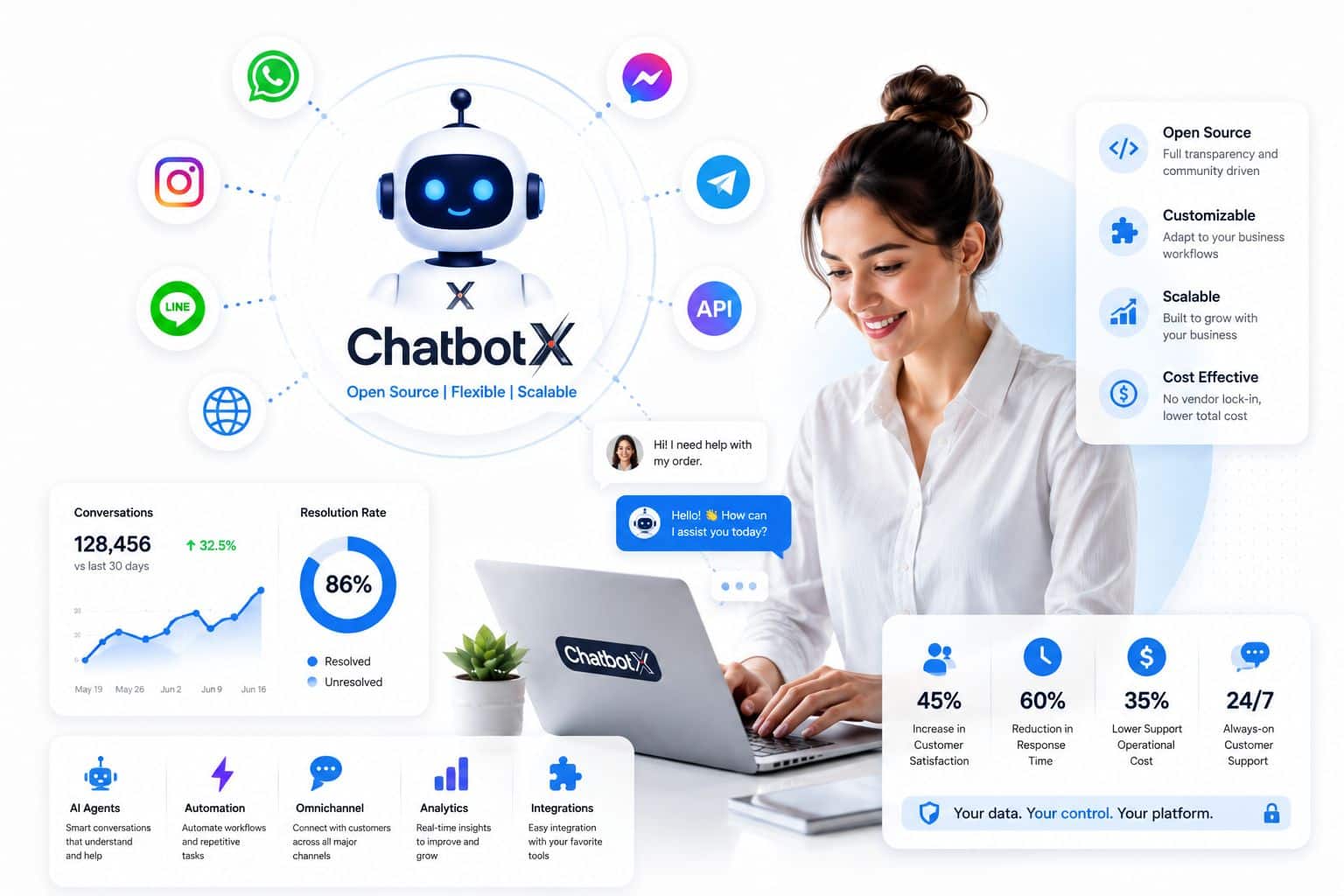
Customers no longer stick to a single channel. They message on Facebook, WhatsApp, Instagram, Telegram, and your website interchangeably, often within the same buying journey. A platform built for business needs a unified inbox that consolidates every channel into one workspace, so no conversation gets lost between tabs or tools.
2. Visual, No-Code Automation Building
Technical teams shouldn’t be the only ones capable of shipping a new automated flow. A drag-and-drop flow builder lets marketing and support teams design welcome sequences, FAQ automations, and lead-qualification logic without writing code, while still giving developers the flexibility to extend flows programmatically when needed.
3. Autonomous AI Agents
Static, rule-based chatbots are giving way to AI agents capable of understanding intent, answering nuanced questions, and escalating to a human only when truly necessary. This is where conversational AI earns its name – it converses, rather than just following a rigid decision tree.
4. Actionable Analytics
Automation without measurement is a guess. A serious platform needs built-in reporting on response times, resolution rates, and conversion funnels so teams can continuously improve conversation quality rather than deploying a bot and forgetting about it.
5. Contact Segmentation and Remarketing
The best conversational AI platforms don’t just answer questions – they help re-engage warm leads with targeted follow-up campaigns based on past behavior and conversation history.
Introducing ChatbotX: An Open Source, Agentic Omnichannel Platform

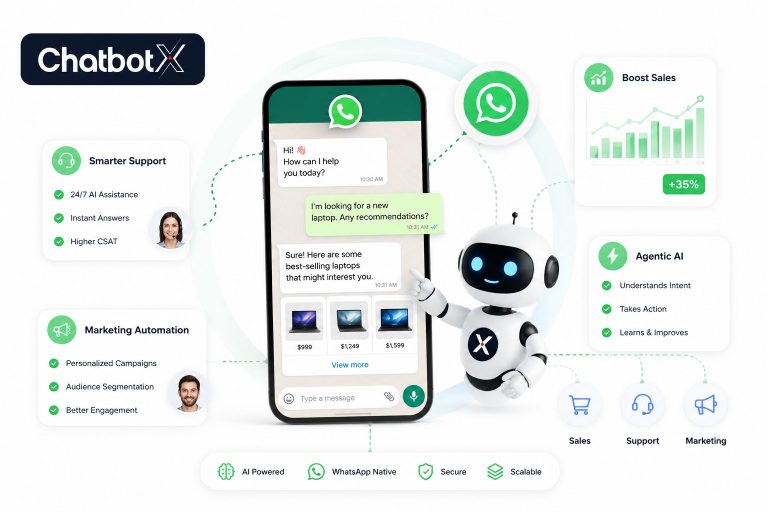
This is precisely the gap ChatbotX was built to fill. ChatbotX is a fully open-source, agentic omnichannel conversational AI platform designed for businesses that want the flexibility of self-hosted software combined with the polish of a modern SaaS product.
Instead of forcing teams to choose between “affordable but limited” and “powerful but locked-in,” ChatbotX brings together:
- AI Agents that operate autonomously across every connected channel, qualifying leads and resolving support questions around the clock.
- Flow Builder, a visual canvas for designing conversation logic without code, so non-technical team members can ship automations independently.
- Shared Inbox, unifying Messenger, WhatsApp, Instagram, Telegram, Zalo, and web chat into a single team workspace.
- Analytics dashboards that turn raw conversation data into concrete decisions about where automation is – and isn’t – working.
Because the entire codebase is publicly available on GitHub, businesses and agencies can self-host ChatbotX for free, inspect exactly how it handles data, and extend it to fit workflows that off-the-shelf SaaS tools simply cannot accommodate. The ChatbotX repository is actively maintained, with new capabilities shipped regularly and documented in the project’s release history for teams that want full transparency into what changed and when.
Open Source vs. Closed SaaS: What Businesses Are Actually Trading Off
It’s worth being honest about the trade-offs rather than pretending open source is a silver bullet.
Closed SaaS platforms typically win on out-of-the-box polish and zero infrastructure management – you sign up and start messaging within minutes. But that convenience comes bundled with rising per-seat pricing, opaque data-handling practices, and a permanent ceiling on customization.
Open source platforms ask a little more upfront, whether that’s self-hosting or working with a partner who does it for you. In exchange, businesses get a system they actually own: no surprise price hikes, no feature paywalls, and no vendor deciding unilaterally that a tool they depend on is being deprecated. For a deeper comparison of platform trade-offs in a related context, the ChatbotX team’s breakdown of white-label chatbot alternatives walks through similar lock-in versus flexibility considerations that apply broadly across the messaging automation category.
Getting Started the Right Way

Migrating conversational infrastructure is not something to rush. A practical rollout usually looks like this:
- Audit existing conversation volume and channels. Know where your customers are actually messaging before choosing a platform.
- Map your highest-friction workflows. Cart abandonment, lead qualification, and repetitive FAQs are usually the fastest wins for automation.
- Pilot on one channel first. Prove the automation logic works before expanding it across every connected platform.
- Connect your CRM. Conversational data becomes far more valuable once it’s tied to lifecycle stage and customer history, a workflow covered in detail in this guide to Messenger CRM integration.
- Review analytics monthly. Automation should be treated as a living system, not a one-time setup task.
Final Thoughts
The businesses winning with conversational AI in 2026 aren’t necessarily the ones spending the most on chatbot software – they’re the ones with full control over the technology stack their customers interact with every day. An open source conversational AI platform for business delivers exactly that: transparency, cost efficiency, and the freedom to build automation around your workflow instead of someone else’s pricing tiers.
If your team is ready to move away from restrictive SaaS chatbot pricing and toward a platform you fully own, explore what ChatbotX can do for your customer conversations. Self-host it, customize it, or simply try the hosted version – either way, your data and your automation logic stay firmly in your hands. Get started with ChatbotX today and see how much further an open, agentic omnichannel platform can take your customer engagement strategy.