Ad spend keeps climbing while click through rates keep falling and almost every marketing team feels the squeeze. Paying more for less traffic has become the norm rather than the exception, and the old playbook of pushing cold visitors toward a landing page is losing steam fast. Meanwhile, generative AI tools and newer social feeds are opening fresh doors for discovery, but the real question is whether brands can actually hold on to the attention they capture, or whether it slips away the moment the ad budget runs out.
The answer showing up across 2026 industry data is consistent: growth no longer comes from chasing more clicks. It comes from retaining the leads you already earned inside owned, private conversations and letting AI run those conversations at scale.
Key Takeaways
- The funnel has flipped. With organic and paid click-through rates falling, brands are moving budget from top-of-funnel acquisition into private domain retention and messaging.
- Agentic AI removes the bottleneck. Instead of manually building chat logic, marketers can now describe a campaign in plain language and let an AI agent assemble the workflow.
- Owned conversations convert far better than static pages. Real-time, personalized messaging on channels like WhatsApp and Messenger regularly outperforms website-only funnels once behavioral data is used to trigger the right message at the right moment.
Launch agentic chat marketing in minutes with ChatbotX











The Numbers Behind the Shift

Global reporting on internet behavior now puts the number of people using generative AI tools for search or problem-solving well past the billion-user mark, with a handful of large language models absorbing most of that usage. At the same time, social platforms hold roughly 68–70% of the world’s population as active users, and that base is still expanding by hundreds of millions of identities a year.
What’s changing faster than the growth numbers is where people go to decide what to buy. Reliance on traditional search engines has been quietly sliding, especially among users under 35, who increasingly treat social apps and AI assistants as their first stop for research and recommendations rather than a search bar. Even though a majority of shoppers still check a brand out on social media before purchasing, algorithm throttling has pushed outbound click-through rates on organic posts to some of the lowest levels on record – a trend documented in DataReportal’s Digital 2026 Global Overview Report.
The practical takeaway is blunt: if a brand can’t capture intent the instant someone lands on a profile, a bio link, or a chat window, that visitor is usually gone for good. Sales increasingly happen inside the conversation, not after a click away from it.
From Traffic to Retention: Why Conversational Commerce Wins
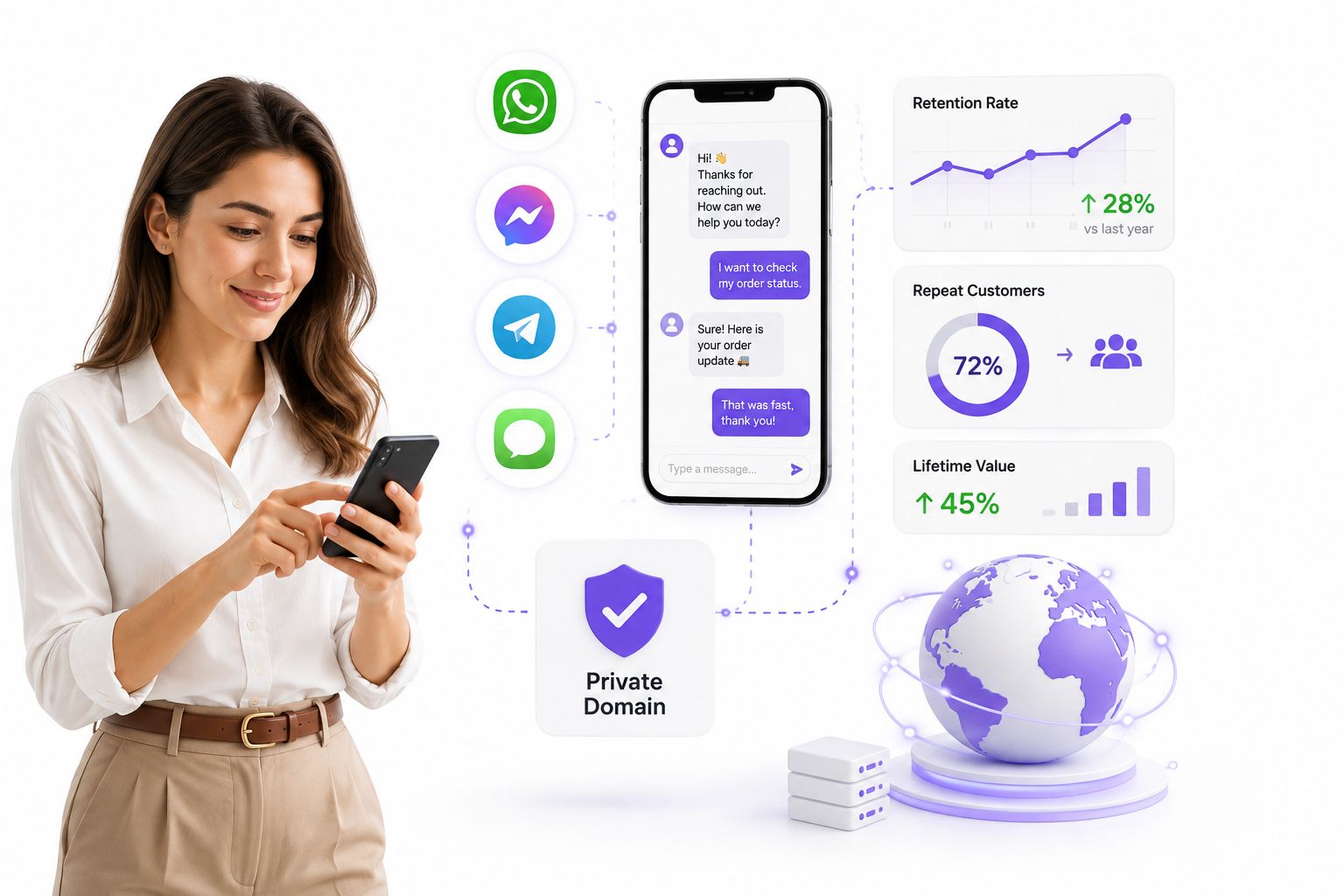
Private domain retention is built on conversational commerce – treating every WhatsApp thread, Messenger DM, or webchat window as a place where a sale can actually close, not just a support inbox.
1. The First Few Seconds Decide Everything
A static product page gives visitors nothing to react to; they scroll, hesitate, and bounce. A conversational flow can greet that same visitor within seconds of arrival, referencing what they just viewed or clicked. Brands running this kind of real-time, behavior-triggered messaging commonly see conversion lifts of 3x to 5x compared with a page that just sits there waiting to be read.
2. One Customer, One Profile, Every Channel
The second advantage is data unification. A shopper might DM a question on Instagram, then follow up about their order on WhatsApp a day later. Without a shared identity layer, that’s two disconnected strangers to your systems. Brands that stitch these touchpoints into a single customer profile – tags, purchase history, channel preference, all in one record – build a first-party dataset that isn’t at the mercy of the next algorithm update. A platform built to unify every messaging channel under one identity layer makes this consolidation the default rather than a custom engineering project.
Balancing Reach and Cost: A Two-Channel Messaging Playbook
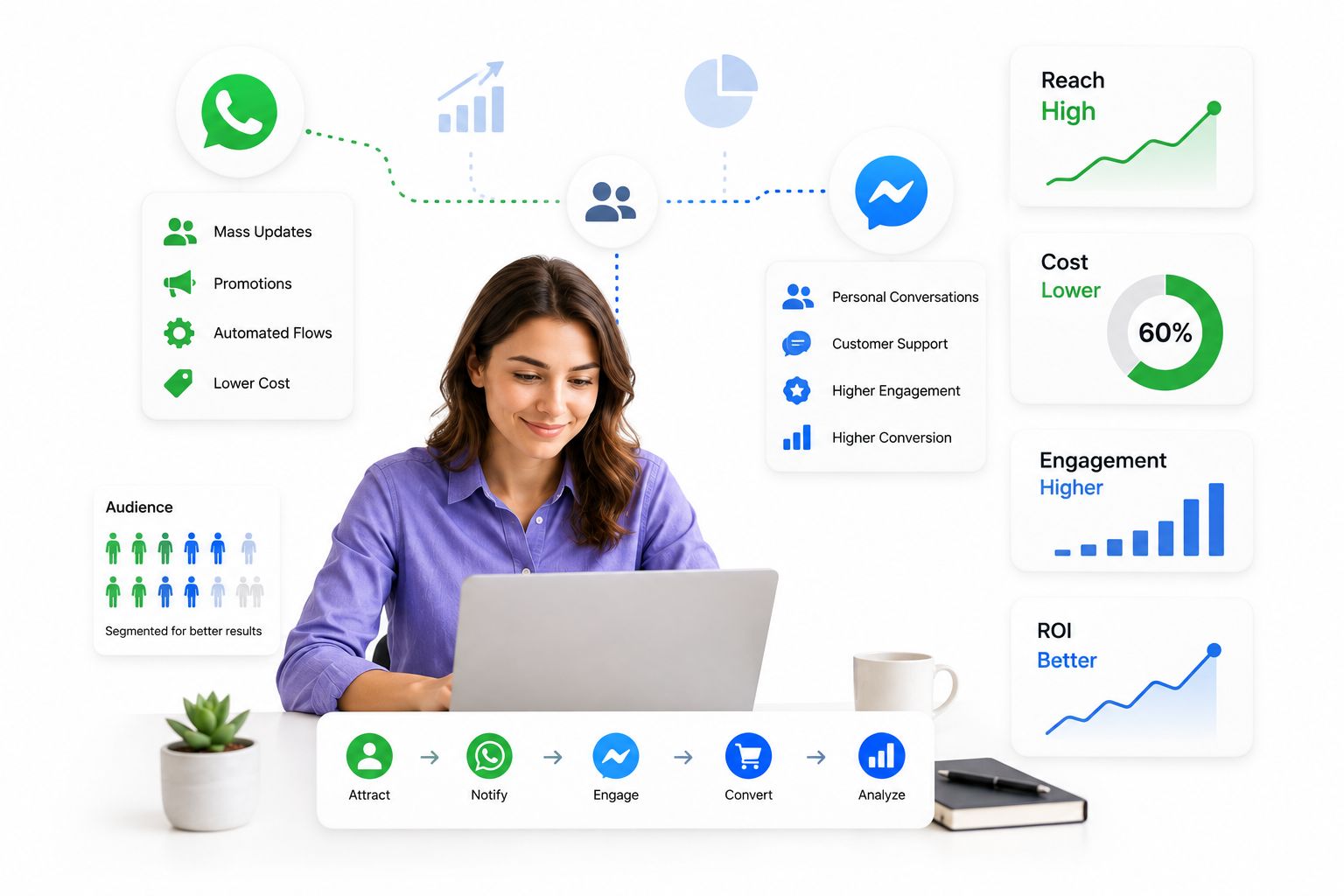
The recurring complaint from marketing teams sounds like this: “We can’t segment WhatsApp broadcasts without knowing who’s actually close to buying, so every blast either annoys loyal customers or burns budget on people who were never going to convert.”
The fix in 2026 is running two channels with two very different jobs.
WhatsApp: Reserved for High-Intent, High-Value Contacts
In markets where WhatsApp penetration tops 90%, it’s less a marketing channel and more a default line of communication. That intimacy is exactly why blasting it indiscriminately backfires – costs rise and opt-outs follow. The better approach is progressive, behavior-based broadcasting: using cart abandonment, browsing history, order status, and loyalty tier to decide who gets a message and when, so spend concentrates on the contacts closest to converting.
Facebook Marketing Messages: Built for Reach
Meta’s marketing-message capability sidesteps the traditional 24-hour support window entirely. Once someone opts in – by commenting on a post, tapping a chat prompt, or matching via an uploaded CRM list – brands can send promotional messages within a rolling 12-hour window at a lower cost per message than most other channels. That makes it the natural home for product launches, seasonal pushes, and reactivating dormant contacts, while WhatsApp stays reserved for the relationships worth protecting.
| Dimension | WhatsApp Progressive Broadcasts | Facebook Marketing Messages |
|---|---|---|
| Best for | Loyal, high-value, high-intent contacts | Broad reach, low-cost re-engagement |
| Audience | Opted-in users with behavioral tags | Opted-in or CRM-matched contacts |
| Budget logic | Tight ROAS control, bottom-of-funnel | Volume-driven, upper/mid-funnel |
Used together, this pairing keeps reach wide while keeping the cost of staying in touch under control.
Where Agentic AI Fits In
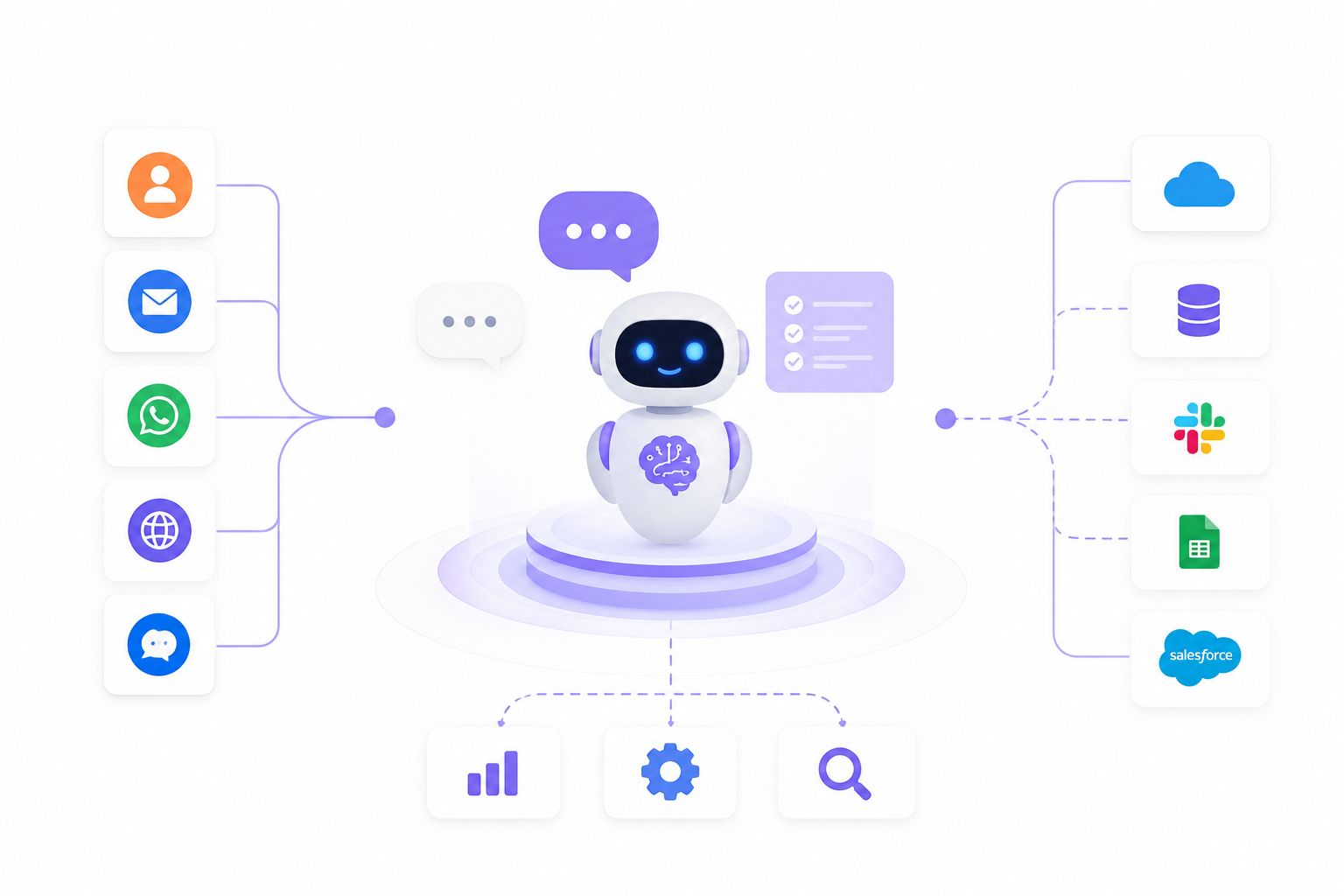
Running two channels well used to mean days of copywriting, manual flow-building, and back-and-forth with a design team – by the time everything launched, the moment had often passed. Agentic AI collapses that timeline. Instead of clicking through dozens of rule-tree menus, a marketer can describe the outcome in a sentence: “Set up a holiday promotion for WhatsApp contacts with abandoned carts. If they don’t purchase within 24 hours, follow up with a discount code on Facebook Marketing Messages.” The system interprets the goal, drafts channel-appropriate copy, and wires the logic together in seconds, leaving a human to review and approve rather than build from scratch.
This is also where an open-source, agentic omnichannel platform earns its place in the stack. ChatbotX was built specifically so teams aren’t locked into a single vendor’s roadmap or pricing tier: it connects WhatsApp, Messenger, Instagram, Zalo, and webchat under one identity layer, lets an AI agent assemble multi-step flows from a plain-language prompt inside its flow builder, and centralizes every conversation in a single shared inbox so support and sales are never working from different data. Because the platform is fully open source, teams that want complete control over hosting, data residency, and customization can self-host it rather than depend on a closed SaaS tier – and can track exactly what ships in each release.
For teams comparing providers before committing to one, it’s worth reading a broader breakdown of WhatsApp Business Solution Providers in 2026, and for Meta’s Messenger side specifically, this guide to automated Facebook Messenger marketing covers segmentation and the 24-hour messaging window in more depth. For the official specifications behind the WhatsApp side of this playbook, Meta’s own WhatsApp Business Platform documentation is the authoritative source, and for broader context on where audiences are spending their time, Sprout Social’s 2026 social media statistics are a useful reference point.
The Bottom Line
Zero-click search and algorithm throttling aren’t going away – but they don’t have to shrink your revenue either. The brands pulling ahead in 2026 aren’t the ones spending more to chase the same shrinking pool of clicks; they’re the ones who’ve turned their private domain – WhatsApp threads, Messenger DMs, webchat windows – into the primary place where relationships are built and deals are closed. Pair a disciplined two-channel broadcast strategy with an AI agent that can build and maintain the workflows behind it, and traffic anxiety stops being a permanent state of the marketing calendar.
If your team is still stitching together spreadsheets, a rules engine, and three separate chat tools, it’s worth seeing what a single, AI-native, self-hostable platform looks like in practice. Book a free walkthrough of ChatbotX and see how quickly your next campaign could go from a one-line prompt to a live, multi-channel flow.
FAQ
What is private domain marketing?
It’s the practice of building and owning direct communication channels with customers – WhatsApp, Messenger, webchat, email – rather than depending entirely on public, algorithm-controlled traffic like organic search or social feeds.
How is agentic AI different from a traditional chatbot?
A traditional chatbot follows rules a human configured in advance. An agentic AI system interprets a goal described in natural language and independently plans, writes, and deploys the multi-step workflow needed to achieve it, with a human reviewing the result rather than building it step by step.
Why combine WhatsApp and Facebook Marketing Messages instead of using just one?
They serve different jobs. WhatsApp works best for high-intent, already-engaged contacts where message quality matters more than volume. Facebook Marketing Messages is built for lower-cost, broader reach – ideal for launches, re-engagement, and audiences that haven’t reached WhatsApp-level intent yet. Running both lets a brand control cost without sacrificing reach.