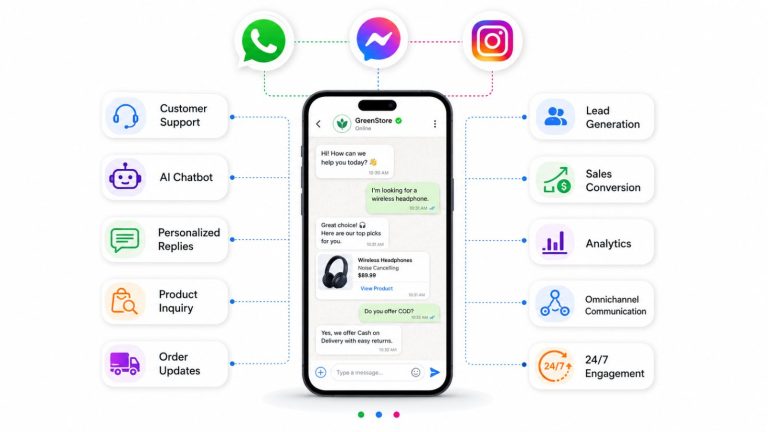

A shopper messages your Instagram page at 11 p.m. asking whether a size is back in stock. A minute later, an autonomous system checks inventory, answers with the exact quantity left, applies a loyalty discount the shopper qualifies for, and sends a checkout link – no human ever opens the conversation. That single exchange captures the entire shift behind agentic chat marketing: messaging is no longer a support queue with scripted replies, it is a growth channel that plans, decides, and acts on its own.
This guide breaks down what agentic chat marketing actually means, why 2026 is the year it stopped being optional, and how to build a system that runs itself across every channel your customers already use.
Launch agentic chat marketing in minutes with ChatbotX













What Is Agentic Chat Marketing?
Agentic chat marketing is the practice of running marketing, sales, and support conversations through autonomous AI agents rather than static chatbot scripts or manual replies. Instead of a rules-based flow that can only follow pre-mapped branches, an agent perceives context (who the customer is, what they asked, what happened in prior sessions), reasons about the best next step, and executes it directly – sending a message, updating a CRM record, applying a discount, or escalating to a person.
The distinction matters because most “chatbots” marketed today are still reactive: they wait for a trigger and return a pre-written answer. A true agentic system behaves more like a digital teammate. It can hold a goal (“recover this abandoned cart” or “qualify this lead before 9 a.m.”) and work toward it across multiple messages and even multiple channels, without a marketer manually building every branch of the conversation in advance.
Why 2026 Is the Turning Point

Three forces converged this year to push agentic chat marketing from experimental to essential.
The economics finally work. Large language models became cheap and fast enough to run real-time reasoning on every inbound message, not just canned responses. Analysts now describe this as the end of channel-based marketing as businesses knew it, with agents spanning marketing, sales, and support to deliver one-to-one personalization instead of segment-level campaigns, according to Gartner’s January 2026 forecast on agentic AI.
The revenue case is proven, not theoretical. Research from McKinsey on agentic marketing workflows points to campaign cycles that move many times faster than manual production, alongside meaningful revenue lift when personalization is handled end-to-end by agents rather than in disconnected pilots.
Customers can’t tell the difference – and don’t mind. Satisfaction scores for pure AI handling are now within a fraction of a point of human agents in comparable scenarios, and resolution costs are a small fraction of what a human-staffed conversation costs, a gap that is reshaping how tech marketers are rethinking customer journeys in 2026. Once the quality gap closes and the cost gap stays wide, the business case builds itself.
Agentic Chat Marketing vs. Traditional Chatbot Automation
| Dimension | Traditional Chatbot | Agentic Chat Marketing |
|---|---|---|
| Decision-making | Follows pre-built rules and menus | Reasons about context and chooses actions |
| Scope | One channel, one flow at a time | Coordinates across channels and tools |
| Personalization | Static, segment-based | Dynamic, one-to-one, updated in real time |
| Maintenance | Marketers rebuild flows for every scenario | Agent adapts without a new flow for each edge case |
| Outcome | Answers a question | Completes a task (booking, upsell, resolution) |
The shift isn’t about replacing chatbots entirely – flow-based automation still has a place for predictable, high-volume paths like FAQs or order tracking. Agentic chat marketing layers autonomous reasoning on top, so the system can handle the long tail of conversations a rulebook was never going to anticipate.
The Core Building Blocks of an Agentic Chat Marketing Stack
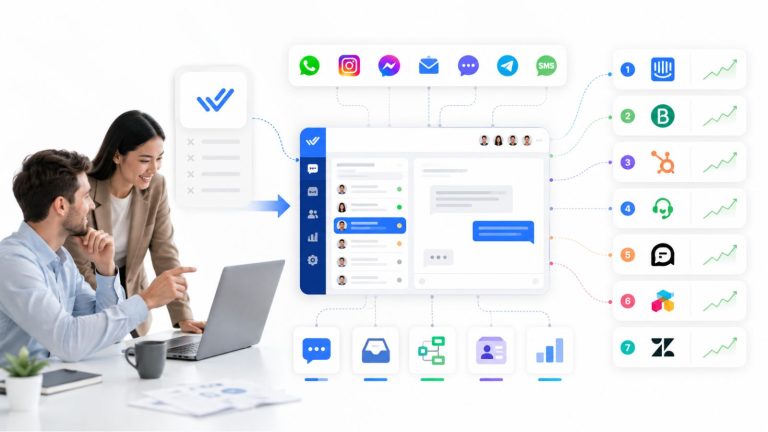
1. Omnichannel presence. An agent is only as useful as the channels it can reach. Customers move between WhatsApp, Messenger, Instagram, Zalo, and web chat mid-conversation, and the system needs to carry context with them rather than starting over on each platform.
2. Autonomous AI agents. This is the reasoning layer – the component that reads intent, checks available data, and decides what to do next. A well-configured AI Agents feature can detect intent, qualify a lead, or resolve a support ticket without a human writing every possible response in advance.
3. A visual orchestration layer. Even agentic systems benefit from guardrails. A flow builder lets marketing teams define the boundaries an agent operates within – what it’s allowed to offer, when it must hand off to a person, and which data sources it can query – without writing code.
4. A unified inbox for human oversight. Full autonomy doesn’t mean zero visibility. A shared inbox keeps every AI-handled and human-handled conversation in one place, so a manager can review escalations, spot patterns, and step in when a conversation needs a human touch.
5. Developer-level extensibility. The most advanced agentic setups connect the chat layer to external systems – CRMs, order databases, pricing engines – through APIs, CLI, and MCP integrations, which is what allows an agent to actually check stock or issue a refund instead of just describing what it would do.
Where Agentic Chat Marketing Is Already Driving Results

- Abandoned cart recovery. Instead of a single generic reminder, an agent can check what was in the cart, apply a relevant offer, and answer follow-up questions about shipping or sizing in the same thread – closer to the lead-response and CRM-sync patterns covered in this guide to Facebook Lead Ads and CRM integration.
- 24/7 lead qualification. An agent can greet a new contact, ask qualifying questions, and create a CRM record before a sales rep ever sees the conversation, a workflow explored in more depth in this Facebook Messenger CRM integration guide.
- Cross-channel consistency. A customer who starts on Instagram and finishes on WhatsApp shouldn’t have to repeat themselves – a requirement covered in this comparison of messaging apps for business.
How to Start Building an Agentic Chat Marketing Program
- Pick one goal, not the whole funnel. Lead qualification or cart recovery are strong starting points because success is easy to measure.
- Give the agent real data access. An agent that can’t see inventory, pricing, or CRM history can only ever describe an action, not complete one.
- Set clear boundaries. Define what the agent can decide on its own (answering a shipping question) versus what needs a human (a refund above a certain amount).
- Keep a human in the loop for escalation. The goal is autonomy with oversight, not a black box.
- Measure outcomes, not just replies. Track completed tasks – bookings, resolved tickets, recovered carts – rather than message volume.
Bringing It Together with ChatbotX

Building this stack from scratch usually means stitching together a messaging API, a separate AI layer, and a CRM integration by hand. ChatbotX was built to remove that friction: it’s an open-source, agentic omnichannel platform that connects WhatsApp, Messenger, Instagram, Telegram, Zalo, Email, and Webchat into one workspace, with autonomous AI agents, a visual flow builder, a shared inbox, and full API/CLI/MCP access already built in. Because the core platform on GitHub is open source, teams can self-host it, inspect exactly how the agent layer works, or extend it with their own logic instead of trusting a closed black box – and every release is published in the open for teams that want to track what’s shipping before they upgrade.
FAQ
What is agentic chat marketing?
Agentic chat marketing is the use of autonomous AI agents – rather than static chatbot scripts – to run marketing, sales, and support conversations across messaging channels. The agent perceives context, decides on the best action, and executes it directly, from answering a question to completing a task like booking or checkout.
How is agentic chat marketing different from a regular chatbot?
A regular chatbot follows a fixed set of rules and can only respond within flows a marketer already built. An agentic system reasons about each conversation individually and can take actions – checking data, applying an offer, updating a CRM – that weren’t explicitly scripted in advance.
Which channels support agentic chat marketing?
Most commonly WhatsApp, Facebook Messenger, Instagram, Telegram, Zalo, email, and website live chat, provided the underlying platform can carry conversation context and connect agents to real business data across each channel.
Do I need developers to launch an agentic chat marketing program?
Not to get started. A visual flow builder can define the guardrails an agent works within without any code. Developer involvement typically comes later, when connecting agents to deeper systems like inventory or billing through APIs.
Is agentic chat marketing only for large enterprises?
No. Because open-source, self-hosted platforms remove per-seat licensing costs, small and mid-sized teams can run the same autonomous agent stack that larger brands use, starting with a single use case like lead qualification.
Ready to move your team from scripted chatbots to autonomous conversations that actually close the loop? Get started with ChatbotX for free and turn your first channel into an agentic chat marketing channel this week.