
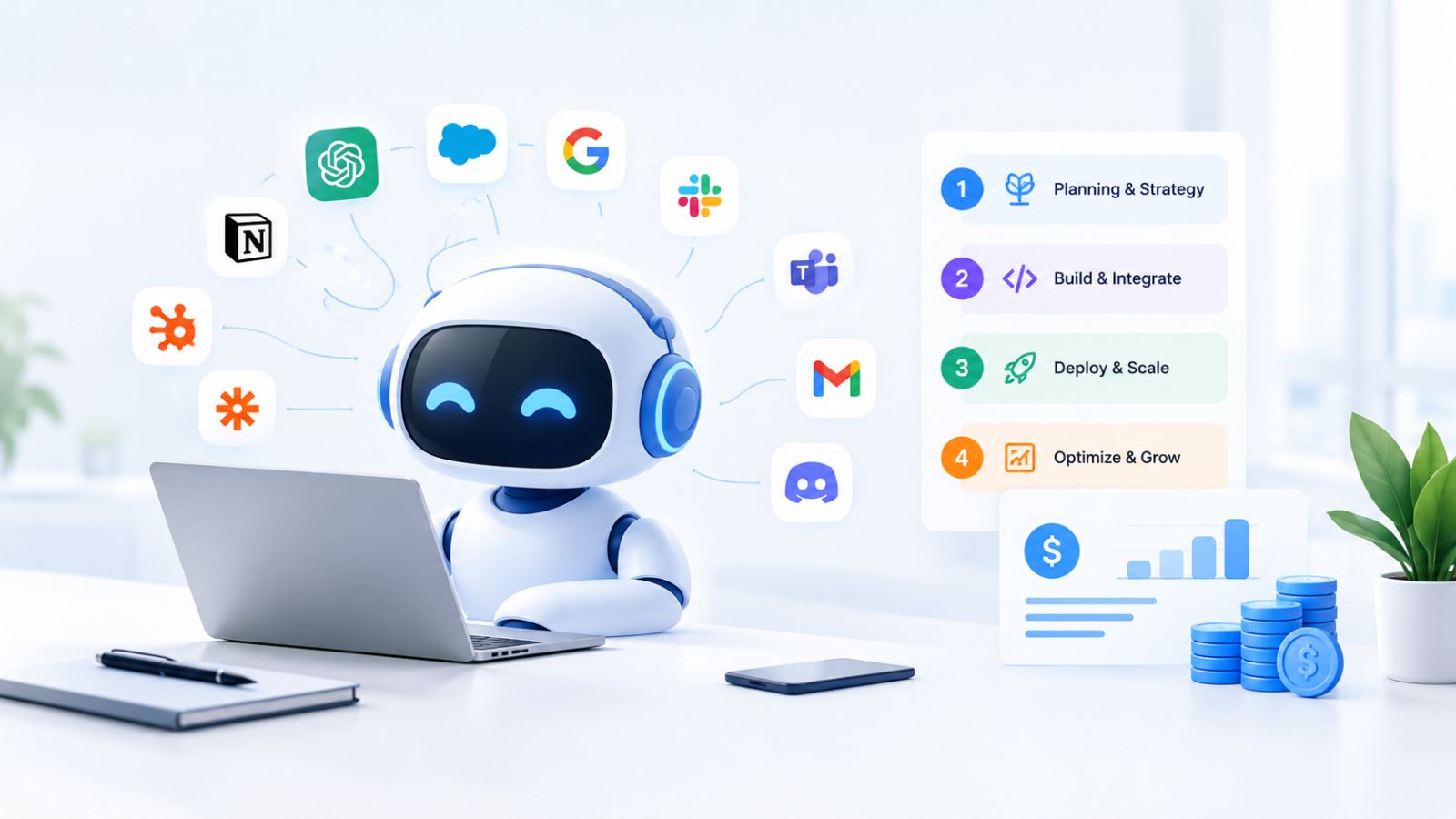
Not long ago, an agency’s toolbox was mostly about content: a writing assistant, a design app, a social scheduler and a CRM. Today the agencies adding revenue fastest sell something different. They deploy working AI agents that greet customers on WhatsApp, qualify leads, book appointments and collect payments, then charge a monthly fee to keep those agents healthy.
That business model calls for a purpose-built AI agent agency tech stack: a platform that hosts many clients at once, language models to power each agent, the channels customers already use, connections into the client’s business systems, and a reporting habit that proves the value every month. This guide covers all eight layers of an AI automation agency tech stack, explains what to look for in each one, and shows what a realistic setup costs at three agency stages.
Key takeaways
– A good agency stack is short: one multi-client agent platform, two or three model providers, the client’s own channels and systems, workflows in the same platform, and a lean back office.
– Choose a platform whose price follows usage and workspaces, not every successful AI resolution, or your margin shrinks as results improve.
– Put model token costs and messaging fees on the client’s own accounts wherever you can.
– Testing, logs and monthly reporting are the layers that decide whether retainers renew.
– A white-label plan covering 50 client workspaces can bring platform cost down to roughly $6 per client per month.
Launch agentic chat marketing in minutes with ChatbotX






What an AI automation agency tech stack must do
Every tool you pay for should earn its place by doing one of five jobs:
- Build agents fast, ideally without code, so a new client can go live within days.
- Deploy them on the channels the client’s customers already open every day.
- Connect them to calendars, stores, CRMs and payment tools, so the agent can take action instead of only replying.
- Prove what the agents did, so the client sees the return and keeps paying.
- Operate your own agency: sell, deliver and bill without drowning in admin.
The timing is on your side. Gartner forecast that 40% of enterprise applications will include task-specific AI agents by 2026, compared with under 5% a year earlier. Customers will soon expect an agent wherever they shop, book or ask for help. The agencies that win will be the ones whose stack delivers agents cheaply and keeps them running reliably.
The AI agent stack at a glance
| Layer | Its job | Typical options | How it is billed |
|---|---|---|---|
| 1. Agent platform | Build agents, run channels, separate client workspaces | ChatbotX, Voiceflow, Botpress | Monthly plan |
| 2. Models | The reasoning engine behind each agent | OpenAI, Anthropic Claude, Google Gemini, DeepSeek | Per token |
| 3. Voice | Phone and voice conversations | Twilio, Deepgram, ElevenLabs | Per minute or per character |
| 4. Channels | Where customers talk to the agent | WhatsApp, Instagram, Messenger, Telegram, Zalo, web chat | Per message on some channels |
| 5. Knowledge and data | What the agent knows and can reach | Knowledge base, Google Sheets, CRM, Stripe, Shopify | Mostly the client’s own tools |
| 6. Workflows and MCP | Logic that links agents to other systems | Flow builder, webhooks, n8n, Make, MCP | Usually bundled with the platform |
| 7. Testing and reporting | Proof that the agents work | Test runs, error logs, analytics | Usually bundled with the platform |
| 8. Agency operations | Running your own business | CRM, project manager, proposals, billing | Per seat or per transaction |
Layer 1: The agent platform
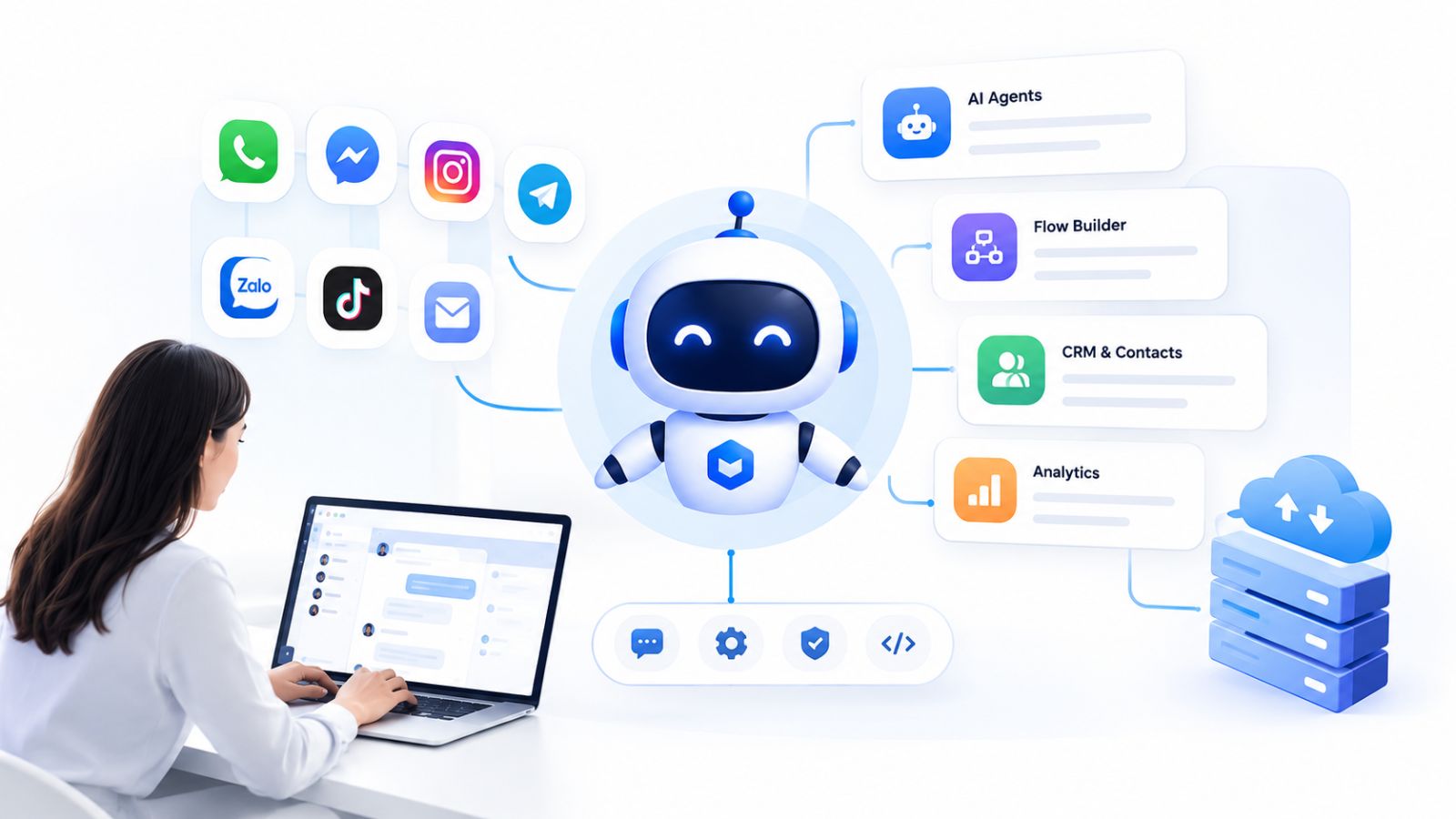
This is the most consequential choice in the stack, because every other layer plugs into it. A tool designed for one company’s support desk will fight you at every step once you manage ten or fifty clients.
What to look for in an agent platform
- A separate workspace per client. Bots, inbox, contacts and analytics stay isolated, and you move between clients from a single login.
- Pricing that does not punish success. Fees per AI resolution or per seat grow with every good conversation, which erodes the margin on a fixed retainer.
- Broad channel coverage. WhatsApp, Instagram, Messenger, Telegram, web chat, email and any regional channel your market relies on.
- Real tool calling. The agent should book, look up orders, update records and send payment links, not just answer questions.
- Freedom to choose models, including a client’s own API keys.
- Human handoff that carries the full conversation context to a teammate.
- Visibility into failures, through logs and test tools you can check before the client notices a problem.
- White-labelling once your client count justifies selling under your own brand.
- An exit route. Open-source code or exportable flows mean a platform decision never traps you.
Where ChatbotX fits
We build ChatbotX, so read this section with that in mind. It is an open-source, agentic chat marketing platform that you can run on ChatbotX Cloud or self-host from the ChatbotX GitHub repository. As of October 2026, it includes:
- Eight channels in one workspace: WhatsApp, Messenger, Instagram, Telegram, Zalo, TikTok, email and web chat.
- AI agents that work with OpenAI, Claude, Gemini, DeepSeek, OpenRouter, NVIDIA NIM or local models, using your own keys, so token costs stay with the model provider you choose.
- Marketing tools such as broadcasts, drip sequences, A/B testing, comment-to-DM automation and contact segmentation with tags and custom fields.
- Agency-ready plans, including a Whitelabel plan built for reselling to clients.
| Plan | Price | Built for | Highlights |
|---|---|---|---|
| Community | $0, self-hosted | Hobbyists and pilots | 1 workspace, unlimited bot messages, ChatbotX branding |
| Lite | $29 per month | Creators and small teams | 1 workspace, 10,000 bot messages, 5 channels, 2 team members |
| Pro | $49 per month | Freelancers and solo marketers | 1 workspace, 100,000 bot messages, 10 channels, 5 team members |
| Whitelabel | $299 per month | Growing agencies | 50 workspaces, 5,000,000 bot messages, unlimited channels and team members, full white-label and SaaS |
| Enterprise | $499 per month | Self-hosted at scale | Unlimited workspaces and bot messages, role-based access, audit logs |
Every plan includes unlimited contacts, and the cloud plans (Lite, Pro and Whitelabel) start with a 7-day free trial. A “bot message” is counted whenever the platform sends a message, shows a typing indicator, runs a delay step or calls an external API, so estimate volume with those actions in mind. Always confirm current prices on the ChatbotX pricing page before you quote a client.
Other platforms agencies evaluate include Voiceflow, Botpress and Stammer.ai. If you are weighing a switch from a closed tool, our breakdown of the best Respond.io alternatives for omnichannel messaging shows how cost curves and self-hosting options compare.
Layer 2: Language models

The model is the agent’s reasoning engine, and in 2027 you will rarely rely on just one. A practical pattern is to route routine conversations to a fast, inexpensive model and reserve a stronger one for complex reasoning, long documents or tool-heavy flows.
Three habits keep this layer manageable:
- Bring the client’s own API key wherever possible. Their token bill then tracks their own traffic, and a viral month never lands on your invoice.
- Mix providers deliberately. OpenAI, Anthropic and Google all publish tiered model families with very different price points, so test your real conversations against two options before you commit.
- Track model retirements. Vendors announce deprecation dates months ahead. Keep a simple sheet listing which client runs which model, and schedule a retest before any shutdown date arrives.
Vendor prices change often, so check each provider’s pricing page on the day you write a proposal rather than copying figures from an article.
Layer 3: Voice
Voice agents are among the easiest services to sell, because every missed call is a lost customer. A voice stack has two parts:
- Telephony: the phone number and call routing, usually from a provider such as Twilio, billed per number and per minute.
- Speech: either a speech-to-speech model or a pipeline that combines speech-to-text and text-to-speech from vendors like Deepgram or ElevenLabs.
Be precise with clients about what each platform handles. ChatbotX focuses on messaging channels, and recent release notes show WhatsApp in-app voice calling arriving in version 1.9.0. For full phone-answering agents, many agencies pair their messaging platform with a specialist voice vendor and bill the voice minutes through to the client.
Layer 4: Channels
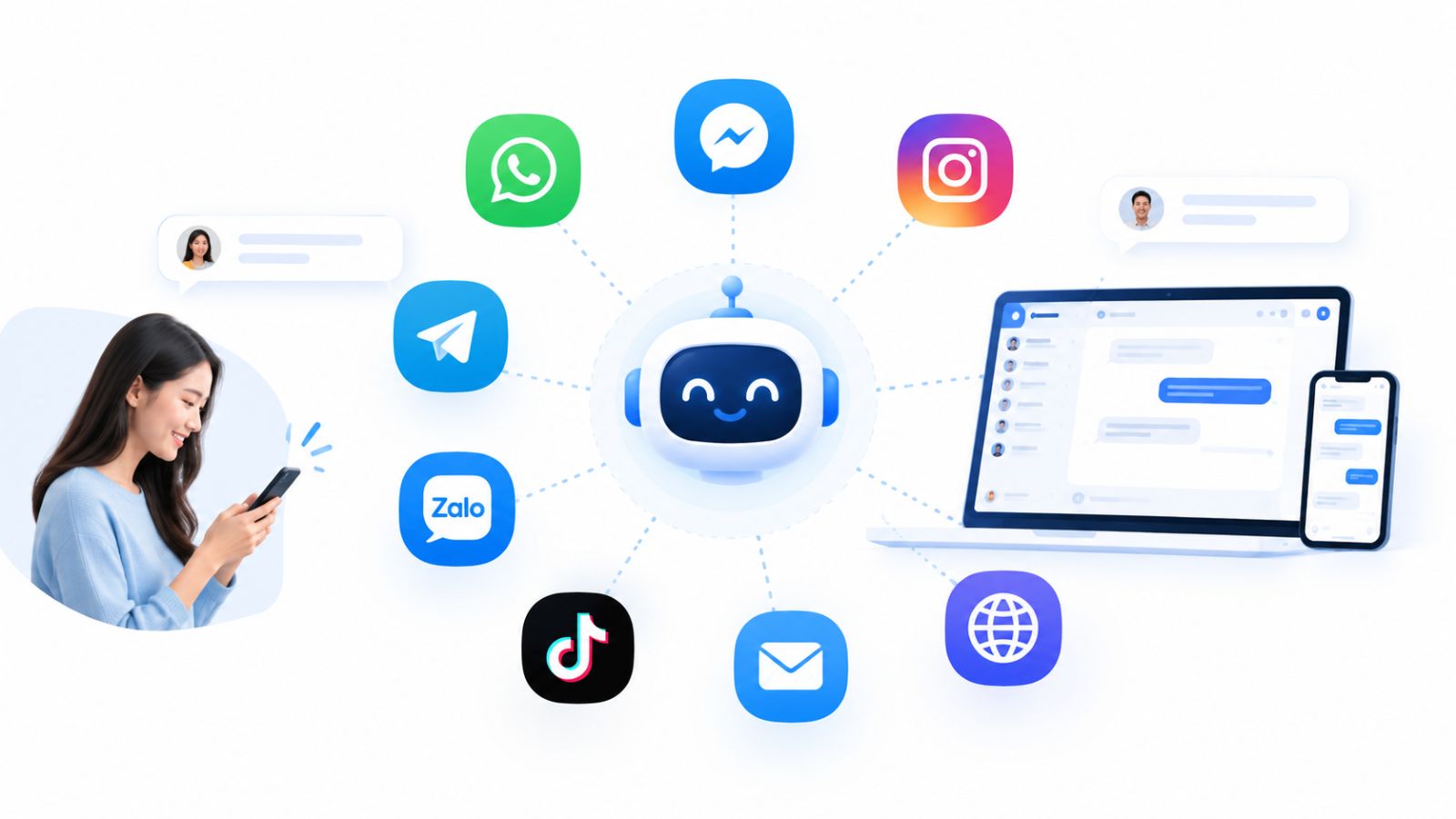
Your clients’ customers pick the channel, not you. For many small businesses in Asia, Latin America and the Middle East that means WhatsApp first, with Zalo or Telegram in specific markets. In the United States, web chat, SMS and Instagram usually lead.
- WhatsApp Business Platform: Meta bills by message type and country, so treat it as a pass-through cost on the client’s own Meta account and check Meta’s current rate card.
- Instagram and Messenger: no per-message fee, but strict rules about when a business may start a conversation.
- Web chat: free to operate and the easiest starting point for a new client.
- Email and SMS: helpful for reminders and follow-ups, with carrier or provider charges on top.
The rule for your stack is simple: one platform, every channel, one inbox per client. A shared inbox with human takeover and conversation assignment means a teammate can step in at the right moment without anyone switching tools. Running a separate app for each channel multiplies your maintenance by the number of clients you serve.
Layer 5: Knowledge and data
An agent is only as useful as what it knows and what it can reach.
- Knowledge base. Point the agent at the client’s website, help center, PDFs and FAQs, and keep that content fresh. If a help center is the starting point, our guide to turning a knowledge base into an AI support agent walks through the process.
- Structured data. Keep prices, stock, opening hours and anything that changes often in a Google Sheet or Airtable base the client owns. A sheet the client can edit stays current far more reliably than a prompt you maintain.
- Systems of record. The CRM, calendar, store and payment tool are where the agent creates real value, because it can read from them and write back.
Layer 6: Workflows, APIs and MCP
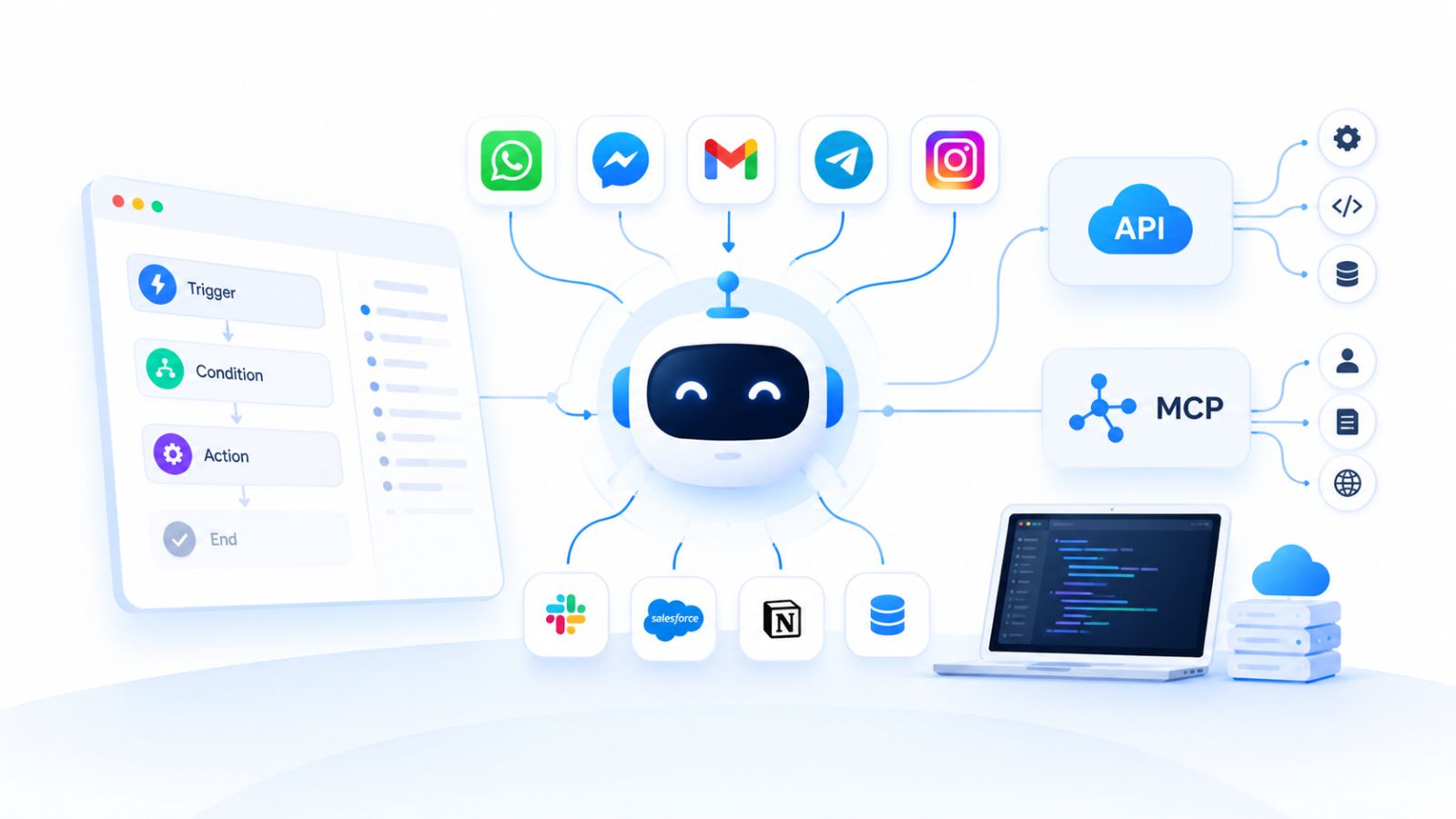
Sooner or later, every client asks for something beyond a conversation: a new lead pushed to the CRM, a nightly spreadsheet sync, or a booking-system webhook that should trigger a WhatsApp message. Many agencies bolt on a separate automation subscription for this, which adds another bill and another place for client workflows to break.
A visual builder inside your agent platform avoids that. ChatbotX’s drag-and-drop Flow Builder offers more than fifteen node types, plus triggers, conditions, webhooks and HTTP requests, so the same canvas holds the conversation and the automation around it. If a client already runs scenarios in n8n or Make, ChatbotX documents integrations for both, so you can connect instead of rebuilding.
Two developments matter especially for 2027:
- Model Context Protocol (MCP). MCP is an open-source standard for connecting AI applications to external data, tools and workflows. A growing number of SaaS products publish an MCP server, which lets your agents act inside tools your clients already use.
- Your AI assistant as an operator. ChatbotX exposes API, CLI and MCP access with hundreds of tools, so assistants such as Claude, ChatGPT or Cursor can inspect contacts, draft broadcasts and run workflows in plain language. Agencies can package that into a managed service.
Layer 7: Testing, monitoring and reporting
Most new agencies skip this layer, and it is the one that decides whether clients renew.
- Test before launch. Run scripted conversations through the real flow, including awkward cases: a fully booked day, a wrong order number, an angry customer.
- Check logs after launch. Review error logs and failed sends every week, so you find problems before the client does.
- Report monthly. Combine platform analytics (conversations, response times, engagement) with outcome counts the client cares about, such as bookings, orders and leads captured. One page is enough.
Ownership after launch matters more than most teams expect. Gartner predicts that 70% of enterprises will abandon agentic AI built through vendor forward-deployed engineering by 2028, citing rising costs and an inability to evolve the systems independently. Monitoring and clear reporting are how you stay the trusted owner clients keep paying. For pricing and packaging ideas, see our playbook on adding $5K in monthly recurring revenue with chatbot services.
Layer 8: Running the agency
The back office is the part of an older agency stack that carries over best. Keep it lean:
| Job | What you need | Cost guidance |
|---|---|---|
| Sales pipeline | A simple CRM | Free tiers cover most solo and small agencies |
| Delivery and projects | A task or project manager | Free or low per-seat plans are usually enough |
| Proposals and visuals | A design and document tool | One or two seats for most teams |
| Recurring billing | Subscription billing software | Percentage-based fees on billing volume plus card fees |
Drop what the new model makes redundant: separate AI writing subscriptions for every teammate, per-seat chatbot tools priced for support teams, a standalone automation tool when your platform already runs workflows, and any single-channel product your platform already covers.
Three AI agent stacks by agency stage

These examples use ChatbotX list prices. They exclude model tokens, Meta and carrier messaging fees and back-office subscriptions, because those scale with usage and team size.
Stage 1: Pilot or first client
Start on the free Community Edition, self-hosted, or pick the Pro plan at $49 per month for a managed cloud workspace. Add free tiers of a CRM and a project manager. Your platform cost sits between $0 and $49 per month, which one small retainer covers many times over.
Stage 2: Growing agency with 5 to 50 clients
Move to the Whitelabel plan at $299 per month, which includes 50 workspaces and 5,000,000 bot messages. The cost per client falls quickly as you sign more of them:
| Active clients | Platform cost per client per month |
|---|---|
| 5 | about $59.80 |
| 10 | about $29.90 |
| 20 | about $14.95 |
| 50 | about $5.98 |
Workflows run inside the same platform, so there is no separate automation bill. At 50 workspaces, the message allowance averages 100,000 bot messages per client per month.
Stage 3: Scaled agency on your own infrastructure
When you need unlimited workspaces, role-based access and audit logs, the self-hosted Enterprise plan at $499 per month adds those controls while keeping data on infrastructure you manage. Add seats to your back-office tools as the team grows.
At every stage, margin comes from retention rather than new builds. The platform cost per client keeps shrinking as you add clients, while the retainer stays fixed.
Mistakes that make an agency stack expensive
- Paying per resolution on a fixed retainer. Your best month becomes your least profitable one.
- One tool per channel. Five channels across twenty clients means a hundred things to maintain.
- Running every client on your own API key. A single busy month on one account becomes your bill.
- Skipping logs. You hear about failures from the client, which is the worst possible way.
- Ignoring model retirement dates. They are announced well ahead, so put them in your calendar.
- Building the stack before the offer. Pick a niche and a service first, then buy only what that service needs.
Frequently asked questions
What is an AI agent agency tech stack?
It is the set of tools an agency uses to build, deploy, monitor and bill for AI agents on behalf of clients. The core layers are an agent platform, language models, channels, knowledge and data, workflows, testing and reporting, and back-office software.
How much does it cost to run an AI automation agency?
Platform costs can be very low. With ChatbotX, a pilot can run on the free self-hosted Community Edition or a $49 Pro plan, and a 50-workspace Whitelabel plan costs $299 per month. Model tokens, messaging fees and your own back-office tools are extra and scale with usage.
What should an agency look for in a white label AI platform?
Look for separate client workspaces, pricing that does not rise with every resolution, broad channel coverage, real tool calling, bring-your-own-model support, human handoff, visible logs and a clear exit path such as open-source code or exportable flows.
Do I need to code to build AI agents for clients?
No. A visual flow builder lets you design conversations, triggers and integrations by dragging and connecting blocks. Developers who want more control can add API, CLI or MCP access on top.
Should an agency self-host or use the cloud version?
Cloud plans are faster to start and need no maintenance. Self-hosting suits agencies that want full control over data and infrastructure, and it is free to try with the open-source Community Edition.
Build your agency stack with ChatbotX
The best AI agent agency tech stack for 2027 is a short one: one multi-client platform, a couple of model providers, your clients’ own channels and systems, workflows in the same place and a lean back office. Everything else can wait until a client pays for it.
Ready to put this into practice? Launch your first client workspace on ChatbotX Cloud with a 7-day free trial, or self-host the open-source Community Edition and explore the code, quick start guide and release notes in the ChatbotX repository on GitHub. Start with one pilot client, prove the results, and scale to white-label when your client list demands it. Your first AI agent could be live this week.


