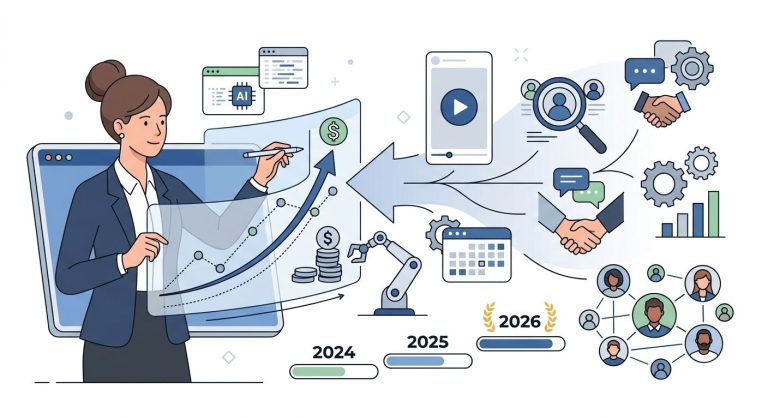

Most companies measuring AI’s impact look at two things: how much time was saved, and how many tasks were automated. Both are valid starting points. But obsessing over speed alone risks missing the deeper transformation AI makes possible – the shift toward work that is genuinely meaningful, creative, and irreplaceable.
The real question is not how fast your team is moving. It is what they are doing with the time AI gives back.
Launch agentic chat marketing in minutes with ChatbotX














Why Speed Is an Incomplete Metric
When organizations adopt AI tools, the default success measure tends to be efficiency: fewer hours per task, faster ticket resolution, shorter report turnaround. These gains are real, but they represent only the first layer of AI’s potential.
Consider what efficiency metrics typically miss. They capture how quickly something was completed, but not whether completing it faster changed a single outcome for a customer, accelerated a product launch, or deepened a relationship that might otherwise have gone cold. Efficiency answers the question of how. High-value work answers the question of why it mattered.
Research from McKinsey Global Institute consistently shows that organizations extracting the most value from AI do not simply automate existing workflows – they redesign roles so that human effort concentrates on judgment, creativity, and relationship-building that machines cannot replicate. The gap between companies that treat AI as a cost-cutting tool and those that treat it as a capability amplifier is growing wider every quarter.
Defining High-Value Work

High-value work is the category of human effort that generates compounding returns – not just for a single task, but for the business over time. It tends to share certain characteristics:
It requires contextual judgment. A skilled advisor reviewing a client’s financial position before a major life event cannot simply apply a rule; they draw on experience, pattern recognition, and emotional intelligence. An AI can surface the relevant data in seconds, but the interpretation and its delivery still belong to the human.
It builds durable relationships. Trust between a business and its customers is not transactional. It accumulates through consistently thoughtful interactions, and it erodes quickly when those interactions feel hollow or impersonal. Human professionals who are freed from administrative overhead can invest that time in conversations that strengthen loyalty.
It drives innovation. New product directions, untested market opportunities, and creative solutions to persistent problems rarely emerge from optimized pipelines. They come from people with the space to think, experiment, and connect ideas that do not obviously belong together.
It signals organizational culture. When employees feel their skills are genuinely used rather than wasted on repetitive processes, engagement rises and attrition falls – one of the highest-leverage outcomes any business can achieve.
The Problem with “Freed-Up Time”
A warning worth heeding: simply removing low-value tasks from someone’s schedule does not automatically produce high-value output. Research published in the Harvard Business Review found that workers whose routines were accelerated by AI frequently filled the recovered time with more of the same work rather than better work. Pace increased, workload expanded, and cognitive fatigue followed – the opposite of what organizations hoped to achieve.
This pattern has a name: workload intensification. It happens when AI creates capacity that the organization has not deliberately redirected. The calendar opens up and gets immediately filled with more meetings, more reviews, and more incremental output – rather than with the kind of deep, unhurried thinking that produces genuine breakthroughs.
The implication is direct: companies that want AI to unlock high-value work must design for it intentionally. That means protecting focus time, restructuring how teams are organized, and establishing clear expectations about what the recovered hours are for.
According to MIT Sloan Management Review, the most successful AI-powered organizations combine technological deployment with deliberate organizational redesign – updating job descriptions, retraining managers, and building new incentive structures that reward outcomes rather than activity.
How Organizations Are Capturing Real ROI

Financial Services: Advisors Focused on Strategy, Not Administration
Wealth management firms that deployed AI meeting-preparation tools have seen measurable shifts in advisor productivity – not in the number of clients seen per day, but in the depth and quality of each engagement. When an advisor’s preparation time drops from an hour to a few minutes, the space that opens up is not absorbed by another client on the schedule. It goes into the conversation itself: more strategic dialogue, more personalized recommendations, more listening.
The downstream effect is higher client satisfaction scores, lower attrition, and – eventually – increased assets under management. None of those outcomes appear on an efficiency dashboard. They surface in retention data and revenue growth quarters later.
Healthcare: Clinicians Redirecting Effort Toward Outcomes
In clinical environments, AI has demonstrated its impact not by replacing clinical judgment but by clearing the path to it. When healthcare professionals spend less time searching across disconnected records, reformatting data for presentations, or manually building cost-benefit analyses, they can focus on the decisions that directly affect patient care.
One compelling example: a nurse practitioner used AI to analyze research and model the financial impact of a prehabilitation program for surgical patients. The analysis, which would have been prohibitively time-consuming before AI, demonstrated potential savings in the hundreds of thousands of dollars annually – and more importantly, it produced a concrete proposal for improving patient outcomes that leadership could act on.
The ROI of that work cannot be captured in time-saved metrics. It is measured in health outcomes and institutional strategy.
Customer Experience: Human Agents Handling What Matters
In customer service, AI’s most effective contribution is not replacing human representatives – it is sorting intelligently. When AI agents handle routine inquiries, account lookups, and transactional support, human service professionals can concentrate on cases that genuinely require empathy, de-escalation, and creative problem-solving.
Businesses that have implemented this model report improvements in customer satisfaction alongside reductions in churn. The mechanism is straightforward: customers who reach a human are more likely to be dealing with a complex situation, and they receive a human who has not been exhausted by a hundred simpler interactions before them.
How ChatbotX Helps Teams Do More of What Matters

This is where the architecture of your AI infrastructure becomes strategically important. Platforms that automate surface-level interactions without connecting to the rest of your business create efficiency without impact. The systems that unlock genuinely high-value work are those that handle the full scope of routine engagement – so your people never have to.
ChatbotX’s AI Agents operate across WhatsApp, Instagram, Messenger, Telegram, and other channels simultaneously, handling qualification, follow-up, FAQ resolution, and lead nurturing without human intervention. The conversations that truly need a human – the ones involving complex decisions, emotional context, or high-stakes relationships – are escalated seamlessly.
The Flow Builder lets teams design sophisticated conversation sequences that mirror the judgment logic a skilled human would apply: routing inquiries by intent, personalizing responses by customer segment, and triggering follow-up actions based on behavior. This is not automation for its own sake – it is the architectural layer that makes high-value human attention possible by protecting it from low-value interruptions.
For teams managing customer relationships across multiple channels, the Shared Inbox consolidates every conversation into a single view, eliminating the context-switching and search overhead that consumes so much of a support professional’s day. When a customer conversation reaches a human, that human arrives fully informed and can give the interaction their complete attention.
For engineering teams and organizations evaluating open-source infrastructure for enterprise deployment, the full ChatbotX codebase is available on GitHub: github.com/ChatbotXIO/ChatbotX.
Redesigning Work: A Practical Framework

If your organization wants to move from efficiency gains to genuine high-value output, the redesign process involves several concrete steps.
Audit where human time is actually going. Before deploying AI broadly, map where your most skilled people spend their hours. In most knowledge-work environments, a substantial portion of that time goes to tasks – data entry, scheduling, status reporting, information retrieval – that generate little direct value. Those are the AI candidates.
Identify what high-value looks like in your context. High-value is sector-specific. For a financial advisor, it might be strategic planning conversations. For a sales professional, it might be relationship development with enterprise accounts. For a product manager, it might be user research synthesis. Make it explicit.
Build in protected time. Without organizational protection, recovered time gets absorbed. Consider blocking calendar time for deep work, delaying non-urgent notifications, and restructuring meeting cadences so that focused thinking is a recognized and valued activity rather than something that happens in the gaps.
Restructure roles to reflect the shift. Frontline employees whose transactional work has been automated are not simply people with empty schedules – they are candidates for new responsibilities that were previously beyond their reach. Invest in the transition rather than assuming it will happen naturally.
Measure outcomes, not inputs. Track customer retention, innovation velocity, employee engagement, and revenue growth. Let those outcomes inform whether your AI deployment is actually creating the high-value conditions you designed for.
For a deeper look at how AI agents are being used to redesign customer-facing roles specifically, see our breakdown of predictive customer service strategies and how forward-thinking teams are using agentic tools to anticipate needs before they arise.
The Employee Dimension: Retention as ROI

One of the most undervalued returns on AI investment is its effect on how employees feel about their work. When people spend most of their day on tasks that feel mechanical and underutilizing, disengagement follows. When AI clears those tasks away and creates space for work that calls on expertise, creativity, and judgment, the experience of the job changes.
Organizations that have successfully made this transition report meaningful reductions in voluntary turnover. The financial impact of retaining experienced employees – particularly in roles where institutional knowledge and client relationships are central – is substantial. By some estimates, replacing a mid-level knowledge worker costs between 50% and 200% of their annual salary when recruiting, onboarding, and productivity ramp-up are fully accounted for.
High-value work is not just better for business results. It is better for the people doing it. That connection matters if you want AI adoption to stick rather than generate short-term efficiency gains followed by organizational resistance.
Frequently Asked Questions
What is high-value work in an AI-enabled organization?
High-value work refers to the category of human effort that requires judgment, creativity, relationship-building, and contextual understanding that AI cannot replicate. It is the work that creates compounding business impact – stronger client relationships, innovative products, and engaged employees – rather than simply completing tasks faster.
Why is measuring AI ROI on speed alone insufficient?
Speed and efficiency gains are real, but they reflect only the first layer of AI’s potential. The deeper ROI comes from what your team does with the time AI returns: deeper customer engagement, higher-quality strategic decisions, and work that builds durable competitive advantage.
How do companies prevent AI from simply intensifying workloads?
The key is intentional organizational design. Recovered time must be explicitly redirected – through protected focus blocks, restructured roles, and updated performance metrics – rather than allowed to be absorbed by more of the same work.
What types of tasks should AI handle versus humans?
AI handles best what is high-volume, rule-based, and predictable: routing inquiries, answering FAQs, scheduling, data retrieval, and status updates. Humans add the most value in conversations requiring empathy, creative problem-solving, strategic judgment, and relationship depth.
How does ChatbotX support a high-value work model?
ChatbotX automates the full scope of routine customer engagement across all major messaging channels, ensuring that human attention is reserved for interactions where it genuinely changes outcomes. Its open-source architecture gives organizations full control over how automation is designed and deployed. You can explore the platform code and contribute at github.com/ChatbotXIO/ChatbotX.
Ready to Unlock the Real ROI of AI?

The organizations winning in 2026 are not the ones with the most AI tools – they are the ones that have designed their operations so that AI handles the routine and humans focus on what only humans can do.
If you are ready to stop measuring AI by how much time it saves and start measuring it by what your team achieves with that time, ChatbotX is built for exactly that model. Our agentic omnichannel platform takes care of the high-volume, repetitive engagement across every channel your customers use – so your team can bring their full expertise to every conversation that truly matters.
Explore how small and mid-sized businesses are already building this model in our guide to becoming an agentic enterprise in 2026, or get started with ChatbotX today – free, open-source, and ready to deploy.