

Quick answer: If you want a genuinely open-source, self-hosted ManyChat alternative that removes the per-contact pricing ceiling, ChatbotX is the strongest pick in 2026 – it’s free to self-host under an MIT license, works across WhatsApp, Messenger, Instagram, TikTok, Zalo, Telegram, and Email, and lets you plug in your own AI agents instead of paying for locked-in add-on credits. Below, we break down six other solid alternatives and the criteria that actually matter before you migrate.
ManyChat helped popularize the idea of a visual, no-code chatbot builder for Messenger and Instagram. But as messaging automation has matured, its limitations have become harder to ignore: pricing that climbs sharply with contact volume, a closed codebase you can never inspect or extend, and channel coverage that still leans heavily on Meta’s ecosystem. For growing businesses – especially teams serving markets where WhatsApp and Zalo dominate over Messenger – that gap has opened the door to a new generation of alternatives.
This guide walks through seven of the best ManyChat alternatives available today, why teams are switching, and how to pick the right one for your stack.
Launch agentic chat marketing in minutes with ChatbotX












Why Businesses Are Looking Beyond ManyChat in 2026
Three recurring complaints show up in almost every migration story:
- Cost scales with growth, not with value. ManyChat’s pricing is tied to contact count, so the more successful your campaigns are, the more you pay – even if your message volume per contact stays flat.
- No self-hosting or source access. Businesses that need data residency, custom integrations, or the ability to audit exactly how their automation works have no way to look under the hood.
- Channel coverage skews toward Meta. WhatsApp support arrived late and remains limited on lower tiers, and platforms popular in Southeast Asia – Zalo, TikTok – aren’t part of the picture at all.
WhatsApp alone now carries roughly 100 billion messages a day worldwide, including billions of voice messages, and active WhatsApp Business accounts have climbed into the hundreds of millions in 2026. A chatbot platform that treats WhatsApp as a secondary channel is increasingly out of step with where conversations actually happen.
What to Look for in a ManyChat Alternative

Before comparing tools, it helps to define the criteria that separate a genuine upgrade from a lateral move:
- Pricing model: flat or usage-based pricing beats per-contact pricing once your list grows past a few thousand subscribers.
- Channel breadth: WhatsApp, Zalo, TikTok, and Telegram support matter as much as Messenger and Instagram for global and Southeast Asian audiences.
- AI flexibility: the ability to bring your own LLM (OpenAI, Claude, Gemini, or a local model) instead of being locked into one vendor’s AI add-on.
- Deployment control: open-source, self-hosted options give you full data ownership and let developers extend the platform through an API, CLI, and MCP layer rather than waiting on a vendor roadmap.
- CRM depth: built-in CRM Contacts with tagging and segmentation, not just a subscriber list.
1. ChatbotX — Best Open-Source, Self-Hosted Alternative

ChatbotX is an open-source, agentic chat marketing platform designed specifically as a self-hostable answer to ManyChat, Chatfuel, and Wati. Instead of charging per contact, ChatbotX prices around bot messages, with unlimited contacts, channels, and team members even on paid tiers – and a free Community edition you can self-host indefinitely under the MIT license.
What sets it apart:
- True omnichannel reach: WhatsApp, Messenger, Instagram, TikTok, Telegram, Zalo, Email, and Webchat all run through the same Flow Builder, so you build one automation logic and deploy it everywhere.
- Bring-your-own AI: the AI Agents feature connects to OpenAI, Claude, Gemini, DeepSeek, OpenRouter, NVIDIA NIM, or fully local models – no proprietary AI credit markup.
- Developer-first architecture: a public API, CLI, and Model Context Protocol (MCP) server mean technical teams and agencies can automate workflows or white-label the platform for clients.
- Unified customer data: a Shared Inbox and built-in CRM Contacts keep every conversation, tag, and segment in one place instead of scattered across channel-specific tools.
Because the entire codebase lives on GitHub, teams that need audit control, custom integrations, or compliance sign-off can inspect exactly how automations, AI calls, and customer data are handled – something a closed platform like ManyChat simply cannot offer.
2. Chatfuel — Best for Simple Facebook and Instagram Bots
Chatfuel remains one of the most recognizable names in the space, focused primarily on Facebook Messenger and Instagram automation. Its drag-and-drop builder is approachable for non-technical marketers running comment-to-DM campaigns and basic FAQ bots.
Where it falls short: channel coverage outside Meta’s ecosystem is thin, and like ManyChat, there’s no self-hosted or open-source option – you’re renting access to a closed system.
3. Tidio — Best for E-Commerce Live Chat + Bots
Tidio blends live chat with rule-based and AI chatbot automation, aimed squarely at Shopify and WooCommerce store owners who want abandoned-cart recovery and support triage in one tool.
Where it falls short: automation logic is less flexible than a full flow-builder platform once you move beyond common e-commerce templates, and deeper AI customization sits behind higher-priced plans.
4. Respond.io — Best for Multi-Agent Support Teams
Respond.io positions itself as an omnichannel inbox first and an automation builder second, which makes it a strong fit for support-heavy teams juggling WhatsApp, Messenger, and Telegram conversations across multiple agents.
Where it falls short: its automation builder is less mature than dedicated flow-builder tools, and pricing is quote-based rather than transparent, which complicates budgeting for smaller teams.
5. WATI — Best for WhatsApp-Only Teams
WATI (WhatsApp Team Inbox) is purpose-built around the WhatsApp Business API, offering broadcast campaigns, chatbot flows, and shared team inboxes exclusively for that channel.
Where it falls short: if your audience also lives on Messenger, Instagram, or Zalo, you’ll need a second tool entirely, since WATI doesn’t attempt omnichannel coverage.
6. Landbot — Best for Conversational Landing Pages
Landbot’s strength is turning chatbot flows into embeddable, conversational web experiences – quizzes, lead forms, and product finders that feel like a chat rather than a static form.
Where it falls short: it’s a web- and WhatsApp-focused tool rather than a full omnichannel marketing suite, so it’s often paired with, not used instead of, a broader automation platform.
7. Botpress — Best Developer-Focused Open-Source Option
Botpress is another open-source contender, popular with developers who want fine-grained control over conversational AI logic through a visual flow editor and custom code hooks.
Where it falls short: its strength is conversational AI design rather than marketing automation – broadcast campaigns, remarketing sequences, and CRM-style segmentation are less developed than in platforms built specifically for chat marketing.
Comparison at a Glance
| Platform | Open Source | Self-Hosted | Omnichannel | Pricing Model |
|---|---|---|---|---|
| ChatbotX | ✅ | ✅ | WhatsApp, Messenger, Instagram, TikTok, Telegram, Zalo, Email, Webchat | Bot messages, unlimited contacts |
| Chatfuel | ❌ | ❌ | Messenger, Instagram | Per subscriber |
| Tidio | ❌ | ❌ | Web chat, Messenger, Instagram | Per conversation/seat |
| Respond.io | ❌ | ❌ | WhatsApp, Messenger, Telegram | Custom quote |
| WATI | ❌ | ❌ | WhatsApp only | Per agent |
| Landbot | ❌ | ❌ | Web, WhatsApp | Per active chat |
| Botpress | ✅ | ✅ | Web, custom integrations | Usage-based |
Why Open Source Matters More Than It Used To

The shift toward open-source infrastructure isn’t limited to chatbots. GitHub’s own data shows the open-source ecosystem growing at a pace that would have been hard to imagine a decade ago, with the developer base and repository count both expanding sharply through 2025. Businesses that once defaulted to closed SaaS tools are increasingly choosing self-hosted, auditable alternatives wherever the option exists – and chat marketing is catching up to that trend.
On the demand side, the global chatbot market is projected to keep growing at more than 20% a year through the end of the decade, which is exactly the kind of trajectory that makes vendor lock-in and unpredictable per-contact pricing harder to justify long-term.
For a marketing tool specifically, self-hosting isn’t just a developer preference. It means:
- No vendor can suddenly change your pricing tier or deprecate a channel you depend on.
- Customer conversation data stays inside infrastructure you control, which matters for regions with strict data-residency expectations.
- You can extend the platform’s triggers and actions with your own webhooks instead of waiting for an official integration.
How to Migrate From ManyChat Without Losing Your Flows
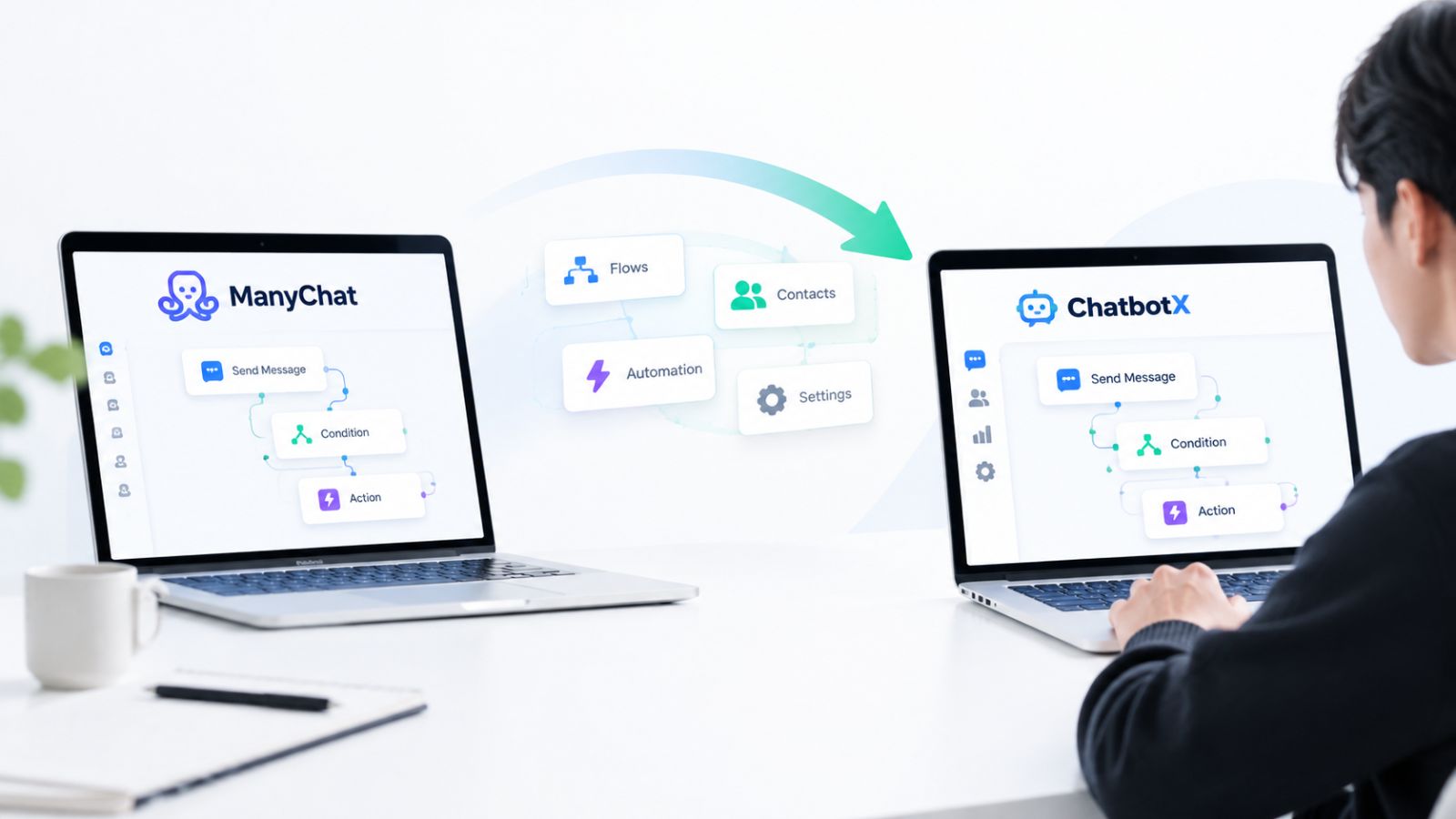
Switching platforms feels riskier than it usually is. A practical migration path looks like this:
- Export your contact list and tags from ManyChat’s dashboard before making any other changes.
- Rebuild your core flows first – welcome sequences, FAQ auto-replies, and lead-qualification paths – since these carry the most day-to-day traffic.
- Reconnect your channels one at a time, starting with your highest-volume channel, so you can verify delivery before fully cutting over.
- Import contacts and re-tag segments using your new platform’s CRM to preserve audience targeting for broadcasts.
- Run both systems in parallel briefly for critical flows, then fully decommission ManyChat once delivery is confirmed stable.
If your team runs multiple flows across WhatsApp, Zalo, and Messenger, ChatbotX’s Flow Builder documentation walks through importing existing automation logic step by step.
Frequently Asked Questions
Is there a truly free ManyChat alternative?
Yes. ChatbotX offers a Community edition that is completely free to self-host, with unlimited bot messages, contacts, channels, and AI agents – the main trade-off is that you manage your own hosting rather than using a managed cloud plan.
Can I self-host a chatbot platform without a developer on my team?
It helps to have some technical comfort, but platforms like ChatbotX ship with a documented Docker Compose setup that gets a self-hosted instance running with a few commands, and managed paid tiers exist if you’d rather skip infrastructure work entirely.
Do open-source chatbot platforms support WhatsApp?
Yes – ChatbotX connects directly to the official WhatsApp Business Platform, alongside Messenger, Instagram, Telegram, Zalo, TikTok, and email, so WhatsApp automation doesn’t require a separate tool.
Is ManyChat still worth using in 2026?
For very small Messenger- and Instagram-only campaigns, ManyChat’s simplicity can still be appealing. But once you need WhatsApp at scale, multi-channel coverage, or predictable pricing as your contact list grows, an alternative built for omnichannel automation is usually the better long-term investment.
Choosing the Right Fit
There’s no single “best” ManyChat alternative for every business – WATI wins if you’re WhatsApp-only, Tidio wins if e-commerce live chat is your priority, and Botpress wins if your team wants to write custom conversational logic in code. But for businesses that want the broadest channel coverage, freedom from per-contact pricing, and the long-term security of an open, self-hosted codebase, ChatbotX is built specifically to close the gaps ManyChat leaves open.
If you’re ready to see it in action, you can explore ChatbotX’s full feature set, read the Marketing Workflow Management playbook for how to structure your automation once you migrate, or check the WhatsApp Groups API guide if community-based messaging is part of your strategy. And if you want to see how agentic AI is reshaping owned-channel marketing more broadly, the Private Domain Marketing playbook is a useful next read.
Ready to leave per-contact pricing behind? Star ChatbotX on GitHub to see the code for yourself, check the latest releases to see how fast the platform ships, or get started free and have your first flow live in minutes.