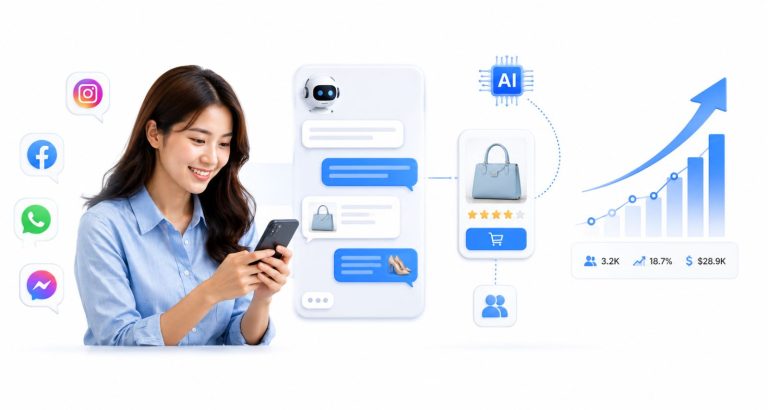

Running a startup in 2026 means competing with brands that have bigger budgets, larger teams, and deeper data pools. Yet an increasing number of lean startups are outpacing established players – not by spending more, but by using AI smarter.
AI has fundamentally shifted the marketing equation. Tasks that once required entire departments – content production, audience segmentation, campaign analysis, customer support – can now be handled autonomously, at scale, for a fraction of the cost. Startups that embrace this shift are building compounding growth advantages from day one.
This guide breaks down 10 high-impact AI marketing strategies every startup should be implementing right now.
Launch agentic chat marketing in minutes with ChatbotX














What Is a Startup Marketing Strategy in the Age of AI?

A startup marketing strategy defines how you attract, convert, and retain customers with the resources available to you at each stage of growth. In earlier eras, that meant choosing between paid acquisition and slow organic growth, often betting everything on a single channel.
In 2026, AI has added a third option: intelligent automation that amplifies every channel simultaneously. Instead of hiring a social media manager, a content writer, a data analyst, and a customer support team separately, startups can deploy AI systems that perform each of these functions around the clock – and improve over time as they accumulate data.
According to HubSpot’s 2026 State of Marketing Report, 78% of marketers who have adopted AI tools report meaningful gains in both productivity and campaign performance. For startups with limited runway, those gains are not a luxury – they are a survival mechanism.
The goal of any startup marketing strategy remains constant: establish product-market fit, build brand recognition quickly, and generate sustainable lead flow. AI simply accelerates every step of that journey.
Why AI Is a Startup’s Most Valuable Growth Asset
Startups have historically faced a structural disadvantage against larger competitors: limited resources spread across too many priorities. AI collapses that gap.
When AI handles distribution, personalization, and analysis, your small team can stay focused on strategic decisions and creative direction – the areas where human judgment still matters most. AI does not replace your marketing instincts; it gives them leverage.
There are important ethical considerations here as well. Startups that build on transparent, privacy-respecting AI practices earn trust faster than those that prioritize short-term data extraction. According to McKinsey’s Global AI Survey 2025, companies that embed responsible AI principles early see stronger customer retention and lower regulatory risk over time – a meaningful competitive advantage for brands building for the long term.
10 AI Marketing Strategies That Work for Startups in 2026

1. Build an AI-Powered Social Media Engine
Social media remains one of the highest-ROI acquisition channels for startups – but only when executed with consistency and precision. AI removes the manual burden while improving both reach and relevance.
Modern AI tools analyze your audience demographics, engagement patterns, and content performance in real time. They identify optimal posting windows, recommend content formats for each platform, and flag trending topics before they peak. Understanding how social media algorithms work in 2026 is foundational – and AI is the most efficient way to stay ahead of those constantly shifting ranking signals.
Key applications:
- Behavioral audience segmentation – identify which content types drive follows, clicks, and conversions for each audience cohort
- Automated scheduling – publish at the moments when your specific audience is most active, not based on generic best-practice windows
- Sentiment monitoring – track how customers perceive your brand and campaigns in real time across platforms
2. Deploy AI Chatbots for 24/7 Customer Engagement
Customer expectations have shifted dramatically. Buyers in 2026 expect immediate, personalized responses regardless of time zone or business hours. Startups that cannot match this expectation lose deals to competitors that can.
AI-powered chatbots bridge this gap entirely. They handle product questions, qualify inbound leads, book appointments, recover abandoned carts, and escalate complex cases to human agents – all without additional headcount.
ChatbotX is built precisely for this use case. As an open-source agentic omnichannel chatbot platform, it deploys a single AI-powered chatbot across WhatsApp, Messenger, Instagram, Telegram, Zalo, and web – delivering consistent, intelligent conversations at scale. Its AI Agents feature handles routine queries autonomously while the Flow Builder lets your team design complex conversation logic visually, without writing a single line of code.
For startups managing customer acquisition across multiple channels, this kind of unified engagement infrastructure is no longer optional – it is a baseline requirement for competitive performance.
3. Use AI to Accelerate Content Production
Content marketing remains one of the most durable long-term growth strategies for startups. It builds organic search visibility, establishes authority, and generates inbound leads without ongoing ad spend. The challenge has always been volume and consistency – qualities that AI now makes achievable for small teams.
AI can generate first drafts for blog posts, scripts for short-form video, captions for social content, and variations for A/B testing – all guided by keyword data and audience intent signals. Your role shifts from writing everything from scratch to directing, refining, and adding the authentic brand voice that makes content memorable.
Practical applications include:
- SEO-driven ideation – identify content gaps and high-intent keywords your competitors are missing
- Multi-format repurposing – transform a single long-form article into social posts, email newsletters, and video scripts automatically
- Headline and meta optimization – test multiple variations to improve click-through rates before committing to a final version
According to Semrush’s Content Marketing Statistics 2026, brands publishing AI-assisted content at higher frequencies see 3.5x more organic traffic growth than those relying solely on manual production cycles.
4. Automate Content Distribution Across Every Channel
Creating great content is only half the equation. Distribution determines whether that content ever reaches the audience it was built for.
AI removes the operational overhead of cross-channel distribution entirely. It analyzes audience behavior across platforms, identifies each channel’s peak engagement windows, and publishes content automatically at the right moment. When a piece of content gains early traction organically, AI can amplify it with targeted broadcast campaigns – turning organic reach into direct revenue without additional ad spend.
Startups should prioritize:
- Dynamic repurposing – automatically reformat content for the specifications and culture of each platform
- Cross-platform scheduling – maintain a consistent publishing cadence across all channels simultaneously
- Trend-triggered amplification – promote relevant content automatically when related topics spike in search or social conversation
5. Identify the Right Influencers with AI
Influencer marketing delivers strong results when the partnership is well-matched – and poor results when it is not. AI dramatically improves the accuracy of influencer selection by analyzing audience overlap, engagement authenticity, content alignment, and historical campaign performance at a scale no human research process can replicate.
Beyond identification, AI can monitor campaign performance in real time, flag anomalies in engagement data, and automate compliance checks for sponsored content disclosures. This means faster pivots and fewer wasted budget cycles.
For startups with limited influencer budgets, prioritizing micro-influencers (10,000–100,000 followers) with highly engaged niche audiences consistently outperforms partnerships with larger accounts. AI makes identifying and managing these relationships at scale practical for the first time.
6. Track Campaign Performance with AI Analytics
One of the most underutilized advantages AI offers startups is the ability to measure and optimize campaigns while they are still running – not after the budget has already been spent.
AI-powered analytics dashboards track KPIs across every channel simultaneously: engagement rates, conversion funnels, cost per acquisition, customer lifetime value, and revenue attribution. Predictive models identify which campaigns are trending toward their targets and which need immediate adjustment.
The practical implication is significant: startups can reallocate budget from underperforming channels to high-performing ones mid-campaign, compressing learning cycles from months to days.
For startups using Facebook and Instagram as primary acquisition channels, the Facebook Lead Ads and CRM integration guide for 2026 outlines how to connect lead generation directly to automated follow-up workflows – closing the loop between ad spend and revenue outcomes.
7. Optimize Press and PR with AI
Media coverage remains one of the most credible and cost-effective ways for startups to build brand authority quickly. AI has made it significantly easier to earn that coverage consistently.
AI tools analyze which press release formats, angles, and timing patterns generate the highest pickup rates from journalists in your industry. They monitor the media landscape in real time to identify emerging stories where your startup’s perspective adds genuine value. They can also map the relationships between your story and the journalists most likely to find it relevant – replacing the spray-and-pray outreach approach with precision targeting.
Additionally, AI ensures that every piece of earned media is SEO-optimized from the start, so coverage in third-party publications continues to drive referral traffic long after the initial publication date.
8. Enhance Events and Webinars with AI Automation
Events – whether virtual, hybrid, or in-person – are high-value touchpoints for startups trying to build relationships with prospects and partners simultaneously. AI removes most of the logistical complexity that makes event marketing feel expensive and time-consuming for small teams.
From automated registration and personalized pre-event communication to real-time session recommendations and post-event follow-up sequences, AI handles the operational layer so your team can focus on content quality and relationship building.
AI can also analyze attendee behavior data from past events to identify which session formats, topics, and formats generate the highest engagement – feeding directly into smarter event strategy for the next cycle.
9. Build AI-Optimized Commerce and Lead Generation Flows
For startups selling products or services online, the combination of AI and conversion optimization creates a compounding revenue advantage that compounds over time.
AI personalizes the purchase journey in real time – adjusting product recommendations, pricing presentation, and promotional offers based on individual visitor behavior. It identifies the moments in the funnel where friction is highest and surfaces recommendations for removing it.
The ChatbotX Broadcast feature enables startups to run high-volume, personalized messaging campaigns to opted-in contacts across WhatsApp, Messenger, and other channels – turning existing contact lists into a direct revenue channel without additional acquisition cost.
For startups building their first automated lead generation infrastructure, the priority should be integrating AI at the point of first contact – capturing intent signals, qualifying leads automatically, and routing high-value prospects to the right sales resources without delay.
10. Unify Your Team’s Marketing Operations with AI
The final – and often most transformative – step is consolidating your marketing stack around a single AI-powered operational layer.
Fragmented tools create fragmented data. When your social scheduling, customer messaging, lead management, and campaign analytics live in separate platforms that do not communicate, your team spends significant time on data reconciliation instead of execution.
A unified AI marketing infrastructure gives every team member a single view of the customer, the campaign, and the conversion pipeline. It enables faster decisions, cleaner attribution, and better cross-functional coordination between marketing, sales, and customer success.
You can explore the open-source ChatbotX codebase and integration architecture on GitHub to understand how the platform connects across channels and tools – and the ChatbotX GitHub repository provides full documentation for teams that want to self-host or customize their deployment.
Quick-Start Checklist: AI Marketing Priorities for Startups
| Priority | Action |
|---|---|
| Week 1 | Deploy an AI chatbot on your highest-traffic customer channel |
| Week 2 | Set up AI-powered social scheduling and sentiment monitoring |
| Week 3 | Launch an AI-assisted content production workflow |
| Month 2 | Implement cross-channel analytics and campaign tracking dashboards |
| Month 3 | Build automated lead qualification and follow-up sequences |
Build Your AI Marketing Stack from Day One
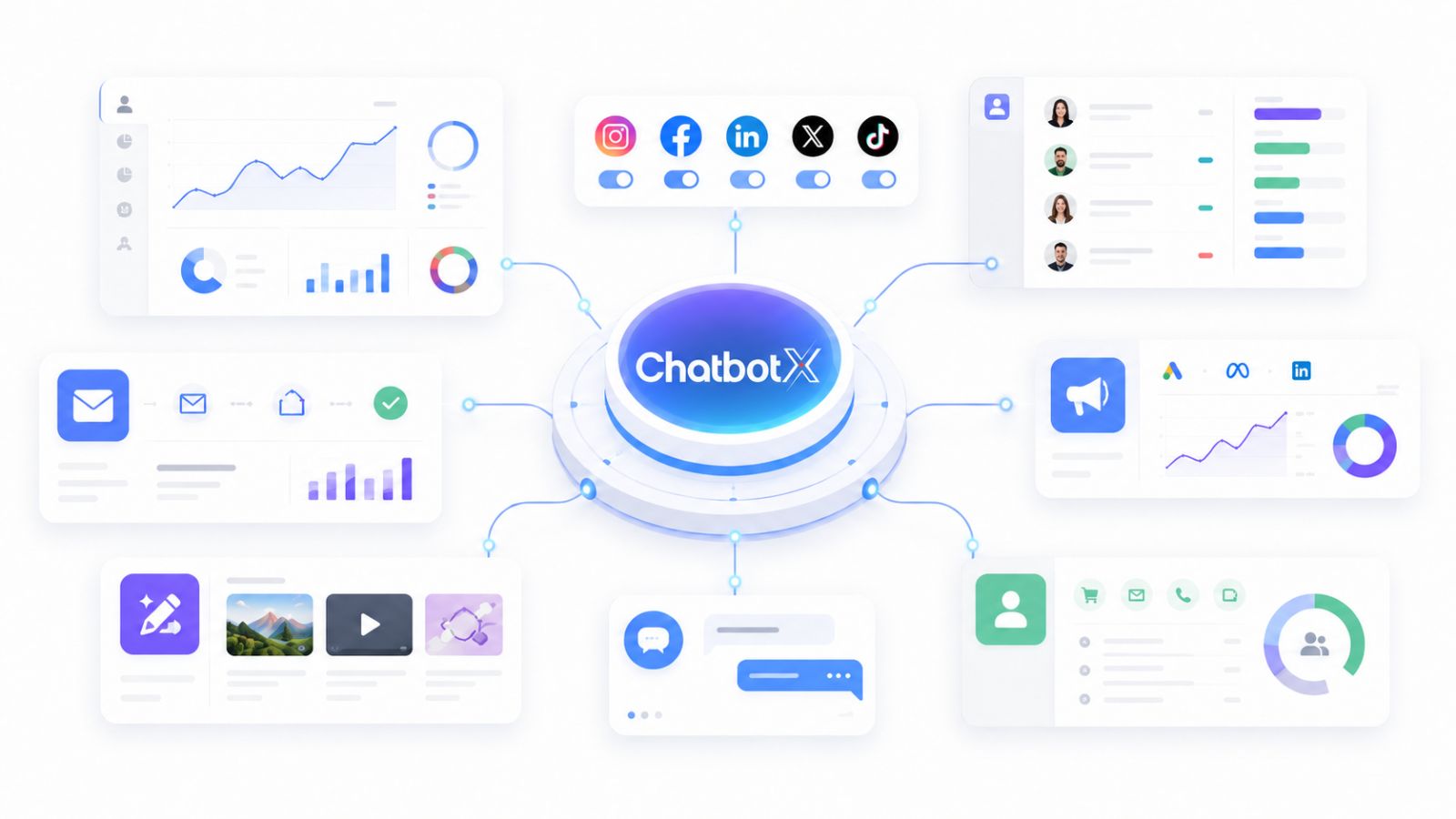
The startups that will define their markets in the next three years are not waiting for AI to become mainstream. They are building their marketing infrastructure around it right now – before their competitors have figured out where to start.
Every strategy in this guide is achievable for a lean team with a focused execution plan. The technology is accessible, the cost barriers have dropped dramatically, and the competitive advantage for early movers remains significant.
ChatbotX gives startups a practical entry point into AI-powered marketing. As an open-source agentic omnichannel chatbot platform, it eliminates the technical complexity of deploying AI across multiple customer channels simultaneously. Whether you are automating customer support, running personalized broadcast campaigns, or building lead qualification flows that work while your team sleeps – ChatbotX is built for exactly this kind of growth infrastructure.
Ready to put AI at the center of your startup’s marketing strategy?
- Explore ChatbotX features – discover what the platform can do for your business
- Star the project on GitHub – join a growing community of developers and marketers building with ChatbotX
- Read the AI Agents guide – see how autonomous AI agents handle customer engagement at scale
The window for building a first-mover AI marketing advantage is open right now. Start building.