

The search landscape has fundamentally shifted. Ranking on page one of Google is no longer the final destination. In 2026, building sustainable organic visibility requires AI citation optimization-also known as Generative Engine Optimization (GEO). To ensure your brand isn’t left behind, you must adapt your content strategy so that conversational engines like ChatGPT, Perplexity, and Gemini confidently extract and cite your data. Here is your definitive, actionable playbook to mastering this new era of discovery.
Launch agentic chat marketing in minutes with ChatbotX













Introduction: The Search Landscape Has Fundamentally Changed
Not long ago, ranking on page one of Google was the holy grail of digital marketing. In 2026, that goal still matters – but it is no longer enough. A new layer of discovery has emerged above traditional search results: AI-generated answers.
Platforms like ChatGPT, Google AI Overviews, Perplexity, Claude, and Gemini now handle billions of queries every month. Users ask a question and receive a synthesized response – often without clicking a single link. The brands that appear inside those AI-generated answers are not there by accident. They have earned their place through a deliberate strategy called AI citation optimization, also known as Generative Engine Optimization (GEO).
This guide breaks down exactly what AI citation optimization is, why it matters more than ever in 2026, and the tactical steps your business can take to get cited consistently across AI search platforms.
What Is AI Citation Optimization?

Generative Engine Optimization (GEO) is the practice of structuring digital content and managing your online presence so that large language models (LLMs) discover, extract, and reference your content when generating responses to user queries.
Unlike traditional SEO – which focuses on ranking signals like backlinks, page speed, and keyword density – GEO focuses on semantic relevance, factual density, and content structure that AI systems can confidently extract and cite.
In 2026, Google itself released official documentation stating that “optimizing for generative AI search is optimizing for the search experience, and thus still SEO.” This marked a turning point: GEO is no longer a fringe experiment. It is mainstream search strategy.
AI Citation Optimization vs. Traditional SEO: Key Differences
| Dimension | Traditional SEO | AI Citation Optimization |
|---|---|---|
| Primary goal | Rank in SERPs | Get cited in AI-generated answers |
| Success metric | Click-through rate, rankings | Citation frequency, brand mentions in AI responses |
| Content format | Long-form, keyword-rich pages | Structured, extractable, semantically dense content |
| Authority signals | Backlinks, domain authority | E-E-A-T, original data, expert authorship |
| Discovery method | Crawling and indexing | Retrieval-Augmented Generation (RAG) |
🎬 Watch this breakdown to understand how SEO, AEO, and GEO work together to get your brand recommended across AI platforms.
Why AI Citation Optimization Matters in 2026
The numbers behind this shift are impossible to ignore.
Roughly 62% of users now start their search journey with AI tools rather than traditional search engines. AI-referred web sessions grew by over 527% between January and May 2025, and that growth has continued into 2026. Meanwhile, AI Overviews now appear on a significant portion of Google searches, reducing organic click-through rates for non-cited results by up to 61%.
But here is the critical insight: when your brand is cited inside an AI Overview, CTR is 35% higher than traditional organic results. Being cited is not just about visibility – it drives qualified traffic.
For businesses operating across messaging platforms and social channels, this shift creates both a challenge and an opportunity. Brands that invest in AI citation optimization now are capturing disproportionate attention at precisely the moment when AI-generated answers are displacing traditional discovery.
How AI Systems Decide What to Cite
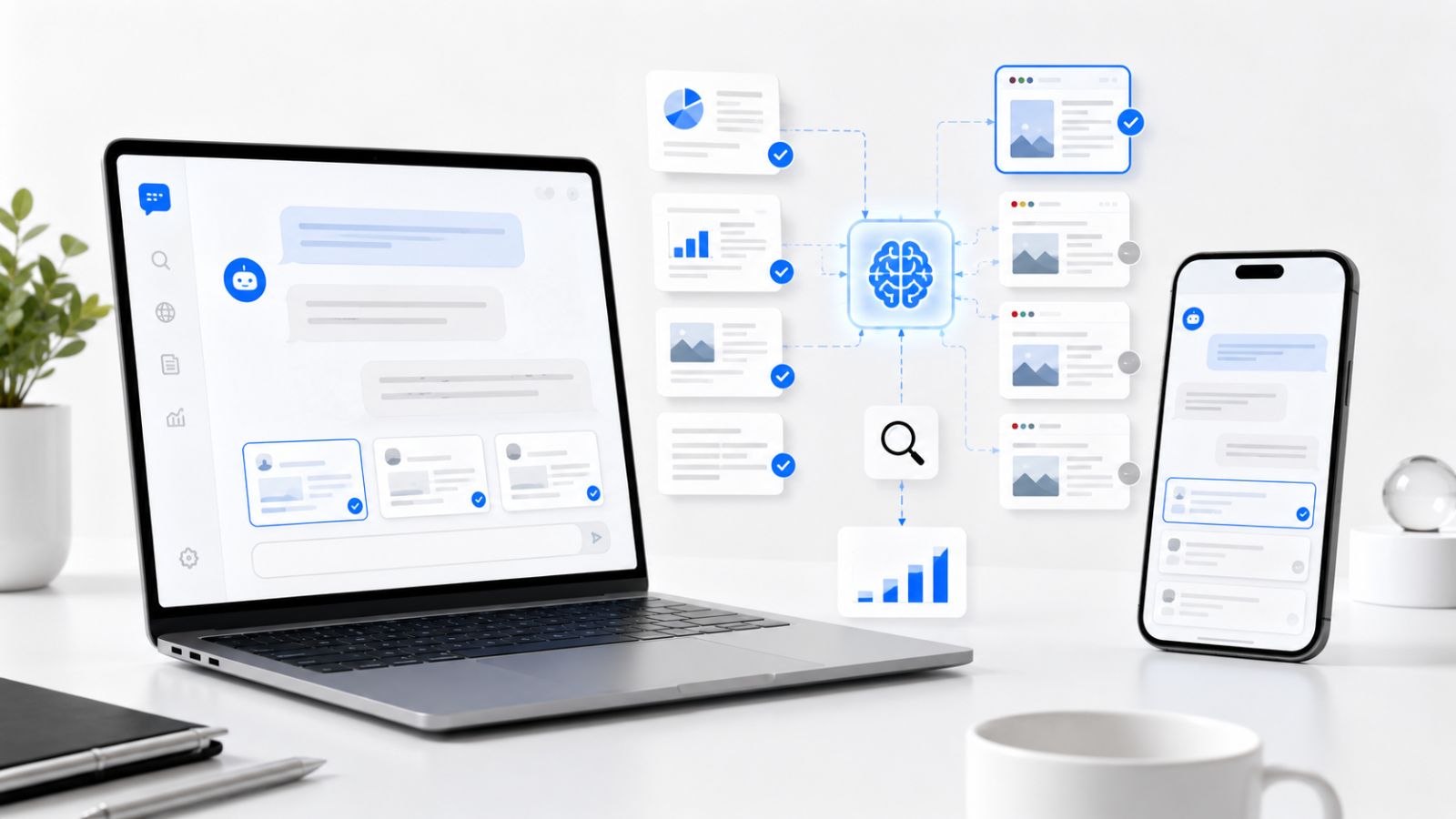
Understanding the mechanics of AI citation helps you structure content that gets selected. AI engines evaluate content along several core dimensions:
1. Semantic Clarity
AI models prefer content where individual passages can be extracted and understood in isolation. If a paragraph requires three other paragraphs of context to make sense, it is unlikely to be cited. Write in self-contained, declarative units.
2. Factual Density
Specific, verifiable claims outperform vague assertions. “Our clients reduced support costs by 43% after implementing AI chat automation” is infinitely more citable than “AI chatbots improve customer service.” Research-backed strategies can boost AI visibility by up to 40%, precisely because specificity signals trustworthiness to LLMs.
3. E-E-A-T Signals (Experience, Expertise, Authoritativeness, Trustworthiness)
AI systems heavily weight content from verified experts. Author bios with credentials, brand mentions across authoritative third-party sites, and citations of primary research all contribute to your E-E-A-T score.
4. Structured Formatting
FAQs, comparison tables, numbered lists, and schema markup make it dramatically easier for AI to extract and attribute your content. Use FAQ schema, HowTo schema, and Article schema wherever appropriate.
5. Freshness and Accuracy
AI models are increasingly trained on and retrieve content from recent, accurate sources. Stale content or factual errors are penalized – either by exclusion from retrieval or by being flagged as low-quality.
The 7-Step AI Citation Optimization Framework

Step 1: Identify Your Target AI Query Clusters
Map the questions your ideal customers are asking AI tools. Use tools like ChatGPT, Perplexity, and Google AI Overview to run target queries and study which sources are currently being cited. These are your competitors in the citation space.
Step 2: Structure Content for Extractability
Rewrite your most important pages with extractable paragraphs. Each key claim should stand alone. Lead with the answer, then provide supporting evidence. Think “answer first, explanation second” – the inverted pyramid model that journalists use.
Step 3: Invest in Original Data and Research
Original research, proprietary case studies, and unique statistics are citation gold. AI systems reward content that contains information unavailable anywhere else. Publish original surveys, benchmark reports, and experiment results regularly.
Step 4: Implement Comprehensive Schema Markup
Deploy Article, FAQPage, HowTo, and Organization schema across your site. Schema markup is machine-readable metadata that makes it significantly easier for AI crawlers to understand the context and authority of your content.
Step 5: Build Brand Signals Across the Web
GEO and AEO enhance rather than replace traditional SEO – and that means off-page authority still matters. Earn mentions on authoritative publications, industry directories, and review platforms. When AI systems see your brand consistently referenced across trusted third-party sources, your citability increases substantially.
Step 6: Optimize for Conversational Query Formats
AI users ask questions differently than Google users. They ask: “What is the best platform for WhatsApp automation for a small e-commerce team?” – not just “WhatsApp automation platform.” Structure your content to match these long-form, intent-rich query patterns.
Step 7: Monitor and Iterate Citation Performance
Track your AI citation footprint manually by running target queries weekly across ChatGPT, Perplexity, Claude, and Gemini. Document which sources are cited. Supplement manual tracking with emerging AI visibility tools that automate citation monitoring across major platforms. Measure referral traffic from AI platforms in Google Analytics 4 by filtering for known AI user agents.
Content Formats That Get Cited Most Frequently
Not all content formats are equally citable. Based on observed patterns across AI platforms in 2026, these content types earn citations most reliably:
High-citation formats:
- Comprehensive how-to guides with numbered steps
- Original research reports with specific data
- Comparison tables (tool X vs. tool Y)
- FAQ sections with direct, concise answers
- Definition-led explainer articles (like this one)
- Case studies with quantified outcomes
Lower-citation formats:
- Opinion pieces without supporting data
- Thin product pages with minimal descriptive content
- Content that mirrors competitors without adding new information
- Overly promotional copy without factual grounding
Common AI Citation Optimization Mistakes to Avoid
Even well-intentioned content teams make errors that reduce their citability. Watch for these pitfalls:
Writing for rankings instead of answers. Content optimized purely for keyword density often lacks the semantic clarity AI systems need to extract reliable answers.
Publishing AI-generated content without human review. AI systems detect and downweight low-quality AI-generated content. Generation is a tool; human editorial judgment is the differentiator.
Neglecting structured data. Unstructured content is harder for AI systems to parse. Even if your content is excellent, missing schema markup reduces your citation probability.
Ignoring citation decay. Content that was cited six months ago may no longer be cited today if competitors have published fresher, more specific alternatives. Maintain a regular content refresh schedule.
Measuring only traditional SEO metrics. Rankings and organic traffic tell an incomplete story in 2026. Add AI citation tracking, brand mention monitoring, and AI-referral traffic analysis to your reporting stack.
How ChatbotX Supports AI-Ready Content at Scale

For marketing and customer engagement teams, AI citation optimization requires more than a content strategy. It requires infrastructure that can deliver consistent, extractable, high-quality information at every customer touchpoint – across every channel.
This is where ChatbotX AI Agents become a meaningful part of the picture. ChatbotX is an open-source, omnichannel AI chat marketing platform that enables businesses to deploy intelligent agents across WhatsApp, Messenger, Instagram, Zalo, and Webchat – with full developer-level control over how those agents think, respond, and escalate.
When your AI agents are powered by the same factual, structured knowledge base that fuels your GEO strategy, every customer interaction reinforces brand authority. Customers receive consistent, accurate answers – the kind of high-quality responses that, when shared and referenced, further build the brand signals that AI citation systems reward.
The ChatbotX Flow Builder allows teams to design conversation flows that mirror the structured, extractable content logic that GEO demands: clear question → clear answer → relevant follow-up. This same principle that makes AI engines cite your content also makes your chatbot conversations more satisfying and conversion-ready.
Additionally, ChatbotX Remarketing helps close the loop between AI-driven discovery and conversion. When a user finds your brand through an AI citation and enters your messaging ecosystem, ChatbotX remarketing flows keep that conversation alive – nurturing leads across channels until they are ready to convert.
For teams who want to explore the platform’s architecture or contribute to its development, ChatbotX is fully open-source and available on GitHub:
For deeper reading on AI-powered automation strategies, the ChatbotX blog offers excellent complementary resources:
- Personal AI Agent: How to Design Your Own Intelligent Daily Operating System in 2026
- How Social Media Algorithms Really Work in 2026 (And How to Beat Them)
The Future of AI Citation Optimization
The trajectory is clear. AI-generated answers will handle a growing share of information queries. The brands that invest in AI citation optimization today are building a compound advantage: each citation earns brand authority, which earns more citations, which drives awareness, trust, and ultimately revenue.
Traditional SEO is not dying – but it is no longer sufficient on its own. The winning digital marketing strategy in 2026 combines technical SEO hygiene, E-E-A-T content investment, structured data implementation, and deliberate AI citation optimization into a unified, coherent approach.
Businesses that treat GEO as a separate discipline risk falling behind. The smarter framing: AI citation optimization is the natural evolution of content marketing – one that rewards clarity, specificity, authority, and genuine usefulness above all else.
Frequently Asked Questions
What is the difference between GEO and SEO?
Traditional SEO optimizes content to rank in search engine results pages. GEO (Generative Engine Optimization) optimizes content to be cited as a source within AI-generated answers from platforms like ChatGPT, Perplexity, and Google AI Overviews. Both strategies share many foundational elements – quality content, E-E-A-T signals, technical optimization – but GEO adds specific requirements around semantic clarity, structured formatting, and factual density.
How long does it take to see AI citation results?
Citation timing varies by platform and competitive landscape. Some brands see early citations within weeks of publishing well-structured, authoritative content. For established AI platforms with longer training cycles, the timeframe may extend to several months. Consistent publishing cadence, regular content updates, and proactive brand signal building across the web accelerate results.
Does AI citation optimization require technical expertise?
The foundational practices – clear writing, structured content, FAQ sections, original data – require no technical expertise. Schema markup implementation and GA4 citation tracking do require some technical knowledge, but most modern CMS platforms (including WordPress) offer plugins that simplify schema deployment significantly.
Can small businesses compete for AI citations against large brands?
Yes. AI citation systems reward specificity and relevance over domain size. A small business that publishes the most detailed, accurate, and well-structured guide on a niche topic can consistently outperform large competitors in AI citations for that topic. Focus on narrow, well-defined query clusters where your expertise is genuine and your content is demonstrably better than existing alternatives.
Conclusion: Start Optimizing for AI Citations Today

The shift from keyword rankings to AI citations is not a future possibility – it is the present reality. Every month that passes without an AI citation optimization strategy is a month of compound disadvantage against competitors who are already building theirs.
The good news: the core principles are straightforward. Create content that answers questions directly. Support every claim with specific data. Structure your pages for extractability. Build authority signals consistently across the web. And make sure your customer engagement infrastructure – your chatbots, your messaging flows, your remarketing sequences – reinforces the same clarity and quality that AI citation systems reward.
Ready to Build an AI-Ready Customer Engagement Stack?
If AI citation optimization is about showing up in the conversation, ChatbotX is about owning the conversation once customers arrive.
ChatbotX gives your team a fully open-source, agentic omnichannel platform to deploy intelligent AI agents across WhatsApp, Messenger, Instagram, Zalo, and Webchat – with no platform lock-in, no feature ceilings, and full control over your data and automation layer.
Start your 7-day free trial today – no credit card required, no contact limits, no restrictions.
👉 Explore ChatbotX and start your free trial at chatbotx.io
Whether you are a developer who wants to inspect every line of the codebase, a marketer who wants powerful no-code automation flows, or a growth leader building a scalable customer engagement system – ChatbotX is built for you.
👉 Star ChatbotX on GitHub and join the open-source community
The brands winning in AI search are the same brands winning in AI-powered customer engagement. Make sure yours is one of them.