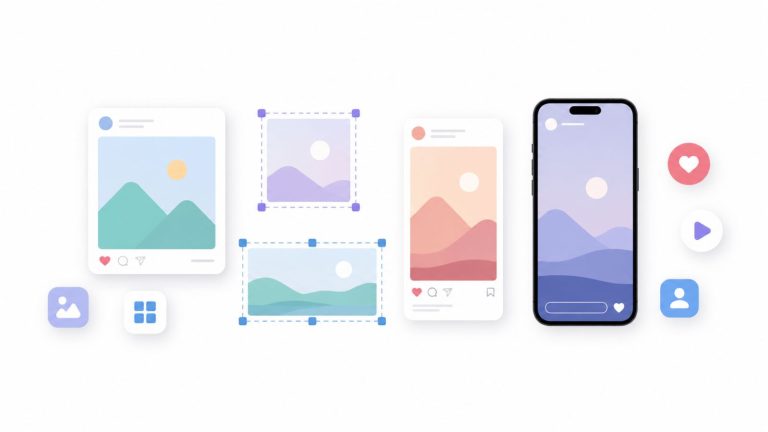

For years, “social media automation” meant one thing: a scheduling calendar. You wrote a caption, picked a time, and let a queue publish it while you did something else. That model solved a real problem, but it only ever touched half of the job – the broadcasting half. The other half, the actual back-and-forth with real customers in comments and DMs, still lived in a dozen separate inboxes.
Social Media MCP changes that equation. Built on Anthropic’s open Model Context Protocol, it lets AI assistants such as Claude connect directly to the tools that run your social presence – reading data, drafting content, and triggering actions without a human copying information from one tab to another. Instead of a scheduler that waits for instructions, you get an AI layer that can reason about your workflow and act on it.
This guide breaks down what Social Media MCP actually is, how it is reshaping the gap between social posting and social conversations, and where an omnichannel platform like ChatbotX fits into that picture for teams that live in WhatsApp, Messenger, Instagram, and Zalo as much as they live in feeds.
Launch agentic chat marketing in minutes with ChatbotX









What Is Social Media MCP, Exactly?
The Model Context Protocol (MCP) is an open standard, introduced and open-sourced by Anthropic, designed to build secure, two-way connections between AI assistants and the systems where business data actually lives. Before MCP, every AI tool that wanted to talk to every business system needed its own custom-built connector – a maintenance nightmare once you multiply models by tools. MCP replaces that patchwork with a single, shared interface: a data source becomes an “MCP server,” and any compliant AI assistant becomes a “client” that can query it or trigger actions inside it.
Applied to social media, this means an AI assistant working inside your development environment, your notes app, or your chat window can:
- Pull the status of a campaign, contact list, or content calendar on request
- Draft and queue posts or replies based on a plain-language instruction
- Fire an action in a completely different tool the moment a condition is met
- Keep working across the handful of platforms your audience is actually on, without you re-typing the same update six times
The practical result is fewer tab switches and less lag between “we should post about this” and the post actually going live – or between “a customer just asked this” and a useful reply landing in their inbox.
From One-Way Scheduling to Two-Way Conversations

Most of the current MCP conversation focuses on outbound content: turning a finished blog post, product update, or Notion page into a scheduled announcement. That is a genuinely useful pattern, and it is where most public MCP demos start.
But scheduling was never the hardest part of running social channels – the conversations that follow a post are. A comment asking about pricing, a DM asking whether an item is in stock, a WhatsApp message from someone who just abandoned checkout: these need a reply that understands context, not just a timestamp on a queue. This is exactly the layer that an AI agent built for messaging is designed to own, and it is where an MCP-style connection becomes far more valuable than a posting calendar.
ChatbotX approaches this from the messaging side rather than the publishing side. Its API, CLI & MCP feature exposes contact data, conversation state, campaign metadata, and workflow actions so that AI tooling can retrieve the right context and safely trigger the next operational step – whether that step is a reply on Instagram, a follow-up sequence on WhatsApp, or a handoff to a human agent on Messenger.
How AI-Driven Automation Actually Helps Day to Day
Strip away the buzzwords and the appeal of Social Media MCP comes down to four concrete gains:
- Fewer context switches. Teams stop bouncing between a content tool, a scheduler, an inbox, and a CRM to finish one task.
- Faster response times. AI agents can pick up a routine question the instant it arrives, instead of waiting for the next person to check the queue.
- Consistency at scale. The same product answer, tone, and offer go out whether a customer messages on Facebook, Zalo, or your website chat.
- Data that flows both ways. A CRM win, a support resolution, or a new lead can trigger a social or messaging action automatically, and a social interaction can just as easily update a CRM record.
None of this replaces human judgment. It removes the repetitive first mile – the routing, tagging, and first-response work – so people can spend their time on the conversations that genuinely need a human.
Connecting AI Assistants to Your Messaging Stack

The Cursor-and-Claude pattern popularized by early Social Media MCP tooling – writing code, then scheduling a post about it without leaving the editor – is a narrow but useful example of a much broader idea: AI assistants that act inside the tools you already use, rather than forcing you into a new interface.
For customer-facing messaging, the same idea plays out differently. Instead of “schedule this LinkedIn post,” the request looks more like “summarize this week’s unresolved WhatsApp conversations” or “tag every contact who mentioned our new pricing plan.” An omnichannel Flow Builder still handles the visual, no-code side of conversation design, while an MCP-style connection gives technical teams a way to script, extend, and automate that same layer from outside the UI – through code, a CLI, or an AI assistant issuing instructions in plain language.
That combination matters most for teams running content and support across several regions or languages at once, where a single missed handoff can mean a lost lead sitting untouched in an inbox overnight.
Automating Workflows Beyond Scheduling: Triggers, Webhooks, and Cross-Channel Actions

A scheduling queue only knows one thing: what time it is. Real automation needs to react to events – a tag being applied, a new contact arriving, a conversation being reassigned, a customer replying to a broadcast. This is where Triggers & Actions does the heavy lifting: a rule watches for a condition, and the moment it’s met, ChatbotX applies a tag, starts a flow, transfers the conversation to a human, or pushes the event to an external system through a webhook.
Paired with an MCP-style AI layer, this turns a single business event into a coordinated, multi-channel response instead of a manual checklist. A new lead captured through a Facebook ad, for example, can automatically enter a welcome sequence on Messenger, get logged in a connected spreadsheet or CRM, and be flagged for follow-up if there’s no reply within a set window – all without anyone opening three different apps.
For a deeper look at why this kind of always-on responsiveness increasingly determines organic reach as well as conversion, our breakdown of how social media algorithms really work in 2026 covers the ranking signals that reward fast, consistent engagement.
Personalizing Content Across Every Platform
Automation without personalization just produces faster spam. The platforms your audience uses expect different formats, tones, and posting cadences – a caption that works on Instagram rarely reads well as a WhatsApp broadcast, and a support macro that works over email can feel cold in a live chat window.
An AI layer that has access to structured context – customer tags, past purchases, channel history – can adapt a single message intent into the right shape for each channel automatically, rather than forcing one generic version everywhere. ChatbotX’s analytics view closes that loop by surfacing reply speed, conversion performance, and engagement by channel, so teams can see which adapted version is actually working and refine the underlying automation instead of guessing.
Real-World Patterns Teams Are Already Using

Forward-thinking teams are combining social, messaging, and MCP-style automation in a few recurring ways:
- Comment-to-conversation capture: turning a keyword left in a comment into a private, structured conversation instead of a missed opportunity.
- CRM-triggered messaging: a closed deal, a new signup, or a support resolution automatically kicking off a thank-you sequence or feedback request.
- Cross-platform announcements: one product update reformatted and pushed to Messenger, Instagram, and WhatsApp simultaneously, each tailored to that channel’s format.
- AI-assisted first response: an agent triaging incoming messages, answering the routine 60–80% instantly, and escalating the rest with full context attached.
Because ChatbotX is open source, teams that want to build custom versions of these patterns can inspect and extend the platform directly on GitHub rather than working around a closed API. Our comparison of open-source vs. SaaS chatbot platforms goes further into what that flexibility means at scale, from self-hosting to avoiding per-contact pricing.
A Practical Roadmap for Getting Started
Jumping straight into AI-driven automation without a plan tends to produce noisy, over-eager bots. A steadier rollout looks like this:
- Map the volume, not the ambition. Identify the handful of questions or actions that eat the most manual time – order status, FAQ replies, lead tagging – and start there.
- Connect one channel and one system first. Prove the workflow on your highest-traffic channel before expanding to every platform at once.
- Keep a human in the loop for edge cases. Set clear handoff rules so anything outside the automated flow reaches a person quickly, not eventually.
- Review the data, then expand. Use channel-level analytics to decide which automations earned the right to scale up.
Teams evaluating AI-driven support at this stage may also find our guide to choosing AI customer service software in 2026 useful for setting evaluation criteria before committing to a stack.
Where This Is Heading
The pressure to get this right is only growing. Global social media user identities reached roughly 5.79 billion by April 2026, meaning more than two in three people on Earth now use at least one platform every month – and on the enterprise side, Gartner’s own analysis projects agentic AI moving from under 5% to 40% of enterprise applications within a single year as task-specific agents move from pilots into everyday operations. Expect three shifts over the next few product cycles:
- Deeper reasoning, not just triggers. Agents that decide what to say based on context, not only when to send it.
- Governance built in from the start. Clearer audit trails and permission scopes as MCP-style connections touch more sensitive customer data.
- Messaging and social converging further. The line between a “social post” and a “customer conversation” keeps thinning, and platforms that only handle one side of that line will fall behind.
Frequently Asked Questions
What is Social Media MCP?
It’s the application of Anthropic’s Model Context Protocol to social and messaging tools – an open standard that lets AI assistants securely read data and trigger actions inside platforms like scheduling tools, CRMs, and chatbot systems, without a custom integration for every pairing.
Is MCP only useful for scheduling posts?
No. Scheduling is the most visible early use case, but the same connection pattern applies to customer replies, lead routing, CRM updates, and any workflow where an AI assistant needs live context from a business system.
Do I need to be a developer to use MCP-style automation?
Not necessarily. No-code tools like a visual flow builder and rule-based triggers cover most day-to-day automation. MCP and API access matter most for technical teams that want to extend that automation into their own custom systems.
How is this different from a regular chatbot?
A traditional chatbot follows a fixed script. An MCP-connected AI agent can pull live context – a customer’s tags, order history, or conversation state – before deciding how to respond, and it can act across multiple connected systems rather than staying inside one interface.
Does automation replace human support teams?
It shouldn’t. The strongest implementations use automation for repetitive, high-volume tasks and route anything ambiguous, sensitive, or high-value to a person, with full context already attached.
Social Media MCP is a preview of where customer engagement is headed: less time moving information between tools, more time on the conversations that actually move a relationship forward. If your team already juggles WhatsApp, Messenger, Instagram, and Zalo separately, that’s exactly the gap ChatbotX was built to close – one open-source, agentic omnichannel platform instead of five disconnected ones.
Get started with ChatbotX for free and see how AI Agents, Flow Builder, and MCP-ready APIs work together on your own channels, or explore the latest releases on GitHub if you’d rather self-host and customize from day one.