

Artificial intelligence has moved from experimental tech to the backbone of global online retail. In 2026, the question is no longer whether to adopt AI in your e-commerce stack – it’s how fast you can deploy it before competitors do. From real-time product recommendations to autonomous fraud detection, AI is rewriting the rules of how consumers discover, evaluate, and purchase goods online.
This guide breaks down the most impactful AI-driven shifts in e-commerce today, with practical insights on how retailers – from independent stores to enterprise brands – can take advantage of them.
Launch agentic chat marketing in minutes with ChatbotX














The State of AI in Online Shopping: A 2026 Snapshot
The numbers make the case plainly. The global AI in retail market is on track to surpass $22 billion by 2030, driven by the accelerating adoption of machine learning, natural language processing, and computer vision across the customer journey.
More than 40% of retailers globally have embedded AI into at least one core operational function, whether demand forecasting, customer service automation, or dynamic pricing. Among those, early adopters consistently report higher average order values, lower cart abandonment rates, and measurable gains in customer lifetime value.
What’s changed in 2026 specifically is the depth of integration. AI is no longer a standalone tool bolted onto an existing storefront. It now operates as a continuous intelligence layer – processing behavioral signals, inventory signals, and conversational data simultaneously to shape every touchpoint of the shopping experience.
1. Hyper-Personalization at Every Stage of the Funnel

Personalization in e-commerce used to mean showing someone a “you might also like” widget based on their last purchase. That era is over.
In 2026, AI personalization operates at a granular level: adjusting homepage layouts, search result rankings, promotional banners, email subject lines, and even product pricing in real time based on individual user profiles. These profiles are built from hundreds of data points – session behavior, purchase cadence, channel preference, device type, and time-of-day patterns.
Research from McKinsey consistently shows that well-executed AI personalization lifts e-commerce revenue by 10–15% across industries. The mechanism is straightforward: when a shopper sees products and offers that match their actual intent rather than generic bestseller lists, conversion probability increases substantially.
The challenge for most retailers is data unification. Customers move across websites, mobile apps, and social channels without leaving a clean trail. This is where an omnichannel automation layer becomes essential. Platforms like ChatbotX aggregate conversational data across WhatsApp, Instagram, Messenger, Telegram, and web chat into a unified customer profile, giving retailers the cross-channel behavioral data that makes personalization genuinely effective – not just superficially targeted.
2. AI Chatbots: Always-On Customer Service That Actually Converts

The customer service expectation gap is real. Shoppers in 2026 expect instant, accurate responses at 2 AM on a Sunday. Human support teams cannot scale to meet this demand without ballooning operational costs. AI chatbots close that gap efficiently.
Modern AI-powered chatbots do more than field FAQ requests. They handle product discovery conversations, process order status inquiries, manage returns and exchanges, upsell contextually based on cart contents, and escalate complex issues to human agents with full conversation context intact.
A HubSpot study found that nearly 40% of consumers are completely indifferent about whether they receive support from a human or an AI agent – as long as their issue gets resolved quickly and accurately. This represents a significant shift in consumer psychology that retailers should act on.
For e-commerce brands, the practical implication is clear: deploying a well-trained AI chatbot means no customer goes unserved during off-hours, flash sale spikes, or seasonal demand surges. ChatbotX’s AI Agents feature enables retailers to build context-aware, multi-turn conversation flows that handle complete purchase journeys autonomously – not just isolated one-shot responses.
Beyond reactive support, ChatbotX’s Remarketing feature allows merchants to re-engage shoppers who browsed without buying through targeted automated messages sent via their preferred channel. Combining always-on support with proactive re-engagement creates a compounding conversion advantage that static storefronts cannot replicate.
3. Smarter Inventory Management Through Predictive Analytics
Stockouts cost retailers sales and customer trust. Overstock ties up capital and triggers costly markdowns. AI-driven demand forecasting addresses both problems by analyzing historical sales data, seasonal patterns, promotional calendars, and external signals like search trend data and supply chain disruptions to predict inventory needs with significantly higher accuracy than traditional methods.
According to KPMG’s 2024 supply chain report, more than half of logistics and distribution organizations have prioritized AI investment specifically for warehouse operations. The return on that investment is measurable: faster order fulfillment cycles, reduced carrying costs, and fewer stockout incidents during peak demand periods.
For direct-to-consumer brands, integrating AI inventory signals with chatbot automation creates another advantage. When a customer asks about product availability via WhatsApp, an AI-powered system can check live inventory status and provide accurate answers instantly – rather than giving a generic “contact us” response that kills the purchase intent.
You can explore how ChatbotX handles complex multi-step automation including inventory-aware responses in the open-source repository on GitHub, where the core workflow engine and integration logic are fully documented.
4. Visual Search and Intelligent Recommendation Engines

Text-based search has a fundamental limitation: shoppers often cannot articulate what they’re looking for in words. Visual search removes that friction. A customer who photographs a product they spotted in a magazine or on a street can upload that image and receive a curated list of visually similar products from your catalog within seconds.
Retailers using visual search report meaningful improvements in both engagement and average order value. The technology works by extracting visual attributes – shape, color, texture, style – and matching them against product image libraries using convolutional neural networks. As catalog sizes grow and image quality improves, matching accuracy continues to increase.
Recommendation engines complement visual search by working in the background at all times. Rather than waiting for a customer to initiate a search, intelligent recommendation systems surface relevant products based on real-time behavioral signals: what pages they’ve visited this session, what they purchased six months ago, what customers with similar profiles bought last week. Amazon’s recommendation engine alone is estimated to drive approximately 35% of total platform revenue – a number that has inspired every major e-commerce player to build or license comparable systems.
Retailers integrating these capabilities can find further context on how AI-driven product discovery fits into a broader omnichannel commerce strategy in the ChatbotX guide to WhatsApp AI in 2026.
5. Real-Time Fraud Detection and Transaction Security

E-commerce fraud costs the global industry tens of billions of dollars annually. As payment methods diversify and transaction volumes grow, human review processes cannot keep pace with the speed and sophistication of fraudulent activity.
AI fraud detection systems operate in real time, analyzing hundreds of data points per transaction: device fingerprint, IP geolocation, behavioral biometrics (typing speed, mouse movement patterns, session duration), purchase history consistency, and cross-account pattern analysis. When a transaction deviates from established patterns – for instance, a high-value purchase from an unfamiliar device in a different country seconds after account login – the system can flag, delay, or decline it automatically while the customer completes checkout seamlessly if the risk score falls within acceptable parameters.
Critically, these models learn continuously. Each fraudulent transaction that is identified becomes training data that improves future detection. This adaptive quality makes AI fraud prevention substantially more effective over time compared to rule-based systems with static thresholds.
For retailers building their own AI-powered transaction monitoring or integrating AI security into conversational commerce flows, the ChatbotX GitHub repository provides open-source tools that developers can extend and adapt for their specific security requirements.
6. Voice Commerce: The Hands-Free Shopping Channel
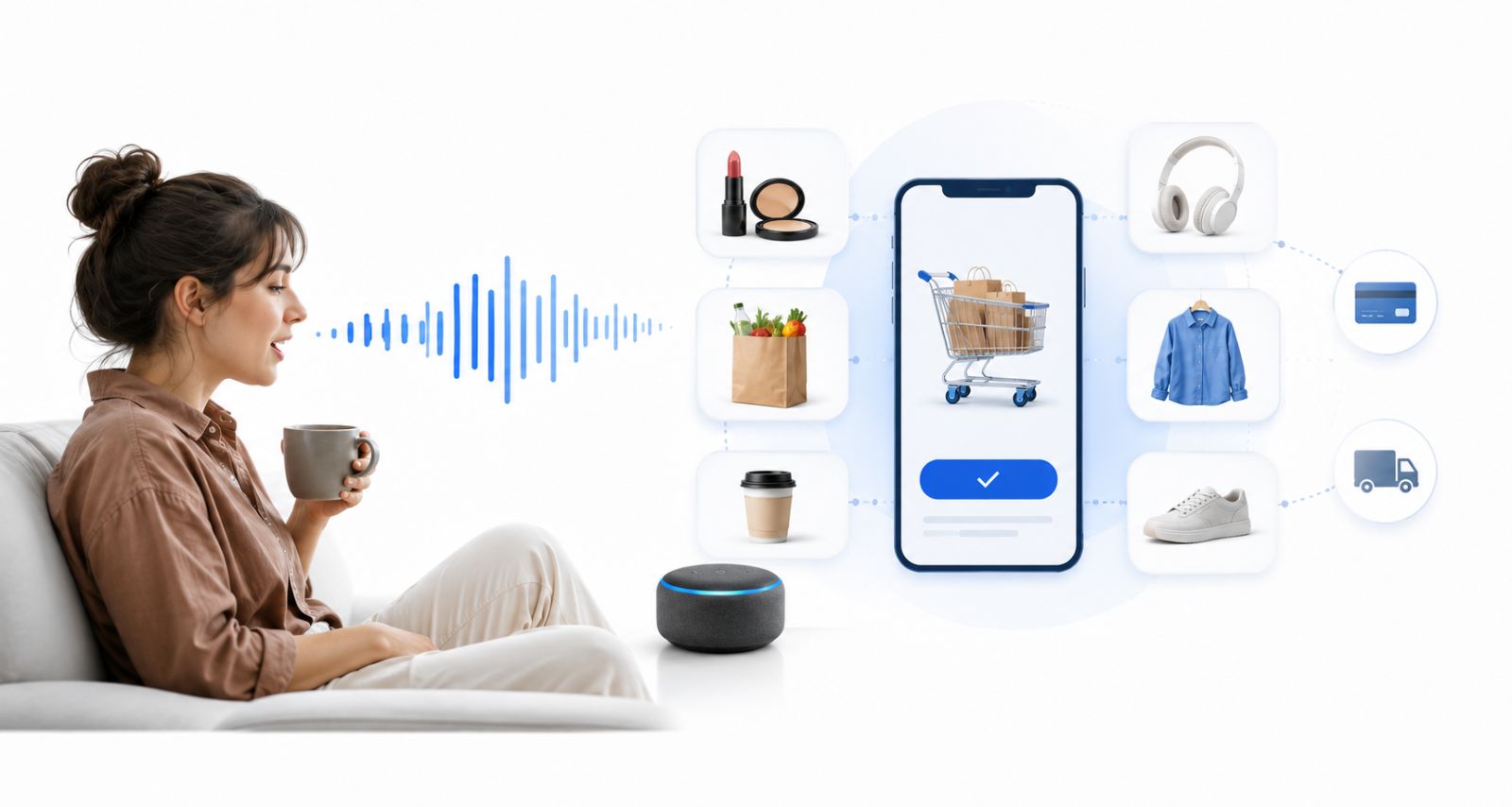
Smart speaker adoption continues to grow steadily. The US alone is expected to reach more than 170 million voice assistant users by 2028, according to eMarketer projections. Voice commerce – purchasing goods through spoken commands to devices like Amazon Echo or Google Nest – is moving from novelty to routine for a growing segment of shoppers.
The commerce applications extend beyond simple reordering of household staples. Voice interfaces are becoming capable of handling product discovery, price comparison, delivery tracking, and customer service queries in natural conversational language. As large language models improve in contextual understanding and speech recognition accuracy increases, voice commerce experiences will become substantially more sophisticated.
For brands selling in markets with high mobile penetration and messaging-first consumer behavior – Southeast Asia, Latin America, the Middle East – voice commerce often integrates naturally with existing messaging channel strategies. Retailers already operating on WhatsApp and Telegram through platforms like ChatbotX are well-positioned to extend those conversational commerce capabilities to voice interfaces as the channel matures.
7. Augmented Reality and Virtual Try-On Technology
One of the persistent friction points in online shopping is the inability to evaluate a product physically before purchasing. AR virtual try-on technology addresses this by overlaying products – clothing, eyewear, cosmetics, furniture – onto the customer’s environment or body in real time through their device camera.
The business impact is substantial. Research from Accenture indicates that virtual try-on implementations reduce product return rates by up to 25%. Given that returns represent one of the largest cost centers in e-commerce operations – logistics, restocking, damage assessment, and customer service overhead – a 25% reduction translates directly to margin improvement at scale.
Beyond return reduction, AR try-on increases purchase confidence for high-consideration categories. A customer who has virtually worn a pair of sunglasses or placed a sofa in their living room through an AR overlay is significantly more likely to complete the purchase than one making the same decision based on static product images alone.
As AR hardware becomes more accessible through standard smartphone cameras rather than specialized headsets, adoption among mid-market retailers is accelerating. Brands that implement AR experiences now are building customer familiarity with the technology before it becomes table stakes.
You can learn how leading e-commerce brands are combining AR discovery with social commerce automation in the ChatbotX blog post on Instagram Shop strategy in 2026.
8. AI-Powered Dynamic Pricing and Competitive Intelligence

Static pricing is increasingly a competitive disadvantage. AI-powered dynamic pricing systems monitor competitor pricing, demand signals, inventory levels, and customer price sensitivity in real time – adjusting prices automatically to maximize margin while remaining competitive.
The same technology works in reverse for promotions. Rather than applying blanket discounts that erode margin across all customers, AI systems can identify which customer segments are most price-sensitive and deliver personalized offers only to those likely to churn or abandon without an incentive. This targeted approach preserves margin with customers who would convert at full price.
For e-commerce teams managing large catalogs, the scale advantage of AI pricing is particularly significant. A human merchandising team cannot realistically monitor and adjust pricing across thousands of SKUs in response to hourly competitor changes. AI systems do this continuously and automatically.
ChatbotX’s Flow Builder allows marketing teams to create automated promotional conversation flows triggered by pricing events – for example, automatically sending a targeted offer to a customer who viewed a product three times without purchasing, triggered the moment that product enters a promotional window.
The Road Ahead: What to Prioritize in Your AI E-Commerce Strategy
The AI e-commerce landscape in 2026 rewards action over analysis. The retailers outperforming their categories are not necessarily those with the largest technology budgets – they are the ones who identified their highest-friction customer journey moments and deployed targeted AI solutions to address them first.
A practical prioritization framework:
- Highest immediate ROI: AI chatbots for 24/7 customer support and abandoned cart recovery. Deployment is relatively fast, results are measurable within weeks, and the customer experience improvement is immediate.
- Medium-term competitive advantage: Personalization engines and predictive inventory management. These require data infrastructure investment but deliver compounding returns as models improve over time.
- Longer-term differentiation: Visual search, AR try-on, and voice commerce. These are becoming expectations in premium retail categories but still represent differentiation for most mid-market brands.
The underlying enabler across all of these is conversational data. Retailers with rich, unified customer interaction histories across channels will build AI models that outperform those built on fragmented data. This is the strategic case for investing in omnichannel messaging infrastructure now, before the data advantage gap becomes insurmountable.
How ChatbotX Helps E-Commerce Brands Compete with AI

ChatbotX is an open-source agentic omnichannel chatbot platform built specifically for businesses that need to operate at the intersection of AI automation and human-quality customer experience. It connects WhatsApp, Instagram, Messenger, Telegram, Zalo, TikTok, email, and webchat into a single intelligent platform.
For e-commerce teams, this means:
- Automated sales conversations that qualify intent, recommend products, and close transactions across every major messaging channel without human intervention.
- Remarketing sequences that re-engage window shoppers with personalized messages based on their browsing and purchase history.
- AI Agents that handle full customer service journeys – from order status to returns – while escalating to human agents only when genuinely needed.
- Open-source transparency so development teams can inspect, extend, and customize every layer of the platform for their specific use case.
The platform is free to self-host, with full source code available on GitHub. For businesses that prefer managed deployment, ChatbotX Cloud offers the same capabilities with enterprise-grade reliability.
Start Building Your AI-Powered E-Commerce Engine Today
The gap between retailers using AI and those operating without it will continue to widen through 2026 and beyond. Early movers are compounding advantages in customer data, model accuracy, and operational efficiency that late adopters will find increasingly difficult to close.
If you are ready to deploy AI chatbots, omnichannel automation, and intelligent customer engagement tools for your e-commerce business, ChatbotX is the platform built to make that happen – affordably, transparently, and at scale.
→ Get started with ChatbotX – free to use, free to self-host.
→ Explore the source code and documentation on GitHub – fork it, extend it, make it yours.
Your next customer is already in a chat window somewhere. Make sure your AI is there to meet them.
Frequently Asked Questions
What is the biggest AI trend in e-commerce in 2026?
Hyper-personalization powered by AI is the dominant trend. Retailers are using machine learning to tailor product recommendations, pricing, and marketing messages to individual customers in real time across every channel – moving well beyond basic “you may also like” suggestions.
How do AI chatbots improve e-commerce conversion rates?
AI chatbots increase conversions by providing instant, accurate responses to purchase-related questions at any hour, proactively re-engaging shoppers who browse without buying, and guiding undecided customers through product selection conversations that would otherwise require a human sales agent.
Is AI fraud detection reliable enough for high-volume e-commerce?
Yes. Modern AI fraud detection systems analyze hundreds of behavioral and transactional signals in milliseconds, catching patterns that rule-based systems miss entirely. They also improve continuously as they process more data, making them more effective over time rather than becoming stale.
How does virtual try-on technology reduce product returns?
AR virtual try-on allows customers to visualize products on themselves or in their environment before purchasing. This significantly reduces mismatched expectations – the leading cause of returns in fashion, cosmetics, and home goods categories – with research indicating return rate reductions of up to 25%.
Can small e-commerce businesses afford AI tools?
Increasingly yes. Open-source platforms like ChatbotX make enterprise-grade AI chatbot and automation capabilities accessible to businesses of any size without large upfront licensing fees. Self-hosted deployment means ongoing costs scale with actual usage rather than fixed subscription tiers.
What channels does ChatbotX support for e-commerce automation?
ChatbotX supports WhatsApp, Instagram, Messenger, Telegram, Zalo, TikTok, email, and webchat – allowing retailers to automate customer conversations across all major channels from a single platform.