Key takeaways
– Cloudflare CEO Matthew Prince predicted at SXSW 2026 that automated traffic would pass human traffic online by 2027, and later said it may have happened sooner.
– The cause is AI agents: one user request can send an agent to thousands of sites instead of a handful.
– Your website and support channels now serve two audiences: people and machines acting for people.
– Winning businesses combine structured content, fast and accurate AI answers, multi-channel coverage, and smart bot controls.
For most of the web’s history, people were the main visitors. That assumption is breaking down. AI assistants now browse, compare, and shortlist on behalf of users, and they do it at a scale no human can match. If your business depends on being found, understood, and chosen online, the shift from human-led to agent-led traffic deserves a place on your 2026 roadmap.
This guide explains what is changing, why it matters for marketing and customer support, and what you can do about it today.
Launch agentic chat marketing in minutes with ChatbotX






What Is Happening to Web Traffic?
Speaking at SXSW in March 2026, Cloudflare CEO Matthew Prince forecast that online bot traffic would exceed human traffic by 2027. Months later, in early June 2026, he said on X that the milestone had arrived faster than he expected. Measurement methods differ between sources, so treat precise percentages with caution. The direction, however, is not in doubt: automated traffic is growing faster than human traffic.
Two facts explain the trend.
- Bots used to be a minority. Before generative AI went mainstream, automated traffic made up roughly one-fifth of the internet, and much of it came from search engine crawlers, scrapers, and spam.
- AI agents browse at industrial scale. Prince’s example is memorable: a person shopping for a camera might open about five sites, while an agent doing the same job may check around five thousand. That is a thousand-fold multiplier on every task.
Cloudflare sits in front of roughly a fifth of all websites, which is why its leadership has an unusually wide view of these patterns.
Why This Is a Platform Shift, Not a Passing Trend
The move from desktop to mobile did more than shrink screens. It changed how people discovered products, how businesses designed experiences, and which brands won. The rise of AI agents is a comparable change.
Instead of typing a query and clicking through ten blue links, users increasingly hand a task to an assistant: find, compare, filter, recommend, sometimes even buy. The agent does the legwork and returns an answer. In many cases, the person never sees your homepage, your brand story, or your carefully crafted landing page.
Your website therefore plays a new role. It remains a destination for visitors, but it is also a data source that machines read, summarize, and rank before a human ever arrives.
What the Bot-Heavy Web Means for Your Business

1. Your content has two readers
Human visitors still decide purchases, yet AI agents increasingly decide which options reach them. Clear pricing, complete product details, and unambiguous policies help machines represent you correctly. Vague copy and buried facts get skipped.
2. Speed and accuracy become competitive weapons
An agent that can survey thousands of competitors in seconds will not wait around. A slow reply or an unanswered pricing question sends it elsewhere. Loyalty is replaced by a simple test: who gave the best answer, fastest?
3. Traditional chat widgets fall short
A scripted bot that walks users through a decision tree struggles with the open-ended, context-rich questions that agents and modern shoppers ask. You need conversational AI that understands context, draws on your knowledge, and hands off to a person when judgment is required.
4. Infrastructure must absorb more automated load
Prince described a future with millions of short-lived sandboxes being created every second, each one a temporary environment where an agent completes a task and disappears. For site owners, that translates into more requests, more API calls, and tighter expectations for uptime and load time. Reliability is no longer a nice-to-have.
Six Steps to Prepare Your Business

Step 1: Make your content machine-readable
Audit your key pages as if you were an AI agent. Is pricing explicit? Are specifications complete? Can facts be extracted without parsing marketing language?
Adding markup helps search engines and AI systems interpret your pages. Google’s documentation on how structured data works is a practical starting point, and JSON-LD is the format it recommends in most cases. Pair that with a thorough FAQ section written in plain language.
Step 2: Deploy conversational AI that actually answers
Choose a chatbot that reads your knowledge base, responds in context, and escalates cleanly. If you are weighing options, a well-built AI agent can understand multilingual questions, retrieve company knowledge, route intent, and take action. Our guide to turning a help center into an AI support agent walks through the process.
Step 3: Cover every channel your customers use
Agents and people reach businesses through websites, messaging apps, social inboxes, and email. Running them in one place prevents dropped conversations. A shared inbox lets your team assign, annotate, and resolve conversations from every channel with full customer context.
Step 4: Respond in seconds, not hours
Speed wins leads. If a prospect fills in a form at night, the first company to reply often keeps the deal. See how automation makes sub-minute replies realistic in our piece on speed to lead with AI.
Step 5: Prepare for consumers who bring their own AI
Large platforms are building personal assistants that run errands for consumers. Understanding how they interact with business messaging helps you plan ahead, and our explainer on what Meta’s personal AI agent means for WhatsApp and Messenger businesses covers the implications.
Step 6: Decide which bots you welcome, and which you block
Not all automated traffic helps you. Some bots are valuable discovery channels; others scrape content or strain your servers. Cloudflare documents its AI bot controls, including behavior-based policies for search, agent, and training crawlers. Note that its older “Block AI bots” setting is being phased out in favor of these finer-grained options, so review your configuration rather than assuming past settings still apply.
Combine that with rate limiting and access rules so your infrastructure serves the right visitors and resists the wrong ones.
Where ChatbotX Fits In
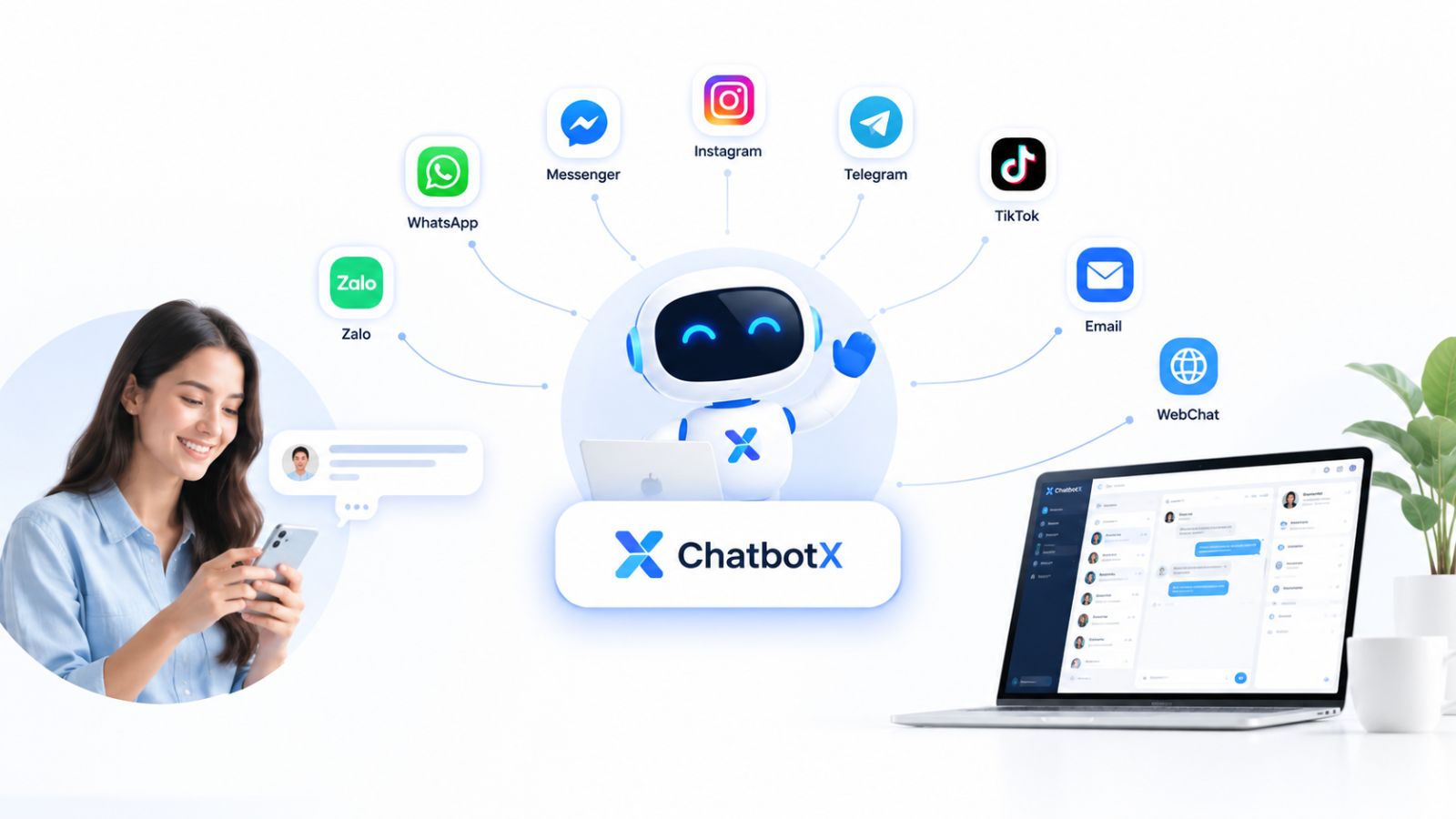
If you want one platform to cover Steps 2, 3, and 4, ChatbotX is built for exactly that. It is an open-source, agentic omnichannel chatbot platform that connects WhatsApp, Messenger, Instagram, Telegram, Zalo, TikTok, Email, and Webchat in a single workspace.
A few capabilities stand out for the agent-driven web:
- Visual automation. Design qualification, support, and booking journeys with the Flow Builder, then let AI agents handle the open-ended questions in between.
- Developer-ready foundations. Connect internal systems and AI assistants through API, CLI & MCP, so your conversations are not locked inside a single interface.
- Control and transparency. The community edition is open source, so you can inspect the code, self-host it, and white-label it. Browse the project on GitHub.
Whether you are a small business, an agency serving clients, or a developer team, the aim is the same: give every conversation a fast, accurate, and consistent answer, whether it comes from a person or a machine.
The Opportunity Inside the Disruption
Every platform shift produces winners and laggards. Businesses that adapted early to mobile gained a lasting advantage, and the same pattern is likely with AI agents. Early movers that structure their data, automate smart conversations, and cover multiple channels will capture demand that late adopters never see.
The rise of agent traffic is less a threat to defend against than a new channel to design for.
Frequently Asked Questions
Will bot traffic really exceed human traffic?
Cloudflare’s CEO predicted a crossover by 2027 and later indicated it may have occurred earlier. Exact figures depend on how traffic is measured, but multiple industry reports point to automated traffic growing faster than human traffic.
Is all bot traffic bad for my website?
No. Search crawlers and legitimate AI agents can send valuable visibility and customers. Harmful bots, such as content scrapers and credential stuffers, are the ones to block or throttle.
How do I make my website easier for AI agents to understand?
Publish clear pricing and product details, add structured data in JSON-LD, maintain a detailed FAQ, and keep pages fast and reliable.
Do I still need a human support team?
Yes. AI handles volume and speed, while people handle nuance, empathy, and exceptions. The best setups pass conversations to a human smoothly when needed.
What should I do first?
Audit your current stack. If your chatbot cannot handle complex questions, your data is not machine-readable, or you rely on a single channel, start by closing those gaps.
Ready to Meet the AI Agent Web?
The shift is already under way, and the businesses that act now will be the ones agents and customers find first. Explore how ChatbotX can automate your conversations across every channel, from your first AI agent to a full omnichannel inbox. Start building today, or follow the open-source project and its latest updates in the ChatbotX release notes. Your next customer, human or AI, is already asking a question. Make sure your business has the answer.