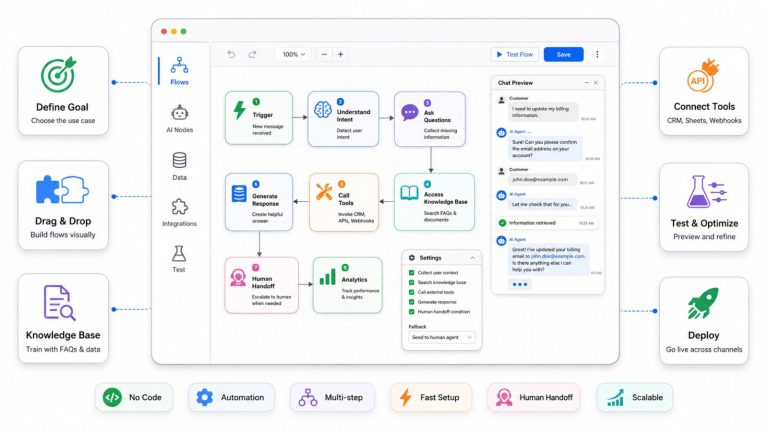

Choosing the right AI chatbot platform in 2026 is more important than ever for businesses looking to scale customer support, automate conversations, and improve omnichannel engagement. In this detailed comparison, we break down the key differences between ChatbotX and Tidio – including pricing, AI capabilities, WhatsApp automation, open-source flexibility, and multi-channel support – to help you decide which chatbot solution is best for your business growth.
Launch agentic chat marketing in minutes with ChatbotX













Introduction: Why Your Chatbot Choice Matters More Than Ever in 2026

The chatbot landscape has shifted dramatically. The global AI chatbot market, valued at roughly $15.6 billion in 2024, is projected to nearly triple to $46.6 billion by 2029 – driven by businesses demanding smarter, faster, and more cost-effective customer engagement. In 2026, choosing the right chatbot platform is no longer a technical decision; it’s a strategic one.
Two names consistently appear in that conversation: Tidio and ChatbotX. Tidio has earned a loyal following among e-commerce small businesses, while ChatbotX is rapidly emerging as the open-source, omnichannel powerhouse for developers, agencies, and growth-focused teams.
This guide breaks down every key dimension – features, pricing, channel support, AI capabilities, and scalability – so you can make the right call for your business.
Quick Overview: ChatbotX vs Tidio at a Glance
| Feature | ChatbotX | Tidio |
|---|---|---|
| Type | Open-source, agentic omnichannel | Closed-source, website-first |
| Channels | WhatsApp, Messenger, Instagram, Telegram, Zalo, Email, Webchat | Website, Messenger, Instagram, WhatsApp, Email |
| AI Engine | OpenAI, Gemini, DeepSeek (configurable) | Lyro AI (proprietary) |
| Self-Hosting | ✅ Yes | ❌ No |
| White-Label | ✅ Yes | ❌ No |
| Open Source | ✅ Yes (GitHub) | ❌ No |
| Free Plan | ✅ Community edition | ✅ 50 conversations/month |
| Starting Price | Usage-based, transparent | $29/month + Lyro AI add-on ($39/month) |
| MCP / API / CLI | ✅ Full support | ❌ Limited |
Section 1: Platform Philosophy Closed vs Open

Understanding the philosophy behind each platform clarifies nearly everything else in this comparison.
Tidio was built as a plug-and-play live chat widget for websites. Its primary strength is accessibility: install a snippet of code, connect your Shopify or WordPress store, and you’re live in minutes. Tidio’s Lyro AI – its conversational AI agent – learns from your support content and handles common queries automatically. Reviews consistently praise how well it combines AI, chatbot flows, and live chat in one easy-to-use package, especially for e-commerce.
ChatbotX, by contrast, was built for teams that want full control. It is an open-source, agentic omnichannel platform designed as a transparent alternative to ManyChat, Wati, and Respond.io. Rather than locking you into a proprietary ecosystem, ChatbotX gives you the source code, self-hosting options, white-labeling capabilities, and support for APIs, CLI, and MCP-compatible clients. The result: a platform that developers, agencies, and growth teams can shape entirely around their own business logic.
Verdict: If you want a polished, no-configuration website widget, Tidio is faster to start. If you want a system you actually own and can extend, ChatbotX is in a different league.
Section 2: Channel Support Website Only vs True Omnichannel
In 2026, customers are not just on your website. They are on WhatsApp, Instagram, Telegram, Zalo, and Facebook Messenger simultaneously. Meeting them where they are is no longer optional.
Tidio covers the essentials: website live chat, Messenger, Instagram, WhatsApp (via integration), and email. For many small business owners, that is sufficient. However, its core experience is fundamentally website-centric. WhatsApp and Instagram support are add-ons layered onto a platform built around a chat widget.
ChatbotX was architected around true omnichannel deployment from day one. A single set of AI-powered flows can be deployed simultaneously across WhatsApp, Facebook Messenger, Instagram, Telegram, Zalo, Email, and Webchat – with no extra code and no per-channel add-ons. For Southeast Asian markets especially, native Zalo integration is a significant advantage that Tidio simply does not offer.
The ChatbotX Visual Flow Builder includes 15+ node types and lets teams design complex conversation trees, trigger sequences, and AI-powered branches that run identically across every connected channel.
Verdict: For businesses operating across multiple messaging platforms, especially in Asia-Pacific markets, ChatbotX’s omnichannel architecture is a decisive advantage.
Section 3: AI Capabilities Lyro vs Agentic AI

Both platforms have invested heavily in AI, but their approaches differ fundamentally.
Tidio’s Lyro AI
Lyro is Tidio’s proprietary AI agent, introduced in 2023 and significantly improved through 2025–2026. It learns from your FAQ pages, uploaded documents, and manual Q&A entries to answer customer questions conversationally. According to independent reviewers, Lyro resolves up to 67% of customer questions automatically and is praised for its accuracy on common support content. The onboarding experience is genuinely simple: point Lyro at a URL, and it scrapes the content immediately.
The limitation is that Lyro is a proprietary black box. You cannot choose your underlying model, adjust reasoning parameters, or integrate it into custom agentic workflows. You are locked into Tidio’s AI roadmap.
ChatbotX’s Agentic AI
ChatbotX takes an entirely different approach. Rather than offering a single fixed AI model, it functions as an orchestration layer that connects to OpenAI, Gemini, DeepSeek, and more – giving teams the freedom to choose the model that best fits their use case, compliance requirements, and budget.
More importantly, ChatbotX supports MCP-compatible agentic workflows, meaning your AI is not just answering questions – it is taking actions, routing leads, updating CRM records, triggering sequences, and making decisions autonomously across channels. This is the defining shift of 2026: from reactive bots to autonomous AI agents that act with purpose.
For technical teams that want to build advanced workflows, the ChatbotX GitHub repository provides full access to the source code, detailed documentation, and an active open-source community contributing real improvements.
Verdict: Tidio’s Lyro is excellent for answering FAQs. ChatbotX’s agentic AI architecture is built for teams that want their chatbot to do things, not just say things.
Section 4: Pricing What You Actually Pay
Pricing is where many Tidio users encounter their biggest frustration.
Tidio Pricing in 2026
Tidio’s pricing model has been widely described as one of the most complicated in the customer support space. The structure looks affordable at first glance but escalates quickly:
- Free: 50 conversations/month only
- Starter: $29/month per seat
- Growth: $59–$349/month depending on conversation volume
- Plus: $749/month
- Lyro AI add-on: $39–$289/month, billed separately
The critical detail: Lyro AI is not included in Tidio’s base plans. For most growing businesses, the realistic monthly cost with AI enabled ranges from $68 to $252/month before you hit enterprise tiers. Conversation-based billing means your costs can spike unpredictably during high-traffic periods.
ChatbotX Pricing in 2026
ChatbotX’s pricing is based on monthly active contacts – not per-seat or per-conversation. The open-source community edition is available for self-hosting at no license cost, making it genuinely free for technical teams. The cloud-hosted version offers transparent, usage-based tiers with unlimited channels and unlimited team members included at every level.
For agencies building client solutions, the white-label capability means a single ChatbotX instance can power multiple client deployments – something Tidio does not support at any price point.
Verdict: For predictable scaling and multi-client deployments, ChatbotX’s pricing model is fundamentally more sustainable than Tidio’s metered AI add-on structure.
Section 5: Developer Experience & Extensibility

This is where the open-source model shines most clearly.
Tidio provides a basic API and Zapier integration, suitable for simple workflows. But there is no CLI, no MCP server, no way to self-host, and no ability to inspect or modify the core codebase.
ChatbotX was built by developers, for developers. The platform ships with:
- A full REST API for custom integrations
- A CLI tool for automation and deployment scripting
- An MCP server for building advanced agentic workflows with compatible AI clients
- Native webhook support for real-time event handling
- Complete self-hosting capability via Docker Compose
The ChatbotX GitHub repository is actively maintained, with new features merged regularly. For agencies and enterprise teams, the ability to fork, extend, and white-label the platform is a level of freedom that no closed-source competitor can match.
Verdict: Tidio is a consumer-grade SaaS. ChatbotX is infrastructure-grade software.
Section 6: Live Chat, CRM & Growth Tools
Both platforms include live chat inbox functionality with human takeover capabilities, but their depth differs.
Tidio’s live chat experience is polished and well-suited to small teams. Its Shopify integration is particularly strong – agents can view cart contents, order status, and purchase history directly from the chat window. For Shopify-first businesses, this context is genuinely valuable.
ChatbotX includes a real-time live chat inbox with conversation assignment, human takeover, and team routing. Beyond live chat, it offers a built-in CRM for contact management, broadcast campaigns for mass messaging, drip sequences for nurture workflows, and Growth Tools for generating conversation starter links across every connected platform. The platform’s analytics layer tracks performance metrics, user engagement, and campaign results across all channels from a single dashboard.
A real-world case study shared by ChatbotX illustrates the scale possible: an education campaign using the Auto-Inbox feature generated 123,000 comments and 43,000 successful registrations. A separate lead generation campaign for Enpro achieved a 3.5x ROAS using ChatbotX to automate top-of-funnel consultation.
Verdict: Tidio wins on Shopify-specific depth. ChatbotX wins on breadth, scale, and cross-channel campaign capability.
Section 7: Who Should Use Each Platform?
Choose Tidio if:
- You run a Shopify or WooCommerce store and want deep e-commerce integration
- You need a simple, no-code chatbot widget live within hours
- Your primary channel is your website, with occasional Messenger/Instagram needs
- You have a small support team (under 10 agents) and predictable chat volume
Choose ChatbotX if:
- You operate across multiple messaging platforms, including WhatsApp, Zalo, Telegram, and Messenger
- You want full ownership of your data and infrastructure through self-hosting
- You are building a white-label chatbot solution for clients as an agency
- You need agentic AI workflows that connect to external APIs and take autonomous actions
- You want to tap into an active open-source community and shape the product roadmap
- Your business operates in Southeast Asia or other markets where Zalo and multi-platform reach are critical
Section 8: The Bigger Picture Where Chatbot Platforms Are Headed in 2026

According to industry analysis, over 91% of businesses have already moved past the “should we adopt AI?” question – they are now asking “which platform gives us the most leverage?” The era of rule-based bots offering canned responses is over. The winners in 2026 are platforms that support autonomous AI Agents capable of managing full workflows, not just answering questions.
This is precisely the direction ChatbotX was designed for from the ground up. Its support for MCP-compatible agentic workflows, multi-LLM orchestration, and omnichannel deployment positions it as the infrastructure layer for the next generation of conversational commerce – a trend also explored in depth in the ChatbotX blog’s coverage of social media algorithms and automation strategies.
For businesses that have outgrown single-channel chatbots and are ready to build intelligent, autonomous customer engagement systems, the trajectory is clear.
Frequently Asked Questions
Is ChatbotX free?
Yes. The open-source community edition is available to self-host at no license cost. Cloud-hosted plans are priced on monthly active contacts with no per-seat or per-conversation limits.
Does ChatbotX support WhatsApp?
Yes. ChatbotX supports WhatsApp, Facebook Messenger, Instagram, Telegram, Zalo, Email, and Webchat natively from a single platform.
Is Tidio good for beginners?
Yes. Tidio is one of the easiest live chat and chatbot platforms to set up for website-focused businesses, particularly those on Shopify.
Can ChatbotX replace Tidio for e-commerce?
Yes. ChatbotX supports e-commerce use cases including cart abandonment recovery, product recommendation flows, and order inquiry automation across WhatsApp and Messenger – platforms where a growing share of purchase decisions are now made.
Final Verdict: ChatbotX vs Tidio in 2026
Both platforms are strong in their intended contexts. Tidio is a refined, accessible tool for small e-commerce businesses that live primarily on their website. If your needs are straightforward and your growth ambitions are modest, it delivers genuine value.
But if you are building for scale – across channels, across markets, across use cases – ChatbotX offers something Tidio simply cannot: a platform you own, can extend, can white-label, and can deploy as true agentic AI infrastructure.
Ready to Experience the Difference?

Stop renting a chatbot. Start owning your customer conversations.
ChatbotX is built for businesses and agencies that are serious about growth in 2026 and beyond. Whether you are migrating from Tidio, ManyChat, or starting fresh, the ChatbotX platform gives you the tools, the AI power, and the open-source freedom to build exactly the customer engagement system your business deserves.
👉 Explore ChatbotX and start building for free today
👉 View the source code and join the community on GitHub
No lock-in. No hidden costs. No limits on what you can build.