

Why WhatsApp Is Introducing Usernames
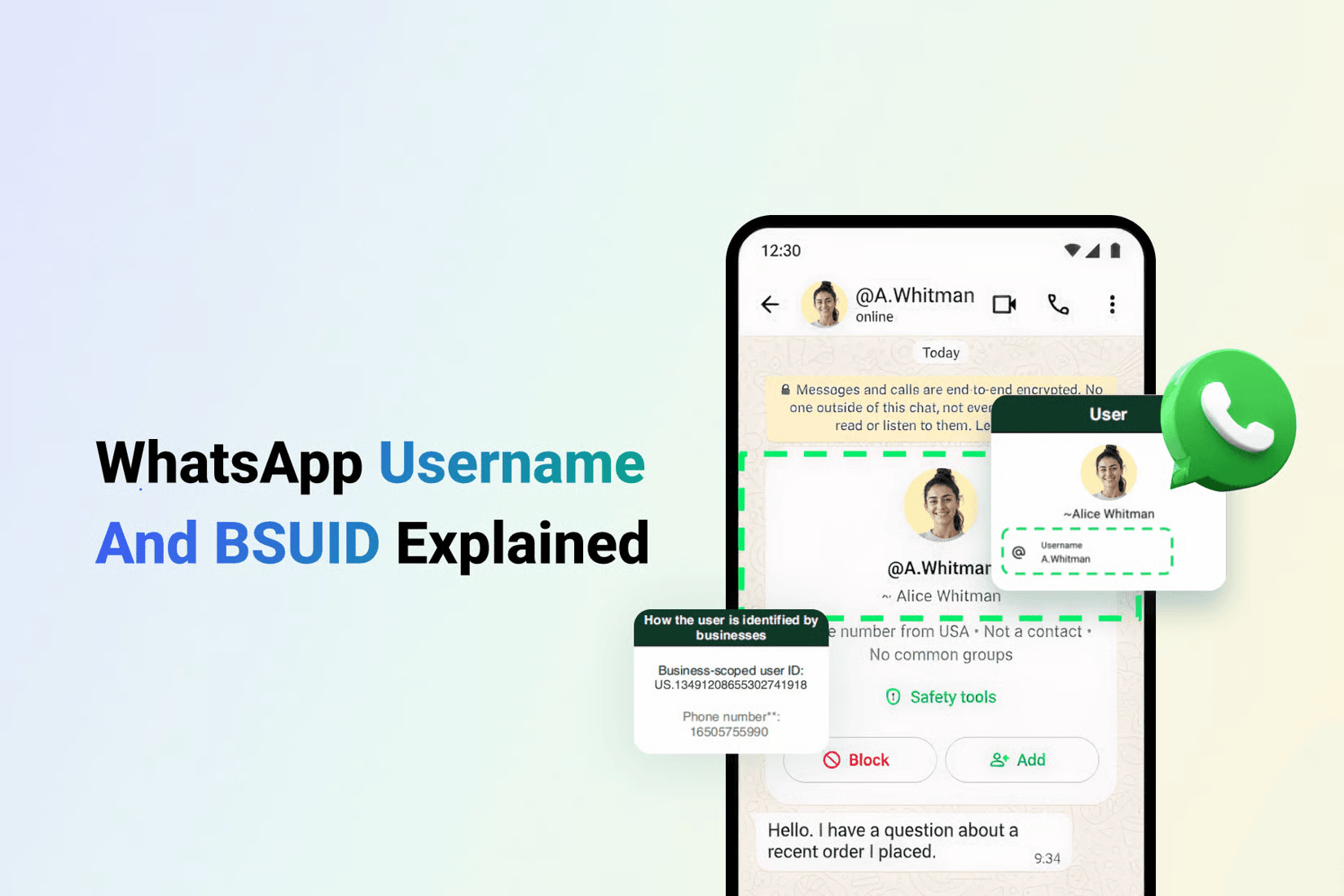
Privacy is a top priority for modern messaging app users. Previously, whenever customers initiated a conversation with a business on WhatsApp, they had to reveal their personal phone number. This created hesitation for users who simply wanted quick product information or preliminary assistance. The username feature addresses this concern:- For Users: Users can create a unique username (@username) and use it to communicate with businesses instead of sharing their phone number.
- For Businesses: Businesses can establish distinct usernames, allowing prospective customers to find them directly via WhatsApp search without saving phone numbers in advance, increasing lead acquisition and conversion rates.
Contact Identification: Before vs. After the Update
The table below summarizes the key changes in customer identification: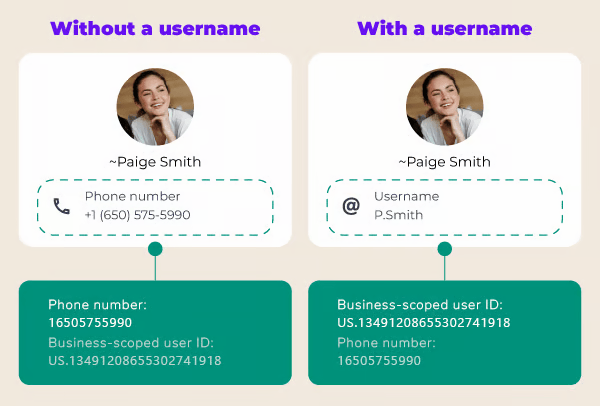
How BSUID Operates
BSUID (Business-Scoped User ID) is a unique identifier automatically generated by Meta for each specific pair between a user and a business. This identifier allows you to message and track customers without requiring access to their phone number.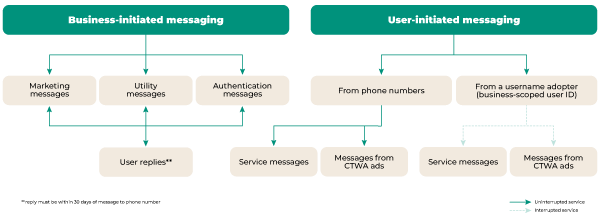
4 Core Technical Rules of BSUID
Businesses should understand the following operational characteristics of BSUID:- Business-Scoped Uniqueness: The same WhatsApp user will have different BSUIDs when interacting with Business A versus Business B. This architecture protects user privacy and prevents unauthorized cross-business data sharing.
- Fixed String Format: A BSUID starts with a 2-letter ISO 3166 country code, followed by a period and an alphanumeric string up to 128 characters (e.g.,
US.13491208655302741918). You must use this string verbatim in API calls without modification or truncation. - Scoped to Business Portfolio (Meta Business Manager): A BSUID generated under one Meta Business Portfolio cannot be used to message a customer from a different Portfolio.
- Automatic Webhook Delivery: Meta automatically generates and returns the BSUID in webhook payloads under the
user_idfield, even if the user has not configured a public username.
What ChatbotX Is Doing About It
ChatbotX provides enterprise-ready infrastructure to handle BSUID seamlessly across all communication channels:Already Live
- Automatic BSUID Capture: Automatically captures BSUIDs from all inbound interactions and all successfully delivered outbound messages with zero manual setup required.
- Contact Profile Visibility: BSUID displays directly inside Contact Profiles and Audience Segmentation lists.
- Webhook & Open API Support: The
bsuidfield is included in all webhook payloads and Open API responses alongside the phone number (phone). - Automatic Contact Matching: When a customer with a username messages in, ChatbotX uses the captured BSUID to match them accurately with existing contact profiles, preventing duplicates.
- Multi-channel Messaging via BSUID: Supports direct messaging via BSUID across Live Chat, Flows, Sequences, Broadcast campaigns, and Open APIs.
- Search Contacts by BSUID: Easily search and filter contact records by BSUID within the Contacts directory.
- 1-Tap Get Contact Info Button: Native action card inside Flow Builder that allows customers to share their verified phone number in a single tap.
- One-Way CRM Sync: Seamlessly syncs BSUID data from ChatbotX to external CRM platforms (like HubSpot and Salesforce) via Webhooks or automation tools like Make and n8n.
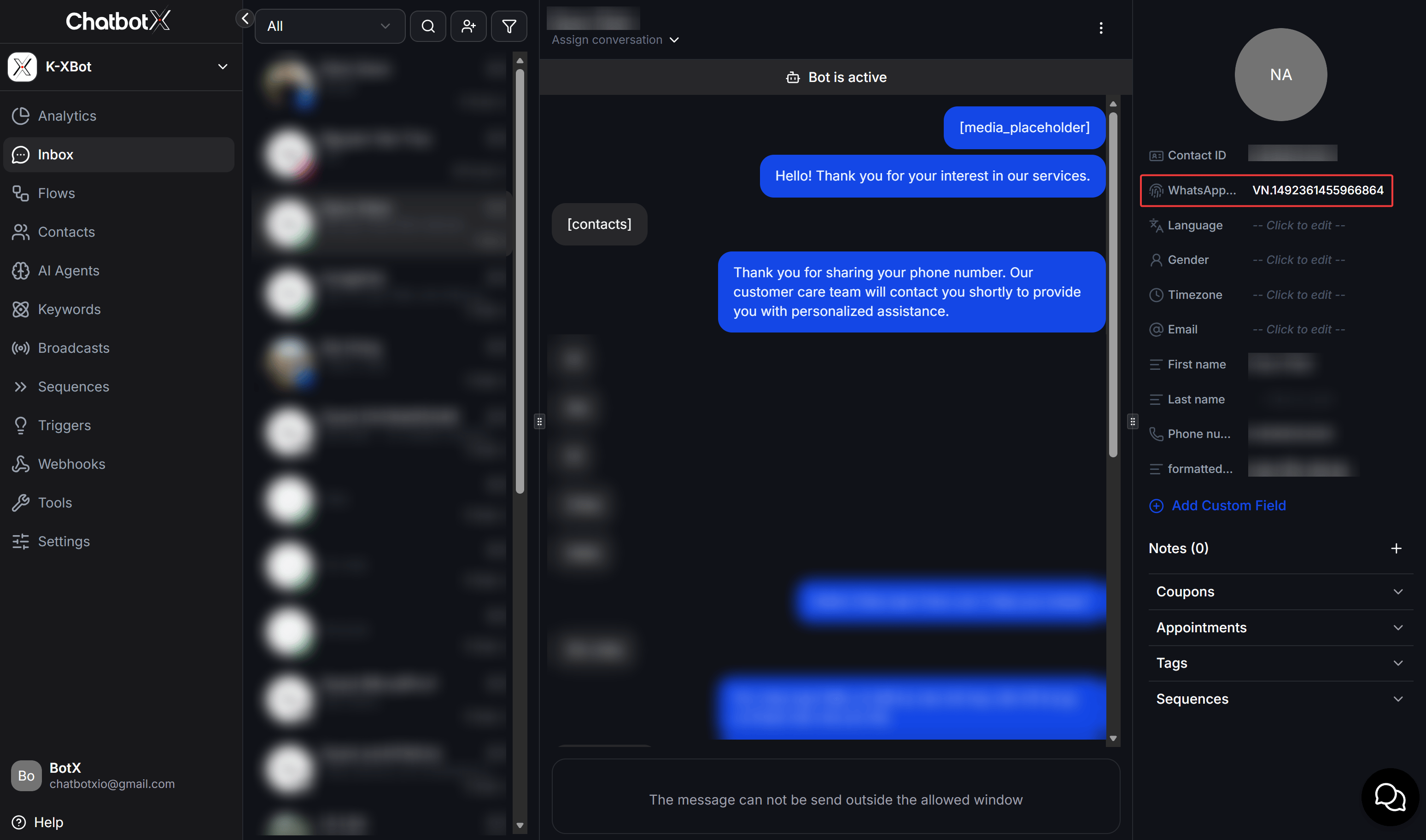
- Direct BSUID Visibility: On the contact profile panel on the right sidebar, the WhatsApp BSUID (e.g.,
VN.1492361455966864) is clearly visible, enabling support teams to identify users even when phone numbers are masked. - 1-Tap Contact Information Capture: When a user shares their phone number, a
[contacts]card is received in the chat and automatically linked to the active BSUID record. - Seamless Live Support: Support agents can easily monitor active automation states (
Bot is active), add tags, create notes, and reassign conversations smoothly.
Rolling Out
Operational Impact & Business Solutions
When WhatsApp transitions to BSUID customer identification, businesses should proactively adapt across 3 operational domains to maintain uninterrupted service and reliable customer records:CRM and Database Management
If your CRM uses phone numbers as primary keys, new conversations from username-only leads could result in anonymous contacts or synchronization errors.- Challenge: Traditional CRM setups will reject or create duplicate empty records when new leads reach out without a phone number.
- Solution: Update your database schemas to store
BSUIDalongsidePhone. Upgrade search and lookup queries to support both fields. ChatbotX automatically associates theBSUIDwith the correct customer record as soon as a phone number is provided during conversation.
Click-to-WhatsApp (CTWA) Ads
For users who click Click-to-WhatsApp ads with phone-masking enabled, initial contact data is recorded solely via BSUID.- Challenge: Businesses risk losing re-engagement access once the 72-hour free messaging window closes if no phone number was gathered.
- Solution: Design a Welcome Flow that automatically greets users and presents a convenient Native 1-tap Get Contact Info button to collect their phone number for long-term customer care.
Support and Inbox Management
Inside the ChatbotX Live Chat Inbox, customer conversations initiated through WhatsApp are managed seamlessly without disruptions.- Challenge: Support agents may encounter customer profiles displaying alphanumeric BSUIDs instead of conventional phone numbers.
- Solution: Train support teams to recognize BSUIDs as valid, persistent customer identifiers. Agents can utilize built-in canned responses or contact request actions whenever phone verification is necessary for specialized actions (e.g., shipping, warranty, or authentication).
5-Step Implementation Roadmap
To prepare your operations smoothly for WhatsApp updates, follow this 5-step implementation plan:1
Audit Systems and Workflows
Review all chatbot flows, API integrations, and database tables to identify dependencies where phone numbers are used as the sole unique identifier.
2
Update Data Architecture
Add a
BSUID field (up to 131 characters, supporting alphanumeric strings) to your contact tables to store alongside phone numbers.3
Refactor Automation Flows
Configure ChatbotX Flows to support BSUID branching. Add automated phone collection blocks for order placement and OTP verification flows.
4
Test Conversation Journeys
Run end-to-end tests using username-enabled WhatsApp test accounts to verify data capture accuracy and contact profile deduplication.
5
Deploy and Monitor
Launch your updated workflows. Monitor response rates, phone capture conversion metrics, and user feedback to refine conversation steps proactively.
Frequently Asked Questions (FAQ)
Will existing customer phone numbers be lost?
Will existing customer phone numbers be lost?
No. All historical contacts and their recorded phone numbers remain fully intact in ChatbotX. You do not need to re-collect data for existing leads.
Does this impact sending Broadcast campaigns using phone numbers?
Does this impact sending Broadcast campaigns using phone numbers?
No. You can continue sending Broadcast campaigns to existing phone number lists as usual. The update only affects new users who proactively reach out via username.
Can I send OTP authentication messages directly to a BSUID?
Can I send OTP authentication messages directly to a BSUID?
No. OTP authentication messages must be delivered to a verified physical phone number. You must collect the customer’s phone number before triggering an OTP flow.
Is the BSUID identical for the same user across different brands?
Is the BSUID identical for the same user across different brands?
No. BSUIDs are isolated per Meta Business Portfolio. If you manage two brands under separate Portfolios, the same user will have two independent BSUIDs.
Does the BSUID change if a user deletes or updates their username?
Does the BSUID change if a user deletes or updates their username?
No. The BSUID is anchored to the persistent relationship between the user and your business, independent of whether the user changes or removes their public username.